
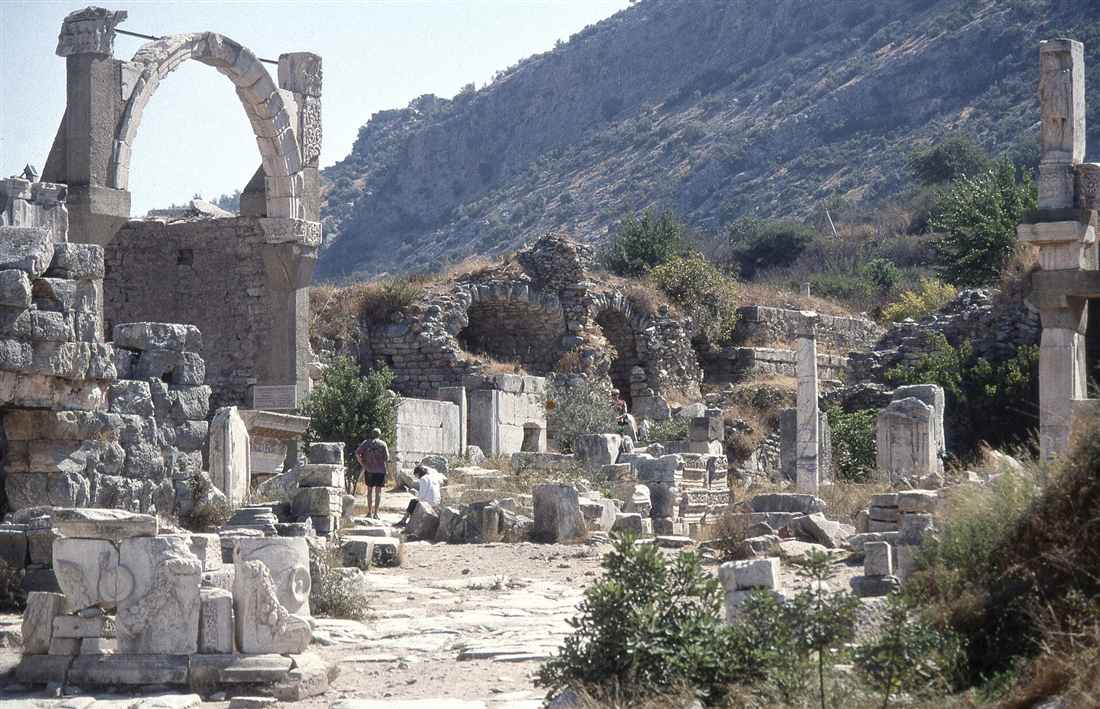
The Pollio Fountain of Ephesus is a monumental nymphaeum on Domitian Square in the upper city, built in honour of Gaius Sextilius Pollio, who raised the Marnas aqueduct that watered Ephesus. Its tall arched facade rises beside the Temple of Domitian. Plan the whole trip with Greece Tours.
This guide covers the Pollio Fountain in full: what the fountain is and where it stands, who Pollio was and who built it, what the fountain looked like, the Odysseus and Polyphemus statue group that crowned it, how the water reached it by aqueduct, what it was used for, and what is left to see on Domitian Square today.
What is the Pollio Fountain in Ephesus?
The Pollio Fountain is a monumental nymphaeum on Domitian Square in the upper city of Ephesus, a Roman public fountain of the first century AD. Its tall arched facade rises above a wide water basin at the western edge of the square.
A nymphaeum is a Roman fountain house dedicated to the nymphs, and the Pollio Fountain ranks among the earliest of the grand fountain monuments at Ephesus. The structure combines a practical water outlet with a display facade, turning the delivery of drinking water into a civic showpiece. The single broad arch that survives today defines the monument and marks its position on the skyline of the upper city.
The fountain stands within the group of public buildings that frame Domitian Square, the political heart of Roman Ephesus. Alongside the State Agora, the Temple of Domitian and the civic offices, the nymphaeum formed part of the ceremonial architecture that greeted people entering the city from the east. The monument honours Gaius Sextilius Pollio, the engineer whose aqueduct brought water to this quarter.
Where is the Pollio Fountain on the Ephesus site?
The Pollio Fountain stands on the west side of Domitian Square in the upper city of Ephesus, just off the top of Curetes Street. It sits beside the Temple of Domitian and faces the open plaza next to the State Agora.
Domitian Square opens at the upper end of the ancient city, the zone visitors reach first through the eastern Magnesia entrance. From the square, Curetes Street descends toward the Library of Celsus and the lower city. The fountain marks the western boundary of this upper plaza, its arch turned toward the paved open space where processions and civic gatherings assembled.
The immediate neighbours anchor the location. The Temple of Domitian rises on its terrace directly to the south, and the long State Agora with its basilica lies to the east. To fix the fountain against the wider layout of the site, the Ephesus map plots Domitian Square and the route down Curetes Street from this point.
Who was Pollio and who built the fountain?
Gaius Sextilius Pollio was the Roman patron and engineer who financed the Marnas aqueduct that supplied Ephesus. His family raised the fountain in his honour in the first century AD, and the dedicatory inscription records his name and the monument’s purpose.
Pollio held a position of standing in the colony of Roman Ephesus and put his wealth into the city’s water infrastructure. The aqueduct that carries his name channelled water from the Marnas river across a valley into the upper city, an engineering feat that made the display fountains of the district possible. His stepson, Gaius Ofillius Proculus, completed works in the family programme of public building. The same family financed the basilica along the north side of the State Agora, which fixes the Pollio name across the monuments of the upper city.
The nymphaeum functions as a memorial as much as a water source. By attaching the fountain to Pollio’s name, the family fixed his benefaction into the daily life of the city, where residents drew water at a monument that repeated his gift. This pairing of practical service and personal commemoration defines Roman civic patronage at Ephesus.
What did the Pollio Fountain look like?
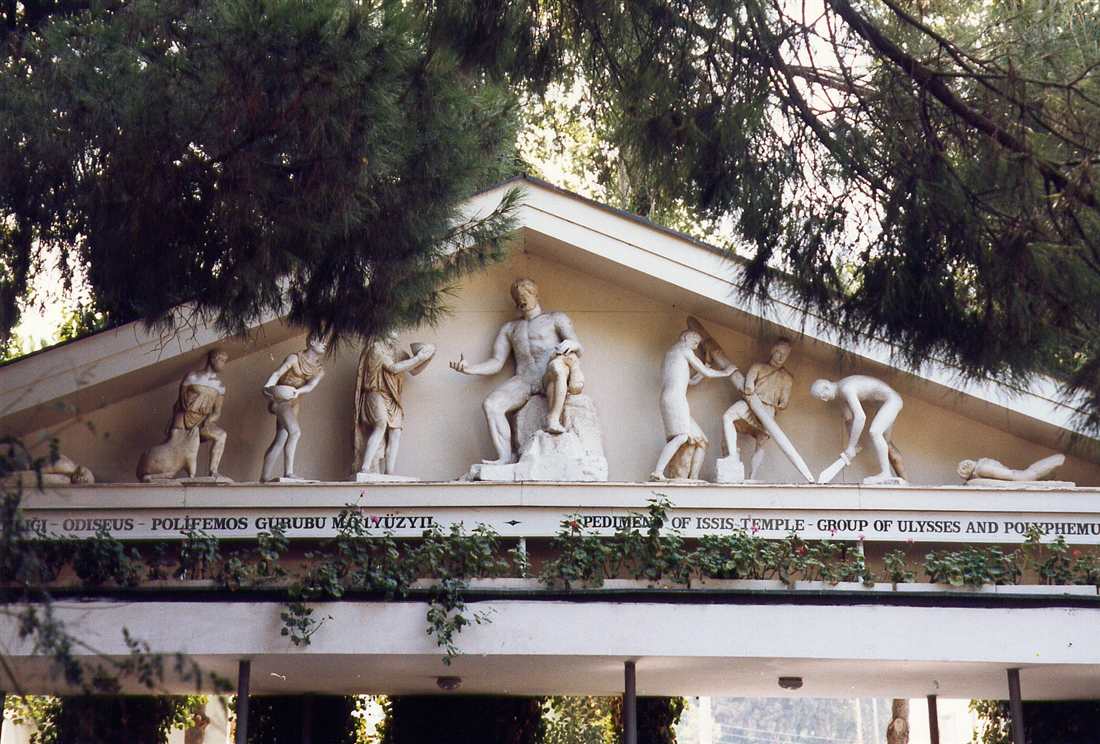
The Pollio Fountain presented a wide single arch above a deep semicircular basin, faced with marble and framed by an ornamented screen wall. A sculptural group of Odysseus and Polyphemus once crowned the structure, projecting the story above the flowing water.
The surviving arch spans the front of the monument in one broad curve, the form that gives the fountain its arched silhouette on Domitian Square. Behind and around this arch, the original facade carried a decorated aedicular front of columns, niches and a deep cornice, which framed statues and dressed the water outlet in the language of a temple front. The basin caught the water at the base and held it for public use.
The decorative programme raised the monument beyond plumbing. Marble revetment sheathed the core, sculptural figures filled the niches, and the crowning statue group turned the fountain into a stage for myth. The architecture belongs to the tradition of the Roman display fountain, where the facade matters as much as the flow.
What was the statue group of Odysseus and Polyphemus?
The statue group shows Odysseus and his companions blinding the Cyclops Polyphemus, a marble ensemble that crowned the Pollio Fountain. The figures now stand in the Ephesus Archaeological Museum at Selcuk, reassembled from fragments recovered near the fountain and the Isa Bey quarter.
The scene draws on the ninth book of Homer’s Odyssey, where Odysseus escapes the giant’s cave by driving a stake into his single eye. The sculptor arranged the crew around the reclining Polyphemus in a tableau, the type of Hellenistic-inspired composition that decorated grand Roman fountains across the empire. A parallel group adorned the fountain at the imperial villa at Sperlonga in Italy, which places the Ephesus set within a recognised type.
Today the Odysseus and Polyphemus figures rank among the highlights of the Ephesus Museum. Displayed indoors, the marble preserves the detail lost to weathering on the open square, and the museum labels tie the group back to its origin on the crown of the Pollio nymphaeum.
How did the fountain work and where did the water come from?
The Marnas aqueduct, built under Pollio’s patronage, carried water from the Marnas river into the upper city and fed the fountain by gravity. The flow entered through terracotta and lead pipes, filled the semicircular basin, and ran off through overflow channels.
The aqueduct crossed the Marnas valley on a bridge of tall arches, a structure that lifted the channel to the height needed to reach Domitian Square. From the distribution point in the upper city, pressurised pipes delivered water to the nymphaeum and to the other public fountains of the district. The gravity system needed no pumps; the fall from the source drove the whole supply.
At the fountain itself, water issued from spouts into the basin, where residents dipped vessels from the standing pool. Overflow drained into the street network and the drains beneath the paving. This arrangement kept fresh water moving through the monument without pause, a constant flow that supplied the population and cleaned the basin.
What was the fountain used for?
The Pollio Fountain supplied public drinking water to the upper city while advertising the generosity of its patron. It served the practical role of a neighbourhood water point and the civic role of a monument that dignified the arrival of piped water into Ephesus.
Residents of the upper city drew household water at the basin, filling jars and buckets at a source close to the State Agora and the civic offices. In a city without indoor plumbing for the population, the street fountain was the daily water supply, and its position on the main square placed it within reach of the central public quarter.
Beyond utility, the fountain projected a message. The scale of the arch, the marble facing and the mythological statue group turned the delivery of water into an act of display, binding the name of Pollio to a service the whole city used. Roman patrons treated fountains as instruments of prestige, and the Pollio nymphaeum stands as an early example of that practice at Ephesus.
What is there to see at the Pollio Fountain today?
The standing arch of the Pollio Fountain remains the centrepiece on Domitian Square, rising above the outline of its semicircular basin. The setting, the neighbouring Temple of Domitian terrace and the open plaza let visitors read the monument in its original civic context.
The broad arch survives as the tallest surviving feature, a clear landmark for the western edge of the square. At its foot, the curved footprint of the basin marks where water once pooled, and blocks of the marble facade lie around the base. The elevation of the arch fixes a sense of the height the complete facade reached.
The statue group that crowned the fountain no longer stands here, as those figures moved to the Ephesus Museum at Selcuk, so the visit pairs naturally with the museum, where the Odysseus and Polyphemus marbles complete the picture. On site, the reward is the architecture and the position: a Roman fountain framing the political square at the head of the city. Morning light strikes the arch from the east, and the raised terrace of the Temple of Domitian gives a vantage over the whole plaza and the fountain below.
How does the Pollio Fountain fit an Ephesus visit?
The Pollio Fountain sits at the top of the route through Ephesus, on Domitian Square beside the Temple of Domitian, where a walk down Curetes Street begins. Visitors entering from the eastern gate reach it early, before the descent to the Library of Celsus.
The upper city rewards a slow start. From Domitian Square, the fountain, the Temple of Domitian and the State Agora form a tight cluster of monuments that set the scene for the rest of the site. Taking them in first builds the context for the grand street below, where the Hercules Gate opens onto Curetes Street.
The fountain slots into a half-day walk through Ephesus that runs from Domitian Square down to the Library of Celsus and the Great Theatre. Pairing the on-site arch with the statue group in the Ephesus Museum rounds out the story of Pollio, his aqueduct and the water that fed the upper city.
Frequently Asked Questions
What is the Pollio Fountain in Ephesus?
The Pollio Fountain is a monumental nymphaeum on Domitian Square in the upper city of Ephesus, a wide arched fountain built in honour of Gaius Sextilius Pollio, the benefactor who raised the Marnas aqueduct that supplied the city.
What statue crowned the Pollio Fountain?
A marble statue group of Odysseus blinding the giant Polyphemus once stood on the Pollio Fountain. The group survives in the Ephesus Archaeological Museum in Selcuk, a work of the imperial Roman period.
Where is the Pollio Fountain on the Ephesus map?
The Pollio Fountain stands on the west side of Domitian Square, off Curetes Street beside the Temple of Domitian and near the State Agora, at the top of the city by the Upper Gate.