
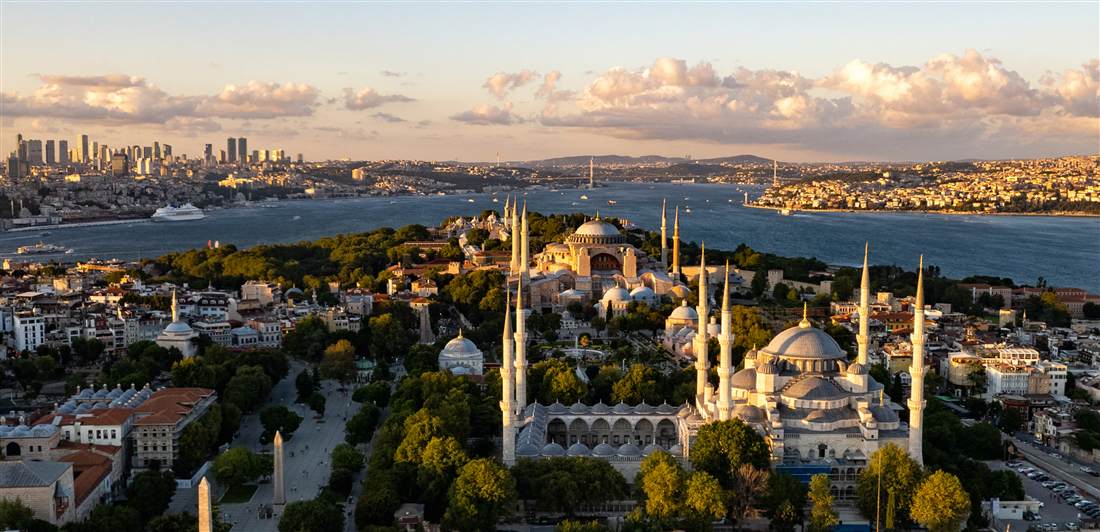
Ephesus from Istanbul is a day trip built around a short flight: an early plane from Istanbul to Izmir takes about an hour, and a coach covers the last hour to Ephesus near Selcuk, putting the ancient city within a single day of the Turkish capital. Plan the whole trip with Greece Tours.
This guide covers Ephesus from Istanbul in full: how to get there, doing it in a day, the distance, the flights from Istanbul to Izmir, what a day tour with flight includes, the cost, what you see at Ephesus, the bus and train alternatives, staying overnight, combining Pamukkale, the best time to go, how it compares with the Kusadasi and Izmir routes, and whether it is worth it.
How do you get to Ephesus from Istanbul?
You reach Ephesus from Istanbul by flying to Izmir Adnan Menderes Airport in about one hour, then driving roughly one hour south to Selçuk, the town beside the ancient ruins. This fly-and-drive route is the fastest, standard way travellers cross the 500 kilometres between the two cities.
Ephesus sits in Turkey’s western Aegean region, near the small town of Selçuk in İzmir Province. Istanbul lies far to the north, straddling the Bosphorus. No direct road, rail line, or air link connects Istanbul to Selçuk itself, so the journey breaks into two legs: a domestic flight to İzmir, the nearest major city, and a short overland transfer to the archaeological site. Understanding this two-part structure is the key to planning the trip, whether you build it yourself or book an escorted package. Travellers who research Aegean and Mediterranean itineraries through operators such as Greece Tours recognise this same fly-then-drive pattern across the region’s scattered ancient sites.
The first leg is the flight. Turkish Airlines, Pegasus Airlines, AJet, and SunExpress operate frequent domestic services from both Istanbul airports to İzmir. The airborne portion lasts around 60 to 75 minutes, and departures run from early morning until late evening. İzmir Adnan Menderes Airport (airport code ADB) is the arrival point, a modern hub 18 kilometres south of İzmir’s city centre and directly on the road toward Selçuk.
The second leg is the ground transfer from ADB to the ruins. The distances break down clearly:
- Airport to Selçuk town: about 55 kilometres, a 50-minute drive south on the D550 highway and O-31 motorway.
- Selçuk to the Ephesus main gate: about 3 kilometres, a 5-minute drive.
- Airport directly to the Ephesus lower gate: roughly 60 kilometres, around one hour by car or coach.
Three transfer methods cover this second leg. A private car or booked tour coach waits at arrivals and drives straight to the site, the smoothest option and the one built into organised day tours. A rental car collected at ADB gives full independence and follows the same motorway. Public transport strings together the airport train (İZBAN) to Selçuk station, then a short taxi or dolmuş minibus to the gate, the cheapest route and the slowest.
The İZBAN suburban rail line links ADB airport directly to Selçuk station in about 75 minutes for a few Turkish lira, a budget-friendly self-guided choice. From Selçuk station the ruins lie a flat 30-minute walk or a brief taxi ride away. Independent travellers who prefer flexibility fly in, pick up the train, and explore the Ephesus archaeological park at their own pace before returning north.
The entire door-to-door transit, from an Istanbul airport gate to standing before the Library of Celsus, runs about three to four hours: an hour of flight, an hour of transfer, plus check-in, security, and boarding time on either side. That compact timeline is exactly why a single-day return trip from Istanbul is realistic, provided the outbound flight departs early.
Selçuk itself deserves a note as the gateway town. It holds the Ephesus Archaeological Museum, the Basilica of Saint John on Ayasuluk Hill, the İsa Bey Mosque, and the İZBAN train terminus, so a traveller who arrives by rail lands in the heart of the region’s monuments. Two site gates serve Ephesus: the upper Magnesia Gate and the lower Koressos Gate. Coaches and tours enter at the top and exit at the bottom, walking the city downhill, while independent visitors who arrive by train from Selçuk reach the lower gate first and walk uphill or ride a shuttle to the top to follow the descending route.
Can you visit Ephesus from Istanbul in a single day?
Yes, you visit Ephesus from Istanbul in a single day by taking an early morning flight to İzmir, touring the ruins through midday and afternoon, and flying back the same evening. Organised day tours package the flights, transfers, guide, and entry into one fixed itinerary that fits inside daylight hours.
The single-day trip works because the flying leg is short and departures start early. An organised Ephesus day tour from Istanbul follows a tight, tested schedule. Travellers meet at the Istanbul airport before dawn, board a flight around 06:00 to 07:00, land at İzmir near 08:00, and reach the ruins by 09:30. Touring runs through the late morning and early afternoon, lunch fits between site visits, and the group returns to ADB for an evening flight back to Istanbul, landing by night.
A typical day-tour-with-flight timeline unfolds like this:
- 05:00–05:30: Meet at Istanbul Airport (IST) or Sabiha Gökçen (SAW) domestic departures.
- 06:30–07:00: Flight departs Istanbul for İzmir.
- 08:00–08:15: Land at İzmir Adnan Menderes; meet the licensed guide and driver.
- 09:15–09:30: Arrive at Ephesus; begin the guided walk through the ruins.
- 12:30–13:30: Lunch at a local restaurant near Selçuk.
- 13:30–15:30: Visit the House of the Virgin Mary, the Temple of Artemis, and time for shopping.
- 17:00–18:00: Return to ADB airport for the evening flight.
- 19:30–20:30: Land back in Istanbul.
The format removes every logistical decision from the traveller. The operator books both flight segments, positions a driver and licensed guide at İzmir, times the ruins visit around the coach parking and gate flow, and reserves lunch. Guests carry only hand luggage, a passport for domestic ID checks, sun protection, and water. Because the tour absorbs the transfers and entry tickets, the group moves from airport to ruins with no waiting in ticket queues.
Timing discipline makes the day succeed. The early departure is non-negotiable: a 10:00 flight leaves too little daylight for the full site, the House of the Virgin Mary, and the Temple of Artemis before the evening return. Tours that promise all three landmarks depart Istanbul by 07:00 at the latest. The touring window on the ground stretches eight to nine hours, ample for the archaeological park plus the two nearby monuments.
A single day delivers the headline sights but compresses them. Guests walk the marble streets, photograph the Library of Celsus, sit in the Great Theatre, and stand at the Virgin Mary’s house, then leave. Travellers who want the İzmir seafront, the Selçuk museum, Şirince village, or nearby Kuşadası and Pamukkale extend the trip to two days with an overnight in Selçuk or Kuşadası. For a first visit focused on the ruins themselves, the one-day fly-in tour is complete and self-contained.
Weather and season steer the day’s comfort more than the schedule. Spring and autumn deliver mild temperatures and thinner crowds, the ideal windows for the exposed marble streets, which hold no shade through the midday sun. Summer visits demand an early start, a wide-brimmed hat, and water, because the ruins bake by noon. Winter departures run cheaper, and a crisp clear day lays the Library façade against a blue sky with no queue at the gate. The tour operates year-round, and the fixed early-flight structure holds across every season.
How far is Ephesus from Istanbul?
Ephesus lies about 500 kilometres south of Istanbul in a straight line, roughly 560 to 600 kilometres by road. Flying covers the gap in one hour plus transfers, while driving the full distance takes eight to nine hours, which makes air travel the practical choice for a short trip.
The distance is the single fact that shapes every Ephesus itinerary from Istanbul. Istanbul occupies Turkey’s northwest, at the meeting of Europe and Asia. Ephesus sits far down the Aegean coast, near Selçuk in İzmir Province. The as-the-crow-flies separation measures close to 500 kilometres; the driving route, which curves inland and back to the coast, stretches to about 570 kilometres via the motorway network.
The two ways to cross that distance compare sharply:
- By air: a 60 to 75-minute flight to İzmir, then a one-hour drive to the ruins. Total transit near three to four hours including airport processing.
- By road: an eight-to-nine-hour drive of roughly 570 kilometres, mostly on the O-5 and O-31 motorways through Bursa and Balıkesir.
- By bus: an intercity coach from Istanbul to Selçuk or İzmir, nine to ten hours, an overnight service being the common form.
- By train: no direct passenger rail links Istanbul to Selçuk; the journey requires connections and exceeds ten hours.
Flying wins decisively for a day trip or a short break. The airborne hour replaces a driving day, and the frequency of İzmir flights, dozens each day across two Istanbul airports, means a traveller picks a departure to suit the itinerary rather than the reverse. The cost of a domestic hop stays modest relative to the time it saves, and the İzmir airport sits directly on the road south to Selçuk, so no backtracking eats into the schedule.
Driving suits a specific traveller: one building a longer Aegean road trip who wants to stop at Bursa, Assos, Pergamon, or the Troy site along the way. The eight-to-nine-hour figure assumes a direct run with brief fuel stops; adding sightseeing pushes it into a two-day drive. The motorways are modern and tolled, and the western Aegean roads near Selçuk are well signposted. A self-drive traveller gains full freedom over the schedule at the cost of a long day behind the wheel.
The intercity bus is the budget overland answer. Turkish coach lines run comfortable, air-conditioned services from Istanbul’s main bus terminals to İzmir and onward to Selçuk. The overnight departure lets a traveller sleep through the nine-to-ten-hour ride and arrive near the ruins at breakfast, saving a hotel night. The trade-off is arrival fatigue and a rigid timetable. For most visitors weighing 500 kilometres against a fixed sightseeing window, the İzmir flight remains the clear and efficient answer.
What are the flight options from Istanbul to Izmir?
Two Istanbul airports serve İzmir: Istanbul Airport (IST) on the European side and Sabiha Gökçen (SAW) on the Asian side. Both fly to İzmir Adnan Menderes (ADB) in about 65 minutes. Turkish Airlines, Pegasus, AJet, and SunExpress run dozens of daily flights across the two hubs.
Istanbul operates from two large airports, and both matter for an Ephesus trip. Istanbul Airport (IST), the vast newer hub northwest of the European centre, hosts Turkish Airlines and AJet. Sabiha Gökçen International Airport (SAW), on the Anatolian side to the southeast, is the base for Pegasus Airlines and a second AJet operation. Travellers pick the airport nearer their hotel, since crossing Istanbul between the two airports consumes a full hour or more in traffic.
İzmir Adnan Menderes Airport (ADB) is the single arrival point. It sits 18 kilometres south of İzmir city and directly on the highway toward Selçuk, so an ADB landing already points a traveller in the right direction. The airport has a domestic terminal fed by high flight frequency from Istanbul, and the İZBAN suburban train connects it to İzmir and Selçuk from a station beneath the terminal.
The carriers and their character break down clearly:
- Turkish Airlines: the flag carrier, flying IST–ADB with the most frequent full-service schedule, checked baggage and a snack included.
- Pegasus Airlines: the low-cost leader from SAW–ADB, base fares low with baggage and seating charged as extras.
- AJet: Turkish Airlines’ value brand, flying both IST and SAW to ADB with competitive fares.
- SunExpress: a Turkish-German carrier serving the Aegean, adding İzmir frequency across peak periods.
Frequency is the standout feature of this route. Across the two Istanbul airports and four airlines, the daily İzmir departure count runs into the dozens, with flights spaced from before 06:00 until after 23:00. A day-tripper picks a 06:30 outbound and a 19:30 return; a two-day visitor spreads the timing wider. The density of options means a cancelled or delayed flight rebooks onto a later service the same day with minimal disruption.
The flight itself lasts 60 to 75 minutes of airborne time, with total gate-to-gate near 90 minutes once taxiing is counted. The route runs south down the Aegean, and window seats on the right side of the outbound cabin overlook the coastline on approach to İzmir. Fares fluctuate by season and booking lead time: booking two to four weeks ahead secures the lowest domestic prices, while same-week bookings on Turkish Airlines still stay reasonable for a short hop.
For the smoothest Ephesus day, travellers match the airport to their base and the airline to their priority. A traveller staying in Sultanahmet or Taksim on the European side flies from IST; a guest near Kadıköy on the Asian side uses SAW. Cost-focused visitors book Pegasus or AJet; those valuing included baggage and lounge access choose Turkish Airlines. Organised tours default to whichever early departure lands the group at İzmir by 08:00.
Domestic flights inside Turkey carry lighter formalities than international travel, which speeds the day. A national ID or passport clears the domestic gate, no visa or customs step applies, and check-in for a hand-luggage-only traveller closes closer to departure. Both Istanbul airports run dedicated domestic terminals with security lanes separate from the international crush. Arriving 90 minutes ahead covers the pre-dawn flight comfortably, and travelling with only a small backpack skips the checked-baggage counter and the İzmir carousel wait entirely.
What does an Ephesus day tour from Istanbul include?
An Ephesus day tour from Istanbul includes return domestic flights to İzmir, airport transfers by private vehicle, a licensed English-speaking guide, Ephesus site entry, and visits to the House of the Virgin Mary and the Temple of Artemis. Lunch at a local restaurant is standard on full-day packages.
The all-inclusive structure is the reason travellers book a package rather than assembling the trip themselves. Every logistical piece, from the pre-dawn flight to the evening return, folds into one price and one itinerary. The traveller arrives at the Istanbul airport, hands the operator the responsibility for flights, driving, ticketing, and guiding, and follows the group through the day.
A standard full-day Ephesus tour from Istanbul covers these components:
- Return flights: both segments Istanbul–İzmir–Istanbul on a scheduled airline, booked and ticketed by the operator.
- Airport transfers: a private car or coach from ADB to the ruins and back, with a driver meeting the group at arrivals.
- Licensed guide: a professional Ministry-of-Culture-licensed guide who leads the archaeological walk and interprets the monuments.
- Ephesus entry: the main site admission ticket, skipping the ticket queue.
- House of the Virgin Mary: entry to the pilgrimage chapel on Mount Koressos above Selçuk.
- Temple of Artemis: a stop at the remains of the ancient wonder near Selçuk.
- Lunch: a set midday meal at a restaurant near the site.
The licensed guide is the element that turns a walk through stones into a understood story. Turkey licenses guides through the Ministry of Culture and Tourism, and only a licensed professional is authorised to lead groups inside the archaeological park. The guide sequences the route to avoid crowd bottlenecks, explains the Library of Celsus, the Great Theatre, and the Terrace Houses, and answers questions the signage leaves unaddressed. Groups run small on premium tours and larger on budget coach departures.
The two off-site monuments round out the classical and religious significance of the region. The House of the Virgin Mary, a stone chapel on Mount Koressos, is venerated as the place where Mary spent her final years, a Catholic and Muslim pilgrimage destination visited by popes. The Temple of Artemis, near Selçuk, once ranked among the Seven Wonders of the Ancient World; a single reconstructed column marks the site today, and the guide reconstructs its lost scale in the telling.
Extras sit outside the base price. The Terrace Houses carry a separate entry ticket that premium packages bundle and budget ones leave optional. Drinks beyond the set lunch, personal shopping in Selçuk’s leather and carpet outlets, and gratuities for the guide and driver fall to the traveller. Reading the inclusions line by line before booking clarifies whether the Terrace Houses, the Ephesus Museum in Selçuk, and beverages are covered or added.
The set lunch itself reflects the Aegean table. Restaurants near Selçuk serve mezze plates of dips and vegetables, grilled meats and fish, fresh bread, seasonal salad, and regional olive oil, with tea or coffee to close. The stop breaks the day between the ruins and the afternoon monuments, and the venue sits within a short drive of both. Vegetarian and dietary requests notify the operator ahead, and the fixed menu keeps the meal brisk so the group returns to sightseeing on schedule.
How much does an Ephesus trip from Istanbul cost?
An Ephesus day trip from Istanbul with flights costs roughly 150 to 250 euros per person on a group tour, and 350 to 600 euros or more for a private tour. The price covers return flights, transfers, guide, and Ephesus entry; premium and private formats raise the figure.
Cost splits into the flight and the tour, and the package price folds both together. A self-assembled trip pays for the İzmir flights, the airport transfer, the site ticket, and an optional guide separately; a booked tour bundles them at a rate close to the sum of the parts, with the operator absorbing the coordination. The headline number a traveller pays depends on group versus private format and the season of travel.
The price bands break down by tour type:
- Group day tour with flights: roughly 150 to 250 euros per person, sharing a coach and guide with 15 to 40 travellers.
- Small-group premium tour: roughly 250 to 350 euros per person, smaller coaches and a lower guest count.
- Private day tour with flights: roughly 350 to 600 euros per person for two, falling per head as the party grows.
- Flight alone, self-guided: roughly 40 to 90 euros return on a low-cost carrier, plus the site ticket and transfers arranged independently.
The domestic flight is the fixed floor of the cost. A return Istanbul–İzmir ticket on Pegasus or AJet runs 40 to 90 euros when booked ahead, and Turkish Airlines sits a little higher with baggage included. Booking two to four weeks in advance holds the fare at the low end; last-minute peak-season seats climb. The flight portion alone, before any touring, sets the baseline that every package builds on.
Group versus private is the largest price lever. A group tour spreads the coach, driver, and guide across dozens of guests, so the per-person figure stays modest, the trade-off being a fixed itinerary, a larger crowd, and less flexibility at each stop. A private tour dedicates a car, driver, and guide to one party, delivering a tailored pace, hotel pickup timing, and route adjustments, at a per-person cost that drops sharply as the group grows from two to four to six travellers.
Reading what the price includes prevents surprises. The base fare covers flights, transfers, a licensed guide, and Ephesus entry on a standard package. The Terrace Houses ticket, the Ephesus Museum, drinks beyond the set lunch, and gratuities sit outside most quoted prices. Season shifts the total: spring and autumn peak demand lifts both flight and tour rates, while winter departures run cheaper with thinner crowds at the ruins. A traveller comparing quotes checks the flight inclusion, the guide licensing, the lunch, and the exact monuments listed.
What do you see at Ephesus on the tour from Istanbul?
At Ephesus you see the Library of Celsus, the Great Theatre, marble-paved Curetes Street, the frescoed Terrace Houses, and the Temple of Hadrian. These monuments trace a Roman city of 200,000 people, walked end to end on a downhill route from the upper gate to the lower.
Ephesus is the best-preserved classical city on the Mediterranean, and the guided walk moves through it as a continuous streetscape rather than a scatter of ruins. The standard route enters at the upper Magnesia Gate and descends toward the lower Koressos Gate, a downhill mile that passes the civic, commercial, and residential quarters in the order the ancient city arranged them. The marble underfoot, the standing façades, and the intact street plan let a visitor read the city as a living place.
The headline monuments each anchor a stretch of the walk:
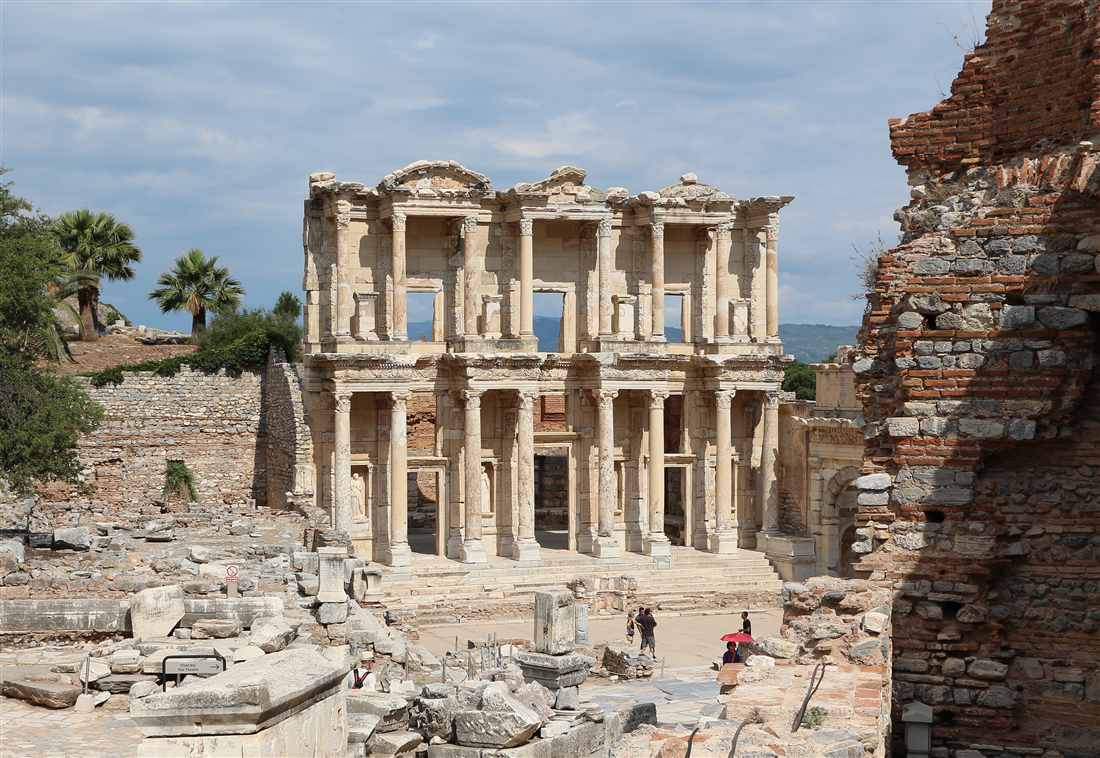
- Library of Celsus: the two-storey marble façade with statues of Wisdom, Knowledge, Intelligence, and Virtue, the signature image of Ephesus and the most photographed structure on the site.
- Great Theatre: a hillside amphitheatre seating 25,000, where Saint Paul preached to the Ephesians and where performances still resonate off the stone.
- Curetes Street: the marble-paved processional avenue lined with columns, statue bases, and shopfronts, running downhill through the city’s heart.
- Terrace Houses: the covered hillside mansions of Ephesus’s wealthy, preserving mosaics, frescoes, and marble-clad rooms under a protective roof.
- Temple of Hadrian: the elegant Corinthian façade on Curetes Street, its arch carved with the goddess Tyche and the mythical founding of the city.
The Library of Celsus is the emotional centre of the visit. Built as a monumental tomb and library holding 12,000 scrolls, its reconstructed façade rises two storeys in golden marble, framed by four statues in wall niches. Beside it stands the triple-arched Gate of Mazeus and Mithridates, opening onto the Commercial Agora. Groups pause here longest, and the guide unpacks the trompe-l’oeil design that makes the façade appear wider than its base.
The Great Theatre closes the downhill route near the lower gate. Carved into Mount Pion, its stone tiers seat 25,000 spectators and open onto the Arcadian Way, the colonnaded avenue that ran to the ancient harbour before the coastline silted away. The acoustics carry a spoken word from the stage to the top row, and the guide demonstrates the effect. Saint Paul’s confrontation with the silversmiths of Ephesus, recorded in the Acts of the Apostles, unfolded in this theatre.
The Terrace Houses reward the separate ticket. Under a modern protective canopy, six terraced dwellings preserve the private world of Ephesus’s elite: floor mosaics, wall frescoes of the Muses, marble-panelled reception rooms, and an early hot-and-cold plumbing system. The Temple of Hadrian, midway along Curetes Street, presents a slender Corinthian porch with a carved arch and a frieze of the city’s mythology, one of the most refined small structures in the classical world.
Beyond the five headline structures, the descending route passes a dense sequence of civic landmarks. The Odeon, a roofed council chamber, seated 1,400 for meetings and concerts at the upper city. The State Agora, the Prytaneion with its sacred hearth, and the Memmius Monument anchor the administrative quarter. The Fountain of Trajan, the Gate of Hercules with its relief of the hero’s lion skin, and the public latrines with their marble bench seating each draw a pause. The Marble Road, grooved by ancient cart wheels, links the Library to the Great Theatre and carries the famous carved footprint that pointed toward the ancient brothel.
The whole walk covers about 1.5 kilometres over one to two hours at a guided pace. The route descends, sparing the knees on the outward journey, and the marble underfoot turns slick after rain, so sturdy shoes matter. A visit closes at the Ephesus Archaeological Museum in Selçuk, where the twin Artemis statues, the bronze athlete, and the finds lifted from the Terrace Houses fill the gap the bare ruins leave. Together the site and museum reconstruct a harbour metropolis that rivalled Alexandria before its bay silted into the plain that now separates the ruins from the distant sea.
Is it better to fly or take the bus or train from Istanbul to Ephesus?
Flying wins for a day trip: a 75-minute flight from Istanbul to Izmir puts you on the coast before breakfast, while the overnight intercity bus runs 9 to 10 hours and the rail route demands a change at Izmir onto a slower regional line into Selçuk.
Ephesus sits inland from Selçuk in Izmir province, roughly 400 kilometres south of Istanbul as the crow flies. Turkish Airlines, Pegasus and AnadoluJet run frequent departures from both Istanbul Airport (IST) on the European side and Sabiha Gökçen (SAW) on the Asian side to Izmir Adnan Menderes Airport. The first flights leave between 06:00 and 07:00, land near 08:15, and connect a driver or a shuttle to Selçuk in about 55 minutes, delivering you to the ancient city gate before the midday sun and before the cruise coaches arrive from the port.
The flight route splits by airport, and the split matters for timing. Istanbul Airport (IST) on the European side serves Turkish Airlines and its full-service network, while Sabiha Gökçen (SAW) on the Asian side hosts Pegasus and AnadoluJet on leaner fares. A traveller sleeping in Sultanahmet or Taksim reaches IST in 45 to 60 minutes by the M11 metro or a shuttle, while an Asian-side base favours SAW. Both airports run pre-dawn departures to Izmir, and the package operators build their pickups around whichever field the booked flight uses, sparing the traveller the airport arithmetic entirely.
The intercity bus is the budget route. Companies such as Kamil Koç, Pamukkale Turizm and Metro Turizm depart Istanbul’s Esenler and Alibeyköy terminals in the evening and reach Izmir Otogar at dawn, from where a local bus or dolmuş covers the final 80 kilometres to Selçuk. The seats recline, hostesses serve tea, and a rest stop breaks the journey, yet the arithmetic is punishing for a single day: 10 hours down, a few hours on site, 10 hours back. The bus earns its keep only when you plan two or more nights on the coast.
The train is the scenic compromise. Turkey’s high-speed YHT network links Istanbul to Ankara and Konya, not the Aegean, so a rail traveller rides the standard Izmir Blue Train or the İzmir Mavi Tren overnight to Basmane station, then transfers to the İZBAN suburban line and the Selçuk regional service. Total transit exceeds 13 hours. Compare the three routes at a glance:
- Flight: 75 minutes gate to gate, plus 55 minutes by road to Selçuk; the only option that fits a same-day return.
- Overnight bus: 9 to 10 hours, lowest fare, arrives at dawn, best paired with an overnight stay.
- Train plus connection: 13 hours and two changes, the most scenic and the slowest.
Cost sharpens the decision further. A round-trip domestic flight booked weeks ahead runs €50 to €90, and the escorted day-trip package that wraps the airfare, transfer, guide and tickets prices from €120 to €200 per person. The overnight bus undercuts the raw airfare at €20 to €35 each way, yet the two lost sleeping nights and the dawn dolmuş transfer erode the saving for a solo-day visitor. The train fare tracks the bus, and the double connection adds cost in taxis between Basmane and the İZBAN platform. Time, not money, decides the day trip: the plane returns 16 hours to your itinerary that the road surrenders.
For a traveller with one free day, the flight is the decisive choice, and the flight-and-guide package sold from Istanbul bundles the airfare, the airport transfer, a licensed guide and the site tickets into one price. Those chasing a lower fare and a slower rhythm take the night bus and build a two-day itinerary around it. A visitor already staying on the coast skips the Istanbul calculus entirely and reaches the ruins in under an hour, the pattern behind the Ephesus from Kusadasi route.
Do you visit Ephesus as a day trip from Istanbul or stay overnight in Selçuk or Kusadasi?
Fly down and back inside a single day when Ephesus is your one goal; add one or two nights in Selçuk or Kusadasi when you want the House of the Virgin Mary, the museum, Sirince village and a Pamukkale extension without the pressure of a return flight.
The day trip is a tightly engineered package. The 06:30 flight lands at Izmir by 08:15, the transfer reaches the site by 09:15, and a licensed guide walks you down the marble street from the Magnesian Gate to the Library of Celsus and the Great Theatre across two to three hours. Lunch follows, a stop at the House of the Virgin Mary fills the afternoon, and the evening flight returns you to Istanbul by 21:00. Everything is prepaid, escorted and timed, which suits a first-time visitor on a short Turkey itinerary who treats Ephesus as a headline sight rather than a base.
Staying overnight rewrites the pace. Selçuk, the small market town at the foot of Ayasuluk hill, sits 3 kilometres from the ruins and holds the Ephesus Archaeological Museum, the Basilica of St John, and the lone reconstructed column of the Temple of Artemis. A room here means you reach the site at opening, beat the cruise crowds by two hours, and photograph the Library in soft morning light. Kusadasi, 20 kilometres west, trades the historic hush for a resort seafront, a marina, hotels of every grade and a nightlife strip.
Weigh the two bases against your priorities:
- Selçuk: closest to the ruins, walking distance to the museum and the Basilica, quiet stone-town character, limited nightlife.
- Kusadasi: beaches, marina dining, big hotels, cruise-port energy, a 20-minute drive from the gate.
- Same-day from Istanbul: no luggage, no hotel booking, every logistic solved by the package, and a fixed return time.
The luggage question tilts the balance for a large share of visitors. A same-day return means you leave your Istanbul hotel room booked, carry nothing but a day bag, and skip the hassle of a second check-in on the coast. An overnight forces a packed bag, a coastal hotel reservation and a morning transfer back to Izmir Airport for the return leg. Families and older travellers who tire of repacking lean toward the day trip; a couple building a slow Aegean holiday accepts the extra logistics for the reward of a museum morning and a Sirince evening.
An overnight also unlocks the second-day extensions that a day trip forbids. With a night on the coast you reach the travertine terraces of Pamukkale, ride out to Sirince for wine and village lunch, or spend a slow morning in the museum reading the Artemis statues face to face. The choice reduces to one question: is Ephesus the trip, or the anchor of a wider Aegean loop? A single marble afternoon justifies the flight-and-return package; a hunger for the whole cluster justifies the overnight.
Can you combine Ephesus with Pamukkale from Istanbul?
Yes: the two-day Ephesus and Pamukkale tour from Istanbul pairs the ancient city on day one with the white travertine terraces and the ruined spa city of Hierapolis on day two, linked by a 3-hour road transfer and one overnight in a Pamukkale or Karahayit thermal hotel.
The standard two-day package flies you to Izmir on the first morning, tours Ephesus with a guide, and drives 190 kilometres east to Pamukkale by evening. You sleep beside the terraces, rise for the travertines at their emptiest, and explore Hierapolis before an afternoon flight home from Denizli or a return drive to Izmir. The itinerary compresses two of Turkey’s most photographed sites into 48 hours without backtracking, and the single overnight keeps the cost far below two separate excursions.
Pamukkale, the “cotton castle,” is a cascade of chalk-white basins built by calcium-carbonate-rich hot springs that have deposited travertine for millennia. Visitors walk the terraces barefoot, wading through warm shallow pools that spill down the hillside above the plain of the Menderes river. The mineral water emerges at around 35°C, and the dazzling white surface against a blue Aegean sky is the image that draws photographers from across the world.
Above the terraces stretches Hierapolis, a Greco-Roman spa city founded in the second century before the common era and later a Roman healing resort. Its ruins reward a full afternoon:
- The Roman theatre: a steeply raked auditorium seating 12,000, its stage building carved with reliefs of Apollo and Dionysus.
- The Antique Pool: the thermal “Cleopatra’s Pool,” where swimmers float over submerged marble columns toppled by an earthquake.
- The necropolis: one of the largest ancient cemeteries in Anatolia, with more than 1,200 tombs lining the roads out of the city.
- The Plutonium: a sacred cave whose carbon-dioxide vapours the ancients tied to the underworld god Pluto.
The overnight stop earns its own place on the itinerary. Pamukkale and neighbouring Karahayit ring the terraces with thermal hotels whose pools draw the same mineral water that built the travertines, and guests soak under the stars after the day-trippers depart. The village restaurants serve Denizli lamb and testi kebab, cooked and cracked open at the table, and the quiet after the coaches leave turns the white cliffs into a private spectacle at dawn. This second night is the hinge that lets the tour reach a site 190 kilometres from Ephesus without a punishing single-day drive.
The two-day format resolves the geography problem that defeats a single day: Ephesus and Pamukkale sit 190 kilometres apart, too far to bracket around one flight. Splitting the drive across two mornings turns a frantic dash into a paired experience, ancient marble on the first day and geothermal spectacle on the second. Travellers who want both marvels in one Istanbul departure take the two-day tour rather than attempting each as an isolated day trip.
What is the best time to visit Ephesus from Istanbul?
Spring, from April to early June, and autumn, from September to October, deliver the ideal blend of mild temperatures, thin crowds and clear light; the early 06:30 flight from Istanbul lands you at the gate before the cruise coaches, sidestepping both the July heat and the midday crush.
Ephesus offers almost no shade. The marble streets, the terraces and the open Great Theatre bake under a direct sun, and July and August temperatures on the Aegean coast climb past 35°C by noon. A summer visitor walks a kilometre of reflecting stone with no canopy, which turns the archaeology into an endurance test. Spring and autumn hold the air in the low-to-mid twenties, warm enough for shirtsleeves and cool enough to read every inscription without wilting.
Crowds follow the cruise calendar as much as the season. Ships dock at Kusadasi through the day and disgorge coach after coach toward Ephesus between 10:00 and 14:00, filling the Curetes Street and the Library forecourt with tour groups. The Istanbul day-trip package answers this with the dawn flight: arrive at 09:15, walk the site while it breathes, and clear the Library before the port traffic peaks. The same early start rewards photographers, since the morning sun rakes low across the two-storey Library façade.
Season by season, the trade-offs read clearly:
- Spring (April–June): wildflowers on the hillsides, 20–26°C, moderate crowds, the best all-round window.
- Autumn (September–October): warm sea, 22–28°C, thinning cruise traffic after the peak, gold evening light.
- Summer (July–August): 33–38°C, peak cruise volume, only a dawn arrival keeps it comfortable.
- Winter (November–March): 10–15°C, rain spells, the emptiest ruins and the lowest fares.
Practical packing tracks the calendar. The stone underfoot is uneven marble and worn limestone, so grippy walking shoes matter in every season, and the total site walk from the upper Magnesian Gate to the lower Harbour Street covers about 3 kilometres downhill. Summer visitors carry a wide hat, refillable water and high-factor sun cream, since the only reliable shade sits inside the terrace-house shelter and the museum. Spring and autumn travellers pack a light layer for the cool morning and shed it by midday. The dawn flight from Istanbul suits every season by front-loading the walk into the coolest, quietest hours.
Winter deserves a mention for the crowd-averse. Rain interrupts the coast between November and February, and short daylight trims the touring window, yet the site stands nearly deserted and the flight-plus-hotel prices fall to their yearly floor. A traveller who packs a waterproof and accepts a grey sky walks Curetes Street in near solitude. For the widest appeal, though, the shoulder months win: comfortable stone underfoot, a sky that photographs, and a Library forecourt you reach before the day-trip fleet.
How does the Istanbul route compare with going from Kusadasi or Izmir?
Kusadasi and Izmir place you within an hour of the gate for a relaxed morning start, while Istanbul demands a flight and a longer day; the Istanbul route trades that convenience for the reality that most first-time visitors sleep in Istanbul and treat Ephesus as a fly-in headline.
Kusadasi is the cruise-port doorway. Ships berth at the Ege Port terminal, and the ruins lie 20 kilometres and 25 minutes east, so a passenger steps off the gangway and reaches the marble street inside an hour. This is the shortest approach of the three and the reason the Ephesus from Kusadasi excursion sells so heavily to cruise itineraries, with skip-the-line guides tuned to the tight in-port window before the ship sails at dusk.
Izmir suits the independent traveller who wants a full Aegean base. Turkey’s third city sits 80 kilometres north of Ephesus, holds an international airport, a long seafront kordon, museums and a deep hotel stock, and connects to Selçuk by the İZBAN suburban rail and regional trains for a few euros. A visitor basing in Izmir tours Ephesus one day, the ancient agora and Kemeraltı bazaar the next, and swings to Pergamon or Sardis without repacking.
The Istanbul route stands apart because Istanbul is where most itineraries begin and end. Compare the three departures:
- From Kusadasi: 25 minutes by road, cruise-port timing, the shortest and simplest approach.
- From Izmir: 1 hour by road or rail, a full city base with airport, ideal for a multi-day Aegean loop.
- From Istanbul: a 75-minute flight plus a 55-minute transfer, a long but self-contained day the flight-and-tour package handles end to end.
Connectivity separates the three bases as much as distance. Izmir Adnan Menderes Airport handles domestic and international flights and links to the city centre and Selçuk by the İZBAN commuter rail, so Izmir doubles as a transport hub the whole region hangs off. Kusadasi has no airport of its own and leans on Izmir 90 kilometres north or on the cruise berths that feed it directly from the sea. Istanbul, by contrast, owns two major airports and the country’s densest flight schedule, which is exactly why flying south for the day is frictionless even though the ground distance is greatest.
The comparison resolves by where you already sleep. A cruise passenger or a coast-based traveller reaches Ephesus faster from Kusadasi or Izmir and has no reason to route through Istanbul. A visitor whose hotel, flights and wider plan sit in Istanbul flies down for the day rather than relocating the whole trip to the Aegean for one archaeological site. The Istanbul package exists precisely because the marble city is a bucket-list stop bolted onto an Istanbul-centred holiday, and the dawn flight converts a distant ruin into an afternoon on Curetes Street.
What else do you see near Ephesus on a trip from Istanbul?
Within a few kilometres of the ruins lie the House of the Virgin Mary on Mount Koressos, the reconstructed column of the Temple of Artemis, the Basilica of St John on Ayasuluk hill, the hill village of Sirince, and the Ephesus Archaeological Museum in Selçuk, each a natural add-on to the marble city.
The House of the Virgin Mary is the most visited of the satellites. A small stone chapel on a forested slope 7 kilometres above Ephesus, it marks the spot Catholic tradition and the visions of Anne Catherine Emmerich identify as the place the mother of Jesus spent her final years. Popes have made pilgrimage here, a wall of tied wish-ribbons flutters below the spring, and the site draws Christian and Muslim visitors alike. Most Istanbul day-trip packages fold it into the afternoon.
Two Selçuk monuments frame the town’s skyline. The Temple of Artemis, one of the Seven Wonders of the Ancient World, survives as a single re-erected column in a marshy field, a stark relief of the vast temple that once held 127 columns. Above it, the Basilica of St John crowns Ayasuluk hill, a sixth-century church built by the emperor Justinian over the traditional tomb of the apostle John, its marble floor plan and reconstructed arches commanding a view across the plain to the sea.
The Ephesus Archaeological Museum deserves a dedicated hour on any overnight plan. Its Artemis Hall displays the Great Artemis and the Beautiful Artemis, the two marble cult statues of the egg-covered goddess lifted from the temple’s ruin, alongside the bronze figure of a resting athlete scraping oil from his skin. Galleries of terrace-house frescoes, glassware, coins and grave goods restore the domestic texture the open site strips away, and the exhibits carry the small finds that weather and looting removed from the streets. A guided site walk paired with the museum tells the fuller story: the city outdoors, the treasure indoors.
Two more stops round out the cluster:
- Sirince: a hillside village of Ottoman-Greek houses 8 kilometres from Selçuk, famous for fruit wines, olive oil and a slow lunch among vineyards.
- Ephesus Archaeological Museum: the Selçuk museum holding the two Artemis statues, the bronze athlete, household frescoes and finds lifted from the terrace houses.
- The Terrace Houses: the covered “houses of the rich” inside the site itself, with mosaic floors and painted walls under a modern shelter, entered on a separate ticket.
Inside the ancient city itself, the headline monuments reward the extra time a guide affords. The Library of Celsus, a two-storey marble façade built as a tomb-monument for a Roman governor, anchors every photograph and once held 12,000 scrolls. The Great Theatre, carved into Mount Pion, seated 25,000 and staged the riot of the silversmiths recorded in the Acts of the Apostles. The Temple of Hadrian on Curetes Street carries a delicate arched frieze, and the communal latrines beside the baths draw a smile from every group. These set pieces fill the core two-hour walk before the satellites even begin.
The density of the cluster is the argument for an overnight and the constraint on a day trip. A same-day visitor from Istanbul pairs Ephesus with the House of the Virgin Mary and glimpses the Basilica and the Artemis column from the road. A traveller with a night in Selçuk walks the museum’s Artemis gallery, climbs Ayasuluk hill at sunset, and drives up to Sirince for dinner, turning a single ruin into a two-day Aegean chapter.
Is the Ephesus day trip from Istanbul worth it?
Yes for the traveller who has one free day and treats Ephesus as a bucket-list headline: the flight-and-tour package converts a 400-kilometre gap into a single escorted afternoon on the best-preserved classical city in the Mediterranean, and the prepaid airfare, transfer, guide and tickets remove every logistical worry.
The value case rests on what the package solves. Booking the dawn flight, arranging an airport driver, hiring a licensed guide and buying skip-the-line tickets separately eats hours of planning and risks a missed connection that wastes the whole day. The bundled excursion prices all of it into one figure, times the transfers to land you ahead of the cruise coaches, and hands you a guide who reads the Library façade, the Great Theatre and the terrace houses into living history rather than a field of stone.
The escorted format adds value beyond logistics. A licensed Ephesus guide reads the site’s layers in sequence, ties the silversmiths’ riot to the Great Theatre, explains why the Library faces east to light its reading room at dawn, and points out the terrace-house mosaics a solo visitor walks past unaware. Skip-the-line entry spares the ticket queue at the peak of cruise-coach arrivals, and the group cap keeps the guide within earshot. For a first-time visitor with no background in classical archaeology, that narration converts a field of ruins into a legible city, which is the difference a self-guided ticket rarely delivers.
The trip suits a clear profile. It rewards the first-time Turkey visitor on a short Istanbul-based holiday, the traveller who wants the marble street and the Library photograph without relocating to the coast, and the pilgrim adding the House of the Virgin Mary to a wider itinerary. It serves less well the crowd-averse who dislike a guided group, the slow traveller who wants the museum and Sirince, and anyone already sleeping in Kusadasi or Izmir, for whom the Istanbul flight is a needless detour.
Judge the verdict against the alternatives:
- Worth it if: you sleep in Istanbul, have one day, and want Ephesus handled end to end.
- Choose the overnight if: you want the museum, Sirince, the Basilica and a Pamukkale extension.
- Skip the Istanbul route if: you are cruising into Kusadasi or basing in Izmir, where the gate is an hour away.
The historical weight of the site underwrites the whole calculation. Ephesus was a Greek foundation, a Roman provincial capital of Asia and a metropolis of a quarter-million people, home to the Temple of Artemis among the Seven Wonders and a cradle of early Christianity where Saint Paul preached and Saint John wrote. Walking its marble main street past the Library, the theatre and the terrace houses puts a traveller inside one of the ancient world’s great urban stages, preserved to a degree few classical cities match. No photograph substitutes for standing in the theatre or reading the Library façade at eye level, and that immediacy is what the flight and guide deliver.
The Ephesus day trip from Istanbul earns its price for the visitor it is built for. A dawn flight, a marble morning under a guide who knows the stones, an afternoon at the House of the Virgin Mary and an evening return north deliver one of antiquity’s great cities inside twelve hours, fully organised. For the Aegean completist the overnight remains the richer choice, but as a self-contained headline day the flight-and-tour package repays every euro.
Frequently Asked Questions
Can you visit Ephesus from Istanbul in a day?
Yes. An early flight from Istanbul to Izmir takes about an hour, and a one-hour drive reaches Ephesus near Selcuk. A day tour with return flights covers the ancient city, the House of the Virgin Mary and the Temple of Artemis, back the same evening.
How far is Ephesus from Istanbul?
Ephesus lies about 500 kilometres south of Istanbul. Flying to Izmir and driving to Selcuk covers the journey in around three hours each way; driving the whole way takes eight to nine hours.
How much does an Ephesus trip from Istanbul cost?
An Ephesus day trip from Istanbul bundles return flights, transfers, a licensed guide and entry into one price. Group tours sit in the mid-hundreds of euros; private tours with a car and guide cost more, scaled to the group size.