
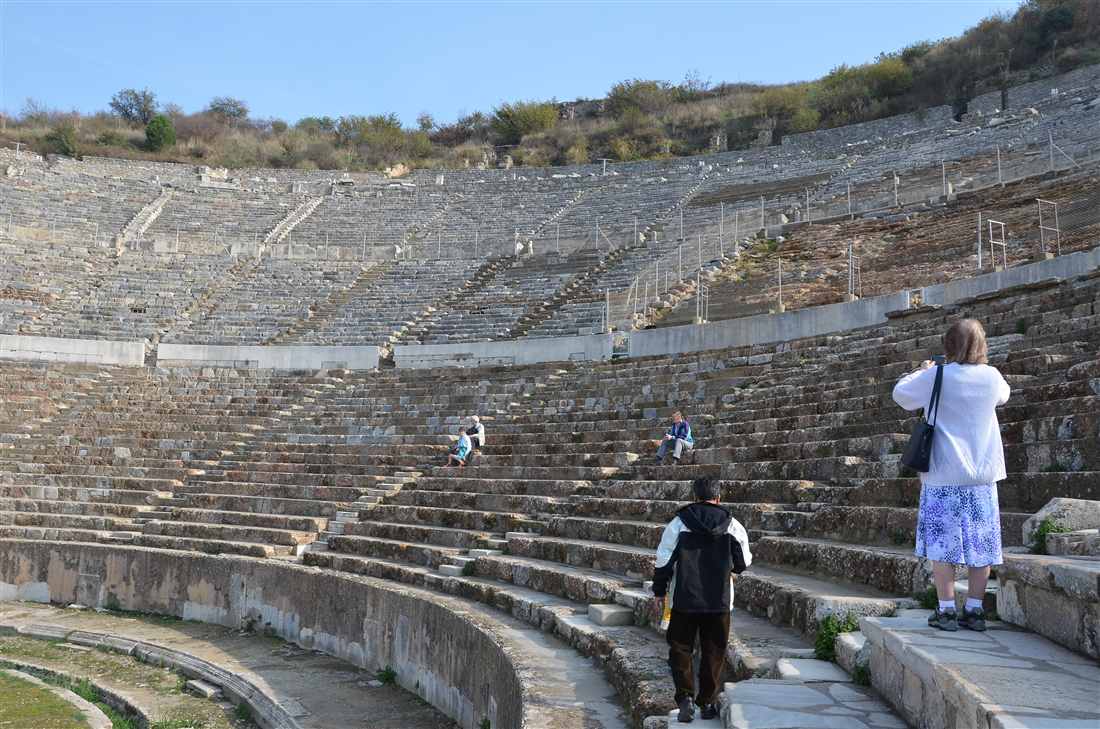
The Great Theatre of Ephesus is the largest theatre of the ancient world, a vast three-tier auditorium cut into the slope of Mount Panayir at Ephesus, seating about 25,000 spectators and facing the line of the ancient harbour. Plan the whole trip with Greece Tours.
This guide covers the Great Theatre of Ephesus in full: what it is and how big it is, when it was built and enlarged, the parts of the theatre, what it was used for, the riot of the silversmiths against Saint Paul, where it stands in the city, its condition today, and how to visit it from the Kusadasi cruise port or the Greek island of Samos.
What is the Great Theatre of Ephesus?
The Great Theatre of Ephesus is the largest theatre of the ancient world, cut into the western slope of Mount Panayır and holding an audience of about 25,000 spectators. It dominated the harbour city and served drama, assemblies, and Roman games.
The Great Theatre stands as the central monument of ancient Ephesus, a Greek city on the Aegean coast of Asia Minor that later became the capital of the Roman province of Asia. Builders carved its vast semicircular seating bowl straight into the natural hillside of Mount Panayır, using the gradient of the rock to raise tier upon tier of stone benches above the flat performance floor. This union of engineering and topography gave the structure both its enormous capacity and its acoustic power. Visitors who explore Greece Tours and the wider Aegean world encounter no single ancient theatre that surpasses it in seating scale.
The theatre faced west, so the audience looked out over the stage building toward the ancient harbour and the marble avenue that ran down to the waterfront. The setting placed the building at the visual and civic heart of the city. Beyond entertainment, the theatre operated as the assembly hall of the Ephesian people, the place where the citizen body gathered to decide public affairs, honour benefactors, and hear proclamations. Its stone rows recorded the rhythm of civic life across the Hellenistic and Roman ages.
Ephesus itself ranked among the greatest cities of the eastern Mediterranean, home to the Temple of Artemis, one of the Seven Wonders of the ancient world. The Great Theatre matched that prestige in built form. It defined the skyline of the lower city, anchored the grid of colonnaded streets, and gave Ephesus a stage worthy of its wealth, its port trade, and its role as a religious pilgrimage centre for the cult of Artemis.
- Location: western slope of Mount Panayır, facing the ancient harbour.
- Capacity: about 25,000 seated spectators, the largest known in antiquity.
- Construction method: the seating bowl cut into the natural rock of the hillside.
- Function: theatre, gladiatorial arena, and the civic assembly of Ephesus.
- City rank: the flagship public building of a provincial capital.
The name of the building reflects both fact and reputation. Ancient authors and modern archaeologists rank it first in seating capacity, and its position beside a wealthy harbour gave it a prominence that few provincial monuments in the entire Roman east matched. The word “great” attached to it in the literal sense, a superlative earned by measured dimensions rather than by praise alone. Every element, from the depth of the seating bowl to the height of the stage screen, pushed the type to its physical limit.
The Great Theatre survives as the single most impressive standing structure at the Ephesus archaeological site. Its scale astonishes modern visitors who climb its tiers, and its history binds together Greek dramatic tradition, Roman spectacle, and one of the most famous scenes of the early Christian record. To stand in its orchestra is to occupy the exact spot where an entire city once gathered as one crowd.
What are the dimensions of the Great Theatre of Ephesus?
The Great Theatre measures roughly 145 metres across at its widest, rises about 30 metres in height, and carries 66 rows of seats arranged in a three-tier cavea split by two horizontal walkways, the diazomata, into three vertical sections of benches.
The dimensions of the theatre express deliberate ambition. The seating bowl spans about 145 metres in diameter, and the top row stands 30 metres above the level of the orchestra floor. The height of the auditorium equals a modern ten-storey building, and the climb from the stage to the uppermost gallery tests the legs of every visitor. From that top row the sightline reaches across the whole lower city to the line of the vanished harbour and the sea beyond.
The 66 rows of stone benches divide into three superimposed horizontal bands, called the cavea or koilon. Two broad walkways, the diazomata, run around the curve of the seating and separate the lower, middle, and upper tiers. These passages let spectators move sideways and reach their rows without climbing the entire height. Radiating staircases, the klimakes, cut vertically through the benches to create wedge-shaped seating blocks, the kerkides, and to speed the flow of thousands of people in and out of the building.
- Diameter: approximately 145 metres across the seating bowl.
- Height: about 30 metres from orchestra floor to the top gallery.
- Rows: 66 tiers of stone benches.
- Tiers: three superimposed sections divided by two diazomata walkways.
- Access: radiating staircases forming wedge-shaped seating blocks.
The three-tier arrangement reflected the growth of the building over time. The lowest tier belonged to the earliest Greek design, and the upper tiers rose as Roman engineers extended the cavea to swell its capacity. The steep pitch of the seating served two ends at once. It packed 25,000 people into a compact footprint, and it projected the human voice with such clarity that an actor in the orchestra reached the highest row without amplification.
The width of the seating bowl exceeded a semicircle, wrapping the audience around the orchestra in an arc greater than 180 degrees. This over-embrace tightened the acoustic focus and drew the outer wings of the crowd closer to the action than a plain half-circle allowed. The dimensions therefore served performance as much as capacity, concentrating tens of thousands of listeners within earshot of an unaided human voice on the stage below.
The lower rows carried the seats of honour, the proedria, reserved for magistrates, priests, and distinguished citizens, and framed by decorated marble. Ordinary citizens filled the middle and upper tiers. The vertical wedges organised the crowd into blocks, and the scale of the whole structure turned the audience itself into a spectacle, a solid wall of humanity curved around the stage in a single sweeping arc of bright white stone.
When was the Great Theatre of Ephesus built?
The Great Theatre began in the Hellenistic period during the third century BC, took its first monumental form under the successors of Alexander, and reached its final scale through repeated Roman enlargement across the first and second centuries AD, a building programme spanning four hundred years.
The earliest theatre rose in the Hellenistic age, after the general Lysimachus refounded Ephesus on its harbour site in the early third century BC. That first structure followed the Greek pattern, with a horseshoe-shaped orchestra and a modest stone stage building set against the hillside. The Greek architects chose the slope of Mount Panayır precisely because the natural gradient supplied a ready-made frame for the seating without the need for the vast substructures that later Roman theatres on flat ground demanded.
Under Roman rule the theatre grew into the giant that survives. During the first century AD, in the reigns of the emperors Claudius and Nero, engineers raised the stage building to a monumental multi-storey façade and expanded the seating. The work continued into the second century AD under Trajan and Hadrian, when the cavea reached its full three-tier height and the skene gained its richest decoration. Inscriptions from the building record the emperors and benefactors who funded these campaigns.
- Hellenistic origin: third century BC, after the refounding by Lysimachus.
- First Roman phase: first century AD, under Claudius and Nero.
- Second Roman phase: second century AD, under Trajan and Hadrian.
- Total span: about four hundred years of building and rebuilding.
- Design shift: from a Greek horseshoe orchestra to a Roman monumental scheme.
The long chronology explains the layered character of the ruin. Greek foundations underlie Roman superstructure, and the two building traditions meet within a single monument. The Greeks fixed the position, the acoustics, and the basic bowl. The Romans amplified everything, tripling the visual mass of the stage building and lifting the seating to its record capacity. The city that carried out this work stood at the height of its wealth as the administrative seat of Roman Asia, and the theatre broadcast that prosperity in stone.
The Greek-to-Roman transition left visible seams in the masonry. The lowest section of seating and the horseshoe outline of the original orchestra belong to the Hellenistic scheme, while the squared Roman orchestra, the raised stage, and the towering scaenae frons overlay them. Archaeologists read the sequence in the joints between older and newer stone, in the reused blocks, and in the dedicatory inscriptions that name the emperors and civic donors who paid for each stage of the work.
The building continued in use through late antiquity, and later modifications adapted it to changing tastes in public spectacle, including the barriers and fittings needed for gladiatorial and animal combat. The Ephesus excavations have traced these successive phases through the masonry, the inscriptions, and the stratified debris, producing one of the most fully documented construction histories of any ancient theatre.
What are the main parts of the Great Theatre?
The Great Theatre comprises four principal elements: the cavea or koilon of curved seating, the semicircular orchestra at its centre, the tall multi-storey skene stage building facing the audience, and the vaulted parodoi, the arched side passages that channelled the crowd into the orchestra.
The cavea, also called the koilon, forms the seating bowl and dominates the structure by sheer mass. Its 66 rows curve around slightly more than a semicircle, embracing the performance floor. Cut into the hillside and faced with dressed stone, the cavea rises in three tiers separated by the diazomata. This is the part visitors climb, and the highest benches deliver the sweeping panorama over the ruined city toward the sea.
The orchestra sits at the foot of the cavea, a paved semicircular floor where the chorus performed in the Greek period and where gladiators later fought. In its Roman form the orchestra was ringed by the lowest seats of honour and, in the arena phase, protected by a barrier that shielded spectators from the beasts and combatants below. It marks the acoustic focus of the whole building, the point from which sound radiates cleanly to every row.
- Cavea (koilon): the three-tier bowl of 66 seated rows.
- Orchestra: the semicircular performance floor at the centre.
- Skene: the multi-storey stage building facing the audience.
- Parodoi: the vaulted side passages leading into the orchestra.
- Proskenion: the raised stage platform in front of the skene façade.
The skene, the stage building, closed the open side of the theatre and rose to three storeys at its greatest height. Its façade, the scaenae frons, carried columns, niches, statues, and richly carved marble arranged into an architectural screen that served as a permanent backdrop for the action on the stage. The height of the skene matched the top of the cavea, so the building enclosed the audience within a bowl of stone that trapped and reflected sound. The proskenion, a raised platform in front of this façade, formed the acting stage of the Roman theatre.
The parodoi were the two vaulted passages that entered the orchestra between the ends of the cavea and the skene. Roofed with stone barrel vaults, these arched corridors carried processions, performers, and the flood of the departing crowd. Above them ran boxes for honoured guests. Together the four elements produced a self-contained machine for spectacle, each part tuned to gather thousands of people, hold their attention, and carry a single voice to every one of them.
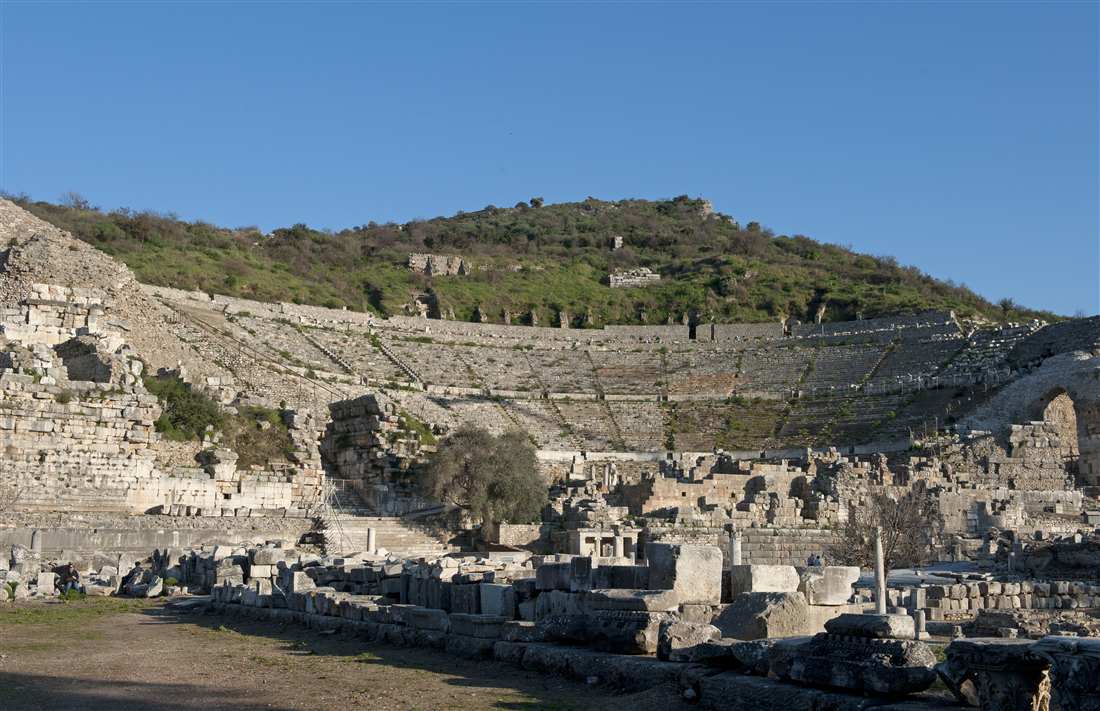
What was the Great Theatre used for?
The Great Theatre served three roles across its life: a venue for Greek drama, music, and festival performance; a Roman arena for gladiatorial combat and wild-animal games; and the formal assembly hall where the citizen body of Ephesus met to govern the city.
In the Greek and early Roman periods the theatre staged the classical repertoire of tragedy, comedy, and choral performance, along with musical and rhetorical contests tied to the city’s religious festivals. The cult of Artemis structured the Ephesian calendar, and dramatic and musical competitions honoured the goddess before crowds drawn from the whole region. Actors performed on the raised proskenion, the chorus worked the orchestra, and the towering scaenae frons framed the action as a fixed architectural stage set.
Under Roman rule the taste for blood sport reshaped the building’s use. Engineers adapted the orchestra into an arena, adding a protective barrier so that gladiators fought and wild beasts were hunted before the mass audience. The discovery nearby of a gladiator cemetery, with skeletons bearing combat wounds, confirms that Ephesus embraced the games with the same enthusiasm as the great cities of the west. The theatre’s scale made it the natural stage for these spectacles.
- Drama: tragedy, comedy, and choral works of the classical stage.
- Music and rhetoric: festival contests honouring Artemis.
- Gladiatorial games: combat between trained fighters in the adapted orchestra.
- Animal hunts: wild-beast spectacles behind a protective barrier.
- Civic assembly: meetings of the Ephesian citizen body.
Beyond entertainment, the theatre functioned as the political heart of the city. The Ephesian assembly, the demos, gathered in the cavea to pass decrees, elect officials, receive envoys, and honour benefactors with public inscriptions. A crowd of 25,000 gave the citizen body real weight, and the acoustics that carried an actor’s voice equally carried the words of magistrates and orators. The same stone benches that held festival audiences held the sovereign assembly of the city.
Seating in the theatre followed a fixed social order. The front rows of honour held the priests of Artemis, the city magistrates, and visiting Roman officials, while the tribes and trade associations of Ephesus filled assigned blocks higher up. Inscribed names and reserved places cut into the marble fixed this hierarchy in stone, so the audience mirrored the structure of the city, with rank rising and falling across the curve of the seating.
This triple role made the theatre the busiest public space in Ephesus. Sacred festivals, popular spectacle, and civic government all converged on one building, and its central position at the meeting of the great avenues reinforced that concentration. The theatre bound together religion, entertainment, and politics in a single monumental frame, and its life reflected every major current in the history of the ancient city.
What is the connection between the Great Theatre and Saint Paul?
The Great Theatre is the setting of the riot of the silversmiths recorded in the Acts of the Apostles. Demetrius, a silversmith who made shrines of Artemis, roused the crowd against the apostle Paul, and the mob filled the theatre chanting, “Great is Artemis of the Ephesians.”
The nineteenth chapter of the Acts of the Apostles places one of the most dramatic episodes of Paul’s mission inside this very building. Paul had preached in Ephesus for an extended period, and his message that gods made by human hands were no gods threatened the trade in silver shrines of Artemis. Demetrius, a silversmith who profited from the pilgrimage business around the Temple of Artemis, gathered his fellow craftsmen and warned that Paul’s teaching endangered both their livelihood and the honour of the goddess.
The craftsmen’s anger spread through the city, and the crowd surged into the Great Theatre, seizing two of Paul’s travelling companions, Gaius and Aristarchus, as they went. According to the account, the assembly fell into confusion, most people not knowing why they had come, and for about two hours the theatre rang with the repeated shout, “Great is Artemis of the Ephesians.” Paul wished to enter and address the crowd, but his disciples and friendly officials held him back, judging the danger too great.
- Source: the Acts of the Apostles, chapter nineteen.
- Instigator: Demetrius, a silversmith who made shrines of Artemis.
- Grievance: Paul’s preaching threatened the trade in idols.
- The chant: “Great is Artemis of the Ephesians,” repeated for two hours.
- Resolution: the city clerk calmed the mob and dismissed the assembly.
The episode ended when the city clerk, the grammateus, stepped forward and calmed the crowd. He argued that Ephesus needed no proof of its devotion to Artemis, that the accused men had committed no crime against the temple, and that any complaint belonged before the courts and the proconsuls. He warned the citizens that the uproar exposed the city to a Roman charge of rioting, and with that he dismissed the assembly. Paul left Ephesus for Macedonia shortly afterward.
This account fixes the Great Theatre in the memory of millions of readers who never studied ancient architecture. It supplies a precise historical setting, names real civic offices that inscriptions confirm existed at Ephesus, and turns the building into a landmark of early Christian history. Standing in the orchestra, a visitor occupies the floor over which that famous chant once echoed, and the biblical scene binds the monument to the wider Christian heritage of the region.
Where is the Great Theatre in Ephesus and what stands around it?
The Great Theatre stands at the eastern end of the Harbour Street, the colonnaded Arcadian Way, facing the site of the vanished harbour. It anchors the lower city near the Library of Celsus, Curetes Street, the Marble Road, and the commercial agora.
The theatre occupies the meeting point of the two grand axes of Ephesus. From its stage building the Arcadian Way, also called Harbour Street, ran dead straight to the west, a wide marble avenue lined with columns that led down to the ancient port. When ships still docked at Ephesus, arriving travellers walked up this street with the immense curved mass of the theatre rising before them, a deliberate stage-managed first impression of the city’s wealth.
To the south of the theatre lies the Marble Road, which carries the visitor toward the Library of Celsus, the most photographed monument at Ephesus, and on to the sloping course of Curetes Street. This route links the theatre to the terraced houses, the fountains, the temples of the upper city, and the twin agoras. The theatre sits at the hinge of the whole urban plan, the point where the harbour approach meets the ceremonial spine of the city.
- West: the Arcadian Way running to the ancient harbour.
- South-west: the commercial agora beside the Harbour Street.
- South: the Marble Road toward the Library of Celsus.
- Beyond: Curetes Street, the terraced houses, and the upper agora.
- East: the slope of Mount Panayır rising behind the seating.
The harbour that the theatre faced silted up over the centuries as the Cayster River deposited its load, and the coastline retreated kilometres to the west. The sea that once lapped at the foot of the Arcadian Way now lies well beyond the ruins, and the plain in front of the theatre is dry farmland. That retreat of the sea sealed the fate of Ephesus as a port, but it left the theatre and its avenue preserved rather than buried under a living town.
The position at the end of the Harbour Street means the theatre serves as the natural climax of the standard walk through Ephesus. Most visitors descend Curetes Street from the upper entrance, pass the Library of Celsus, and arrive at the theatre with the harbour avenue stretching away before them. The building’s placement was designed for exactly that effect of arrival, and it still delivers the same coup de théâtre to the modern crowd that streams up the marble avenue toward its towering seats.
What condition is the Great Theatre in today, and is it still used?
The Great Theatre stands excavated and partly restored, with its cavea, orchestra, and lower stage building well preserved. Conservation work has stabilised the seating, and the theatre has hosted concerts and performances in modern times, reviving its ancient function on a controlled scale.
Systematic excavation of the theatre began under Austrian archaeologists in the late nineteenth century and has continued through long campaigns since. The work cleared the seating bowl of collapse debris, exposed the orchestra, and revealed the foundations and lower courses of the multi-storey stage building. The cavea survives to its full sweep of 66 rows, though the upper tiers show more damage than the lower, and much of the towering scaenae frons has fallen, leaving its footprint and scattered marble.
Conservation has focused on stabilising the seating and the vaulted parodoi, whose stone barrel vaults still stand and still funnel visitors into the orchestra exactly as they funnelled the ancient crowd. Restorers have reset displaced blocks, consolidated the diazomata walkways, and controlled the erosion that threatens any structure cut into a hillside. The scale of the monument makes full reconstruction impractical, so the priority remains protecting what survives and keeping the seating safe for the flow of visitors.
- Excavation: begun in the late nineteenth century, continuing in long campaigns.
- Seating: the full cavea of 66 rows preserved, upper tiers more worn.
- Stage building: foundations and lower courses standing, upper storeys fallen.
- Parodoi: the vaulted side passages still intact and in use.
- Modern use: concerts and festival events staged in the cavea.
The theatre returned to live use in the modern era as a concert and festival venue, its ancient acoustics carrying music to audiences seated on the restored lower tiers. Large events raised concern about the strain that heavy crowds and stage rigging placed on the ancient stone, and conservation authorities have since limited and regulated such performances to protect the fabric. The building’s acoustics remain remarkable, and a voice from the orchestra still reaches high into the cavea.
Today the Great Theatre reads clearly as an ancient monument rather than a reconstruction. Visitors climb the same stone stairs, sit on the same benches, and look out over the same avenue that carried the crowds of antiquity. The balance struck between access and preservation lets the modern traveller experience the building’s overwhelming scale directly while the excavators and conservators safeguard it for the generations that follow.
How do you visit the Great Theatre of Ephesus?
You reach the Great Theatre as part of the Ephesus archaeological site, most easily on a day trip from the cruise port of Kuşadası or from the Greek island of Samos by ferry. Enter from the lower gate, climb the cavea for the harbour view, and arrive early to beat the heat and crowds.
The theatre lies inside the fenced Ephesus site and needs no separate ticket beyond site admission. Two gates serve the ruins, an upper entrance near the Magnesian Gate and a lower entrance close to the harbour end. The theatre sits by the lower gate, so visitors who begin at the top descend through Curetes Street and the Library of Celsus and finish at the theatre, while those who start at the bottom meet it first. Either route makes the theatre the pivot of the visit.
The most popular approach comes from Kuşadası, the coastal resort and cruise port a short drive from Ephesus. Cruise passengers step ashore and reach the ruins within half an hour, which makes an Ephesus from Kuşadası excursion the standard shore day. Travellers based in the Greek islands cross from Samos by ferry to Kuşadası, a short sea passage, and join the same route inland to the site.
- From Kuşadası: a short transfer from the cruise port to the site.
- From Samos: ferry to Kuşadası, then the road to Ephesus.
- Entrances: the lower harbour gate beside the theatre, or the upper gate.
- The climb: ascend the cavea for the view down the Arcadian Way.
- Timing: arrive at opening to avoid the midday heat and cruise crowds.
Inside the theatre the essential experience is the climb. Ascending the tiers of the cavea rewards the effort with the panorama that made the building famous, the marble line of the Harbour Street running west across the plain toward the retreated sea. The upper rows are steep and the stone uneven, so sturdy footwear and care on the steps matter. From the top the whole plan of the lower city spreads out below, and the biblical and architectural stories of the theatre come into focus at a single glance.
Timing shapes the quality of the visit. The site opens in the early morning and closes in the late afternoon, and the shadeless ruins grow fierce under the midday summer sun. Arriving at opening delivers cooler air, softer light for photographs, and the theatre before the cruise groups fill it. Water, a hat, and sun protection are essential, and a guided visit adds the history of the silversmiths’ riot and the layered construction that the bare stones alone do not tell. Spring and autumn deliver the mildest conditions, with green surrounds and comfortable temperatures, while high summer demands an early start and steady hydration to enjoy the long, shadeless climb through the ruins.
Why is the Great Theatre of Ephesus important?
The Great Theatre matters for three reasons: its record scale as the largest theatre of antiquity, its place in the Acts of the Apostles as the setting of the silversmiths’ riot, and its role as the climax of the Ephesus walk, where architecture, history, and Christian heritage converge.
Its importance begins with sheer scale. No other surviving theatre of the ancient world seated as large an audience, and the engineering that carved a bowl for 25,000 spectators into a hillside represents a peak of Greek and Roman public architecture. The building demonstrates how the two traditions combined, the Greeks fixing the site and acoustics and the Romans multiplying the mass, and it stands as the clearest single measure of the wealth and population of Ephesus at its height.
Its second claim rests on the biblical narrative. Few ancient buildings are matched so precisely to a famous written scene, and the Acts of the Apostles turns the Great Theatre into a fixed point of early Christian history. The riot of the silversmiths, the two-hour chant to Artemis, and the intervention of the city clerk all unfolded in this space, and that story draws pilgrims and readers who value the monument for its testimony rather than its columns.
- Architectural record: the largest known theatre of the ancient world.
- Engineering: a 25,000-seat bowl carved into Mount Panayır.
- Biblical setting: the silversmiths’ riot of the Acts of the Apostles.
- Urban climax: the endpoint of the Harbour Street and the Ephesus walk.
- Living acoustics: a stage that still carries voice and music.
The theatre also crowns the experience of visiting Ephesus. The standard route through the ruins builds toward it, and its position at the head of the colonnaded Harbour Street stages a deliberate climax. A traveller descends past temples, fountains, terraced houses, and the Library of Celsus, then emerges before the vast curved auditorium with the marble avenue stretching to the horizon. That designed sequence of arrival remains as effective now as it was when ships still filled the harbour.
The building also holds importance as a document of urban change. The silted harbour, the retreating sea, and the abandonment of the port all register in the landscape framed by the theatre, and the monument stands as a witness to the rise and decline of a whole coastal economy. Its stones record festivals, games, assemblies, and one riot, and through them the visitor reads the full arc of an ancient city’s public life in a single place.
Taken together these qualities make the Great Theatre the defining monument of one of antiquity’s greatest cities. It joins the physical grandeur of the ancient world to a story known across the globe, and it lets the modern visitor stand at the exact point where Greek drama, Roman spectacle, civic democracy, and early Christianity all left their mark on the same stretch of stone. That concentration of meaning secures its place among the essential sites of the ancient Mediterranean.
Frequently Asked Questions
How big is the Great Theatre of Ephesus?
The Great Theatre of Ephesus seated about 25,000 spectators, the largest capacity of any theatre in the ancient world. Its three-tier cavea rises 66 rows and stands about 30 metres above the orchestra, built into the hillside of Mount Panayir.
When was the Great Theatre of Ephesus built?
The Great Theatre began in the Hellenistic period in the third century BC and was enlarged by the Romans through the first and second centuries AD, when the stage building rose to three storeys and the seating reached its full height.
What is the connection between the Great Theatre and Saint Paul?
The Acts of the Apostles records that the silversmith Demetrius led a riot against Saint Paul in the Great Theatre, the crowd shouting “Great is Artemis of the Ephesians” for two hours in defence of the goddess and their trade.