
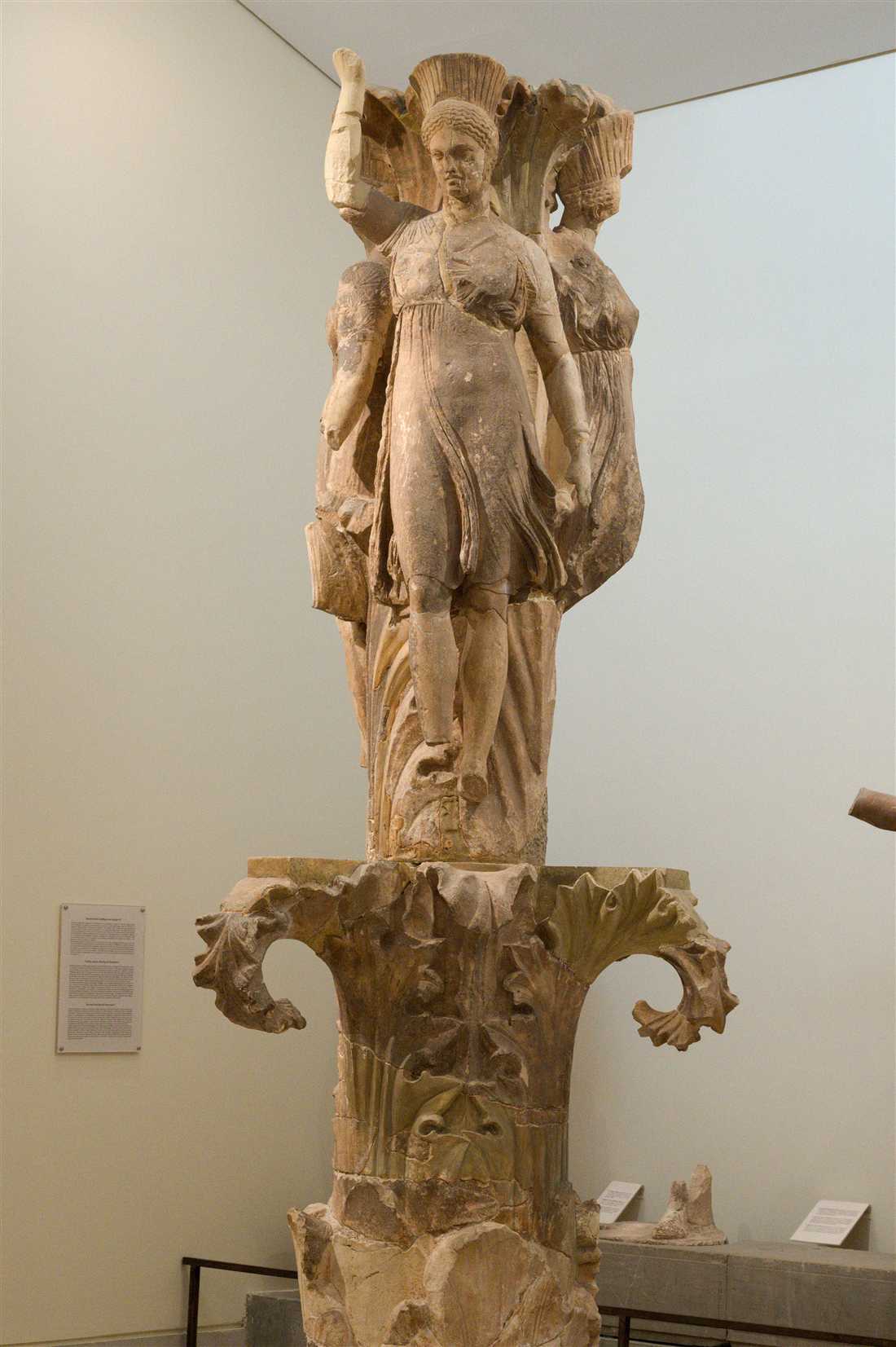
The Dancers of Delphi, also called the Acanthus Column of Dancers, are three marble maidens carved in high relief around the head of a tall votive column set up in the sanctuary of Apollo at Delphi, and now a headline masterpiece of the Delphi Archaeological Museum. Plan the whole trip with Greece Tours.
This guide covers the Dancers of Delphi in full: what the monument is and its three names, the near-thirteen-metre Acanthus Column that carries the figures, who the three dancing women are, the omphalos-stone and bronze tripod that crowned the summit, the Pentelic marble and fourth-century BC date, who dedicated it and why, how it was found and reconstructed, and where it stands among the museum’s greatest works today.
What are the Dancers of Delphi?
The Dancers of Delphi are three marble young women carved in high relief around the top of a tall votive column, sculpted in the fourth century BC and set up in the sanctuary of Apollo at Delphi as one of its finest Classical dedications.
The monument is known by three interchangeable names: the Dancers of Delphi, the Acanthus Column of Dancers, and the Column of the Dancers. Each name points to the same object, a slender free-standing column whose crown blends architecture, botanical ornament, and figure sculpture into a single vertical composition. The three korai stand as the visual climax of the shaft, their bodies emerging from a nest of stone acanthus leaves.
The Dancers rank among the celebrated masterpieces held in the Delphi Archaeological Museum, the collection that gathers the sculpture recovered from the sacred precinct on the slopes of Mount Parnassus. The column belongs to the same artistic milieu that produced the great Delphic bronzes and reliefs, and it demonstrates the ambition of the dedications that lined the Sacred Way toward the Temple of Apollo.
Three qualities define the object and separate it from ordinary votive columns:
- Figural crown \u2014 three dancing women replace a plain capital, turning the column head into sculpture.
- Botanical shaft head \u2014 tiers of acanthus leaves rise from the top of the fluted shaft to frame the figures.
- Sacred cargo \u2014 the summit supported a further element, a stone and bronze crown that raised the whole dedication to nearly thirteen metres.
The Dancers survive because the fragments lay buried in the ruins of the sanctuary until the modern excavation lifted them out and pieced them back together. The reassembled column now stands upright in the museum, restored to its towering height, and it draws visitors alongside the Charioteer of Delphi as a headline exhibit of Classical Greek art. The women read as a frozen instant of ritual movement, arms lifted, drapery swinging, feet on the point of turning.
How tall is the Acanthus Column and how was it built?
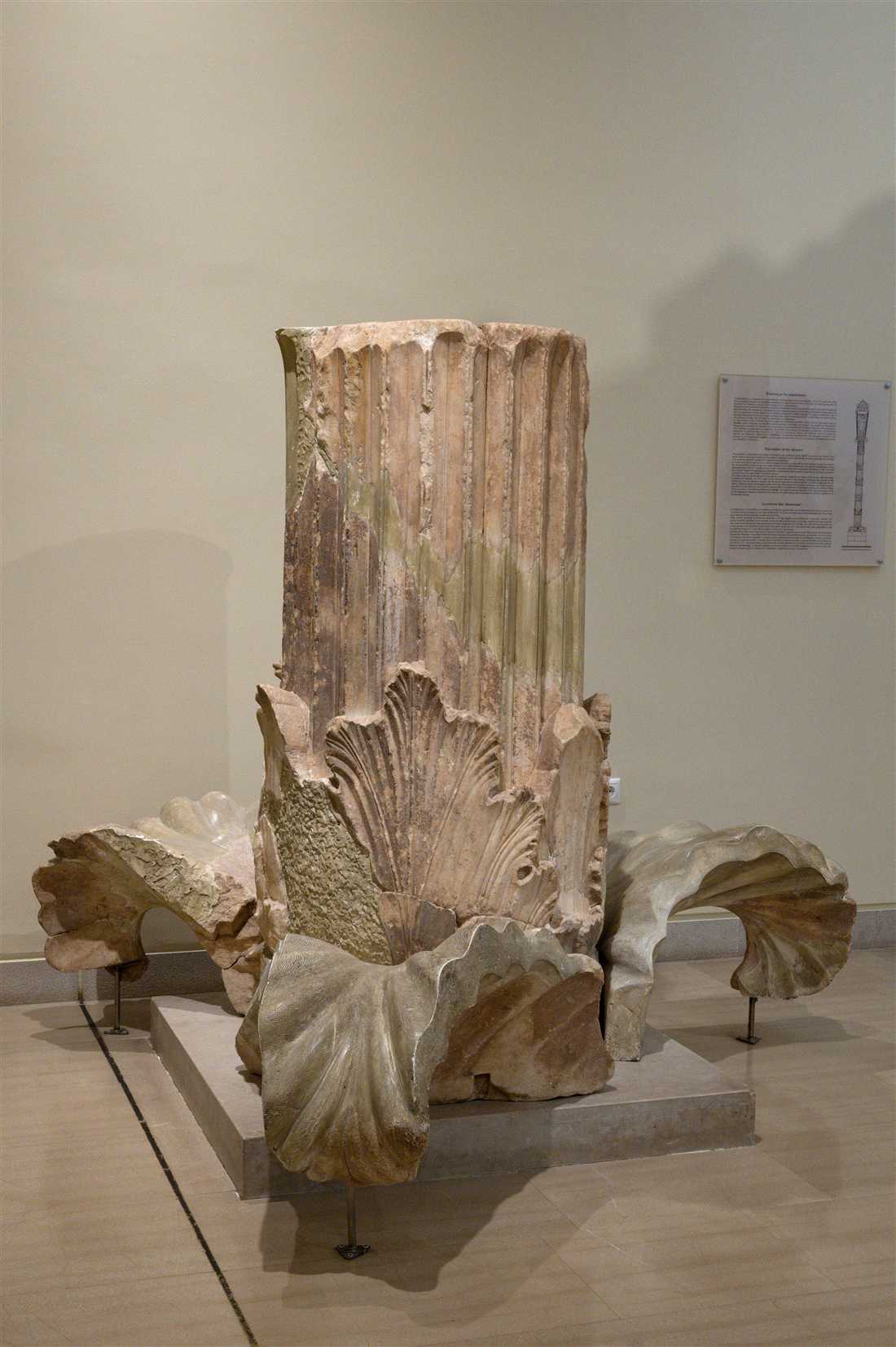
The Acanthus Column rises close to thirteen metres in its full reconstruction, a fluted Pentelic marble shaft whose head opens into three superimposed tiers of carved acanthus leaves, from which the three dancers spring and above which a crowning element once sat.
The structure reads from bottom to top as a deliberate sequence. A stepped base carried the lower drum. Above it climbed the tall fluted shaft, cut in the proportions of a slender free-standing column rather than a building support. Near the summit the plain flutes give way to sculpture: rings of acanthus foliage curl outward in stacked registers, each leaf undercut so that light rakes across the stone and models deep shadow. The three korai grow directly out of this leafwork, their lower bodies wrapped by the topmost acanthus ring.
The engineering of the column answered a single goal, elevation. Delphic dedications competed for height and visibility along the Sacred Way, and a thirteen-metre column lifted its sculpture above the crowd of treasuries, statues, and votive pillars packed into the sanctuary terraces. The dancers stood at eye-catching altitude, legible against the mountain sky.
The proportions and finish mark the column as the product of a first-rank workshop:
- Height \u2014 approximately thirteen metres including base and crowning member.
- Shaft \u2014 a tall fluted drum of Pentelic marble, quarried from Mount Pentelicon near Athens.
- Capital zone \u2014 three tiers of naturalistic acanthus leaves replacing a conventional Doric or Ionic capital.
- Figures \u2014 three korai carved in high relief and near the round, rising from the acanthus.
- Summit \u2014 a stone support that held a bronze crowning object over the dancers’ heads.
The acanthus form links the column to a wider fourth-century BC taste for the plant as an ornamental motif, the same leaf that defines the Corinthian capital. Here the leaf grows to structural scale and becomes the stage for the figures. The result fused the language of architecture with the language of statuary in one upright monument, an approach that set the Dancers apart from the flat votive stelai and simple columns around them.
Who are the three dancing figures on the column?
The three figures are young women, korai, carved in high relief with short belted chitons and low polos headdresses, arms raised and skirts swirling in the middle of a dance; scholars identify them as Thyiades, the female worshippers who danced in the ecstatic cult of Dionysos on Parnassus.
The women stand back to back around the column, so that a viewer walking around the monument meets a fresh figure at each turn. Their bodies twist in controlled motion. One leg bears the weight while the other steps out, hips tilt, and the torsos rotate against the pull of the arms. The sculptor caught the instant when a dancer pivots, the moment before the body completes its turn.
The costume carries precise ritual signals. Each kore wears a short chiton hitched high and belted, cut for movement rather than modesty, its hem lifting to bare the legs mid-stride. The fabric is worked in fine wind-blown folds that stream sideways, recording the speed of the dance in stone. On their heads sit low cylindrical polos crowns, a headdress tied to cult service and to the honouring of a deity.
The reading of the figures rests on their attributes and posture:
- Short chitons \u2014 the abbreviated dancing dress of ritual performers, not everyday street wear.
- Polos headdress \u2014 the cylindrical crown of women in divine service.
- Raised arms \u2014 the lifted, open gesture of the choral dance.
- Swirling drapery \u2014 folds thrown outward by rotation, fixing the tempo of the movement.
The identification as Thyiades, the maenad-dancers of Dionysos, ties the monument to Parnassus itself, the mountain where the god shared the sanctuary with Apollo through the winter months. The Thyiades climbed to the heights to dance in his honour, and the column translates that living rite into permanent marble. Set beside the serene bronze of the Charioteer of Delphi, the dancers show the opposite pole of Classical feeling, stillness against motion, restraint against ecstasy, both mastered by the same period’s sculptors.
What did the Acanthus Column carry at its top?
Above the three dancers the column carried a stone shaped like the omphalos, and on that domed stone rested a great bronze object, read by scholars as a sacred tripod or a metal basket, the crowning dedication that gave the whole monument its religious purpose.
The summit worked as a pedestal for a further offering. Directly over the korai the marble narrowed into a support that held a rounded stone carved in a net-like pattern of interlaced bands, the exact form associated with the sacred navel-stone of the sanctuary. That domed member echoed the famous Omphalos of Delphi, the marker that named Delphi the centre of the earth, so the column tied itself to the deepest myth of the site.
On top of the omphalos-like stone stood the bronze crown of the dedication. The evidence points to a large metalwork object seated on the marble, and reconstructions offer two readings of what it was:
- A bronze tripod \u2014 the three-legged cauldron that served as the signature prize and votive of Apollo at Delphi, echoing the god’s own oracular seat.
- A bronze basket or thymiaterion \u2014 a ceremonial vessel or incense-burner raised aloft to send fragrant smoke over the sanctuary.
Both readings agree on the essentials. The bronze summit turned the column into a raised altar of offering, lifting a gleaming metal object nearly thirteen metres into the Delphic air where pilgrims saw it from across the terraces. The tripod reading strengthens the link to Apollo, whose oracle spoke from a tripod inside the temple. The basket and incense reading strengthens the Dionysian thread carried by the dancers below. The monument fused both gods in one vertical statement, Apolline order at the crown and Dionysian dance at the shaft head.
The layered summit made the column a compressed image of the whole sanctuary: the navel of the earth, the sacred tripod, the ecstatic dancers, and the fragrant offering, all stacked into a single dedication that spoke the language of Delphic cult from base to tip.
What material is the Acanthus Column made of and when was it carved?
The Acanthus Column is carved from Pentelic marble and dates to the fourth century BC, the high Classical to early Late Classical moment, and its finish points to a leading Athenian workshop working at the peak of Greek marble sculpture.
Pentelic marble came from the quarries of Mount Pentelicon in Attica, the same fine white stone that clad the buildings of the Athenian Acropolis. The material weathers to a warm honey tone and holds a razor edge under the chisel, qualities that suited the deep undercutting of the acanthus leaves and the crisp wind-blown folds of the dancers’ chitons. The choice of Attic stone at a Panhellenic sanctuary announced an Athenian hand and Athenian means.
The date rests on style. The proportions of the figures, the wet-drapery folds clinging to and streaming off the bodies, and the naturalism of the acanthus foliage place the work firmly in the fourth century BC. The sculpture carries the confidence of the generation that followed the Parthenon and moved toward the softer surfaces of the Late Classical masters. The carving belongs to the mature phase of Greek marble work, after the Severe style of the Charioteer and long after the archaic stiffness of the Sphinx of Naxos.
The technical signature of the piece includes precise, deliberate features:
- Stone \u2014 Pentelic marble from Attica, the premier white marble of Classical Athens.
- Period \u2014 the fourth century BC, the Classical era at Delphi.
- Surface \u2014 deeply undercut acanthus and thin, flowing drapery cut to catch raking light.
- Workshop \u2014 a first-rank Attic atelier, the standard of the great civic monuments of Athens.
The combination of Attic marble and Attic style dates and locates the makers with confidence. The column stands as a document of the moment when Greek sculptors treated stone as a fluid, living medium, bending marble into the swing of a dance and the curl of a leaf, and it holds its place among the finest fourth-century BC works to survive from any Greek sanctuary.
Who dedicated the Dancers of Delphi and why?
The Dancers of Delphi stood as a votive offering set up in the sanctuary of Apollo, and the Attic marble and Athenian style tie the dedication to Athens; the column honoured the gods of Delphi and advertised the piety and standing of the dedicator before the whole Greek world.
Delphi drew offerings from across the Greek world because its oracle spoke for Apollo and its sanctuary served as neutral Panhellenic ground. Cities and powerful individuals lined the Sacred Way with treasuries, statues, and columns, each dedication a public statement of devotion and prestige. A monument of the Dancers’ scale and quality belonged to a wealthy dedicator with the resources to commission a first-rank Attic workshop and quarry Pentelic marble for a foreign shrine.
The subject matter fixed the meaning of the gift. By crowning the column with the three Thyiades, the Dancers honoured the Dionysian cult that shared Parnassus with Apollo, while the tripod or basket at the summit saluted Apollo himself. The dedication spoke to both resident gods at once and rooted itself in the local ritual calendar of the mountain.
The offering served the standard purposes of a great Delphic votive:
- Devotion \u2014 a permanent act of worship to the gods of the sanctuary.
- Thanksgiving \u2014 a gift rendered for favour granted or victory won.
- Display \u2014 a monument that broadcast the wealth, taste, and standing of the dedicator.
- Memory \u2014 a marker that fixed the giver’s name in the most visited sacred space in Greece.
The Athenian character of the stone and carving reinforces the reading of an Attic dedication, planted in a Panhellenic sanctuary where every city read the message. The column joined the crowded processional route that climbed toward the temple, and it competed for the eye of every pilgrim who walked up to consult the oracle. Its height, its gleaming bronze crown, and its dancing women made it one of the most arresting statements of faith and prestige on the whole approach to the Temple of Apollo.
How were the Dancers of Delphi found and reconstructed?
The Dancers of Delphi came to light in fragments during the modern excavation of the sanctuary, when archaeologists cleared the ruins near the Sacred Way and recovered the broken drums, the acanthus leaves, and the three korai, then reassembled the pieces and raised the column to its full height for the museum.
The great dig that stripped the sanctuary down to its ancient level uncovered the buried monuments of Delphi one terrace at a time. The village that had grown over the ruins was moved, and the systematic excavation of the sacred precinct brought thousands of sculpture fragments out of the earth. The Acanthus Column lay among them, collapsed and scattered, its pieces mixed into the debris that had filled the sanctuary after antiquity.
Recovery and reassembly proceeded in stages:
- Discovery \u2014 the broken column members surfaced in the cleared ruins near the sanctuary of Apollo.
- Identification \u2014 the acanthus drums, the shaft sections, and the three korai read as parts of one original monument.
- Joining \u2014 the fragments went back together, drum on drum, restoring the sequence from base to figured crown.
- Erection \u2014 the reassembled column rose upright to its full near-thirteen-metre height for display.
The dancers themselves survived in a state that preserved their posture and costume, so the twist of the bodies, the swing of the short chitons, and the low polos crowns read clearly on the restored figures. The acanthus tiers rejoined beneath them, and the shaft carried the whole composition back to its towering scale. The crowning stone and its bronze object did not survive intact, so the summit is understood from the surviving support and from comparison with Delphic tripod dedications rather than from a preserved bronze.
The reconstruction turned a heap of broken marble into one of the tallest and most complete sculptural monuments recovered from Delphi. The restored column now demonstrates the full ambition of the original, height, botanical ornament, and living figures combined, and it stands as a model of how the excavation rescued the masterpieces of the sanctuary from the rubble of the abandoned site and returned them to view.
Where are the Dancers of Delphi displayed today, and how do they compare with Delphi’s other masterpieces?
The Dancers of Delphi stand in the Delphi Archaeological Museum, raised to full height in a dedicated gallery, and they belong to the same elite group as the Charioteer of Delphi, the Sphinx of Naxos, and the Siphnian Treasury frieze, the sculptures that make the museum a first-rank collection of Greek art.
The reassembled column occupies a prominent position in the museum’s display, tall enough to command its own space and lit to bring out the deep undercutting of the acanthus and the flowing folds of the dancers’ chitons. Visitors walk around the base and look up into the whirl of the three korai, reading the monument as its ancient audience read it, from below and in the round. The Delphi Archaeological Museum presents the column as a headline exhibit of the sanctuary’s Classical dedications.
Placed against the museum’s other stars, the Dancers hold a distinct position in the sweep of Greek sculptural history:
- The Sphinx of Naxos \u2014 an Archaic guardian on its own tall column, the older ancestor of the figured-column form the Dancers perfected.
- The Charioteer of Delphi \u2014 the Severe-style bronze of stillness and restraint, the counterweight to the Dancers’ ecstatic motion.
- The Siphnian Treasury frieze \u2014 the Archaic narrative relief of gods and battle, the museum’s benchmark of storytelling in marble.
- The Dancers of Delphi \u2014 the fourth-century BC fusion of architecture, acanthus, and dance, the tallest figured column in the collection.
Together these works trace the arc of Greek art from the Archaic rigidity of the Sphinx, through the Severe balance of the Charioteer, to the fluid Classical naturalism of the Dancers, all recovered from one sanctuary and gathered under one roof. The column earns its place among them by scale, by the daring of its design, and by the way it turns cold marble into the living swirl of a Parnassian dance. A visit to the museum sets the Dancers directly against the Charioteer and the Sphinx, and the three define the range of what Greek sculptors achieved in stone and bronze at Delphi.
Frequently Asked Questions
What are the Dancers of Delphi?
The Dancers of Delphi are three young women carved in high relief around the top of a tall votive column, the Acanthus Column, set up in the sanctuary of Apollo at Delphi in the fourth century BC and displayed today in the Delphi Archaeological Museum.
How tall is the Acanthus Column of the Dancers?
The reconstructed column rises close to thirteen metres, a fluted Pentelic marble shaft whose head opens into tiers of carved acanthus leaves from which the three dancers spring, topped by a stone that once carried a bronze crowning object.
Where are the Dancers of Delphi displayed?
The Dancers stand raised to full height in the Delphi Archaeological Museum, in the same first-rank company as the bronze Charioteer of Delphi, the Sphinx of Naxos and the Siphnian Treasury frieze.