
Best Time to Visit Delphi
The best time to visit Delphi is spring, from April to early June, and autumn, from mid-September through October, when the mountain air stays mild, the light runs clear across the Pleistos valley, and the Athens coaches thin out on the Sacred Way. These two windows sit between the shadeless heat of high summer and the cold, wet, short days of the Parnassus winter. Plan the whole trip with Greece Tours.
This guide sets out the best time to visit Delphi season by season and month by month: the weather at 600 metres on Mount Parnassus, the crowd pattern through the day and the year, the best hour to reach the gate, the festivals that fill the villages, and the opening hours, packing and seasonal pairings that turn a trip into the site at its quietest and clearest. Each season carries its own reward, from the wildflowers of April to the snow line of January, and the sections below weigh every one against the crowds, the heat, the light and the price of a room.
When is the overall best time to visit Delphi?
The best time to visit Delphi is spring, from April to early June, and autumn, from mid-September through October. These two windows deliver mild days between 18°C and 26°C, clear air across the Pleistos valley, thinner crowds on the Sacred Way, and full opening hours at the site.
Summer pins the archaeological site under direct sun with July and August highs of 32°C to 38°C, and the hillside terraces of the Delphi sanctuary hold no shade between the Temple of Apollo and the stadium at the top. Coaches from Athens arrive in dense sequence from mid-morning, and the climb from the entrance to the theatre turns strenuous once the stone underfoot radiates heat. Winter reverses the problem: January and February daytime figures sit between 6°C and 12°C, rain closes in on Mount Parnassus, and low cloud erases the long view down to the Gulf of Corinth.
Spring and autumn sit between those extremes. In April, May, early June, mid-September and October the temperature range supports the steep walk, the sky stays clear for photographs of the Tholos of Athena Pronaia, and the visitor numbers drop far below the July peak. Ticket queues at the gate move fast, and the Charioteer of Delphi in the museum draws steady rather than packed rooms.
Timing a visit within these windows also matches the site’s operating calendar. Full daily hours run through spring and autumn, so a morning at the sanctuary and an afternoon in the museum fit one day. Booking a Delphi entry ticket in advance removes the wait at the gate and puts you on the Sacred Way at opening, when the terraces are quiet and the light strikes the Temple of Apollo from the east.
What is Delphi like in spring (March to May)?
Spring turns the slopes of Mount Parnassus green, spreads wildflowers across the Pleistos valley, and fills the ravine with snowmelt. Days warm from 15°C in March to 24°C in May, the steep site walk stays comfortable, and full opening hours return after winter.
March opens the season with cool mornings near 8°C and afternoons around 15°C, and the higher ridges of Parnassus still carry snow. By April the daytime range settles between 16°C and 22°C, the Pleistos gorge runs full with meltwater below the sanctuary, and the terraces between the Athenian Treasury and the theatre dry out for firm footing. May pushes highs to 24°C, extends daylight into the early evening, and brings the greenest slopes of the year across the amphitheatre of hills that frames the site.
Spring conditions favour the sanctuary in specific ways:
- Wildflowers cover the ground from the Castalian Spring up to the stadium, with poppies and anemones along the Sacred Way.
- Snowmelt feeds the Pleistos, so the valley floor of olive groves reads deep green from the Temple of Apollo.
- Mild daytime figures between 16°C and 24°C keep the climb to the theatre and stadium manageable.
- Clear post-rain air opens the long sightline down to Itea and the Gulf of Corinth.
Orthodox Easter falls within this window and draws Greek families to Delphi and nearby Arachova, so the days around it fill the car parks and the museum halls. Outside that period spring crowds stay light. Full opening hours resume across the season, which restores the late-afternoon access that winter cuts short, and a spring visitor walks the whole route from the entrance to the stadium and back with daylight to spare in the museum.
Why are the shoulder seasons the best for the archaeological site?
The shoulder seasons suit the exposed hillside because temperatures between 18°C and 26°C make the open climb comfortable, the clear air opens the view to the Gulf of Corinth, fewer Athens coaches reach the gate, and the sanctuary stands quiet at opening.
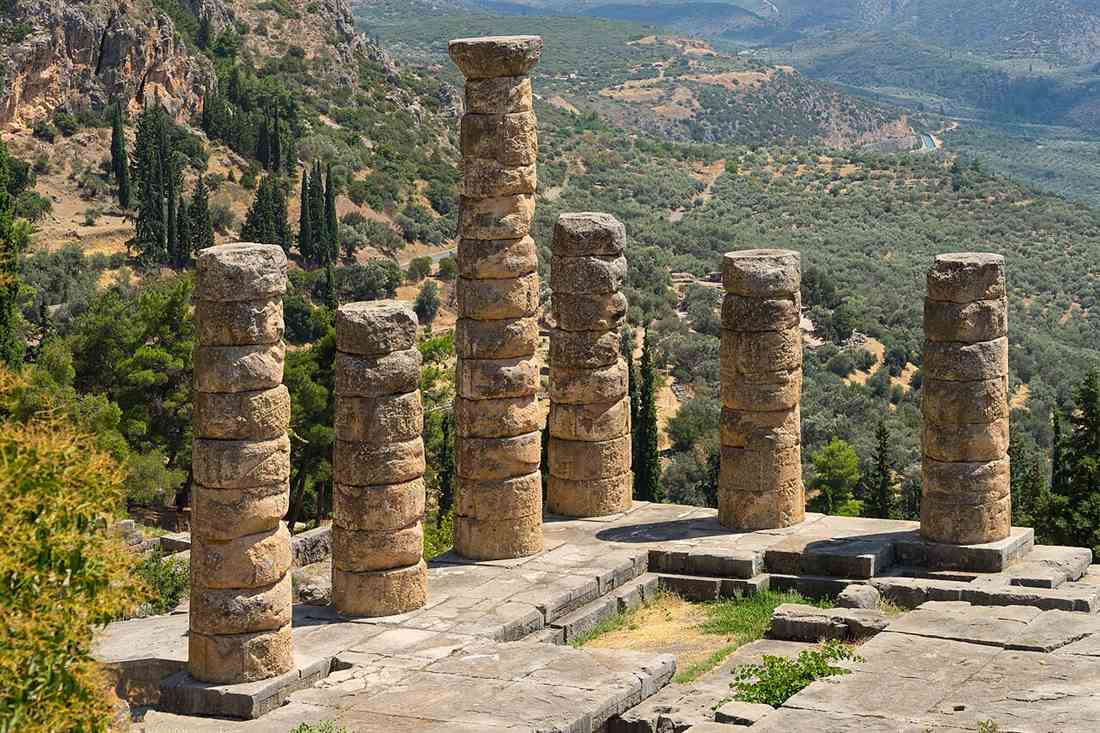
Delphi occupies a steep terrace on the flank of Mount Parnassus, and the path from the entrance rises past the Treasuries, the Temple of Apollo, the theatre and the stadium with no tree cover along its length. In April, May, September and October the daytime range of 18°C to 26°C keeps that ascent within reach, while the July and August figures above 32°C turn the same stone stairs punishing. The rock retains less heat in the shoulder months, so the upper terraces stay walkable through the middle of the day.
Air clarity is the second advantage. Summer haze thickens over the Pleistos valley and blurs the descent toward Itea, but the drier, cleaner air of the shoulder seasons sharpens the sightline from the Temple of Apollo across the olive plain to the Gulf of Corinth. The Tholos of Athena Pronaia below the main site reads crisp against the valley, and the panorama from the stadium at the summit extends to the far shore.
Crowd volume falls sharply outside the summer peak. The day-trip coaches from Athens concentrate in July and August, and in the shoulder months their numbers drop, so the Sacred Way clears and the museum rooms around the Charioteer of Delphi open up. Arriving at opening in these seasons puts you on the terraces before the first coaches climb the mountain road, and the sanctuary holds the quiet that the summer schedule erases by mid-morning.
What is Delphi like in summer (June to August)?
Delphi in summer runs hot and dry across its exposed south-facing slope, with daytime highs near 32C, long daylight from before 6am until after 8pm, the year’s largest crowds, and coach traffic arriving from Athens by mid-morning. The sanctuary climbs an open hillside with little shade, so the sun sits on the stones from the first hours of the day.
The archaeological site opens early, and the first ticket-holders reach the Temple of Apollo before the tour coaches from Athens unload their groups. An arrival at opening time buys a clear hour on the Sacred Way and the theatre before the paths fill. By late morning the terraces carry steady foot traffic, and the stadium at the top of the site bakes under direct sun with no cover on the climb.
Midday heat pushes visitors toward the Delphi Archaeological Museum, where the cool interior holds the Charioteer, the Sphinx of Naxos, and the twin kouroi. The museum works as a refuge through the hottest hours, and a visit timed for early afternoon pairs the shaded galleries with the peak of the outdoor heat. Water, a hat, and closed shoes for the uneven marble carry a summer visitor through the exposed sections.
Evenings cool as the sun drops behind the gorge, and the light turns gold across the valley of olive trees running down to the Gulf of Corinth. The village of Delphi and neighbouring Arachova stay busy with visitors who base overnight and start the site at dawn. Anyone extending the trip toward the summit ridge of Mount Parnassus finds thinner air and lower temperatures a short drive above the ruins.
What is Delphi like in autumn (September to November)?
Delphi in autumn opens warm in September, near 28C, then cools into mild days through October and November, with clear light over the valley, the grape and olive harvest under way below the site, thinning crowds after the summer peak, and the first rains late in the season. The heat breaks while the daylight stays generous.
September holds summer warmth without its intensity, and the coach numbers drop once the school term restarts across Europe. The Sacred Way and the theatre carry fewer groups, so the site reads more openly, and the walk to the stadium loses the midday furnace of high summer. Photographers gain clean air and low, angled light that sharpens the Temple of Apollo against the twin Phaedriades cliffs.
The valley below fills with work through the season. Autumn at Delphi lines up with several harvests and shifts in the landscape:
- Grape picking across the vineyards toward Amfissa and the Gulf of Corinth in early autumn.
- The olive harvest starting in the vast grove on the plain beneath the sanctuary.
- Turning leaves on the plane trees along the Castalian Spring and the ravine.
- First rains arriving late in November, greening the slope after the dry months.
October delivers mild afternoons and cool mornings, a comfortable pairing for the climb through the site and the galleries of the museum in one visit. November brings the season’s first sustained rain, and cloud gathers on the peaks above, though breaks in the weather open crisp, far-reaching views down to the sea. The full Delphi circuit, sanctuary and museum together, fits an autumn day with daylight to spare.
What is Delphi like in winter (December to February)?
Delphi in winter runs cold, with daytime highs near 10C, snow on the peaks of Mount Parnassus and a running ski season at Arachova, shorter site opening hours, the year’s quietest crowds, free-admission winter Sundays, and crisp long views on clear days. The mountain setting turns alpine above the ruins.
Snow settles on the Parnassus ridge through the season, and the ski centre above Arachova draws weekend traffic to the region while the archaeological site itself stays calm. The village of Arachova, minutes from Delphi, fills with a winter crowd for the slopes, so the two destinations pair a mountain-sports base with a near-empty ancient sanctuary a short drive away. Cold air sharpens the views across the gorge toward the Gulf of Corinth.
The site keeps shorter winter opening hours than the long summer schedule, so a winter visit starts earlier in the day to use the available light. On free-admission Sundays in the winter months, entry to the archaeological site and museum costs nothing, a fixed policy that rewards an off-season trip. Frost lingers on the shaded marble of the Sacred Way in the early hours, and closed footwear with a grip handles the cold stone.
Crowds thin to their lowest point of the year, and stretches of the Sacred Way, the theatre, and the stadium stand empty for long spells. Clear winter days deliver the cleanest air of the calendar, and the view runs from the snow line on Parnassus down through the olive plain to the water. Rain and snow close in on unsettled days, so a winter itinerary keeps the museum ready as an indoor anchor when the weather sits on the slope.
What is the weather like at Delphi through the year?
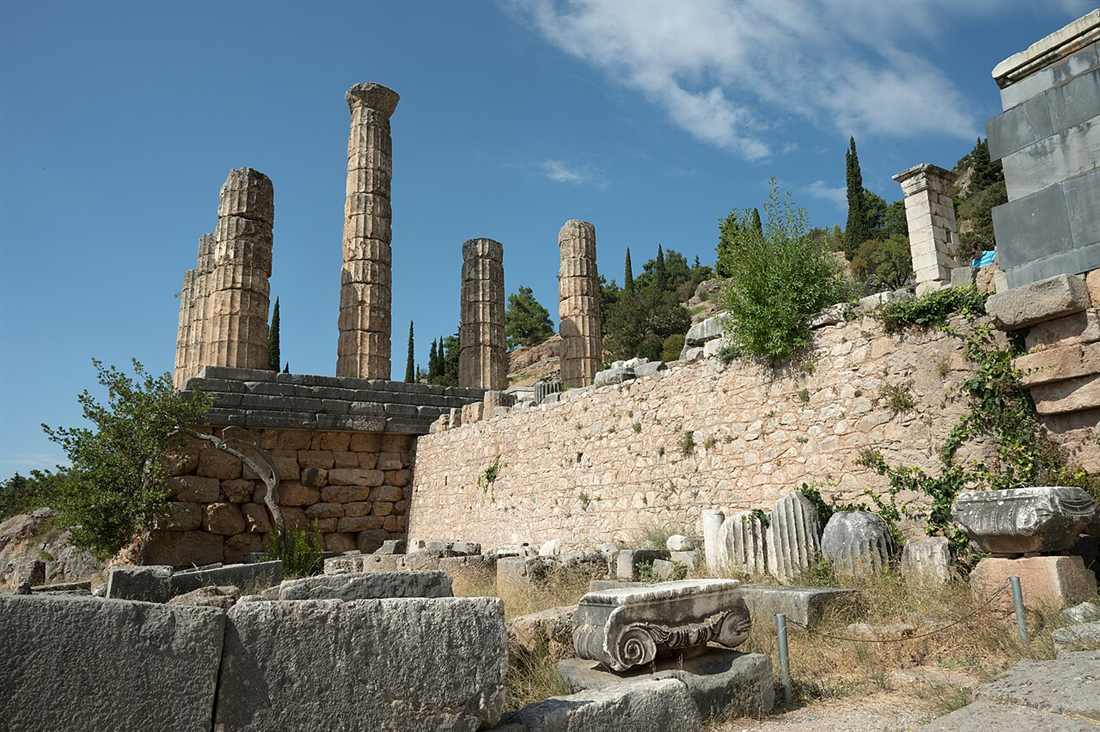
Delphi sits at about 600 metres on the slopes of Mount Parnassus, giving it a mountain-Mediterranean climate: hot dry summers, cold winters with snow on the high peaks, and mild springs and autumns. Evenings stay cool year-round at altitude, and rainfall concentrates in the winter months.
The elevation is the defining fact of the climate. Athens, two and a half hours away on the coast, runs several degrees warmer at the same hour, and the difference widens at night. At the archaeological site the terraces climb from roughly 550 to 700 metres, so a visitor gains altitude on the walk up the Sacred Way, and the air thins and cools with every level. Wind funnels down from the twin peaks of the Phaedriades and along the ravine of the Pleistos, so a still morning in the valley turns breezy on the upper terraces by midday.
Summer delivers hot, dry, cloudless days. July and August afternoons push into the mid-thirties Celsius on the exposed stone, and the site offers little shade between the Temple of Apollo and the stadium. The dry air keeps humidity low, so the heat is sharp rather than heavy, and it drops fast once the sun falls behind Parnassus. Winter reverses the picture: the peaks above the village carry snow from December into March, day temperatures sit in the single digits, and the ski centre on Parnassus draws its own crowd to the mountain. The shoulder seasons hold the balance, with warm days, cold mornings, and the greatest chance of a clear view over the olive plain to the Gulf of Corinth.
- Summer (June to August): daytime 30 to 36 Celsius, night 18 to 22 Celsius, near-zero rainfall.
- Autumn (September to November): daytime 15 to 27 Celsius, night 8 to 15 Celsius, rain returning in November.
- Winter (December to February): daytime 6 to 12 Celsius, night 0 to 4 Celsius, snow on the peaks, the wettest stretch.
- Spring (March to May): daytime 12 to 24 Celsius, night 4 to 12 Celsius, wildflowers across the slopes.
Rain falls almost entirely between November and March, when Atlantic systems reach the mountain and drop their moisture on the windward slopes. The summer stretch from June through August passes with scarcely a shower, which is why the grass around the ancient sanctuary of Delphi browns to gold by July. A visitor plans for cool evenings in every season and carries a layer even in high summer, because the temperature at 600 metres falls quickly after dark.
When is Delphi least crowded, and when is it busiest?
Delphi is quietest in winter and on shoulder-season mornings, and busiest in July and August, when Athens day-trip coaches, cruise excursions, and the Easter surge converge. The coaches arrive mid-morning and thin out by late afternoon, and free-admission Sundays draw their own crowds to the terraces.
The daily rhythm governs the crowd more than the calendar does. Most visitors reach Delphi on organised coaches from Athens, and those coaches follow a fixed pattern: they leave the capital after breakfast, cover the road through Livadeia and Arachova, and empty their passengers onto the Sacred Way between ten and noon. For that window the upper terraces and the Temple of Apollo carry the densest foot traffic of the day. The same buses reload in the early afternoon for the return leg, so the site quiets sharply after three o’clock even at the height of summer.
Seasonally, July and August stack the highest numbers. Peak-summer holiday travel, cruise passengers bussed up from the ports on the Gulf of Corinth, and international tour groups all overlap in those weeks, and the narrow paths between monuments hold the pressure. Greek Orthodox Easter produces a second surge as Athenian families travel over the long weekend and fill the village and the site. Winter empties the terraces almost entirely: cold mornings, snow on the peaks, and fewer coaches leave whole sections of the sanctuary to a handful of visitors at a time.
Free-admission days add a predictable spike. The site opens without charge on the first Sunday of the winter months and on several national dates, and those Sundays pull local visitors and budget travellers in numbers that rival a summer coach morning. A visitor who wants the terraces uncrowded avoids the free Sundays and the midday coach window together, and reaches the gate either at opening or in the last hours before closing.
What is the best time of day to visit Delphi?
The best time is at opening, for the quiet first hour and the cool climb before the coaches arrive, with the morning light raking across the terraces. The museum suits the midday heat, and the late afternoon after the coaches leave returns the site to near-silence, with sunset over the olive plain from the village.
Arriving at opening delivers the single greatest advantage. The gate opens in the early morning, and for that first hour the Sacred Way belongs to the earliest walkers. The air is cool, the climb from the Roman agora to the Temple of Apollo and on to the theatre and stadium goes easily before the sun clears the Phaedriades, and the low eastern light rakes across the polygonal wall and the treasury foundations, throwing the carved stone into relief. This is the hour for photographs and for standing at the temple without a queue behind the columns.
The midday heat is the museum’s hour. When the sun stands high and the terraces bake, the Archaeological Museum of Delphi holds its treasures in cool, shaded halls: the bronze Charioteer, the twin kouroi, the Sphinx of Naxos, and the frieze of the Siphnian Treasury. A visitor times the outdoor site for the cool ends of the day and moves indoors while the stone is hottest, which keeps the whole visit comfortable through summer.
Late afternoon returns the quiet. Once the coaches reload and pull away for Athens, the site empties, the light softens and turns gold on the Temple of Apollo, and the last hours before closing rival the opening hour for calm. After the gate closes, the village above the ruins offers the day’s final scene: the sun drops behind the ridge and colour spreads across the vast olive plain of Amfissa toward the Gulf of Corinth. The tavernas and terraces of Delphi village frame that sunset, and a visitor who stays the night watches it without the pressure of a coach schedule.
How long is Delphi open through the year, and how does daylight change by season?
The archaeological site and museum keep long summer hours, opening in the early morning and closing in the early evening, and short winter hours that close in the early afternoon; the shoulder seasons sit between. Daylight stretches from about nine and a half hours at midwinter to over fourteen and a half hours at midsummer.
The opening hours track the sun. Through the summer stretch the gate opens early and stays open until the early evening, which gives a visitor a long window on the terraces and time for the museum in the same day. Winter reverses that span: the site opens later, closes in the early afternoon, and the museum keeps the same short frame, so the two halves of Delphi compete for a few hours rather than filling a full day. Spring and autumn hold the middle position, with the gate open from morning until the late afternoon and the light lasting past the closing bell. The current opening times and the free-admission dates sit on the official ticketing page for the site, so a visitor checks the Delphi ticket and opening hours before setting out.
Daylight widens and narrows with the season, and at 600 metres on Parnassus the change is sharp. Around the winter solstice the sun clears the Phaedriades late and drops behind the ridge in the middle of the afternoon, leaving roughly nine and a half hours of usable light and a site that closes before the day is spent. Around the summer solstice the same slopes hold light for over fourteen and a half hours, the sun rises well before the gate and sets long after it shuts, and the terraces stay bright into the evening. The shoulder months pass through the balance points near the equinoxes, with close to twelve hours of daylight and the sun climbing at a lower angle that rakes the polygonal wall and the treasury foundations.
The season’s light and hours decide how much of the site and museum fit in one visit. In summer the long day carries the outdoor terraces, the climb to the theatre and stadium, and the cool halls of the museum without pressure, and the extra evening light frees the middle of the day for the shaded galleries. In winter the short afternoon forces a choice of order: the outdoor sanctuary first while the light lasts, the museum second before it closes. A visitor who arrives at opening in every season gains the widest margin, the coolest air on the climb, and the low morning light across the stone of the ancient sanctuary of Delphi before the first coaches reach the Sacred Way.
What do you pack for Delphi in each season?
Delphi packs differently by season: summer demands sun protection, water, and grippy closed shoes for the loose marble; winter demands warm layers, a waterproof, and lugged soles for wet stone and snow; spring and autumn take light layers for cool mornings and warm afternoons. A warm layer travels year-round for the cool evenings at 600 metres.
Summer packing answers the shadeless slope. The terraces climb from the Roman agora to the stadium with almost no cover between the monuments, the marble underfoot is worn smooth and turns slick under a smooth sole, and the exposed stone throws back heat through the afternoon. A hat, high-factor sun protection, and at least a litre of water per person cover the exposure, and closed shoes with a grippy tread hold the polished steps and the loose scree of the upper paths.
Winter and the transition seasons change the list. In winter the peaks above the village carry snow, the stone runs wet from the frequent rain, and the day temperature sits in the single digits, so warm layers, a waterproof shell, and boots with lugged soles carry the visit across cold, slick terraces. Spring and autumn deliver cold mornings and warm afternoons in a single day, so light layers that come on and off match the swing. The altitude sets one constant across all four seasons: the air at 600 metres cools fast once the sun falls behind Parnassus, and a warm layer earns its place in the bag even in high summer.
- Summer (June to August): a hat, high-factor sun protection, at least a litre of water per person for the shadeless slope, and closed grippy shoes for the loose marble.
- Winter (December to February): warm layers, a waterproof shell, and lugged soles for wet stone and possible snow.
- Spring and autumn (March to May, September to November): light layers for cool mornings and warm afternoons, plus a compact waterproof for the rain that returns in November.
- Year-round: one warm layer for the cool evenings at 600 metres, whatever the season.
The pack list follows the visit rather than the calendar alone. A visitor who reaches the gate at opening in summer carries the water and the hat for the climb before the sun clears the ridge; a visitor who arrives on a winter afternoon carries the waterproof and the boots for the wet marble and the early close. Across every season the closed grippy shoe stays on the list, because the polished stone of the Sacred Way and the terraces holds the same risk in July heat and January rain, and the warm layer stays on the list for the moment the light drops behind Parnassus and the temperature falls with it.
What events and festivals happen around Delphi through the year?
Delphi runs on a layered calendar: the European Cultural Centre of Delphi stages conferences and revival performances, the village keeps Orthodox Easter and its August saint’s-day panigyri, and nearby Arachova adds its winter Panagia festival and the Parnassus ski season.
The European Cultural Centre of Delphi, founded on the town’s eastern edge, hosts symposia, ancient-drama workshops and youth theatre meetings. Its open-air and indoor programmes cluster in late spring and summer, when scholars and performers arrive to stage readings of Aeschylus and Sophocles on terraces that face the same gulf the ancient theatre did. These events fill guesthouses in the village midweek, a pattern absent from the pure archaeological visit.
The Centre revives a tradition that started with the interwar Delphic Festivals, when Angelos Sikelianos and Eva Palmer staged Prometheus Bound in the ancient stadium with a chorus in woven costume. Modern ancient-drama meetings and the International Meeting on Ancient Greek Drama carry that thread, so a summer visit lines up with performances, lectures and student productions that turn the archaeological setting into a working stage rather than a museum piece.
Easter reorganises the whole region. Delphi village holds the Good Friday Epitaphios procession and the Saturday-midnight Resurrection service, and the tavernas turn to spit-roast lamb through Easter Sunday. On 8 September the village and its churches mark the nativity of the Virgin with a panigyri of food, music and dancing that draws returning families. These dates move tables outdoors and keep kitchens open past the normal off-season hours.
Arachova, ten minutes east, anchors the winter half of the calendar. Its Panagia festival on 23–26 August fills the stone streets with klarino music, costume parades and communal feasting, and from December to March the town becomes the base for the Parnassos ski centre at Kelaria and Fterolakka. Snow weekends pack Arachova’s hotels and restaurants, so a Delphi trip in deep winter carries a lively après-ski town beside the quiet ancient site.
The festival dates set the pattern for room availability. Easter week, the 8 September panigyri and the 23–26 August Arachova celebration each pull returning families and pilgrims into the villages, and guesthouses in Delphi and Arachova fill weeks ahead of those weekends. Booking around the ski-season Fridays and the August festival avoids the tightest beds, while the weeks between them leave the villages open and the tavernas working at ordinary pace.
When is the best time to combine Delphi with the mountain or a wider tour?
Match the pairing to the season: winter for the Parnassos ski centre and snow above Arachova, spring and summer for hiking the Corycian Cave trails, and autumn for the grape harvest and sharp views over the Corinthian Gulf and its olive plain.
In winter the mountain leads. The Parnassos ski centre opens its runs above 1,600 metres from December, and a Delphi day pairs a snow-dusted archaeological site with an afternoon in Arachova’s woollen shops and grill houses. Drivers on the road up to the slopes cross the alpine meadows of Mount Parnassus, where the ancient path toward the Corycian Cave begins near the same treeline the skiers use.
Spring and summer turn the same slopes into walking country. The trail from Delphi climbs past the Sanctuary of Athena and the stadium onto the Livadi plateau and reaches the Corycian Cave, once sacred to Pan and the nymphs, at around 1,300 metres. Wildflowers and running springs mark the spring route; dry, firm ground and long daylight mark the summer one. Walkers pause at the Castalian Spring in the ravine below before starting up.
Autumn favours the wider loop. The grape and olive harvest fills the Amfissa plain below with activity, the air clears after the summer haze, and the gulf views from the sanctuary sharpen. A two- or three-day itinerary threads Delphi with the monasteries of Meteora to the north, the mountain town of Arachova beside it, and the seaside road along the Corinthian Gulf toward Galaxidi and Nafpaktos.
The Corinthian Gulf pairing works across three of the four seasons. From Delphi the road drops through Chrisso to the port of Itea and the fishing harbour of Galaxidi, where the sea-captains’ mansions face the water and the fish tavernas open onto the quay. Spring, summer and autumn all carry warm-enough afternoons for a swim or a long lunch there, so a morning at the sanctuary rolls into a coastal second half without a change of base.
Each pairing keys to a distinct interest:
- Winter: Delphi plus the Parnassos ski centre and Arachova’s stone-village nightlife.
- Spring: Delphi plus the wildflower hike to the Corycian Cave and the Castalian ravine.
- Summer: Delphi plus early-morning trails and an afternoon swim along the Corinthian Gulf.
- Autumn: Delphi plus the Meteora monasteries and the harvest of the Amfissa olive plain.
What is the worst time to visit Delphi, and how do you avoid it?
The hardest window is midday in high summer, when the shadeless slope bakes and cruise coaches from Itea peak in late morning; wet winter days that turn the marble slick run a close second. An early start, the shoulder seasons and grippy shoes clear all three.
The archaeological site climbs an open hillside with almost no shade along the Sacred Way, the theatre or the stadium. In July and August the surface temperature on the terraces passes 35°C by early afternoon, and the climb to the stadium at the top of the site leaves visitors exposed the whole way. Entering at opening time, before the sun clears the ridge, keeps the ascent in shade and finishes the stadium before the heat builds.
Coach and cruise pressure follows a daily rhythm. Ships docking at Itea on the gulf send excursion buses up the switchbacks, and organised Athens day trips arrive together, so the Sacred Way clogs between roughly 11:00 and 14:00. Arriving at the 08:00 opening, or in the last two hours before closing, drops the visitor ahead of or behind that wave and opens the theatre and museum for unhurried viewing.
The single-ticket queue at the gate stretches through the same late-morning band. Buying the combined site-and-museum ticket online in advance, or arriving before the first coaches, skips the wait entirely. Groups on guided tours cluster at the Treasury of the Athenians and the Temple of Apollo, so climbing straight to the theatre and stadium first and working back downhill puts the crowded monuments in the visitor’s path after the coaches have moved on.
Winter brings the opposite hazard. Rain and the meltwater running off Parnassus glaze the polished marble thresholds and the worn limestone of the Sacred Way, and the steep pitch above the temple turns treacherous when wet. Grippy, closed shoes with a lugged sole handle the slick stone, and timing the visit to a dry morning after a storm passes keeps the footing sound.
Fog and low cloud add a second winter obstacle at altitude. The sanctuary sits on the flank of Parnassus, and cloud settling on the ridge erases the gulf panorama that ranks among the site’s rewards. Checking the mountain forecast the night before and reserving the clearer of two mornings preserves the view down the ravine to the sea of olives and the Corinthian Gulf beyond.
The museum doubles as a heat and weather refuge. When the afternoon sun bakes the terraces or a winter squall crosses the ravine, the air-conditioned halls holding the Charioteer, the Sphinx of Naxos and the twin kouroi absorb an hour comfortably. Timing the indoor collection for the hottest or wettest stretch of the day and the outdoor sanctuary for the cool, dry hours splits the visit to match the conditions.
Across the year the fix repeats: reach the gate early, favour the April–June and September–October shoulder seasons over the July–August peak, carry water and a hat on the shadeless slope, and wear soles that grip. Those four habits turn the site’s worst hours into its emptiest, coolest and safest ones.
Frequently Asked Questions
What is the single best month to visit Delphi?
May and October rank as the two best months. Both deliver daytime temperatures between 18 and 25 degrees for the exposed climb, clear air for the long view to the Gulf of Corinth, and crowd levels well below the July and August peak, with full daily opening hours.
Is Delphi worth visiting in winter?
Winter suits a visitor who wants the terraces almost empty, the cleanest air of the year on clear days, snow on the peaks, and free-admission Sundays. The trade is short opening hours, cold single-digit days, and the risk of rain and fog on the ridge.
How many hours do you need at Delphi?
A full visit runs three to four hours: about two hours on the archaeological site to climb from the entrance past the Temple of Apollo to the theatre and stadium, and one to two hours in the museum for the Charioteer, the Sphinx of Naxos and the treasury sculpture.