
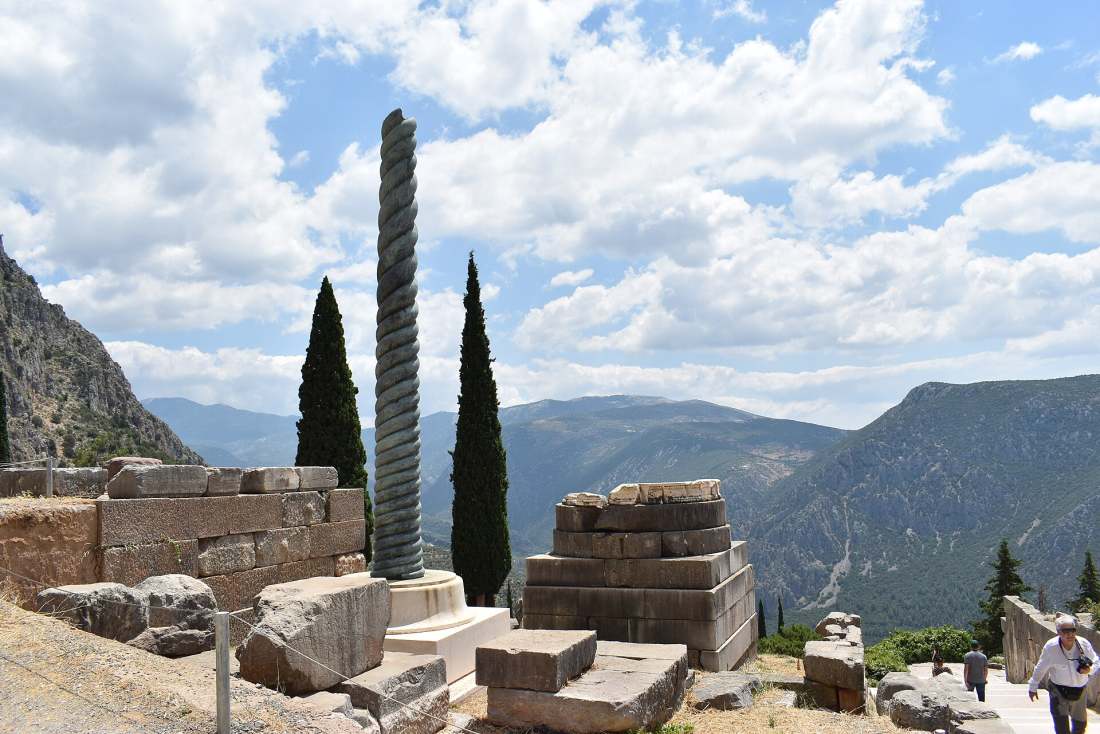
Delphi lies about 180 kilometres northwest of Athens on the slopes of Mount Parnassus, and this guide covers every way to get there: the drive and the route, the KTEL intercity bus, guided day tours, private transfers, and whether a train reaches the site. It also compares the cost of each option, explains how to reach Delphi from Meteora, Nafplio and the airport, sets out how to get around once you arrive, and clears up the common mistakes travellers make on the journey.
The trip takes roughly three hours each way, through Thebes and Livadeia and up the mountain past Arachova. Whichever way you travel, an early start gives the fullest day at the sanctuary. You can also reach Delphi with a licensed guide through My Greece Tours.
How far is Delphi from Athens and how long does the journey take?
Delphi sits about 180 kilometres northwest of Athens, and the journey takes two and a half to three hours by car. The route runs through Thebes and Livadeia across the Boeotian plain, then climbs the slopes of Mount Parnassus through Arachova to the site.
The drive divides into two distinct stages. The first stage covers roughly 130 kilometres of fast national road and secondary highway across flat farmland, from the northern edge of Athens to the town of Livadeia. A car covers this stage in about ninety minutes at a steady pace, passing the turn-offs for Thebes and the fields of Boeotia along the way.
The second stage is the mountain climb. From Livadeia the road gains altitude for the final 45 kilometres, curving up through the Schiste crossroads and the stone village of Arachova at 950 metres before dropping onto the terrace where Delphi overlooks the Pleistos valley. This section runs slower than the plain because of the bends and the gradient, and it adds forty to fifty minutes to the total.
Travellers who go by intercity KTEL bus arrive on a similar timetable, since the coach follows the same roads and reaches the modern village in about three hours. The distance and the terrain, rather than traffic, set the pace: the plain moves quickly, the mountain slows every vehicle to the same rhythm of switchbacks.
How do you drive from Athens to Delphi?
Leave Athens on the national road toward Lamia, exit at the Kastro–Thiva junction for Livadeia, then take the mountain road through the Schiste crossroads and Arachova into Delphi. The final winding stretch demands low gears, and parking waits at the site gate and in the village.
The drive begins on the A1 Athens–Lamia motorway heading north. After about 90 kilometres the signs for Thiva (Thebes) and Livadeia mark the exit at Kastro, where you leave the motorway for the two-lane road that crosses the Boeotian plain into Livadeia. This town is the last full-service stop before the ascent, with petrol stations, bakeries and cafés lining the through-road.
From Livadeia the road turns west and starts to climb. It passes the Schiste crossroads, the ancient junction where three roads meet on the flank of Parnassus, then coils upward in tight switchbacks to Arachova. The village straddles the ridge, and its main street narrows to a single lane between stone houses, so traffic crawls through the centre before the road opens again for the last 12 kilometres down to Delphi.
The closing stretch is the most demanding driving of the trip. The road hugs the mountainside above steep drops, the curves come one after another, and oncoming coaches take the whole width of the bends. Keep to a low gear on the descent into Delphi and use engine braking rather than riding the pedal. Fuel matters here: fill the tank in Livadeia, because the mountain villages carry limited supply and long gaps sit between pumps.
At the destination, parking sits directly outside the archaeological site along the road below the entrance, and further spaces line the streets of Delphi village a few hundred metres west. Both fill early in high season, so arriving before mid-morning secures a place within walking distance of the sanctuary gate.
How do you get to Delphi by public bus (KTEL)?
The KTEL Fokidas intercity coach runs from the Liosion Street terminal in Athens to Delphi in about three hours, with four to five departures a day. The bus stops in the modern village a short walk from the ruins, and tickets are bought at the terminal counter.
The service departs from the Liosion Street bus station in northern Athens, the terminal that handles routes toward central Greece. The company that runs the Delphi line is KTEL Fokidas, the regional operator for the Fokida prefecture. The coach leaves Athens, joins the same national road toward Lamia, and follows the driving route through Livadeia and Arachova, so the scenery of the plain and the mountain unfolds from the window without the effort of steering the bends.
The daily timetable gives riders several windows to work with:
- A first morning departure that reaches Delphi before midday, in time for a full afternoon at the site.
- Midday services for travellers combining Delphi with a stop in Arachova.
- Afternoon and early-evening departures for those staying overnight in the village.
- Return coaches from Delphi to Athens spread across the day, with the last one leaving in the early evening.
The one-way fare runs in the mid-teens of euros, and the coach carries luggage in the hold underneath. Buy the ticket at the counter inside the Liosion terminal before boarding, since seats are assigned and popular departures sell out in peak months; the return leg is bought from the small KTEL office in Delphi village. Confirm the exact departure times on the KTEL Fokidas timetable before travelling, because the schedule thins on Sundays and public holidays.
At the far end, the bus sets down on the main street of the modern village, which runs along the mountainside 300 metres uphill from the sanctuary. From the stop it is a level ten-minute walk east along the road to the site entrance, past the tavernas and guesthouses. The same street holds the ticket office, cafés and the museum, so a visitor without a car reaches every part of Delphi on foot from where the coach stops.
Can you visit Delphi on a guided day tour from Athens?
Yes. Organized full-day coach tours depart Athens each morning, cover the drive to Delphi in a single seat, and include a licensed guide plus the entrance to the archaeological site and museum. The operator handles the route, the parking, and the timing, so you arrive, walk the sanctuary, and return the same evening.
A standard tour leaves central Athens between 8:00 and 9:00 and reaches Delphi in about three hours, with one comfort stop on the way. The coach climbs the slopes of Mount Parnassus, and the guide narrates the history of the Oracle, the Sacred Way, the Temple of Apollo, and the Charioteer of Delphi before you reach the gate. Groups then walk the site as a unit, move into the Delphi Archaeological Museum, and break for lunch in the modern village or in nearby Arachova.
Two formats run this route. Large coaches seat 40 to 50 passengers and carry the lowest per-person price. Small-group minibus tours cap the party at 8 to 19 travellers, keep the guide close, and reach spots a full coach passes by. Both formats book the same entrance and the same licensed guide; the difference sits in group size, pace, and the number of stops the driver makes.
Most operators offer hotel pickup inside the Athens ring or a single central meeting point near Syntagma. The fare bundles the transport, the guide, and the ticket into one price, which removes the need to arrange the Delphi tickets yourself. A guided day tour suits travellers without a car and travellers who want the driving, the navigation, and the site commentary managed end to end.
How do you get to Delphi by taxi or private transfer?
You book a private car with a driver in Athens for door-to-door service to Delphi. The transfer runs the same 180-kilometre route as self-driving, takes about three hours each way, and lets you set the departure time and the stops. The driver waits at the site and returns you to Athens.
A private transfer prices the whole vehicle rather than the seat, so the cost divides across the party. A car carries up to 4 passengers, a minivan up to 8, which drops the per-head figure for a family or a group travelling together. The driver collects you at your hotel or apartment, loads the luggage, and delivers you to the entrance of the sanctuary without a change of vehicle along the way.
The flexibility is the reason travellers pick this option. You direct the route and the schedule, and the driver adds stops on request:
- Arachova, the stone town on Parnassus known for weaving and formaela cheese;
- the Monastery of Osios Loukas, a UNESCO-listed Byzantine complex off the main road;
- the mountain village of Distomo and its viewpoints over the olive plain;
- the coastal town of Galaxidi for a harbour lunch on the return leg.
A private transfer differs from a guided tour in one respect: the driver transports you but does not guide the ruins, so you either walk the site independently or add a licensed guide on site. Read the layout, the opening hours, and the highlights on the Delphi hub page before you go, and the door-to-door car covers every other part of the day.
Is there a train to Delphi?
No railway reaches Delphi. No station sits in the village or at the archaeological site. The practical routes are the road ones: an organized coach tour, a rented car, a private transfer, or the KTEL intercity bus. Rail alone does not complete the journey.
The nearest station on the national network is Livadeia, on the main line that runs north from Athens toward Thessaloniki. Trains link Athens to Livadeia in about 75 minutes, but the station stands roughly 45 kilometres from Delphi across the Parnassus foothills. The final stretch to the sanctuary has no track, which is why the coach and the car serve as the through routes.
Travellers who prefer rail for the first leg combine a train to Livadeia with an onward road transfer. From the station, a pre-booked taxi or a private car covers the remaining 45 kilometres through Distomo and Arachova to Delphi in about an hour. This split trip trades a single seated ride for two connections, and it works for travellers who want a train segment inside the day.
For a same-day return without a car, the direct KTEL bus from Athens and the organized coach tour remain the cleaner choices, because each runs the full distance in one vehicle. Rail earns its place only as a partial leg into Livadeia, paired with a road transfer that closes the gap to the site.
What is the route from Athens to Delphi like, and what do you pass?
The route runs northwest out of Athens across the flat Boeotian plain, past Thebes and Livadeia, reaches the Schiste crossroads of Oedipus, climbs Mount Parnassus to the stone town of Arachova, then drops to Delphi above an olive plain that falls to the Gulf of Corinth.
The first leg follows the national road toward Thebes and Livadeia. The land here is open farmland, a checkerboard of cotton, wheat, and grazing that fills the Boeotian plain between low ridges. Livadeia sits at the base of the mountains and marks the point where the drive leaves the plain behind and begins to gain height. Drivers stop in Livadeia for fuel and coffee because the towns beyond it are small and the road ahead turns steep.
Past Livadeia the road reaches the Schiste crossroads, the fork where three ways meet below the Parnassus massif. Greek myth places the killing of Laius by his son Oedipus at this junction, and the spot keeps the name in local memory. From here the tarmac starts to switchback upward, and the farmland gives way to pine, rock, and long views back over the plain.
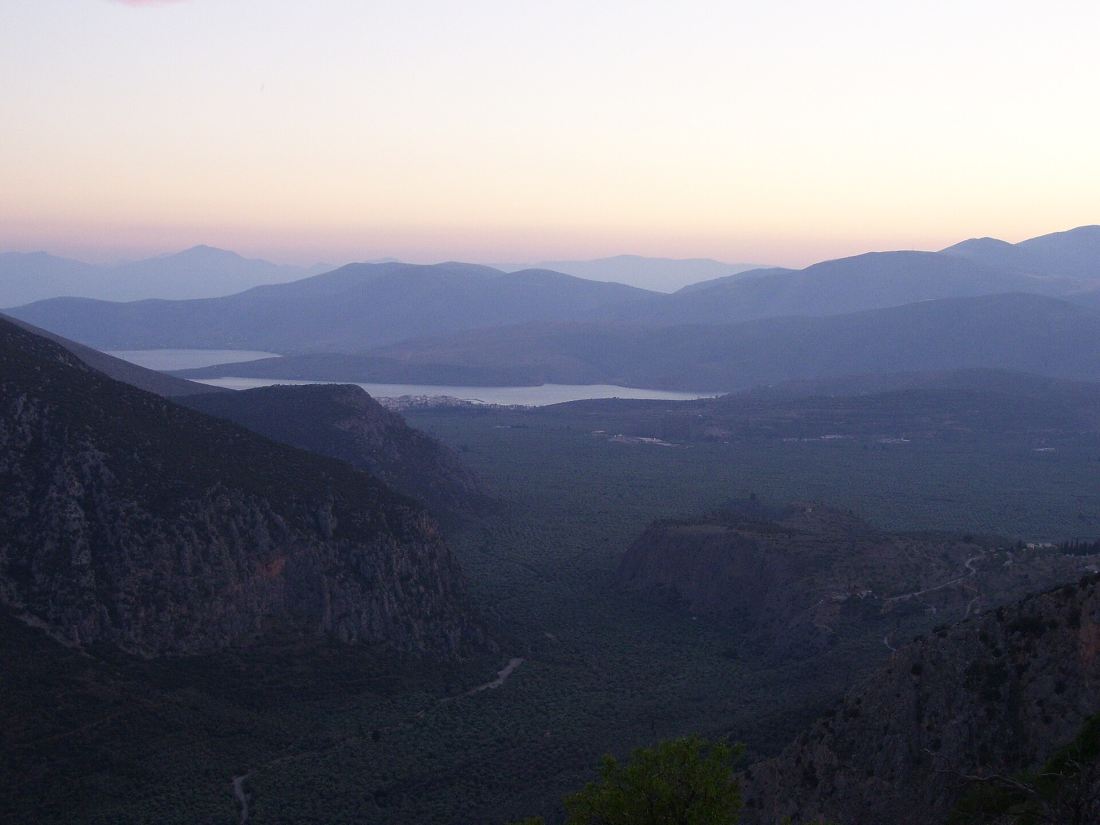
The climb ends at Arachova, a town of grey stone houses stacked on the flank of Mount Parnassus at roughly 950 metres. Arachova straddles the road, so every vehicle passes through its single main street of weavers, cheese shops, and tavernas. Beyond Arachova the road bends west and Delphi comes into view: the sanctuary clings to the mountainside above a vast silver-green olive plain that pours down the valley to Itea and the blue line of the Gulf of Corinth. That final descent past the ruins to Delphi is the reveal that marks the end of the drive.
How do you get to Delphi from Meteora, Nafplio, or the airport?
From Meteora, take the mountain road south via Lamia and Amfissa. From Nafplio and the Peloponnese, loop around the Corinthian Gulf by the Rio-Antirrio bridge or cross to the Itea coast. From Athens International Airport, drive or book a private transfer straight to Delphi without entering the city centre.
The link from Kalambaka and Meteora runs south through the mountains. The road drops from the Thessalian plain toward Lamia, then turns west into the highlands above Amfissa before descending to Delphi from the north. The distance covers about 230 kilometres and the terrain is mountainous for long stretches, so the journey takes close to three and a half hours of steady driving. Many travellers pair Meteora and Delphi across two days for this reason, breaking the drive rather than treating it as a single hop.
From Nafplio and the wider Peloponnese the barrier is the Corinthian Gulf. Two crossings solve it. The western option runs to Patras and over the Rio-Antirrio bridge, a cable-stayed span that carries the road across the narrows onto the northern shore, then east through Nafpaktos and Itea to Delphi. The eastern option cuts back toward Corinth and the mainland road, then follows the coast through Itea and up the olive valley. The bridge route suits travellers already in the western Peloponnese; the Corinth route suits those near Nafplio and the Argolid.
From Athens International Airport at Spata the practical choice is a private transfer or a rental car collected at the terminal. The airport sits on the eastern side of Athens, so the drive skirts the city on the ring road and joins the national road north without crossing the centre. A car covers the airport-to-Delphi run in about three hours. A pre-booked transfer removes the parking and navigation load and lands arriving passengers at the sanctuary directly, which fits visitors who reach Athens late and head for Delphi the next morning.
What is the best way to get to Delphi — car, bus, or tour?
A rental car gives freedom to stop at Arachova and the viewpoints and to leave when you choose. The KTEL bus is the budget route and runs a fixed schedule. A guided tour handles the logistics and adds an expert on site. The best pick depends on your group, your budget, and how much you value flexibility.
The rental car turns the drive into part of the trip. It lets a group halt at the Schiste crossroads, browse the weaving shops in Arachova, and reach the Delphi site gates early before the coaches arrive. It also opens the coast at Itea and the seaside tavernas at Galaxidi for the return leg. The cost is the rental itself, fuel, and the effort of mountain driving, which asks for confidence on switchbacks.
The KTEL intercity bus is the low-cost route. It departs from the Liosion terminal in Athens, follows the main road through Livadeia and Arachova, and sets down in Delphi village a short walk from the archaeological site. Fares stay well below the cost of a car or a tour, which makes the bus the choice for solo travellers and tight budgets. The trade-off is the fixed timetable and the fact that the bus keeps to the road, so the myth crossroads and the coast stay out of reach.
The guided tour removes every planning task. A coach collects passengers in Athens, covers the driving, includes the site entry, and puts a trained guide at the ruins to read the layout of the temple, the theatre, and the stadium. It suits visitors who want the history explained and prefer not to drive a mountain road in a foreign country. The limits are a set departure hour, a group pace, and less time to linger.
- Rental car — full freedom, roadside stops, early arrival; you drive the mountain road and pay for fuel and hire. Best for families and small groups.
- KTEL bus — lowest fare, fixed schedule, drops in Delphi village; no detours to Arachova viewpoints or the coast. Best for solo and budget travellers.
- Guided tour — zero logistics, entry and expert guide included; set hours and group pace. Best for first-time visitors who want the ruins interpreted.
How much does it cost to get from Athens to Delphi?
The KTEL bus costs in the mid-teens of euros each way, a rental car runs 40 to 70 euros a day plus fuel and tolls, a private transfer carries one flat price per vehicle, and a guided day tour costs 90 to 160 euros per person including the guide and site entrance.
- KTEL bus: a single fare in the mid-teens of euros each way; a return doubles that. The ticket covers the seat only, not the archaeological site or the museum.
- Rental car: 40 to 70 euros per day for the vehicle, plus fuel across the 180-kilometre each-way route and the motorway toll on the Athens–Thebes section.
- Private transfer: one flat price per vehicle rather than per passenger, so four travellers split a single fare between them.
- Guided day tour: 90 to 160 euros per person, which folds in the coach, the licensed guide, and entrance to the site and museum.
The bus is the lowest outlay for one or two travellers. A pair pays two mid-teen fares each way and adds the site entrance on arrival, which keeps the total for the day well under the price of a single tour seat. The trade is time and self-navigation: the traveller buys transport alone and organises the visit without a guide.
The rental car changes the sum for a group. Three or four passengers divide the daily rate, the fuel and the toll among themselves, so the per-head figure drops below both the bus-plus-entrance total and the tour price. The car also carries the group onward to Arachova or Galaxidi at no extra transport cost, which a fixed tour route does not.
The guided tour prices the whole day into one number. The 90-to-160-euro band already contains the coach, the guide and the site entrance, so the traveller adds only lunch and personal spending. On the bus or in a car, the entrance is a separate ticket bought at the gate; the current Delphi ticket prices set that added cost, and a combined site-and-museum ticket cuts it against two singles.
How do you get around Delphi once you arrive?
You get around Delphi on foot. The archaeological site, the museum and the modern village sit along one mountain road within walking distance of each other, and the level walk from the bus stop or the village to the site gate takes ten minutes, so no local bus operates inside Delphi.
The KTEL coach sets passengers down at the edge of the modern village. From that stop the road runs east toward the archaeological zone, and the walk to the site entrance covers about one kilometre on a paved, near-level surface. The museum stands beside the site gate, so the walk delivers the visitor to both the ruins and the collection at a single point.
The modern village of Delphi lines the same road on the western side. Its hotels, tavernas and shops string along two parallel streets cut into the slope, and the length of the built-up strip runs under one kilometre end to end. A visitor staying overnight walks from a village room to the site in fifteen minutes and back for dinner without transport.
Drivers park at the site itself. A parking area sits at the gate of the archaeological zone, with further roadside spaces along the approach, so a car reaches the entrance directly and the driver walks the final metres. Inside the site, the Sacred Way climbs on foot only; the path is stepped and unpaved in stretches, and no vehicle enters the ruins.
What do people get wrong about getting to Delphi?
People assume a train reaches Delphi, underestimate the mountain-road driving time, miss the last afternoon KTEL bus back to Athens, set out with a low fuel tank before the climb, and expect to see the whole site and return to Athens without an early start.
The train myth costs the most planning time. No railway line runs to Delphi; the mountain terrain carries roads only. Travellers who search for a direct rail service find none and reach Delphi by coach, car or transfer instead. The nearest rail options end far short of the site and hand the final leg back to the road.
The driving time trips up self-drivers who read the 180-kilometre distance as a fast run. The route leaves the motorway after Thebes and climbs a two-lane mountain road through Livadeia and the pass below Parnassus, where bends and gradient hold the pace down. The full drive runs close to three hours one way, not the two hours a straight-line distance suggests.
The return bus and the fuel tank catch the unprepared. The KTEL timetable thins out through the afternoon, and travellers who linger at the ruins reach the stop after the final Athens departure has left. Drivers face a parallel trap: filling stations space out along the mountain leg, so a car that leaves Athens low on fuel climbs past long gaps with the tank running down. Both faults share one fix — start early, hold the return time, and top up before the mountain.
What stops can you make on the drive from Athens to Delphi?
The Athens–Delphi road runs through Thebes, Livadeia, the Schiste crossroads, and Arachova, with the monastery of Hosios Loukas a short detour near Distomo. Each sits on or beside the national road, so you break the drive without leaving the route.
Thebes stands 90 kilometres from Athens, the first town of substance on the road. Its Archaeological Museum holds Mycenaean tablets, painted larnakes, and Boeotian grave goods drawn from the surrounding plain. The stop adds 30 minutes and sets the historical frame for Delphi, since Thebes and its king Oedipus tie directly into the myths you meet further up the mountain.
Livadeia follows, built around the gorge of the Herkyna. The springs feed cold pools beneath the rock, and a Catalan castle crowns the height above the water. Travellers in antiquity consulted the oracle of Trophonius here before continuing to the Delphic sanctuary, which makes the town a logical pause on the same pilgrim line.
The Schiste crossroads, the Triodos where three roads meet, lies past Distomo on the approach to Delphi. Myth places the killing of Laius by Oedipus at this junction, and the modern road traces the ancient one. From the same turn, a signposted detour reaches the Byzantine monastery of Hosios Loukas, a UNESCO-listed complex whose mosaics rank with the finest in Greece.
- Thebes — Archaeological Museum and the Boeotian plain, 90 kilometres from Athens.
- Livadeia — the springs of the Herkyna and the Catalan castle above the gorge.
- Schiste crossroads — the Triodos of the Oedipus myth on the final approach.
- Hosios Loukas — the UNESCO monastery and its mosaics, signposted near Distomo.
- Arachova — the stone town for lunch and coffee, 12 kilometres before Delphi.
Arachova closes the run into Delphi, terraced across the slope of Mount Parnassus at 960 metres. Its lanes carry tavernas, cheese shops, and the woven textiles the town is known for. A meal and a coffee here fuel the last 12 kilometres west to the sanctuary, and the balconies over the ravine open the first mountain views of the drive.
How do you get from Delphi onward to Arachova, Galaxidi, and the coast?
From Delphi, Arachova sits 12 kilometres east up the mountain, while the road west drops through Itea to the seaside town of Galaxidi on the Corinthian Gulf. The coast road then runs to Nafpaktos and the Rio–Antirrio bridge into the Peloponnese.
Arachova lies 20 minutes east of Delphi, back along the road from Athens and higher up the Parnassus slope. Drivers reach it in a quarter of an hour; the KTEL buses that serve Delphi from Athens pass through the town, so the connection works without a car. The stone streets, the clock tower, and the ski-season trade make Arachova the mountain counterpart to the sanctuary below.
West and down from Delphi, the road descends through the olive groves of the Amfissa plain to the port of Itea on the Gulf of Corinth. From Itea a shore road turns southwest to Galaxidi, 30 kilometres from Delphi, a captains’ town of neoclassical mansions built on the wealth of the old sailing fleets. Its Maritime Museum and twin harbours reward the descent from the mountain to the sea.
Beyond Galaxidi the coast road tracks the northern shore of the gulf westward to Nafpaktos, with its Venetian harbour ringed by a walled castle. The route ends at the Rio–Antirrio bridge, the long cable-stayed span that carries traffic across the strait into the Peloponnese, linking Delphi to Patras and the western Peloponnese in a single drive.
Car makes this chain direct, since the local bus network thins away from the Athens corridor. KTEL Fokidas runs services between Delphi, Itea, Amfissa, and Galaxidi on a fixed daily timetable, and the Nafpaktos leg connects through Itea. Drivers who base at Delphi village reach Arachova, Galaxidi, and the coast on day loops and return to the same room each night.
How do you plan a two-day trip built around Delphi?
A two-day plan puts one night in Delphi village or Arachova, which splits the drive from Athens and opens the sanctuary at dawn. From there, day two extends to Meteora by the Lamia road or to Hosios Loukas and the Corinthian Gulf coast.
Staying overnight removes the pressure of the return leg. Delphi village sits five minutes from the archaeological site, and Arachova stands 12 kilometres east on the mountain. An evening arrival, a night in either town, and a first-hour entry to the sanctuary give you the ruins before the tour coaches climb from Athens. The museum and the Sacred Way fill the morning, and the afternoon opens for the onward route.
The Delphi and Meteora pairing joins the two headline sites of central Greece across two days. Day one covers Delphi and the night in the village; day two drives north on the Lamia road to Kalambaka, where the monasteries stand on their sandstone pillars. The distance between the two is 230 kilometres, and the road runs through Lamia and the Thermopylae pass, itself a battlefield of record.
A gentler second day keeps to the region around the sanctuary. From Delphi the morning reaches the monastery of Hosios Loukas near Distomo, 35 kilometres east, for the mosaics and the crypt. The road then drops to Itea and Galaxidi on the Corinthian Gulf for an afternoon by the water, before the return north. Two unhurried days hold the sanctuary, a Byzantine masterpiece, and the coast without a rushed schedule.
Book the overnight before you set out, since Delphi and Arachova draw weekend and ski-season traffic that fills the rooms. The Delphi hub pairs the sanctuary with the mountain and the gulf across a single loop, and a car turns the two-day frame into a route you drive at your own pace from door to door. Travellers without a car build the same two days on the KTEL network, taking the morning coach from Athens to Delphi, an onward local bus to Arachova or Itea, and the return service on the second afternoon, so the mountain, the sanctuary and the gulf all fall within reach of the intercity timetable. Booking the coach seats and the overnight room in advance keeps the two-day plan on schedule through the busy summer and ski seasons, when the Athens departures and the mountain guesthouses both fill quickly.
Frequently Asked Questions
How do you get from Athens to Delphi?
Delphi is reached from Athens by car, by the KTEL Fokidas intercity bus, by guided day tour, or by private transfer, all following the road through Thebes and Livadeia and up the mountain through Arachova in about three hours.
How far is Delphi from Athens?
Delphi is about 180 kilometres northwest of Athens by road, roughly two and a half to three hours’ drive, split between fast national road across the Boeotian plain and a winding mountain climb through Arachova.
Is there a bus from Athens to Delphi?
Yes. The KTEL Fokidas coach runs from the Liosion Street terminal in Athens to Delphi village in about three hours, with several departures a day and a one-way fare in the mid-teens of euros.
Is there a train to Delphi?
No railway reaches Delphi. The nearest station is Livadeia, about 45 kilometres away; from there a taxi or transfer covers the final mountain stretch. The bus, car and guided tour are the through routes.