
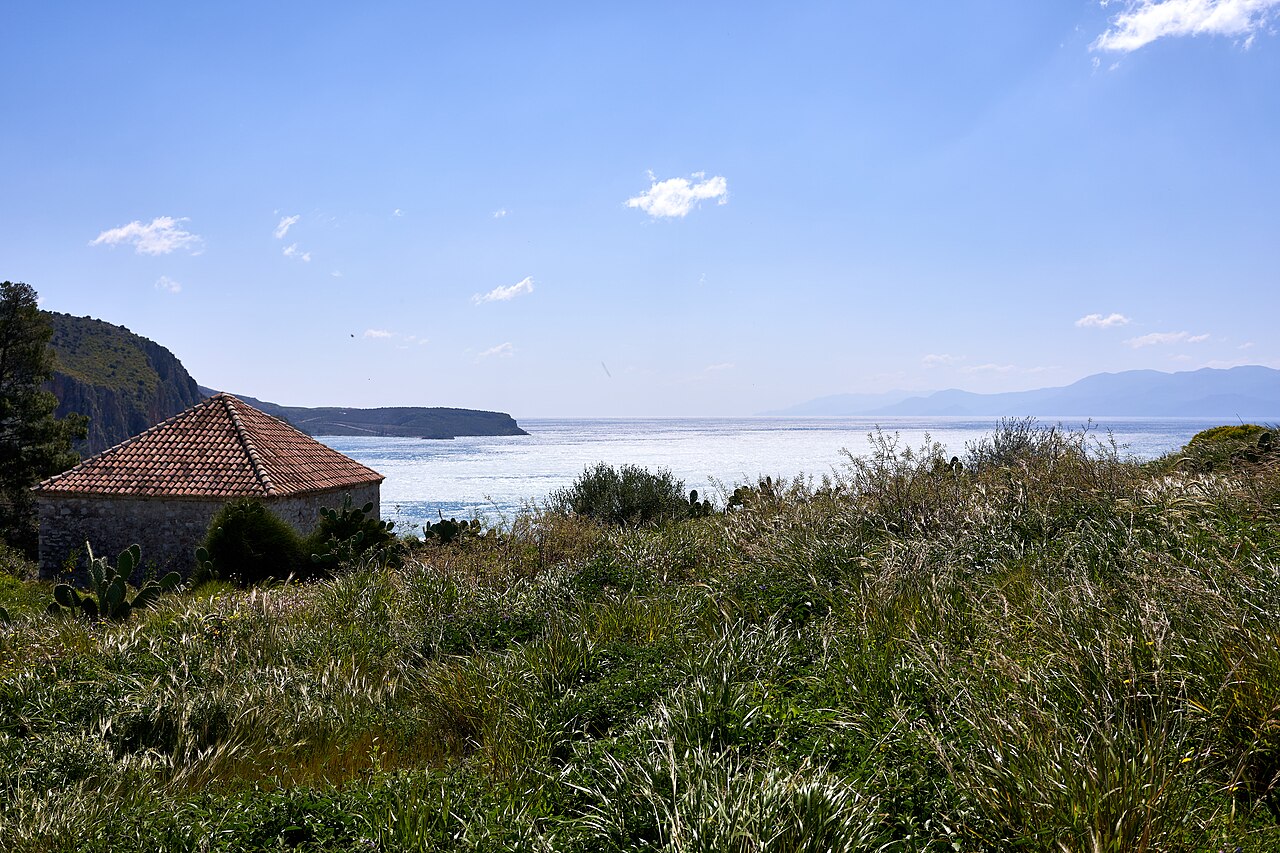
Acronafplia is the oldest of Nafplio’s three castles, a long fortified ridge rising directly above the old town between Palamidi and the sea. Occupied since the Bronze Age and rebuilt by Greeks, Franks, Venetians and Ottomans, its walls carry the marks of every people who held the town. Lower and older than the great fortress of Palamidi, and free to enter, it is easily reached on foot, by a lift from the old town or by road, and its ramparts give sweeping views over Nafplio, the island castle of Bourtzi and the Argolic Gulf. Quiet and uncrowded, Acronafplia is one of the most rewarding and easily reached sights of the town.
This guide covers Acronafplia in full: its history and the three linked castles, what to see on the ridge, how to reach it, the free entry, the views, and how it compares to Palamidi. Read it beside the full Nafplio travel guide, the guide to Palamidi fortress and the guide to Bourtzi castle.
What is Acronafplia?
Acronafplia is the oldest fortress of Nafplio, a fortified rocky ridge above the old town, between Palamidi and the sea. The original acropolis of the town, occupied since the Bronze Age and rebuilt by every later ruler, it is free to enter, easily reached, and offers wide views over the town and gulf.
It is the town’s original fortress. Acronafplia was the fortified core of Nafplio long before Palamidi was built, the ancient acropolis on the ridge above the old town, so it is the oldest part of the city, occupied since antiquity.
Its walls span the ages. The ridge carries walls built and rebuilt by Greeks, Byzantines, Franks, Venetians and Ottomans, so Acronafplia is a layered record of every people who held Nafplio, its stones telling the whole history of the town.
It is easy to reach and free. Rising directly above the old town and open without a ticket, Acronafplia is reached on foot, by a lift from the town or by road, so it gives fortress walls and wide views without the long climb of Palamidi, as the full Nafplio travel guide notes.
What is the history of Acronafplia?
Acronafplia has been fortified since the Bronze Age, with walls of the lower acropolis dating from the 4th century BC. Held by Byzantines, Franks, Venetians and Ottomans, it was split into separate castles by the Franks, and it was freed by the Greeks in 1822 during the War of Independence.
Its roots are ancient. Parts of Acronafplia were fortified in the Bronze Age, and the walls of the lower acropolis date from the 4th century BC, so the ridge has been a stronghold since deep antiquity, the oldest fortified part of Nafplio.
Every ruler rebuilt it. Byzantines, Franks, Venetians and Ottomans each held and strengthened Acronafplia, so its walls carry the marks of every era, and under the Franks the fortress was split into separate castles on the ridge.
The Greeks freed it. Acronafplia was freed by the Greeks in 1822 during the War of Independence, when the revolutionary hero Kolokotronis raised the Greek flag over the fortress, so it shares in the founding history of modern Greece alongside Palamidi.
What are the three castles of Acronafplia?
Acronafplia is made up of three linked castles along its ridge: the Castle of the Greeks on the west, the Castle of the Franks on the east, split off when the Franks took the town, and the later Castle of Toro added by the Venetians. Together they form a single fortified spine above the old town.
The Castle of the Greeks holds the west. The westernmost of the three, the Castle of the Greeks, occupies the higher, older part of the ridge, so it preserves the most ancient fortifications of Acronafplia, its walls reaching back to antiquity.
The Castle of the Franks holds the east. When the Franks took Nafplio they split the fortress, building the Castle of the Franks on the eastern part of the ridge, so the medieval Frankish period left its own distinct castle alongside the older Greek one.
The Castle of Toro was added later. Under Venetian rule a third castle, the Castle of Toro or Torone, was added to the complex, so the three castles together, built by different rulers, form the single fortified ridge of Acronafplia as it survives today.
What can you see at Acronafplia?
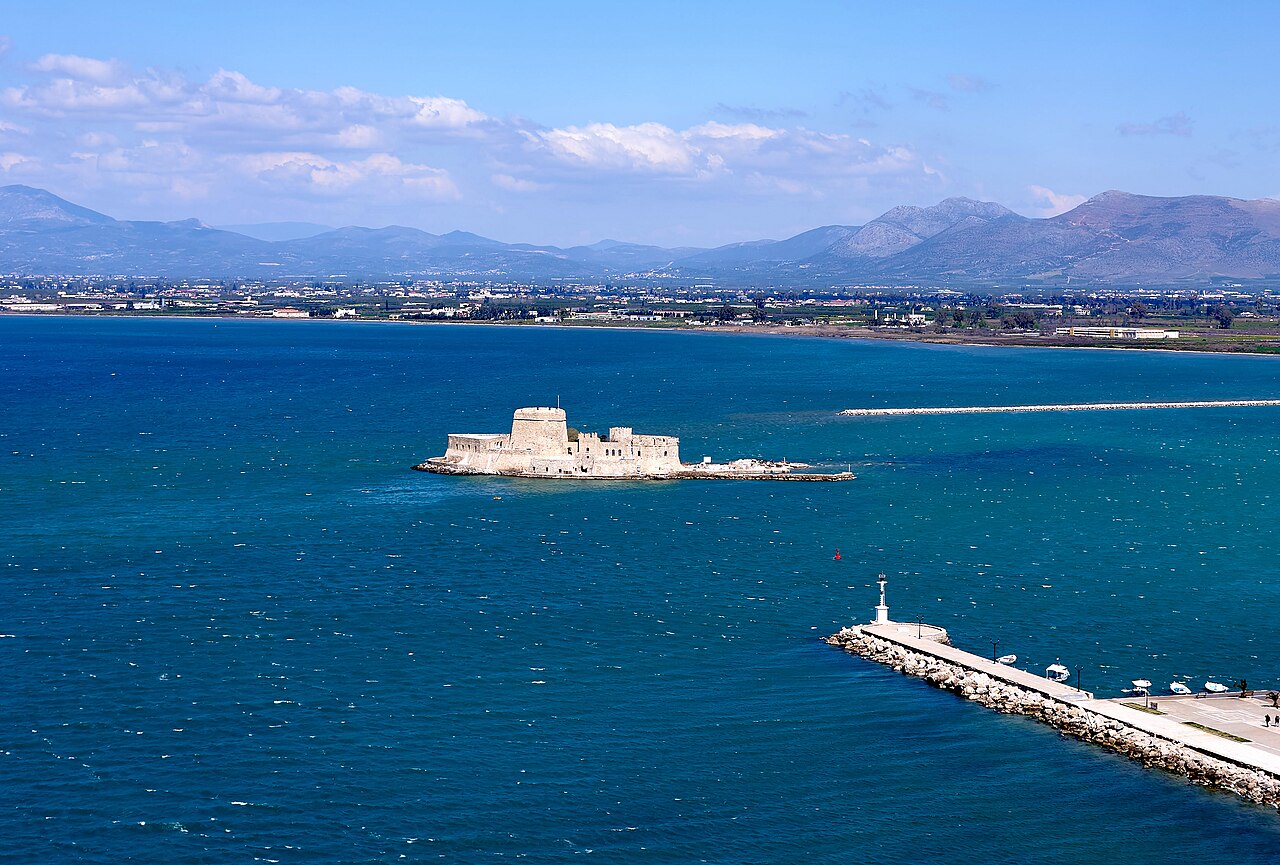
At Acronafplia you can see the walls and towers of the three castles, the Venetian Sagredo gate with its lion of Saint Mark, the Sea Gate, the traversa wall, a clock tower, and the ruins of later buildings, along with sweeping views over the old town, Bourtzi and the gulf from every point.
The gates and walls stand out. The Venetian Sagredo gate, carrying the lion of Saint Mark, and the Sea Gate below, together with the traversa wall built to divide the ridge, are among the finest surviving structures, so the fortifications reward a close look.
Later buildings dot the ridge. A clock tower and the ruins of later buildings, from the fortress’s use in more recent centuries, stand among the walls, so Acronafplia carries traces of its long life beyond its medieval and ancient defences.
The views are everywhere. From every point along the ridge the old town, the harbour with Bourtzi, the fortress of Palamidi and the Argolic Gulf spread out below, so the whole of Acronafplia is a series of viewpoints over Nafplio and its setting.
What is the Five Brothers bastion?
The Five Brothers is a Venetian bastion at the foot of the Acronafplia ridge, on the waterfront below the old town, named for the five cannon that once stood there. Well preserved, with old guns still in place, it is a favourite spot on the seafront walk beneath the fortress.
It guarded the shore. The Five Brothers bastion sits at the water’s edge below Acronafplia, part of the sea defences of Nafplio, so it guarded the shore beneath the great ridge, complementing the fortresses above.
It is named for its guns. The bastion takes its name from the five cannon that once armed it, and old guns still stand on its platform, so it recalls the Venetian defences of the town, a tangible piece of its military past.
It sits on the seafront walk. Because the Five Brothers stands on the waterfront at the start of the Arvanitia promenade below Acronafplia, it is easily seen on a walk round the base of the ridge, so it makes a natural stop, as the guide to the Arvanitia promenade notes.
How do you get up to Acronafplia?
You get up to Acronafplia by a road that climbs from the Staikopoulos park at the edge of the old town, by a lift cut into the rock from near Syntagma Square, or on foot by steps and paths from the old town, including the stairs by the Catholic church. It is an easy climb compared with Palamidi.
A road climbs the ridge. A road runs up to Acronafplia from the Staikopoulos park at the eastern edge of the old town, so those with a car or a taxi can drive to the top, reaching the fortress without a climb.
A lift rises from the town. A lift cut into the rock rises from near Syntagma Square in the old town to the ridge, so Acronafplia is reachable without steps, making it accessible to those who cannot manage the climb, a rare convenience among Greek castles.
Steps lead up on foot. Paths and steps climb from the old town to the fortress, including the stairs by the Catholic church that lead to the Castle of Toro, so walkers can reach Acronafplia on foot in a short, gentle climb far easier than the steps of Palamidi.
What are the views from Acronafplia?
The views from Acronafplia are among the finest in Nafplio: the marble old town directly below, the harbour with the island castle of Bourtzi, the great fortress of Palamidi above, and the Argolic Gulf stretching to the mountains. The ridge faces west, so it is a favourite spot for the sunset.
The old town lies below. From the ridge the marble-paved old town of Nafplio spreads directly beneath, its roofs, squares and waterfront clearly laid out, so Acronafplia gives a fine overview of the town at its feet.
Bourtzi and Palamidi frame the scene. The little island castle of Bourtzi sits in the harbour on one side and the great fortress of Palamidi rises above on the other, so from Acronafplia all three of Nafplio’s castles and the town are seen together.
The sunset is the highlight. Because the ridge looks west over the Argolic Gulf, Acronafplia is one of the best places in Nafplio to watch the sunset, so timing a visit for the evening rewards the easy climb with the finest light over the water.
How does Acronafplia compare to Palamidi?
Acronafplia is older, lower and free, reached easily on foot or by lift, while Palamidi is the great Venetian fortress high above, reached by nearly a thousand steps or a road and charging admission. Acronafplia suits a short, easy visit; Palamidi rewards a longer climb with grander fortifications.
Acronafplia is the easy fortress. Lower and reached by a short climb, a lift or a road, and free to enter, Acronafplia is the easy castle of Nafplio, so it suits those who want fortress walls and views without effort or cost.
Palamidi is the grand one. Palamidi, built by the Venetians high on its rock and reached by the famous stairway of nearly a thousand steps, is the greater and grander fortress, so it rewards a longer, harder visit with its eight bastions and sweeping scale.
They complement each other. Because Acronafplia is old, low and easy while Palamidi is grand, high and demanding, the two fortresses complement each other, so most visitors see both, as the guide to Palamidi fortress describes.
When is the best time to visit Acronafplia?
The best time to visit Acronafplia is spring and autumn for mild weather, and the late afternoon or sunset in any season for the finest light and the view west over the gulf. Because the climb is short and easy, Acronafplia suits an evening visit better than the long ascent of Palamidi.
The shoulder seasons are mild. In spring and autumn the weather is comfortable for the short climb and the exposed ridge, so these seasons are ideal, without the fierce heat of high summer on the shadeless walls.
Sunset is the finest hour. Because the ridge faces west, the late afternoon and sunset give the best light over the town and gulf, so timing a visit for the evening is especially rewarding at Acronafplia.
It suits an easy evening visit. Since the climb is short or avoidable by lift or road, Acronafplia is easily visited in the evening for the sunset, so it makes a fine end to a day, easier to reach at that hour than the long steps of Palamidi.
Is Acronafplia suitable for families and easy access?
Acronafplia is one of the more accessible sights in Nafplio, suited to families and to those with limited mobility, thanks to the lift from the old town and the road to the ridge that avoid the steps. The open ground has uneven paths, but much of the fortress and its views are reached without a hard climb.
The lift and road ease access. Because a lift rises from near Syntagma Square and a road climbs to the ridge, Acronafplia can be reached without the long stairways that make Palamidi hard, so it suits families with children and visitors who cannot manage many steps.
Children enjoy the walls and views. The walls, gates and bastions of the ridge are an easy adventure for children, and the sweeping views over the town, the sea and the castles hold their interest, so Acronafplia makes a good family outing.
Care is still needed on the ground. The fortress is an old site with uneven paths and open drops, so sensible shoes and care with children are wise, but the ease of reaching the ridge makes Acronafplia far more accessible than the other castles of Nafplio.
Why is Acronafplia called the oldest fortress of Nafplio?
Acronafplia is called the oldest fortress of Nafplio because it was fortified long before Palamidi and Bourtzi, with defences reaching back to the Bronze Age and walls from the 4th century BC. It was the original acropolis of the town, the fortified core around which Nafplio grew.
It was the original acropolis. Acronafplia was the fortified height on which ancient Nafplio was founded, so it is the oldest inhabited and defended part of the town, the core from which the later city spread down to the harbour.
Its defences predate the others. While Palamidi was built by the Venetians in the eighteenth century and Bourtzi in the fifteenth, Acronafplia was already fortified in antiquity, so it is by far the oldest of the three castles of Nafplio.
It grew with the town. Because every later ruler added to its defences, Acronafplia records the whole history of Nafplio in one place, so it is both the oldest fortress and the most layered, its walls spanning more than two thousand years.
What was Acronafplia used for in later centuries?
In later centuries Acronafplia served beyond its role as a fortress, used as a military hospital and as a prison in the twentieth century, and later part of the ridge became the site of a hotel. These varied uses reflect the fortress’s long life after its days as the town’s chief defence.
It became a prison. In the twentieth century part of Acronafplia was used as a prison, so the old fortress served the modern state as a place of confinement, one chapter in its long and varied history after its military days.
It served as a hospital. Acronafplia was also used as a military hospital, so beyond defence and imprisonment the fortress played a practical role for the town and the army over the centuries.
A hotel came later. In more recent times part of the ridge was developed as a hotel, taking advantage of the position and the views, so Acronafplia’s later life reflects the changing uses of an old fortress no longer needed for war.
What is the traversa and the Gambello wall?
The traversa is the great cross-wall that divides the Acronafplia ridge, strengthening its defences, and it is linked to the Venetian engineer Gambello, who also worked on Bourtzi. Together with the bastions and gates, it shows the sophistication of the Venetian fortification of Nafplio.
The traversa divides the ridge. The traversa is a strong cross-wall built across the ridge of Acronafplia to divide and defend it, so that if one part fell the rest still held, a clever piece of military design.
It is linked to Gambello. The wall is associated with the Venetian engineer Gambello, who also designed the island fortress of Bourtzi, so the same skilled hand shaped more than one of Nafplio’s defences, tying the fortresses together.
It shows Venetian skill. Together with the bastions, gates and towers, the traversa reveals the sophistication of the Venetian fortification of the town, so Acronafplia is not just old but a fine example of military engineering across the ages.
How long do you need at Acronafplia?
You need about one to two hours at Acronafplia to walk the ridge, see the three castles, the gates and the bastions, and take in the views. Because it is smaller and easier than Palamidi, it makes a shorter visit, easily fitted into a walk through the old town or timed for the sunset.
An hour or two covers it. Walking the walls, the gates and the ruins of the three castles along the ridge, with time for the views, takes about one to two hours, so Acronafplia is a shorter visit than the vast Palamidi.
It fits into a day. Because the climb is short and the fortress compact, Acronafplia is easily added to a day exploring the old town, so it need not take a whole morning or afternoon, unlike the great fortress above.
Sunset makes a fine end. Given its west-facing views, a late visit timed for the sunset rounds off a day well, so many visitors climb Acronafplia in the evening after seeing the town, a short and rewarding end to the day.
Can you stay on Acronafplia?
Yes, Acronafplia is home to some of Nafplio’s most luxurious hotels, built on the ridge among the old walls with terraces, pools and sweeping views over the town and the Argolic Gulf. Staying there offers quiet, seclusion and the finest outlook in Nafplio, reached by road and the lift.
It holds luxury hotels. The heights of Acronafplia are home to grand hotels built among the ancient walls, with terraces, pools and gardens looking over the rooftops and the sea, so the ridge is the address for a luxurious and secluded stay.
The views are unmatched. From a room on Acronafplia the whole of Nafplio lies below, with the harbour, Bourtzi and the gulf beyond, so a stay there gives the finest outlook in the town, especially at sunset.
Access is easy. Acronafplia is reached by the road up the ridge and the lift from the old town, so guests reach the quiet heights easily, as the guide on where to stay in Nafplio describes for the luxury hotels there.
What is there near Acronafplia?
Near Acronafplia are all the sights of Nafplio: the marble old town and Syntagma Square directly below, the great fortress of Palamidi above, the island castle of Bourtzi in the harbour, and the Arvanitia promenade and cove at the foot of the ridge. Everything lies within a short walk.
The old town is below. The marble-paved old town, with Syntagma Square, the museums and the tavernas, spreads directly beneath Acronafplia, so the heart of Nafplio is a few minutes away down the ridge.
Palamidi and Bourtzi are close. The great fortress of Palamidi rises above and the island castle of Bourtzi sits in the harbour, so the other two of Nafplio’s three castles are within easy reach, and all three are often seen together.
The promenade rounds the base. The Arvanitia promenade, running round the foot of the ridge to the swimming cove, begins near the Five Brothers bastion below Acronafplia, so a walk can combine the fortress with the seafront path, as the guide to the Nafplio beaches notes.
Frequently Asked Questions
Is Acronafplia free to visit?
Yes, Acronafplia is free to enter, unlike the great fortress of Palamidi above the town, which charges admission. The ridge and its walls are open without a ticket, so a visit costs nothing beyond the effort of getting up, which is itself easy: a road climbs from the Staikopoulos park at the edge of the old town, a lift rises from near Syntagma Square, and steps and paths lead up on foot from the old town, including the stairs by the Catholic church. This makes Acronafplia one of the best free things to do in Nafplio, giving fortress walls, historic gates such as the Venetian Sagredo gate, and sweeping views over the old town, the island castle of Bourtzi, Palamidi and the Argolic Gulf, all at no cost. Because it is free and easily reached, it is a popular spot for a short walk and especially for the sunset, when the ridge, facing west over the gulf, catches the finest light of the day.
How do you get to Acronafplia in Nafplio?
Acronafplia rises directly above the old town of Nafplio and is reached in three easy ways. A road climbs to the ridge from the Staikopoulos park at the eastern edge of the old town, so those with a car or a taxi can drive to the top without a climb. A lift cut into the rock rises from near Syntagma Square in the old town, making the fortress accessible even to those who cannot manage steps, a rare convenience among Greek castles. And for walkers, paths and steps climb from the old town, including the stairs beside the Catholic church that lead up to the Castle of Toro. Whichever way you choose, the climb to Acronafplia is short and gentle compared with the famous stairway of nearly a thousand steps up to Palamidi, so the oldest fortress of Nafplio is the easiest of its three castles to reach, and it is free to enter, giving wide views for very little effort.
What is the difference between Acronafplia and Palamidi?
Acronafplia and Palamidi are two of Nafplio’s three castles, but they are very different. Acronafplia is the oldest, a low fortified ridge rising directly above the old town, fortified since the Bronze Age and rebuilt by Greeks, Franks, Venetians and Ottomans into three linked castles. It is reached easily by a short climb, a lift from the old town or a road, it is free to enter, and it makes a shorter visit of an hour or two. Palamidi, by contrast, is the great Venetian fortress built in the early eighteenth century high on its rock, a complex of eight bastions reached by a stairway of nearly a thousand steps or by road, charging admission and rewarding a longer visit of two to three hours. In short, Acronafplia is the old, low, easy and free fortress, while Palamidi is the grand, high, demanding and ticketed one. Most visitors see both, along with the island castle of Bourtzi in the harbour, to experience all three of Nafplio’s castles.
Is Acronafplia worth visiting?
Yes, Acronafplia is well worth visiting, and being free and easily reached it is one of the best-value sights in Nafplio. As the oldest of the town’s three castles, fortified since the Bronze Age and rebuilt by Greeks, Franks, Venetians and Ottomans, it carries a deep history in its layered walls, from the ancient fortifications of the Castle of the Greeks to the Venetian Sagredo gate and the Castle of Toro. It is made up of three linked castles along the ridge, and its ramparts give some of the finest views in the town, over the marble old town below, the island castle of Bourtzi in the harbour, the great fortress of Palamidi above and the Argolic Gulf beyond. Unlike Palamidi, it is reached by a short climb, a lift or a road, and it is free, so it suits everyone, and because the ridge faces west it is a favourite place to watch the sunset. Quiet and uncrowded, Acronafplia rewards a short visit as part of exploring Nafplio.