
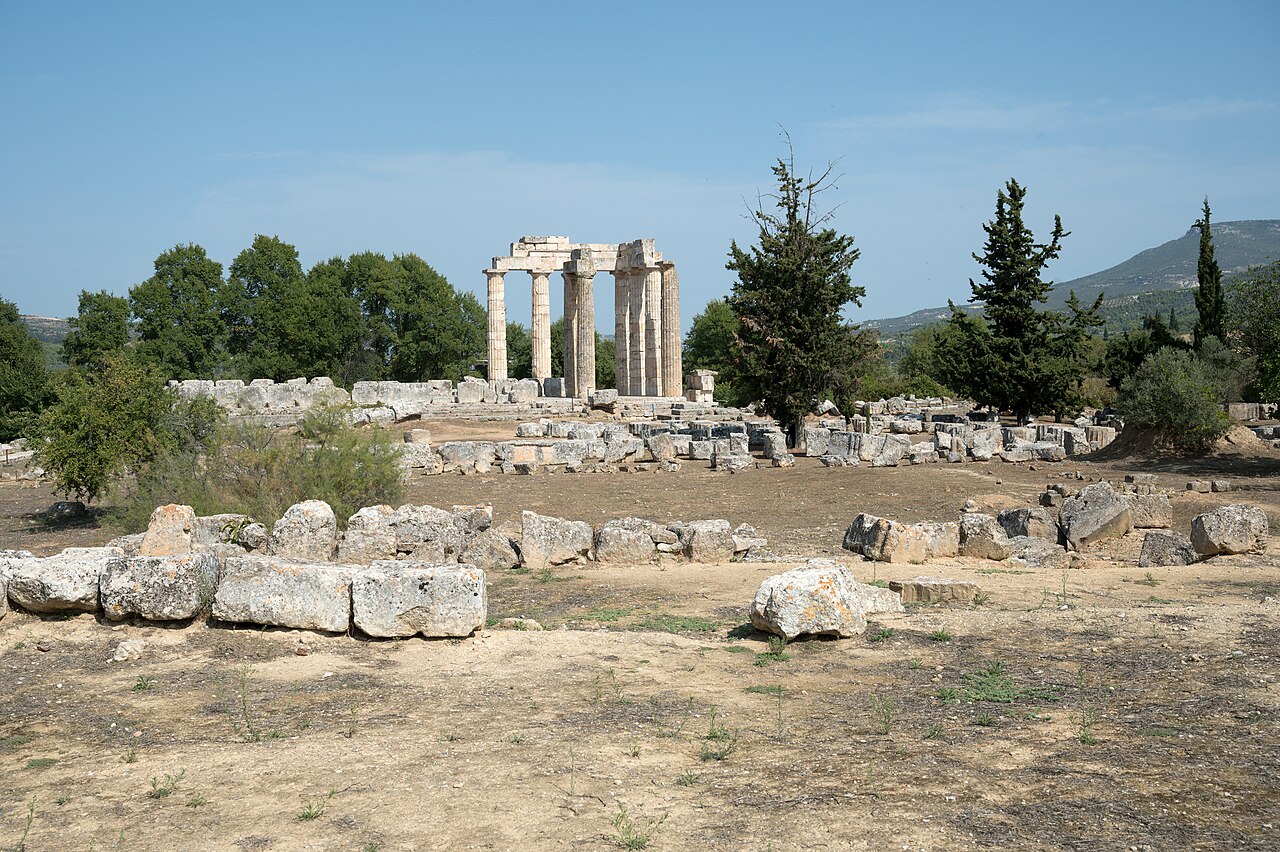
Ancient Nemea was one of the four great sanctuaries of ancient Greece, where the Panhellenic Nemean Games were held in honour of Zeus. Set in a quiet upland valley among vineyards and a sacred grove of cypress trees, it holds the tall re-erected columns of the Temple of Zeus, a remarkably preserved ancient stadium reached by a vaulted tunnel still marked with the graffiti of ancient athletes, and a fine museum. An hour from Nafplio and surrounded by the famous wine country, Ancient Nemea combines great archaeology with the pleasures of the vineyards, a rewarding day trip from the town.
This guide covers Ancient Nemea in full: the Temple of Zeus, the stadium and its tunnel, the Nemean Games and the myth of the lion, the bathhouse and the museum, the modern revival of the games, and how to visit from Nafplio, with the tickets, hours and the wine region alongside. Read it beside the full Nafplio travel guide, the guide to day trips from Nafplio and the guide to Nemea wine.
What is Ancient Nemea?
Ancient Nemea is an ancient Greek sanctuary of Zeus in the hills of Corinthia, about an hour from Nafplio, where the Panhellenic Nemean Games were held. Its main monuments are the Temple of Zeus, the stadium and the museum, set in a quiet valley among the vineyards of the Nemea wine region.
It was a sanctuary of Zeus. Nemea was one of the four great religious centres that held the Panhellenic games of ancient Greece, dedicated to Zeus, so it was a sacred site drawing athletes and pilgrims from across the Greek world, not a city but a sanctuary.
Its monuments survive well. The site holds the tall columns of the Temple of Zeus, a remarkably preserved stadium, the ruins of a bathhouse and hostelry, and a good museum, so it gives a clear picture of an ancient games sanctuary in its setting.
It sits in the wine country. Ancient Nemea lies in an upland valley among the vineyards of the famous Nemea wine region, about an hour from Nafplio, so a visit combines the ancient site with the pleasures of the wineries, as the guide to Nemea wine describes.
What is the Temple of Zeus at Nemea?
The Temple of Zeus is the great monument of Ancient Nemea, a Doric temple of the fourth century BC. Three of its original columns stood through the ages, and six more have been re-erected by archaeologists, so the temple now rises again in its valley, one of the most striking sights of the Peloponnese.
It dates from the fourth century BC. The Temple of Zeus was built in the fourth century BC, replacing an earlier temple, and its slender Doric columns are among the finest of their age, so it is a monument of the classical period at the heart of the sanctuary.
Its columns have been raised again. Three of the temple’s columns stood through the centuries, and archaeologists have re-erected six more from the fallen pieces, so the temple now shows a row of tall standing columns, giving a vivid sense of its original scale.
It crowns the sanctuary. Rising from the valley floor among the ruins and the vineyards, the columns of the Temple of Zeus are the defining image of Ancient Nemea, so they are the first thing visitors seek out and the centrepiece of the site.
What is the stadium of Nemea?
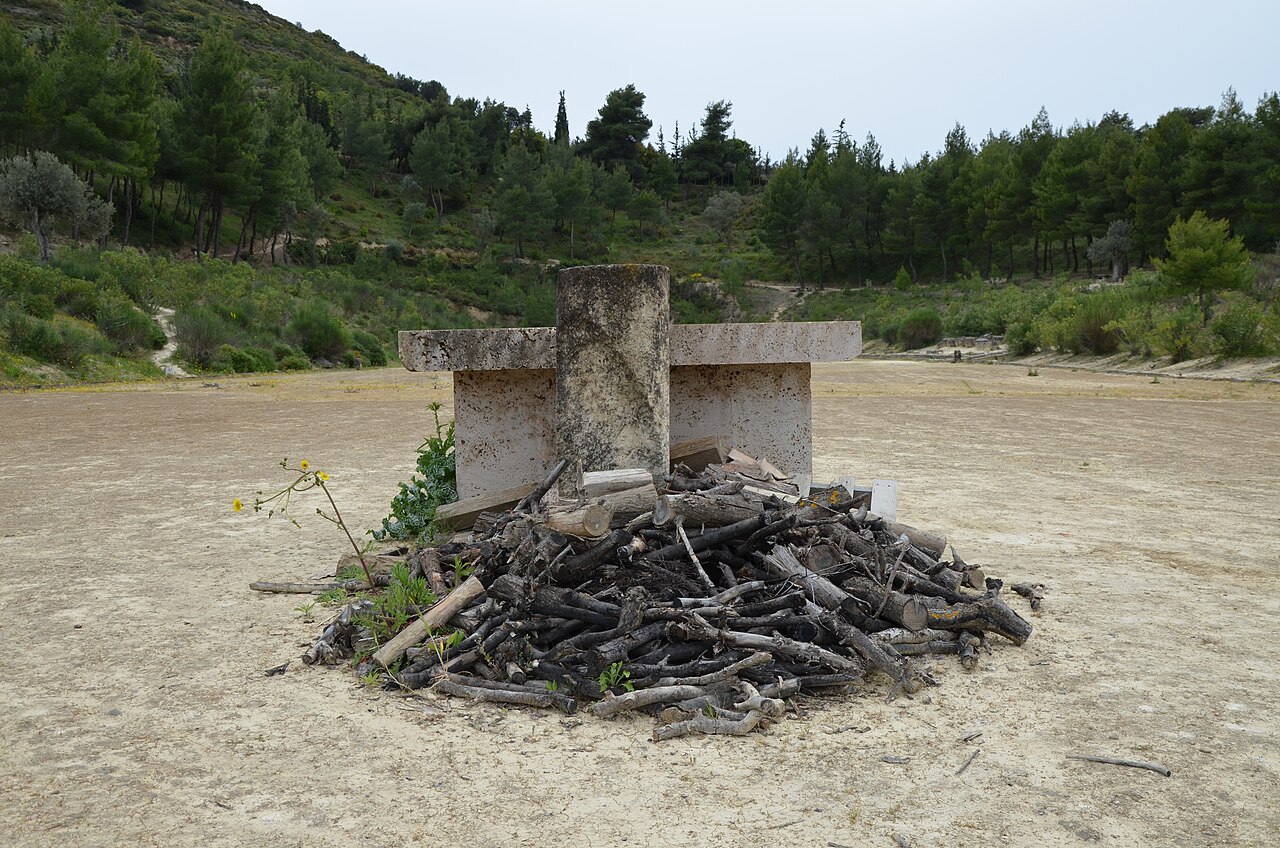
The stadium of Nemea is the ancient running track where the Nemean Games were held, remarkably preserved with its stone start line, judges’ seats and earthen banks. Athletes entered through a vaulted stone tunnel that still stands, its walls carved with the names of ancient competitors.
It held the games. The stadium is the track on which the athletes of the Nemean Games competed, set a short walk from the temple, so it is the sporting heart of the sanctuary, where crowds gathered to watch the running races and other contests.
It is remarkably preserved. The stone starting line, the sockets for the runners’ feet, the judges’ seats and the earthen banks for spectators all survive, so the stadium gives an unusually clear picture of how ancient Greek athletics worked.
The tunnel is the highlight. Athletes entered the stadium through a vaulted stone tunnel, one of the earliest known arches, and its walls carry the scratched names and graffiti of ancient competitors, so walking through it is a direct link to the athletes of two thousand years ago.
What were the Nemean Games?
The Nemean Games were one of the four great Panhellenic games of ancient Greece, held every two years at Nemea in honour of Zeus. Athletes came from across the Greek world to compete in running, wrestling and other contests, and the games ranked alongside Olympia, Delphi and the Isthmus.
They were one of the four great games. The Nemean Games stood with those of Olympia, Delphi and the Isthmus as the four Panhellenic festivals, so they were among the most important athletic and religious events of the ancient Greek world.
They were held for Zeus. The games honoured Zeus, to whom the sanctuary was dedicated, and were held every two years, so they combined athletic contest with the worship of the king of the gods, drawing competitors and crowds from every Greek city.
The victors won a crown. As at the other great games, the prize was not money but a crown, at Nemea made of wild celery, so the honour of victory was the reward, bringing fame to the athlete and his city across the Greek world.
What is the myth of the Nemean lion?
The myth of the Nemean lion tells how the hero Hercules, as the first of his twelve labours, killed a monstrous lion that terrorised Nemea and whose hide no weapon was able to pierce. He strangled it with his bare hands and wore its skin, and the games at Nemea were linked to this legend.
The lion terrorised Nemea. In legend a monstrous lion, its hide impervious to any weapon, ravaged the region of Nemea, so it became the target of the first labour set for the hero Hercules, a test of his strength and courage.
Hercules killed it bare-handed. Unable to pierce the lion’s skin with arrows or club, Hercules wrestled the beast and strangled it with his bare hands, then used its own claws to skin it, so he wore the invulnerable hide as a cloak, one of his emblems.
The games recall the legend. The Nemean Games and the sanctuary were tied to the myth of the lion, so the legend gives Nemea a place in the story of Hercules, and the deep red wine of the region is still sometimes called the “blood of Hercules”.
What else can you see at the sanctuary of Nemea?
Besides the temple and the stadium, the sanctuary of Nemea holds the ruins of a bathhouse where athletes prepared, a hostelry for visitors, an early Christian basilica, and altars and buildings around the temple. These, with the sacred grove of cypress trees, fill out the picture of the ancient sanctuary.
The bathhouse served the athletes. Near the temple stand the ruins of a bathhouse, with well-preserved washbasins, where athletes bathed and oiled themselves before competing, so it gives a glimpse of the practical life of the games alongside the grand temple.
A hostelry housed visitors. The sanctuary had a large hostelry, or xenon, to lodge the visitors who came for the games, so its ruins show that Nemea, like the other great sanctuaries, had to house and feed the crowds it drew.
Later buildings overlie it. An early Christian basilica was later built over part of the sanctuary using stone from the older buildings, so the site carries the marks of its Christian afterlife as well as its pagan greatness, set among the cypress grove and the vineyards.
What is the museum of Nemea?
The Archaeological Museum of Nemea stands on the site, near the Temple of Zeus, and displays finds from the sanctuary and the games: coins left by ancient visitors, athletic equipment, tools, weapons and objects from the excavations. Small but well arranged, it brings the sanctuary and its games to life.
It holds the finds of the site. The museum gathers the objects unearthed at Nemea, from coins and pottery to tools and weapons, so it explains the sanctuary and its games through the things found there, an essential part of a visit.
It tells of the games. Among its displays are items connected to the Nemean Games and the athletes who came to compete, so the museum gives a vivid sense of ancient Greek athletics and the religious festival that surrounded them.
It sits by the temple. The museum stands within the site near the Temple of Zeus, so it is easily combined with the ruins and the stadium, and its admission is included in the site ticket, a natural stop on a visit to Nemea.
What is the modern revival of the Nemean Games?
The Nemean Games have been revived in modern times as a public event in which anyone can run barefoot in the ancient stadium, dressed in a simple tunic, entering through the ancient tunnel. Held every few years, the revived games let visitors take part in the spirit of the ancient contests.
Anyone can take part. The revived Nemean Games are open to all, not just athletes, so ordinary people of every age run in the ancient stadium, making it a participatory celebration rather than a competition of champions.
Runners follow the ancient way. Competitors wear a simple tunic and run barefoot, entering the stadium through the same vaulted tunnel the ancient athletes used, so the revived games recreate the experience of the ancient contests as closely as possible.
They are held every few years. The games take place every few years, organised by a society devoted to reviving them, so a visit timed to coincide with them offers a rare chance to run where ancient athletes once competed, in the spirit of the old festival.
How do you get to Ancient Nemea from Nafplio?
You get to Ancient Nemea from Nafplio in about an hour by car, driving north through the Argolid into the hills of Corinthia, or on an organised tour, often combined with a winery visit. The site lies near the modern town of Nemea, and a car is best for combining it with the vineyards.
A car is easiest. Driving from Nafplio to Ancient Nemea takes about an hour on good roads, so a car is the simplest way to reach the site and to combine it with the wineries of the region, exploring at your own pace.
Tours combine it with wine. Many tours pair the ancient site of Nemea with tastings at the local wineries, so a guided day covers both the archaeology and the wine, a convenient option for those without a car or a designated driver.
It fits a wine day. Because the site sits among the vineyards, a visit to Ancient Nemea slots naturally into a day in the wine country, so many visitors see the temple and stadium in the morning and taste the wines in the afternoon, as the guide to Nemea wine sets out.
How do you get to Ancient Nemea from Athens?
You get to Ancient Nemea from Athens in about an hour and a half by car, some 120 kilometres via the motorway towards Corinth and Tripoli, or on an organised tour. There is no easy direct public transport, so a car or a tour is the practical way to reach the site from the capital.
The drive is straightforward. Ancient Nemea lies about 120 kilometres from Athens, an hour and a half by car on the motorway past Corinth, so it is a manageable day trip from the capital, often combined with the wineries or other ancient sites.
Tours are convenient. Organised tours from Athens visit Nemea, usually with a winery and sometimes other sites, so a guided trip is an easy way to see the sanctuary from the capital without a car.
Public transport is awkward. Reaching the site by bus means travelling to the modern town of Nemea and finding local transport for the last few kilometres, so it is slow and awkward, and a car or a tour is far better, or a visit from a base in Nafplio.
What are the tickets and opening hours for Ancient Nemea?
A ticket to Ancient Nemea costs around 10 euros, including the museum, the sanctuary and the stadium. The site opens daily from 08:00 to 20:00 in summer, with shorter winter hours and closure on Tuesdays in the winter season, so it is worth checking the current times before a visit.
The ticket covers the whole site. Admission of around 10 euros includes the sanctuary with the Temple of Zeus, the museum and the stadium a short distance away, so the single ticket covers everything at Nemea, bought at the entrance.
Summer hours are long. The site opens from eight in the morning until around eight in the evening in the summer season, so a summer visit gives a long day to see the temple, the stadium and the museum without rushing.
Winter hours are shorter. In winter the site closes earlier, in the afternoon, and is shut on Tuesdays, so out-of-season visitors do well to check the current hours and days before setting out, to avoid a wasted journey.
How long do you need at Ancient Nemea?
You need about one and a half to three hours at Ancient Nemea to see the Temple of Zeus, the museum and the stadium at a comfortable pace. The sanctuary and museum take an hour or more, and the stadium, a short distance away, a further while, so allow half a day with the wineries.
The sanctuary takes an hour or more. Walking the Temple of Zeus, the bathhouse, the hostelry and the other ruins, with a visit to the museum, takes an hour or more, so the main site rewards an unhurried visit.
The stadium adds to it. The stadium lies a short distance from the temple, and seeing it, walking through the ancient tunnel and taking in the track and banks takes a further while, so the two parts of the site together fill a good part of a morning or afternoon.
Half a day suits a wine day. Because Nemea sits in the wine country, most visitors give the ancient site an hour and a half to three hours and pair it with a winery, so a half-day covers both the archaeology and a tasting, the ideal way to see the region.
Can you combine Ancient Nemea with the wineries?
Yes, Ancient Nemea is easily combined with the wineries of the Nemea wine region, which surround the site. A typical day sees the temple and stadium in the morning and a winery tour and tasting in the afternoon, so the ancient sanctuary and the famous red wine make a natural pairing.
The vineyards surround the site. The Nemea wine region, the largest red-wine appellation in Greece, spreads across the valleys around the ancient site, so the wineries are only minutes away, and the sanctuary sits among the vines.
A day covers both. Seeing the temple and stadium in the morning and touring a winery with a tasting in the afternoon makes a full and varied day, so the ancient site and the wine are best enjoyed together rather than separately.
It is the classic Nemea day. Because archaeology and wine sit side by side here, the classic way to visit Nemea from Nafplio is to combine the two, so a day trip mixes ancient history with the pleasures of the vineyards, as the guide to Nemea wine describes.
Can you combine Ancient Nemea with Ancient Corinth?
Yes, Ancient Nemea and Ancient Corinth are easily combined in a day, lying about an hour apart in Corinthia. A typical trip takes in the sanctuary of Zeus and stadium at Nemea and the Temple of Apollo, forum and fortress of Acrocorinth at Corinth, with a winery or the Corinth Canal added.
They are close together. Ancient Nemea and Ancient Corinth both lie in the region of Corinthia, about an hour apart by road, so the two great sites pair naturally into a single day of archaeology in the northeast Peloponnese.
They complement each other. Nemea is a Panhellenic games sanctuary with its temple and stadium, while Corinth is a great ancient city with its forum, fountains and the fortress of Acrocorinth, so the two together show different sides of the ancient world, sanctuary and city.
A day links them with wine or the canal. Because the wineries of Nemea and the Corinth Canal both lie on the route, a day combining the two sites can add a tasting or a stop at the canal, so a full day mixes ancient history with wine or engineering, as the guide to Ancient Corinth describes.
What ancient graffiti is in the stadium tunnel?
The vaulted tunnel through which athletes entered the stadium of Nemea is carved with ancient graffiti, the scratched names of competitors and other marks left more than two thousand years ago. Walking the tunnel and seeing these inscriptions is a direct and moving link to the athletes of the ancient games.
The tunnel is an early arch. The stone tunnel leading into the stadium is one of the earliest known true arches, built to bring the athletes from the changing area into the arena, so it is an architectural landmark as well as a dramatic entrance.
Athletes left their names. The walls of the tunnel carry graffiti scratched by ancient competitors and others, including names, so these marks are a personal trace of the people who passed through on their way to compete, a rare survival.
It connects visitors to the past. Walking through the same tunnel the ancient athletes used, and seeing their scratched names on the walls, gives a vivid and direct sense of the games, so the tunnel is one of the most memorable features of Ancient Nemea.
Who excavated Ancient Nemea?
Ancient Nemea has been excavated over many years by archaeologists from the University of California, Berkeley, who uncovered the sanctuary and the stadium, re-erected columns of the Temple of Zeus, and helped revive the Nemean Games. Their work has made Nemea one of the best-understood ancient sanctuaries.
Berkeley led the digs. Archaeologists from the University of California, Berkeley, have excavated Nemea over many years, uncovering the sanctuary, the stadium and their buildings, so much of what visitors see is the result of their long and careful work.
They raised the temple again. The re-erection of fallen columns of the Temple of Zeus, using the original pieces, was part of this work, so the striking row of standing columns that greets visitors today is a modern restoration based on careful study.
They revived the games. The same scholars helped found the society that revived the Nemean Games, in which anyone can run in the ancient stadium, so their work has brought Nemea to life as both an archaeological site and a living tradition.
What is the modern town of Nemea like?
The modern town of Nemea is a small country town at the heart of the wine region, a short drive from the ancient site. With its wineries, tavernas and shops, it is the centre of the Nemea wine country, and it makes a pleasant base or stop for those exploring the ancient site and the vineyards.
It is the wine-country hub. The modern town of Nemea sits among the vineyards a short drive from the ancient site, and it is the centre of the wine region, so it is where many of the wineries and their tasting rooms are found.
It has tavernas and shops. The town has tavernas serving local food and wine, shops selling the region’s produce, and a relaxed country feel, so it makes a pleasant place to eat or to buy wine and local products on a visit.
It serves the visitor. As the hub of the wine country near the ancient site, the town is a natural stop for those touring Nemea, so a day combining the sanctuary, a winery and a meal in the town makes a full experience of the region.
What is the history of Ancient Nemea?
Ancient Nemea rose as a sanctuary of Zeus and a Panhellenic games centre in the archaic and classical periods, with its great temple built in the fourth century BC. The games were later moved to Argos, the sanctuary declined, and an early Christian community left a basilica before the site was abandoned.
It began in the archaic age. Nemea grew as a sanctuary of Zeus and a centre of the Panhellenic games in the archaic and classical periods, so it was among the important religious sites of early Greece, drawing athletes and pilgrims from across the Greek world.
The games moved to Argos. In time the powerful city of Argos took control of the games and moved them to its own territory, so the sanctuary at Nemea lost its festival and began to decline, its buildings falling into ruin.
It faded and was rediscovered. An early Christian community later settled at the site, building a basilica from the old stones, before Nemea was abandoned and its ruins buried, to be uncovered again by archaeologists in modern times, who re-erected the temple columns.
What was ancient Greek athletics like at Nemea?
At Nemea, as at the other great games, athletes competed naked in running races, wrestling, boxing, the pancratium and the pentathlon, watched by crowds on the earthen banks and judged by officials. The athletes prepared in the bathhouse and entered the stadium in procession through the vaulted tunnel.
The events were varied. The Nemean Games featured running races of different lengths, wrestling, boxing, the fierce pancratium and the pentathlon, so they tested speed, strength and skill, the same contests that made up the great festivals of ancient Greek sport.
The athletes competed naked. As throughout ancient Greek athletics, the competitors ran and wrestled naked and oiled, having prepared in the bathhouse, so the games were a display of the trained male body as well as of athletic prowess.
The crowds and judges watched. Spectators packed the earthen banks of the stadium, and officials judged the contests from their stone seats, so the stadium at Nemea, with its start line, tunnel and banks, lets visitors picture the games as they were.
What is the sacred grove of Nemea?
The sacred grove of Nemea is a stand of cypress trees planted at the sanctuary to recall the ancient sacred grove that once surrounded the Temple of Zeus. The upland valley setting, among the cypresses and the vineyards, gives Ancient Nemea a peaceful and evocative atmosphere unlike busier ancient sites.
The grove recalls the ancient sanctuary. Cypress trees have been planted around the temple to evoke the sacred grove that surrounded the sanctuary in antiquity, so the setting recreates something of how the site looked and felt to the ancient visitors.
The valley is peaceful. Set in a quiet upland valley among vineyards and hills, away from the main tourist routes, Ancient Nemea is far calmer than the great crowded sites, so it offers a peaceful and reflective visit among the ruins.
The setting adds to the visit. The combination of the standing temple columns, the cypress grove and the surrounding vineyards makes Nemea one of the most beautiful and atmospheric ancient sites in the Peloponnese, rewarding those who seek it out.
When is the best time to visit Ancient Nemea?
The best time to visit Ancient Nemea is spring and autumn, from April to June and September to October, for mild weather and the vineyards at their best. Autumn brings the grape harvest in the surrounding wine country, while summer visits are best made early or late in the day to avoid the heat.
The shoulder seasons are ideal. In spring and autumn the weather is mild and the site pleasant to walk, without the heat of high summer, so April to June and September to October are the best months to visit the sanctuary and the surrounding wine country.
Autumn adds the harvest. The grape harvest falls in the autumn in the vineyards around Nemea, so a visit then catches the wine country at its most active, an added reason to come in the season of the vintage.
Summer needs timing. The site is open and exposed, so a summer visit is best made early in the morning or late in the afternoon to avoid the midday heat, with water and sun protection essential on the shadeless ground.
What is there near Ancient Nemea?
Near Ancient Nemea are the wineries of the Nemea wine region, the modern town of Nemea, the ancient city of Corinth with its fortress of Acrocorinth, and the citadel of Mycenae. The site sits among vineyards and within reach of the great ancient sites of the northeast Peloponnese.
The wineries are all around. The vineyards and wineries of the Nemea region surround the site, so a visit combines naturally with a tasting, and the wine country is the immediate landscape of Ancient Nemea.
Corinth is close. The ancient city of Corinth, with its Temple of Apollo and the great fortress of Acrocorinth, lies about an hour away, so the two ancient sites pair into a day of archaeology in Corinthia, as the guide to Ancient Corinth describes.
Mycenae lies south. The citadel of Mycenae and the other Argolid sites lie to the south towards Nafplio, so Ancient Nemea fits into a wider tour of the ancient northeast Peloponnese, combining sanctuaries, citadels and vineyards.
What is the difference between Ancient Nemea and the Nemea wine region?
Ancient Nemea is the archaeological site, the sanctuary of Zeus with its temple and stadium, while the Nemea wine region is the wider area of vineyards around it, the largest red-wine appellation in Greece. The two share a name and a landscape, and a visit combines the ancient site with a winery.
The site is the sanctuary. Ancient Nemea, the archaeological site, is the sanctuary of Zeus with its Temple, stadium and museum, so it is a place of ancient history and athletics, a defined site with a ticket and opening hours.
The region is the wine country. The Nemea wine region is the wider area of vineyards and wineries spreading across the valleys around the site and the modern town, the largest red-wine appellation in Greece, famous for the Agiorgitiko grape.
They belong together. Because the sanctuary sits among the vineyards, the ancient site and the wine region are naturally visited together, so a day at Nemea takes in both the archaeology and a tasting, as the guide to Nemea wine sets out.
What to bring for a visit to Ancient Nemea?
For Ancient Nemea bring comfortable shoes for the uneven ground, sun protection and water for the exposed site, and cash for the tavernas of the area. Allow an hour and a half to three hours, start early in summer, and combine the visit with a winery for a full day in the wine country.
Wear comfortable shoes. The ground at the sanctuary and the stadium is uneven earth and stone, so comfortable, sturdy shoes make walking the site and the track easier, especially on the path between the temple and the stadium.
Bring sun protection. The site is open and shadeless apart from the cypress grove, so a hat, sunscreen and water are important, especially in the summer heat of the upland valley.
Plan a wine day. Because Nemea sits in the wine country, planning to combine the ancient site with a winery makes a full and rewarding day, so allow the site an hour and a half to three hours and add a tasting, ideally with a designated driver.
Why were the Nemean Games important?
The Nemean Games were important as one of the four Panhellenic festivals that united the ancient Greek world, drawing athletes and spectators from every city under a sacred truce. Victory brought great honour, and the games spread the fame of Nemea and its sanctuary across Greece.
They united the Greek world. As one of the four great games, held in a cycle with Olympia, Delphi and the Isthmus, the Nemean Games were among the events that brought the scattered Greek cities together, so they had a unifying role beyond sport.
A truce protected them. Like the other Panhellenic games, the Nemean Games were held under a sacred truce that allowed athletes and spectators to travel safely through warring territories, so they were a rare occasion of peace in the often divided Greek world.
Victory brought honour. The crown of wild celery awarded to victors brought great fame to the athlete and his city, celebrated in poetry and monuments, so success at Nemea was a prize sought across the Greek world, adding to the prestige of the sanctuary.
Frequently Asked Questions
Is Ancient Nemea worth visiting?
Yes, Ancient Nemea is well worth visiting, one of the most rewarding ancient sites in the northeast Peloponnese and an easy day trip from Nafplio. As one of the four great Panhellenic sanctuaries, alongside Olympia, Delphi and the Isthmus, it holds real historical importance, and its monuments are unusually well preserved. The tall re-erected columns of the fourth-century-BC Temple of Zeus rise strikingly from the valley floor, and the ancient stadium, reached through a vaulted stone tunnel still carved with the graffiti of ancient athletes, gives an unusually vivid sense of how Greek athletics worked. A good museum, the ruins of a bathhouse and hostelry, and the setting among a sacred grove of cypress trees and the vineyards of the Nemea wine region complete the picture. Because the site sits in the heart of Greece’s greatest red-wine country, it combines perfectly with a winery visit, so a day at Nemea mixes ancient history, athletics and wine, making it far more than a quick stop.
What is Ancient Nemea famous for?
Ancient Nemea is famous as the sanctuary of Zeus where the Nemean Games were held, one of the four great Panhellenic games of ancient Greece, ranking with Olympia, Delphi and the Isthmus. It is known for its Temple of Zeus, a Doric temple of the fourth century BC whose tall columns, three original and six re-erected by archaeologists, rise dramatically from the valley, and for its remarkably preserved stadium, where the athletes’ vaulted entrance tunnel still carries the scratched names of ancient competitors. Nemea is also famous through myth as the home of the Nemean lion, the monstrous beast killed by Hercules as the first of his twelve labours, a legend tied to the games and to the region’s deep red wine, sometimes called the “blood of Hercules”. Today the site is famous too for the modern revival of the Nemean Games, in which anyone can run barefoot in the ancient stadium, and for sitting at the heart of the Nemea wine region, the largest red-wine appellation in Greece.
What prize did winners of the Nemean Games receive?
Winners of the Nemean Games received a crown of wild celery, not money or valuable goods. Like the other three great Panhellenic games, Olympia with its olive crown, Delphi with its laurel and the Isthmus with its pine or celery, the Nemean Games were “crown games” in which the prize was purely honorific. The value lay not in the crown itself but in the immense prestige it carried: a victor brought glory to himself and to his home city, was celebrated in victory odes by poets such as Pindar, and was often honoured with statues and privileges when he returned home. This is why athletes trained for years and travelled long distances under the sacred truce to compete. The wild celery of the Nemean crown was tied to the myth and ritual of the sanctuary, and it made victory at Nemea one of the most sought-after honours in the ancient Greek world, ranking the games among the four that every ambitious athlete hoped to win.
How far is Ancient Nemea from Nafplio?
Ancient Nemea lies about an hour north of Nafplio by car, in the hills of Corinthia, which makes it an easy day trip from the town. Driving is the simplest way to reach it, giving the freedom to combine the ancient site with the wineries of the Nemea region that surround it, and often with the ancient city of Corinth or other sites nearby. Organised tours from Nafplio also visit Nemea, usually paired with a winery tour and tasting, which is a convenient option for those without a car or who prefer not to drive when tasting wine. From Athens, the site is about 120 kilometres and an hour and a half by car. Because Nemea sits in the heart of Greece’s greatest red-wine country and only an hour from Nafplio, the classic way to visit is to combine the ancient sanctuary, with its Temple of Zeus and stadium, with a tasting at one of the local wineries, making a full day of history and wine.