
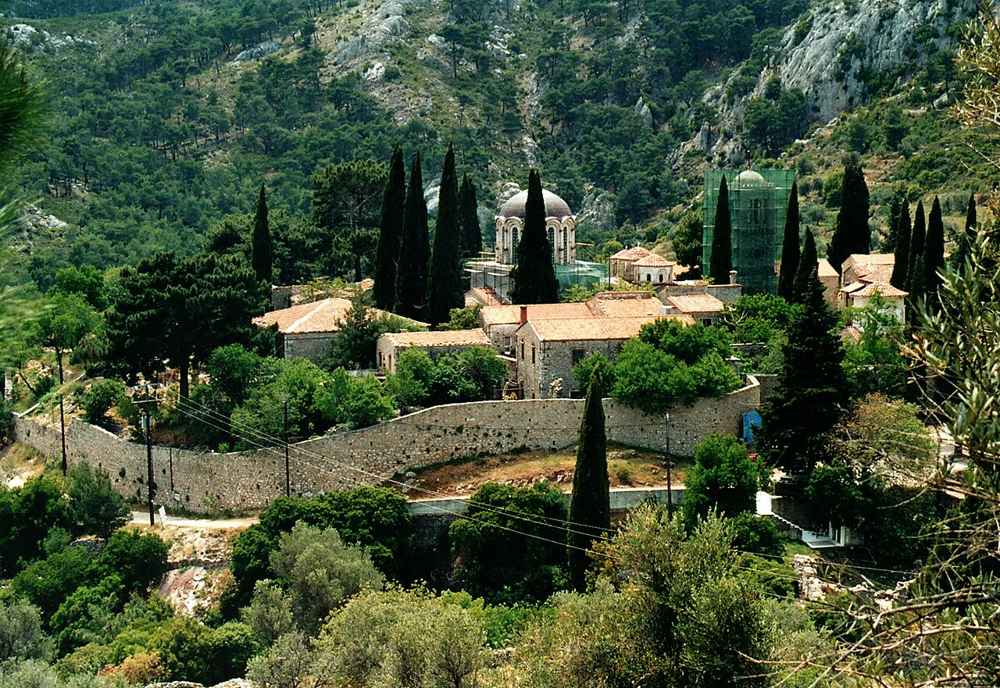
Nea Moni is the greatest monument of Chios and one of the most important Byzantine buildings in Greece. An 11th-century monastery set high in the pine-clad mountains of the island’s centre. Inscribed on the UNESCO World Heritage list for its exceptional gold-ground mosaics, it combines masterpieces of Byzantine art with a moving memorial to the island’s turbulent history. Plan the whole trip with Greece Tours.
This guide covers Nea Moni on Chios: what the monastery is, its history and its famous mosaics, what to see. Its connection to the massacre of 1822. The practical details of visiting, with hours, dress code and how to get there. Read it beside the full Chios travel guide and the guide to the best things to do in Chios.
What is Nea Moni monastery in Chios?
Nea Moni is an 11th-century Byzantine monastery in the mountains of central Chios, about 15 kilometres west of Chios Town.
Nea Moni, meaning the New Monastery, is the cultural jewel of Chios and one of the three great monuments of middle Byzantine art in Greece. Founded in the 11th century and set amid pine forests high in the mountains of the island’s centre, about 15 kilometres west of Chios Town. It is famous above all for the exceptional gold-ground mosaics that decorate its main church, which earned it inscription on the UNESCO World Heritage list.
The monastery is built around its octagonal katholikon, or main church, of a distinctive design known as the island-octagon type. The wider complex includes chapels. A refectory, monks’ cells, a great cistern, a defensive tower and a small museum. Despite the damage of earthquakes and history, it survives as a remarkably complete and atmospheric Byzantine ensemble in a beautiful, peaceful setting.
Still a working monastery, home to a small monastic community, Nea Moni is both a place of living worship and the single most important thing to see on Chios. Drawing visitors for its art, its history and its serene, pine-scented mountain setting. It is an essential and unmissable stop on any visit to the island, as the guide to the best things to do in Chios confirms.
What is the history of Nea Moni on Chios?
Nea Moni was founded in the 11th century by the Byzantine emperor Constantine IX Monomachos, after three hermit monks who had found a miraculous icon of the Virgin on the island foretold his rise to the throne.
The story of Nea Moni begins with three hermit monks living on the mountain, who, according to tradition. Discovered a miraculous icon of the Virgin Mary hanging in a myrtle bush and foretold that the exiled nobleman Constantine Monomachos become emperor. When he duly ascended the Byzantine throne as Constantine IX in 1042, he kept his promise to the monks and funded the building of a great monastery on the spot, dedicated to the Dormition of the Virgin.
Built with lavish imperial patronage between about 1045 and 1055. Supported also by the empresses Zoe and Theodora, Nea Moni was endowed with wealth, land and privileges. And its church was decorated with the finest mosaics that Constantinople provide, making it one of the richest and most important monasteries in the Byzantine world. For centuries it flourished as a major religious and cultural centre on Chios.
Through the Byzantine, Genoese and Ottoman periods the monastery preserved its treasures and its standing, though it suffered greatly in the catastrophe of 1822 and again in the earthquake of 1881, which brought down its great dome, later rebuilt. Despite these blows, Nea Moni endured, and today it stands as a living monastery and a precious survival of eleventh-century Byzantine art and architecture.
What are the famous mosaics of Nea Moni?
The mosaics of Nea Moni are gold-ground Byzantine mosaics of the 11th century depicting scenes from the life of Christ, considered among the finest examples of the ‘Macedonian Renaissance’, alongside those at Daphni and Hosios Loukas.
The mosaics that decorate the katholikon of Nea Moni are the monastery’s supreme treasure and the reason for its worldwide fame. Created in the mid-11th century by artists sent from Constantinople, they cover the upper walls and vaults of the church with scenes from the life of Christ and the great feasts of the Church. Set against shimmering backgrounds of gold, in the sophisticated, classicising style of the period.
Together with the mosaics of the monasteries of Daphni near Athens and Hosios Loukas in central Greece. Those of Nea Moni are regarded as the supreme surviving examples of the artistic flowering often called the Macedonian Renaissance, a high point of Byzantine art. Their elegance, their subtle colour and their radiant gold have drawn art historians, pilgrims and travellers alike for centuries. They lose none of their power in reproduction or in person.
The surviving mosaics remain sweeping, and seeing them in the dim, incense-scented church, glowing in the light, is the highlight of any visit to Nea Moni. They are among the greatest works of Byzantine art to be seen anywhere in Greece, and reason enough in themselves to make the journey to the monastery.
What can you see at the Nea Moni monastery?
At Nea Moni you can see the octagonal main church with its famous mosaics, the smaller chapels, the monks’ refectory, the great cistern, the defensive tower and cells, and a small museum in the old olive press displaying icons, manuscripts.
The heart of the monastery is the katholikon, the main church. An elegant octagonal structure whose interior is adorned with the celebrated gold-ground mosaics and whose atmosphere of hushed devotion rewards an unhurried visit. Around it, the complex reveals the full life of a great Byzantine monastery, with smaller chapels. The long vaulted refectory where the monks ate. The monks’ cells arranged within the walls.
Practical survivals of monastic life include the huge underground cistern that stored the community’s water and the tall defensive tower that offered refuge in dangerous times. Both testifying to the self-sufficiency and vulnerability of the monastery over the centuries. A small museum, housed in the monastery’s old olive press, displays icons, manuscripts, vestments and relics that deepen the picture of its history and treasures.
The most moving sight, however, is the ossuary, a chapel that holds the skulls and bones of victims of the 1822 massacre. A stark and poignant memorial to one of the darkest episodes in the island’s history. Together, the church, the monastic buildings, the museum and the memorial make Nea Moni a rich and affecting place to explore, well worth an hour and a half or more.
What is Nea Moni’s connection to the 1822 massacre?
During the Chios massacre of 1822, in the Greek War of Independence, Ottoman forces sacked Nea Moni, killing the monks and the islanders who had sought refuge there and burning much of the monastery.
The monastery’s history is inseparable from the Chios massacre of 1822, one of the great tragedies of the Greek War of Independence, when Ottoman forces devastated the island in reprisal for its part in the uprising, killing or enslaving tens of thousands of its people. Nea Moni, high in the mountains, became a refuge for islanders, but it did not escape the catastrophe.
The monastery was attacked and sacked, its monks and the refugees sheltering within its walls killed. Much of its fabric burned. A blow from which it never fully recovered and which, together with the earthquake of 1881, reduced the once-mighty foundation. The event, which shocked Europe and inspired Delacroix’s famous painting, remains central to the memory and identity of Chios.
The memory of 1822 is kept at Nea Moni in its ossuary, a small chapel displaying the skulls and bones of the victims, a sombre and powerful reminder of the human cost of the island’s struggle for freedom. This poignant memorial, set amid the beauty of the monastery and its mosaics, gives a visit to Nea Moni an emotional depth beyond its artistic and religious significance. To stand before the gleaming mosaics and the ossuary in the same visit is to feel both the glory and the tragedy of the island’s long history in a single, unforgettable place.
How do you visit Nea Moni, and what are the hours and dress code?
Nea Moni lies about 15 kilometres west of Chios Town, a 20-minute drive by car or taxi. It opens mornings and afternoons, typically with a midday break, and entry is usually free or a small fee.
Nea Moni sits in the mountainous interior of Chios, about 15 kilometres west of Chios Town. Reached in around twenty minutes by hire car or taxi along a scenic mountain road, as there is limited public transport to the monastery. A car also lets you combine the visit easily with the nearby ghost village of Anavatos and the restored village of Avgonyma, making a rewarding half-day into the island’s centre.
The monastery is generally open in the morning and on certain afternoons, typically closing for a couple of hours around midday, though hours vary by season and can change on religious days. It is wise to check locally and arrive earlier rather than later. Entry is usually free or carries only a small charge. It is worth allowing at least an hour and a half to take in the church. The mosaics, the museum and the memorial.
Nea Moni requires modest dress, with shoulders and knees covered for men and women alike. Carry a light layer or wrap, and beachwear is not permitted. Photography be restricted inside the church to protect the mosaics. Follow the posted rules. And note that facilities at the remote monastery are limited, so bring water and anything else you need.
What is near Nea Moni monastery?
Near Nea Moni, in the mountainous centre of Chios, lie the dramatic abandoned ‘ghost village’ of Anavatos on its cliff and the beautifully restored stone village of Avgonyma with its tavernas and views.
Nea Moni sits in the beautiful, pine-clad mountains of central Chios, and it is easily combined with the other highlights of the interior into a single memorable outing. Closest and most striking is Anavatos, the haunting medieval ‘ghost village’ whose grey stone houses cling to a sheer cliff like a natural fortress. Abandoned after the tragedy of 1822 and now a silent, atmospheric ruin with sweeping views, only a short drive from the monastery.
Also nearby is Avgonyma, a beautifully preserved and restored stone village set on a hilltop, whose handsome houses. Narrow lanes and good tavernas make it an ideal place to pause for lunch or a coffee with a view over the surrounding hills and, in the distance, the sea. Its warm, golden stone contrasts with the whitewash of the coast and gives a sense of the island’s mountain heritage.
Together, Nea Moni, Anavatos and Avgonyma form a natural circuit through the scenic heart of Chios. Combining a UNESCO monument, a poignant ghost village and a lovely living village in a half-day trip from Chios Town. Exploring them by hire car, with time to linger at each, is one of the most rewarding things to do on the island, as the wider Chios travel guide describes. The scenic mountain drive that links them, through pine woods with glimpses of the sea. Is a pleasure in itself and shows a side of Chios far removed from its coast and beaches.
What is the architecture of Nea Moni like?
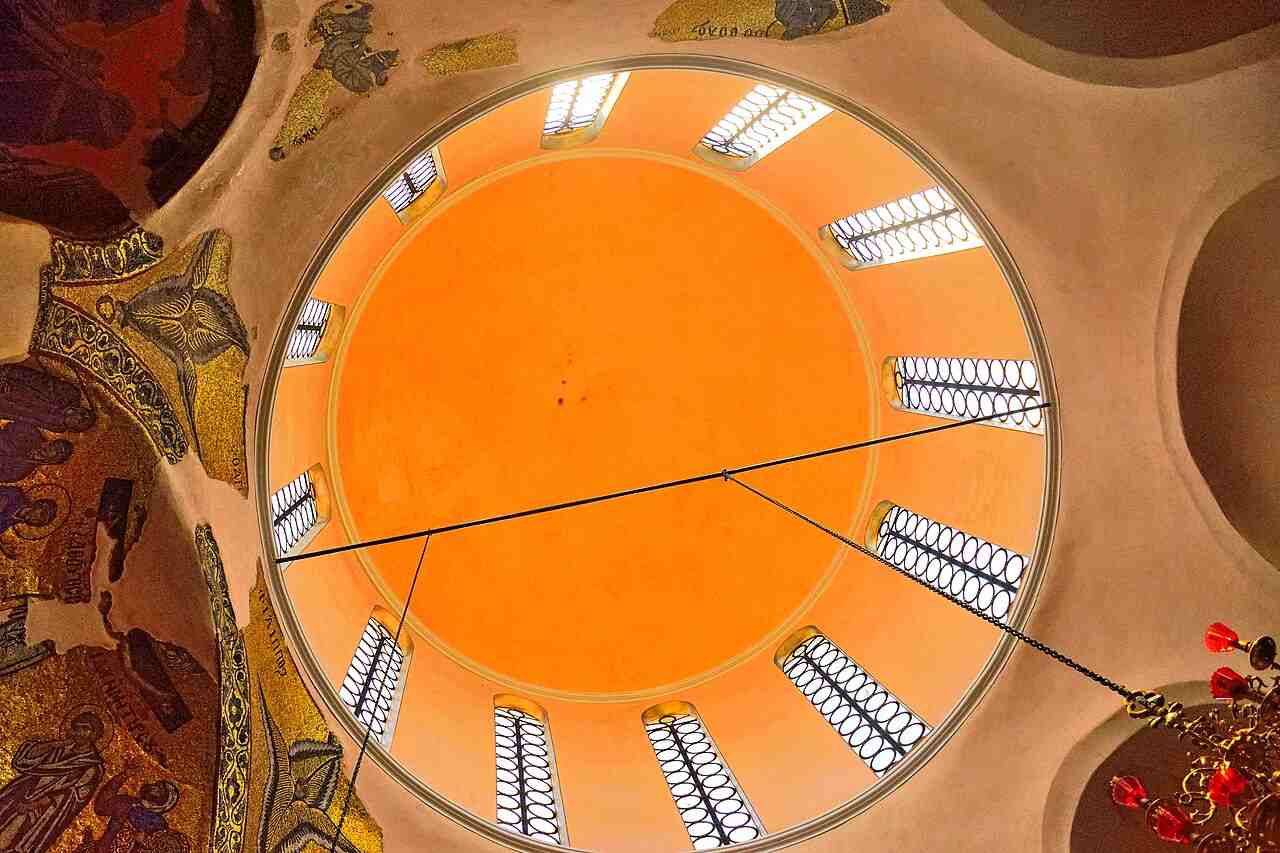
Nea Moni is built around an octagonal main church of the rare ‘island-octagon’ type, in which a single broad dome rests on eight supports over an open, undivided space.
The katholikon of Nea Moni is one of the finest and most distinctive Byzantine churches in Greece, built to a rare plan known as the island-octagon type. Instead of the usual columns dividing the interior, a single wide dome is carried on eight squinches and supports rising from the walls, creating a lofty. Open and undivided central space beneath the dome, an elegant and sophisticated solution that gives the church its sense of soaring unity.
The main church is preceded by two vestibules, an inner narthex and an outer exonarthex, added to the original core. Through which visitors pass to reach the domed nave. The whole interior was clad in fine coloured marbles below and gleaming mosaics above, a display of imperial wealth and artistry. The harmony of architecture and decoration is central to the church’s importance.
The great dome that crowns the church is a later reconstruction, the original having collapsed in the earthquake of 1881. The rebuilding respected the church’s form. And the building retains its essential 11th-century character and remains a rare and precious survival of the age that built it. Together with the smaller chapels, the refectory and the monastic buildings around it. The octagonal church makes Nea Moni an architectural monument of the first rank, quite apart from its celebrated mosaics.
Is Nea Moni worth visiting?
Yes. Nea Moni is the single most important monument on Chios and one of the finest Byzantine monasteries in Greece, combining exceptional UNESCO-listed mosaics, a complete monastic complex, a moving 1822 memorial and a beautiful mountain setting.
For anyone visiting Chios, Nea Moni is unmissable and richly rewarding. Its 11th-century mosaics are among the greatest works of Byzantine art to be seen anywhere in Greece, ranking with those of Daphni and Hosios Loukas. Seeing them in their original setting. Glowing gold in the dim church, is a genuinely moving experience that appeals in equal measure to art lovers, pilgrims and general visitors alike.
Beyond the mosaics, the monastery offers the full sweep of a great Byzantine foundation, from its octagonal church and refectory to its cistern. Tower and museum. Its ossuary memorial to the 1822 massacre gives the visit an emotional depth and connects it directly to the wider, tragic history of the island and its people. All this sits in a beautiful, peaceful mountain setting that is a pleasure in itself.
Combined easily with the ghost village of Anavatos and the stone village of Avgonyma into a half-day trip into the island’s interior. Nea Moni is the highlight of Chios’s cultural sights and one of the main reasons to make the journey to this underrated island. For history, art, faith and setting alike, it is well worth the short trip from Chios Town, as the full Chios travel guide sets out. Few sights in the Aegean pack so much into a single visit. From world-class Byzantine art to a moving memorial and a serene mountain retreat, all within twenty minutes of the island’s capital.
Frequently Asked Questions
Why is Nea Moni a UNESCO World Heritage Site?
Nea Moni was inscribed on the UNESCO World Heritage list in , together with the monasteries of Daphni and Hosios Loukas, as an outstanding example of middle Byzantine architecture and art. Its 11th-century church preserves gold-ground mosaics of exceptional quality, among the finest surviving works of the artistic flowering often called the Macedonian Renaissance. Created by artists sent from Constantinople under the emperor Constantine IX Monomachos. The distinctive octagonal design of its main church and the completeness of its monastic complex add to its significance. UNESCO recognised the three monasteries together as masterpieces representing the high point of this phase of Byzantine art. Making Nea Moni a monument of world importance and the greatest cultural treasure of Chios.
The listing also reflects the completeness of the site, which preserves not only its mosaics but its octagonal church. Its monastic buildings and its long, layered history in a single, remarkably intact ensemble.
How do you get to Nea Moni from Chios Town?
Nea Moni lies about 15 kilometres west of Chios Town. High in the mountainous interior of the island. Is reached in around twenty minutes by car or taxi along a scenic mountain road. There is limited public transport to the monastery. A hire car or a taxi is the practical way to visit. And a car has the advantage of letting you combine Nea Moni with the nearby ghost village of Anavatos and the restored stone village of Avgonyma in a single rewarding half-day trip into the island’s centre. Allow at least an hour and a half at the monastery itself to take in the church, the mosaics, the museum and the ossuary memorial.
Coming in the morning, soon after opening, gives the calmest experience and the best light in the church, and leaves the afternoon free for Anavatos and Avgonyma nearby.
What you wear to visit Nea Moni?
A modest dress code applies: visitors cover their shoulders and knees. Sleeveless tops, short shorts and beachwear are not permitted for either men or women. Carrying a light layer, a shawl or a long wrap is the easiest way to comply, especially in summer, and behaving quietly and respectfully inside the church is expected. Photography be restricted inside the katholikon to protect the fragile mosaics, so watch for the posted signs and follow the guidance of the monastery.
Facilities at the remote mountain monastery are limited, so it is also wise to bring water and to allow time for the scenic drive up from Chios Town.
When was Nea Moni built?
Nea Moni was built in the 11th century, between about 1045 and 1055, under the patronage of the Byzantine emperor Constantine IX Monomachos and the empresses Zoe and Theodora. According to tradition, it was founded after three hermit monks living on the mountain discovered a miraculous icon of the Virgin Mary and foretold Constantine’s rise to the imperial throne. On becoming emperor in 1042 he kept his promise to build them a great monastery. Dedicated to the Dormition of the Virgin. It was richly endowed and its church decorated with the finest mosaics of the age.
Which destroyed its original dome, Nea Moni survives as one of the great Byzantine monuments of Greece. Its mosaics, octagonal church and mountain setting together make it not only the finest monument on Chios but one of the most important medieval sites in the whole Aegean.