
Amorgos has been inhabited since the Early Cycladic era of the third millennium BC. In antiquity it was unusual in holding three separate city-states. Minoa, Arkesini and Aegiali, which together formed a commonwealth known as the Tripolis, each with its own government and coinage. Their remains, on scenic hilltops across the island, along with the fine Archaeological Museum in Chora, reward anyone interested in the island’s deep past. Plan the whole trip with Greece Tours.
This guide covers the ancient sites of Amorgos: the three ancient cities and their commonwealth, the acropolis of Minoa above Katapola. The ancient city of Arkesini and the Tower of Agia Triada, ancient Aegiali. The museum that holds the finds. Read it beside the wider Amorgos travel guide and the guide to the capital, Chora.
What ancient sites can you see in Amorgos?
Amorgos has the remains of three ancient cities, Minoa above Katapola, Arkesini in the south and Aegiali in the north, along with the well-preserved Hellenistic Tower of Agia Triada and the Archaeological Museum in Chora, which displays finds from across.
Amorgos is rich in ancient remains for a small island, the legacy of a long history reaching back to the Early Cycladic period. In antiquity it held three separate city-states, an unusual arrangement. Their acropolises survive on hilltops across the island: Minoa above the port of Katapola. Arkesini in the south, and Aegiali in the north.
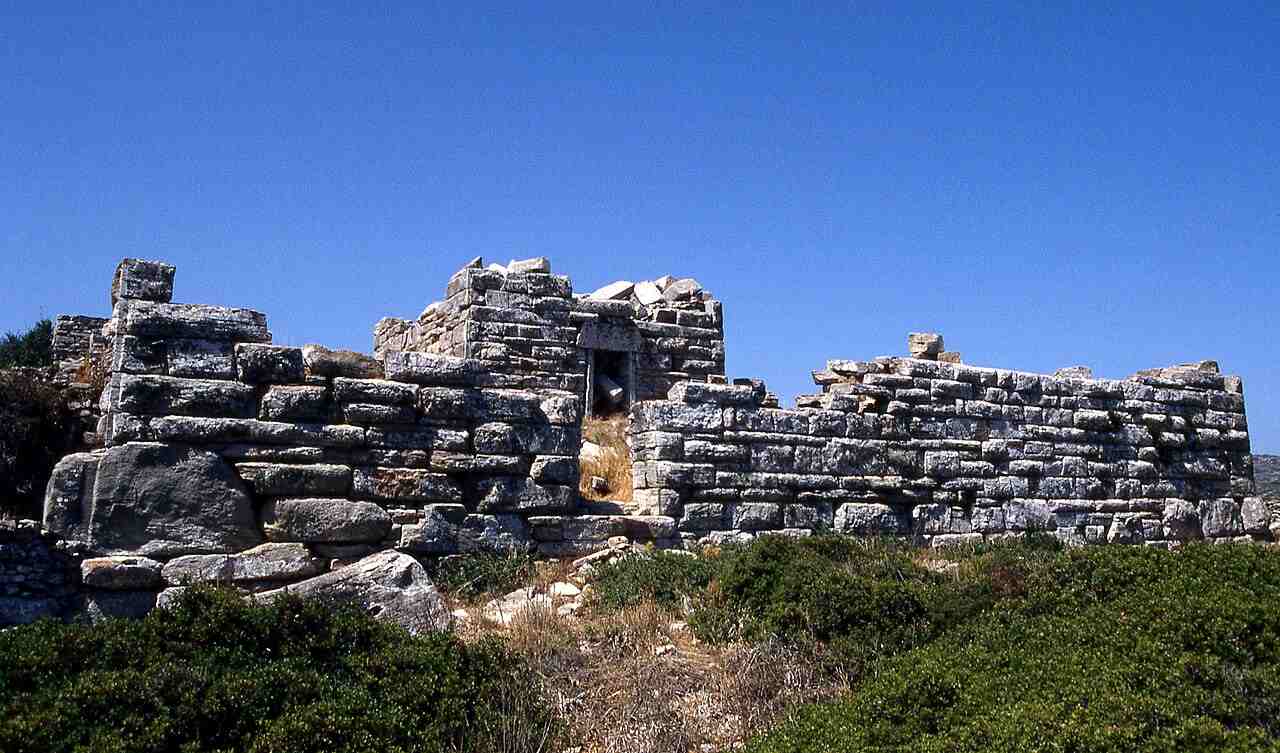
Alongside the three cities stands one of the finest ancient monuments in the Cyclades, the Tower of Agia Triada, a remarkably well-preserved Hellenistic watchtower near Arkesini. The finds from all these sites are gathered in the Archaeological Museum in the capital, Chora, giving a rounded picture of the island’s classical past.
The sites occupy scenic, often dramatic positions with fine views, and reaching them, on foot or by car, makes a rewarding counterpoint to the beaches. The sections below take each in turn, along with the museum and how to visit them, for anyone drawn to the deep history of Amorgos.
What were the three ancient cities of Amorgos?
In antiquity Amorgos held three independent city-states, Minoa, Arkesini and Aegiali, which together formed a commonwealth known as the Tripolis.
Unusually for so small an island, ancient Amorgos was divided among three separate city-states: Minoa in the centre above Katapola, Arkesini in the south-east, and Aegiali in the north. Each was an independent polis with its own system of government and, remarkably, its own currency, reflecting a real political separateness within the one island.
The three cities together formed a loose commonwealth known as the Tripolis, the three-city league. Which gave Amorgos a combined weight, with a significant naval and commercial presence in the Aegean of the classical era. Their prosperity is reflected in the scale and quality of their remains and in the finds now in the museum.
This three-city arrangement is one of the distinctive features of the island’s ancient history. Tracing the three acropolises across Amorgos. From Minoa to Arkesini to Aegiali, is a way of reading the deep past into the modern landscape of ports, villages and hills.
What is ancient Minoa above Katapola?
Minoa was the central ancient city of Amorgos, on Moundoulia hill above the port of Katapola.
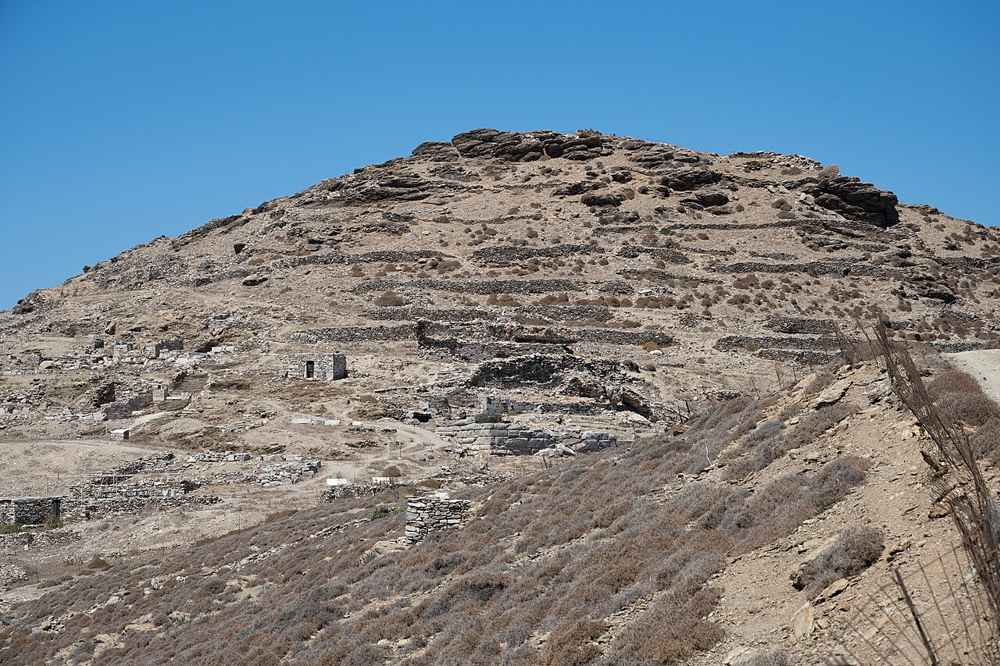
Ancient Minoa occupies the commanding Moundoulia hill directly above the port of Katapola. By legend it was linked to the Cretan king Minos, said to have spent his summers here. Excavation has shown the site to have been continuously and prosperously inhabited from around the eleventh century BC to the fourth century AD. One of the great centres of ancient Amorgos.
The remains reward the visit: a defensive wall from the Geometric period, extended over time with bastions. Encircles the acropolis. The foundations of a long gymnasium building of the fourth century BC dominate the site, along with the traces of temples and other structures scattered across the hill.
A path climbs from Katapola to the ancient city in around thirty-five to forty minutes, and the hilltop rewards the effort with sweeping views over the bay as well as the ruins, as the guide to Katapola describes. It is the most accessible of the island’s three ancient cities.
What is ancient Arkesini and the Tower of Agia Triada?
Arkesini was the ancient city of southern Amorgos, founded by Ionian colonists from Naxos, with surviving fortifications and a monumental double gate.
In the south-east of the island, ancient Arkesini was founded during the Geometric period by Ionian colonists from neighbouring Naxos. The site preserves parts of its fortification walls and, most strikingly, a monumental double gate. Testimony to the strength and reach of this southern city-state among the terraces above the sea.
Close by stands the island’s most celebrated ancient monument, the Tower of Agia Triada. A Hellenistic watchtower of finely dressed stone that survives remarkably intact, among the best-preserved ancient towers in the Aegean. It once guarded the territory of Arkesini, and its solid, elegant form is a highlight of the quiet south.
The ancient city and the tower lie near the modern villages of the south, such as Vroutsi, reached by the winding southern road and a short walk. Combining them with the wild beaches and unspoilt villages of the south, covered in the guide to the villages of Amorgos, makes a rewarding day in the island’s quietest corner.
What is ancient Aegiali in the north?
Aegiali was the third ancient city of Amorgos, its acropolis on the Vigla hill above the modern bay of Aegiali.
The third of the island’s ancient city-states, Aegiali, had its acropolis on the Vigla hill above the broad northern bay that still bears its name. Like Minoa and Arkesini it was an independent polis in antiquity, part of the island’s three-city commonwealth, though less survives and less is visited here than at the other two.
The site occupies a fine, defensible height with wide views over the bay of Aegiali and the sea. It is reached by a short walk of around fifteen minutes from the mountain village of Tholaria. Making it an easy addition to a stay in the north or a walk among the Aegiali villages.
For visitors based at Aegiali for the beach and the hiking, the ancient acropolis on Vigla adds a note of deep history to the northern bay, tying the modern resort and its mountain villages to the island’s classical past, as the guide to Aegiali describes.
What can you see in the Archaeological Museum of Amorgos?
The Archaeological Museum of Amorgos, in the Gavras Tower in Chora, displays finds from the three ancient cities of Minoa, Arkesini and Aegiali, including sculpture, inscriptions and everyday objects, giving a picture of the island’s long history in an atmospheric.
The finds from the island’s ancient sites are gathered in the Archaeological Museum, housed in the Gavras Tower, a fine Venetian-era tower house in the heart of the capital, Chora. The collection brings together sculpture, inscriptions, pottery and everyday objects excavated from Minoa, Arkesini and Aegiali, a rounded record of ancient Amorgos.
Displayed in the atmospheric rooms of the old tower. The exhibits let visitors connect the ruins on the hilltops with the objects and inscriptions they yielded, deepening a visit to the sites themselves. For a small island, the museum offers a rewarding glimpse into a long and prosperous classical past.
The museum makes an easy, shaded stop on a wander through Chora. It pairs naturally with a climb to ancient Minoa above Katapola or a trip to Arkesini in the south. Seeing the ruins and the museum together gives the fullest sense of the island’s antiquity, as the guide to Chora describes.
How do you visit the ancient sites of Amorgos?
The ancient sites of Amorgos are reached on foot or by car: Minoa by a 35-minute walk from Katapola, ancient Aegiali by a short walk from Tholaria, and Arkesini and the Tower of Agia Triada by the southern road and.
Each of the island’s ancient cities is reached by a walk from the nearest settlement. Ancient Minoa is a climb of around thirty-five to forty minutes from the port of Katapola. Ancient Aegiali a shorter walk of about fifteen minutes from the mountain village of Tholaria. Arkesini and the nearby Tower of Agia Triada a short hike from the southern village of Vroutsi.
A hire car or scooter makes reaching the scattered sites far easier, especially Arkesini and the tower in the remote south, which the bus does not serve, as the guide to car rental in Amorgos describes. The sites are open and free to wander, so good shoes, water and sun protection are the main requirements.
A rewarding way to see the island’s antiquity is to combine the Archaeological Museum in Chora with a climb to Minoa above Katapola and. For the keen, a trip to Arkesini and the tower in the south. Together they trace the three ancient cities and the deep history of Amorgos across its dramatic landscape.
Frequently Asked Questions
What are the main ancient sites in Amorgos?
The main ancient sites in Amorgos are the three ancient city-states of Minoa, above the port of Katapola. Arkesini in the south-east. Aegiali in the north, which together formed a commonwealth known as the Tripolis. Near Arkesini stands the remarkably well-preserved Hellenistic Tower of Agia Triada. One of the finest ancient monuments in the Cyclades. The finds from all the sites are displayed in the Archaeological Museum in the Gavras Tower in Chora.
How do you get to ancient Minoa in Amorgos?
Ancient Minoa occupies the Moundoulia hill directly above the port of Katapola, and it is reached by a footpath that climbs from the port in around thirty-five to forty minutes. The site is open and free to wander. With the remains of a Geometric defensive wall and a fourth-century BC gymnasium. The hilltop rewards the climb with sweeping views over the bay of Katapola as well as the ruins. Sturdy shoes, water and sun protection are advisable for the walk up.
Are the ancient sites of Amorgos worth visiting?
Yes, for anyone interested in Greek history. Amorgos is unusual in having held three ancient city-states, Minoa, Arkesini and Aegiali. Whose acropolises survive on scenic hilltops across the island, along with the beautifully preserved Hellenistic Tower of Agia Triada near Arkesini. The sites occupy dramatic positions with fine views. The finds are displayed in the Archaeological Museum in Chora. Giving the island a cultural depth beyond its beaches and a rewarding day for those drawn to its deep past.