
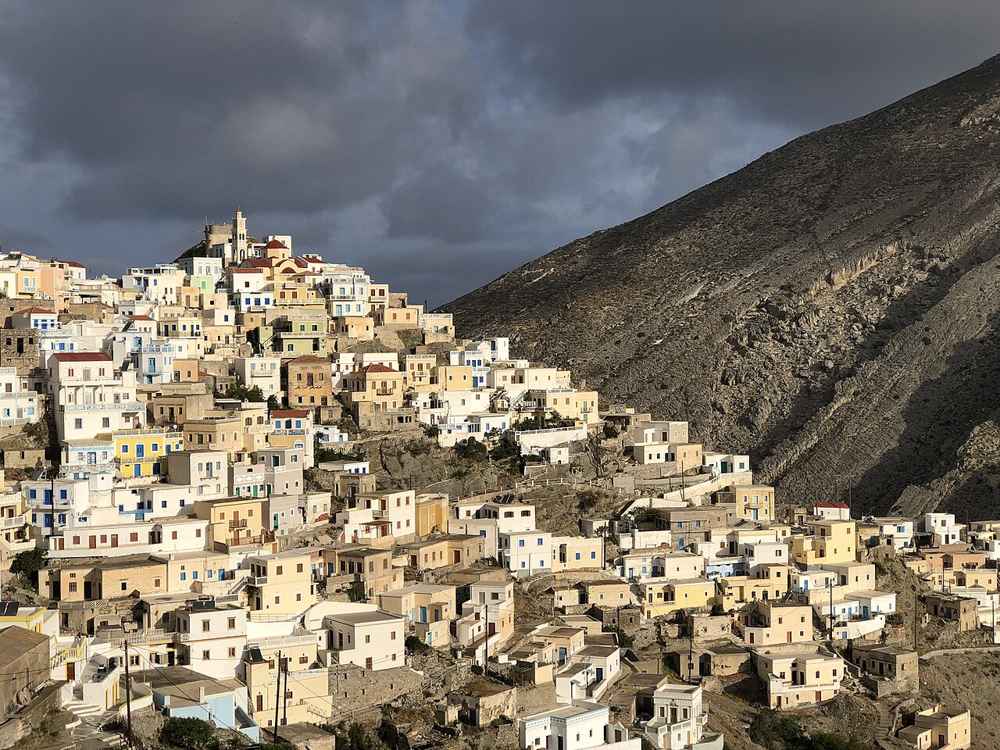
Olympos clings to a mountain ridge in the far north of Karpathos, a village so cut off for so long that it kept traditions the rest of Greece let go. Older women still wear embroidered dress and leather boots as everyday clothing. The local speech carries sounds of ancient Doric Greek. Property passes down through the eldest daughter rather than the son. Founded in the seventh century by people fleeing pirate raids on the coast, it reads today as a living folklore museum that has never stopped being a working village. Plan the whole trip with Greece Tours.
This guide covers everything a visitor needs: the two ways to reach the village, the windmills and the frescoed church. The costume and the dialect, the festivals and the food. Where to stay to see Olympos after the day-trippers leave. It also maps what lies nearby, from the farming hamlet of Avlona to the ancient tombs of Vroukounta and the port of Diafani. Read it alongside the wider guide to things to do in Karpathos to fit the north into a full trip.
Why is Olympos village so special?
Olympos preserves living traditions found nowhere else in Greece: everyday embroidered costume, an archaic Doric dialect, matrilineal inheritance, and working windmills. Its isolation on a mountain ridge kept these customs intact into the present day.
The village sits high on the ridge of Profitis Ilias, built inland and hidden from the sea so that raiders not spot it from the water. That defensive seclusion, combined with the sheer difficulty of reaching the north of Karpathos until a road arrived in recent decades. Sealed Olympos off from the changes that swept the rest of the country. What survives is not a reconstruction for tourists but a genuine continuity of dress, speech, craft and custom that anthropologists have studied for a century.
The most visible sign is the costume. Older women wear the everyday version daily. An embroidered dress with a headscarf and tall leather boots called stivania. On feast days the full ceremonial dress appears with rows of gold coins and elaborate embroidery. Property and the family house pass to the eldest daughter, the kanakara, rather than the eldest son. A matrilineal system unusual in Greece and central to how the village has held its land together across generations.
Beyond the costume, the whole fabric of the village speaks to its past. Whitewashed houses with carved wooden balconies stack up the slope, cobbled lanes wind between them too narrow for cars, and a line of windmills crowns the ridge. The people who live here bake in wood ovens, weave on floor looms and speak a dialect that startles even other Greeks. Olympos is the cultural heart of Karpathos and one of the most distinctive villages in the Aegean.
How do you get to Olympos in Karpathos?
Reach Olympos by the mountain road from Pigadia in about two hours, or take the morning boat to the port of Diafani and ride the connecting minibus up the last eight kilometres.
Olympos lies roughly 55 to 58 kilometres north of Pigadia, the capital, but distance means little on these roads. The paved mountain route climbs and twists for about two hours behind the wheel. Crossing the barren spine of the island with long drops and wide views before dropping toward the northern ridge. A hire car or scooter gives the freedom to stop along the way, though the drive demands care and a full tank, since there are no fuel stations in the north.
The alternative is more relaxing and more scenic. The daily excursion boat leaves Pigadia harbour in the morning and cruises north along the cliffs for about two hours to the small port of Diafani, the gateway to Olympos. From Diafani a connecting minibus climbs the last eight kilometres of hairpins to the village, timed to meet the boat, and returns in the afternoon. This turns the journey itself into part of the day out.
Walkers have a third option: the old signed footpath that climbs from Diafani through pine and terraces to Olympos in about two and a half hours. Many combine the routes, riding the boat up and the minibus down, or driving one way and walking another. However you arrive, the village is car-free, so you park or are dropped at the edge and continue on foot into the stepped lanes.
What is there to see in Olympos village?
The highlights are the ridge of windmills, the frescoed church of the Dormition with its gold icons, the maze of cobbled lanes and balconied houses, and the wood-oven bakeries. The whole village is an open-air museum you explore on foot.
Start with the church of the Dormition of the Virgin, the most important monument on the island, set near the top of the village. Its tall belltower stands over the rooftops, and inside the walls carry vibrant Byzantine-era frescoes and a screen of valuable gold icons. The square around it is the social centre of Olympos, where the tavernas cluster and the view opens north toward the sea. From here the village falls away down the slope in tiers of colour.
Walk the single main lane and the alleys that branch off it, and the village reveals itself slowly. Houses painted white, ochre and blue press together with carved wooden balconies and painted doors, and small chapels tuck into corners. The lanes are stepped and too narrow for any vehicle. The pace is entirely on foot. And every turn frames a new view of rooftops against the mountain or the distant blue of the Aegean.
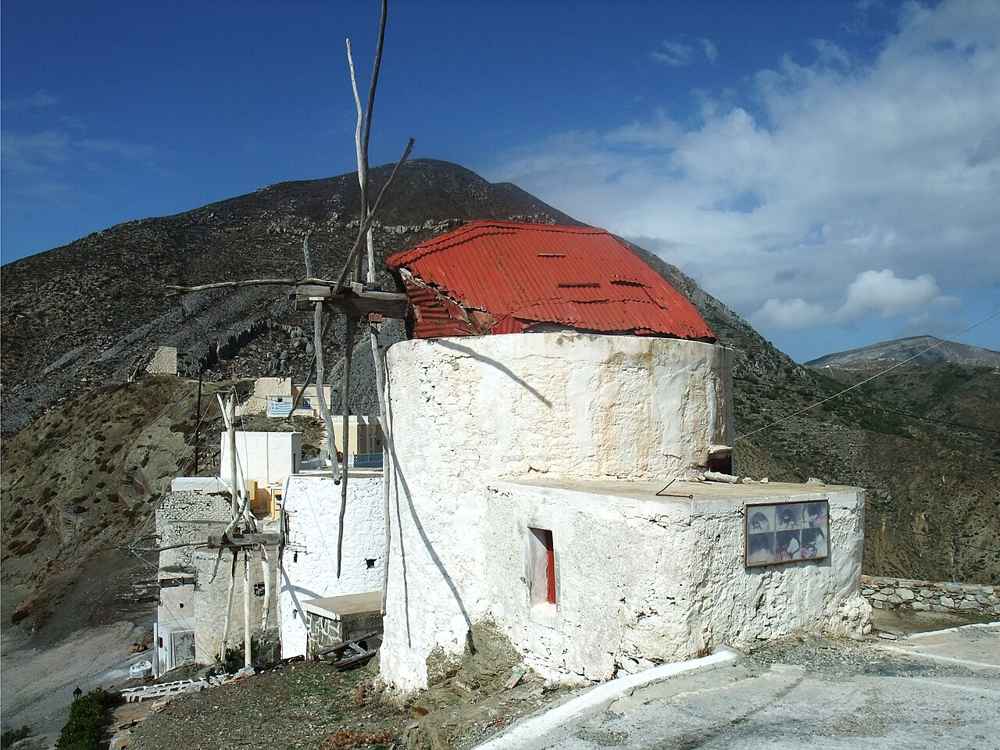
Do not leave without climbing to the west ridge, where a line of stone windmills stands against the sky. Several are ruined, but one has been restored and still grinds grain, its sails turning in the meltemi, and the owner explains the workings to visitors. The bakeries lower in the village fire their wood ovens through the day. The smell of fresh bread and pies drifting through the lanes is as much a part of Olympos as anything you can photograph.
Why do the women of Olympos wear traditional costume?
The women of Olympos wear costume as an unbroken living tradition, not a performance. An everyday embroidered dress with boots and a headscarf is worn daily by older women, while the full gold-trimmed ceremonial dress appears at festivals.
In most of Greece traditional dress survives only in museums or on festival days, but in Olympos it never stopped being ordinary clothing. Older women wear the everyday costume as a matter of course throughout the day: a dark embroidered dress, an apron. A patterned headscarf. The tall soft leather boots known as stivania that suit the steep cobbled lanes of the village. Younger women wear it less often now, a sign of slow change, but it remains a genuine part of daily life rather than a show staged for visitors.
The festival costume is a different order of splendour. For the great feast days women bring out the ceremonial dress, layered and heavily embroidered. With a collar and bib of gold coins that can represent a family’s wealth passed down the female line. The coins, the embroidery and the way the costume is assembled all carry meaning about status. Marriage and lineage. Dressing for a festival is a careful, communal act rather than a quick change of clothes.
The costume ties directly to the village’s matrilineal customs. Because the family house and land pass to the eldest daughter, the woman is the anchor of the household, and her dress signals that role. Visitors are welcome to watch and to photograph respectfully. The costume is worn for the women themselves and their community. Part of an identity Olympos has guarded through centuries of isolation.
What is the dialect of Olympos?
Olympos speaks an archaic form of Greek that preserves sounds and words from ancient Doric. Linguists prize it as one of the most conservative dialects surviving in the Greek world, kept alive by the village’s long isolation.
The Greek spoken in Olympos is not the standard modern language of Athens. Centuries cut off on a northern ridge preserved a dialect that retains features of ancient Doric Greek, including sounds and grammatical forms that vanished elsewhere long ago. Words survive here that appear in no other living speech. The pronunciation can be hard even for other Greeks to follow. Which is one reason scholars have travelled to Olympos to record it since the nineteenth century.
The dialect is bound up with the village’s other traditions. Songs, proverbs and the improvised couplets called mantinades are performed in it at festivals. Carried by the lyra and laouto. The language lives in music as much as in daily talk. This oral culture, passed from one generation to the next without being written down, is as much a part of the village’s heritage as the costume or the architecture.
For a visitor the dialect is mostly something to be aware of rather than to master. Villagers switch to standard Greek and often some English with outsiders. Communication is easy. But listening to older residents talk among themselves gives a sense of how deep the difference runs. It is a reminder that Olympos is not simply a pretty village but a distinct linguistic island within Greece.
What can you eat in Olympos?
Olympos serves mountain Karpathian food from wood ovens: makarounes pasta with fried onion and sitaka cheese, fresh bread and pies, slow-cooked goat, and honey-soaked sweets. Terrace tavernas pair it with local wine and a view north.
The signature dish is makarounes, short twists of pasta rolled by hand, boiled and topped with sweet fried onion and sitaka, a soft sour goat’s-milk cheese. It appears on every menu in the village and is the taste most visitors carry home. Alongside it the wood ovens turn out fresh bread, savoury pies of wild greens and cheese. Slow-cooked goat with rice or potatoes. The plain, rich cooking of a mountain community that fed itself for centuries.
The bakeries of Olympos are worth seeking out in their own right. Bread, rusks and sweets bake in the same wood ovens the village has always used, and the aroma carries through the lanes. Honey-soaked sesame sweets, almond biscuits and baklava round out a meal. The shops sell loaves and pies to take away for a picnic on the walk to Diafani or the drive back south.
Sit at a terrace taverna near the church square and the food comes with a long view over the north of the island. The tavernas pour local Karpathian wine, often from the highland vineyards to the south, and the pace is unhurried. Eating in Olympos is inseparable from its setting, and a slow lunch on a balcony above the rooftops is one of the pleasures of a visit to the village.
When is the festival in Olympos?
The great festival is the Dormition of the Virgin on the fifteenth of August, when Olympos fills with islanders in full costume, lyra music and dancing that lasts past dawn. Smaller saints’-day panigiria run through the summer.
The fifteenth of August, the feast of the Dormition of the Virgin, is the high point of the village year. Karpathians who have emigrated across the world return home for it, the church fills for the liturgy, and afterward the whole village gives itself over to celebration. Women appear in the full ceremonial costume with its gold coins, the lyra and laouto play, and the slow local dances continue through the night into the following day. Booking a bed anywhere near this date is difficult and must be done far ahead.
The August festival is genuine rather than staged, a homecoming and a religious observance as much as a spectacle. Visitors are welcomed to watch and often to join the dancing. The scale of it, with returning families packing the lanes and tables laid with goat, makarounes and wine, gives an unmatched view of Karpathian culture at full strength. The ferries and flights to the island run full around the date, so plan the whole trip around it if you hope to attend.
Beyond the Dormition, smaller feast days dot the summer calendar. The nearby cliff-church of Agios Ioannis at Vroukounta draws a pilgrimage in late August, and other saints’ days bring their own celebrations to Olympos and the northern hamlets. If your visit falls on any of them, ask which chapel is celebrating and go, since a village panigiri is the surest way to experience the living tradition rather than simply to look at it.
What are the windmills of Olympos?
A line of stone windmills crowns the west ridge of Olympos, once used to grind the village’s grain. Several stand in ruin, but one has been restored and still works, its sails driven by the meltemi wind.
The windmills are among the enduring images of Olympos, a row of round stone towers strung along the exposed western ridge above the houses. For centuries they harnessed the steady meltemi wind to grind the wheat and barley grown on the village’s terraces into flour for its bread. Their position on the ridge caught the wind, and their number reflects how much grain a self-sufficient mountain community once needed to process by hand.
Most of the mills fell out of use as cheap flour arrived from outside and the population thinned, and several now stand as roofless shells. One, however, has been restored to working order, complete with cloth sails and the internal machinery of millstones and gears. On windy days it turns and grinds. The miller shows visitors how the sails are set and the grain is fed. A rare chance to see a pre-industrial mill actually working rather than preserved as a static exhibit.
The walk up to the windmills is short but rewarding. The ridge gives the widest view in the village. Out over the rooftops to the sea on both sides of the island. Sunset is the finest time to be there, when the light gilds the stone towers and the houses below. The mills tie the village’s food, its wind and its landscape together in a single line along the skyline.
Can you hike from Diafani to Olympos?
Yes. An old signed footpath climbs from the port of Diafani through pine woods and terraces to Olympos in about two and a half hours.
The path between the port of Diafani and the village of Olympos was the main link. It survives today as a cleared, waymarked trail. It climbs steadily for roughly seven kilometres through pine woods, past ruined chapels and old terraced fields, gaining height until Olympos appears on its ridge above. The walk takes about two and a half hours at a steady pace and rewards the effort with views back down to the coast and the sea.
The usual plan is to ride the morning boat from Pigadia to Diafani, walk up to Olympos. Explore the village. Take the minibus back down to catch the afternoon boat home. This makes a full and satisfying day that combines a cruise, a hike and the village itself. Carry water, a hat and sturdy shoes, since shade is patchy and the sun strong, and start the climb early in summer to finish before the midday heat.
The Diafani trail is the best known of several old footpaths in the north. Others lead from Olympos out to the farming hamlet of Avlona and on to the ancient site of Vroukounta above the sea. For walkers, the north of Karpathos is among the most rewarding corners of the Greek islands. Its paths quiet and its landscapes unspoiled. Olympos makes the natural base or goal for a day on foot.
Where can you stay in Olympos?
Olympos has a handful of small guesthouses and rooms within the village, letting you stay overnight to see it empty of day-trippers. Diafani, the port below, offers more rooms and its own quiet beaches.
Most visitors see Olympos on a day trip and leave in the afternoon, which is exactly why staying overnight is worthwhile. A small number of guesthouses and rented rooms sit within the village. Often in restored traditional houses with balconies over the lanes. They let you experience Olympos after the boats have gone. In the evening the village belongs to its residents again, the tavernas quieten, and the lanes and the ridge take on a stillness the day never shows.
Rooms in the village are simple and limited, so book ahead, especially in summer and above all around the fifteenth of August when they fill months in advance. Staying up here suits travellers who want the atmosphere over comfort and convenience. Who plan to walk or explore the north rather than dart back to the beaches each day. Waking to the sound of the village and watching the light come up over the sea is the reward.
The port of Diafani, eight kilometres below, is the practical alternative. It has more rooms and small hotels, its own pebble-and-sand beaches, tavernas on the quay, and the boat connection to Pigadia. Basing yourself in Diafani lets you combine the village, the beaches and the walks of the north over a couple of days. Using the minibus or the footpath to reach Olympos above.
What is the history of Olympos?
Olympos was founded in the seventh century by inhabitants of the ancient coastal town of Vrykous, who moved inland to escape pirate raids. Its remote ridge kept it isolated for over a thousand years, preserving its traditions.
The village traces its origin to the early Byzantine centuries, when repeated pirate raids made the exposed coast of northern Karpathos dangerous to inhabit. The people of the ancient town of Vrykous, near the modern site of Vroukounta. Withdrew inland and upward to the ridge of Profitis Ilias, where a settlement hidden from the open sea offered lasting safety. Olympos grew there from around the seventh century, its position chosen for defence rather than convenience.
For more than a thousand years the village lived in near-total isolation. There was no road. Contact with the rest of the island came on foot or by boat to Diafani. The sheer effort of the journey kept outside influence to a minimum. That isolation is the single reason the dialect, the costume, the inheritance customs and the crafts survived so intact, while similar traditions faded across the rest of Greece under the pressures of modern life.
Change came slowly and late. Emigration in the twentieth century sent Olympites abroad, especially to the United States. The money they sent home is visible in the grand houses of the village and in the neighbouring villages to the south. And the strong ties between Olympos and its diaspora in the United States remain a defining feature of the community today. The road that finally linked Olympos to Pigadia arrived only in recent decades, and with it tourism, which most villagers now regard as the way to keep the community alive. The challenge Olympos faces is holding on to its traditions while opening its doors.
What can you buy in Olympos?
The best buys in Olympos are hand-woven textiles from the village looms, fresh bread and sweets from the wood ovens, and local honey and herbs. Buying from the makers helps keep the crafts alive.
Olympos is one of the last places in Greece where weaving on floor looms remains a living craft. The women of the village produce striped cloth, table runners, bags and the woven trimmings of the traditional costume, and small shops along the main lane sell them. The patterns and the bright woven bands are unlike anything made elsewhere. A direct link to the costume you see worn in the village. A length of Olympos cloth is the most meaningful thing to carry home.
The wood-oven bakeries are the other great stop. Loaves, rusks, savoury pies and honey-soaked sweets bake fresh through the day, and they sell to take away as well as to eat in. A bag of village bread or a box of sesame sweets makes a simple. Authentic souvenir. It fuels the walk down to Diafani or the long drive back to the south of the island.
Fill out a purchase with the mountain pantry: thyme and wildflower honey from the northern slopes, dried herbs, and small jars and bottles sold in the village shops. Prices are fair, and because so much of what is sold in Olympos is genuinely made or gathered here rather than imported. Shopping in the village supports the households directly and helps sustain the traditions that make it worth visiting.
What is there to do around Olympos?
Around Olympos lie the farming hamlet of Avlona, the ancient tombs and cliff-church of Vroukounta, the port and beaches of Diafani, and boat trips to the wild uninhabited islet of Saria.
North of Olympos the road and old paths lead to Avlona. A farming hamlet on a high plain where villagers still work the terraced fields and keep the traditional way of life at its plainest. From Avlona a path continues to Vroukounta, the ancient town site on a headland above the sea. Where rock-cut chamber tombs line the cliff and the cave-church of Agios Ioannis is hollowed into the rock, filling with pilgrims who walk out from Avlona for its August festival each year.
Below the village, the port of Diafani is worth a half-day of its own. Its quiet harbour has seafood tavernas, a pebble-and-sand town beach, and a coastal path north to secluded coves such as Vananda in its green gully. Diafani is also the launch point for excursion boats to the uninhabited islet of Saria, off the northern cape. Where Byzantine ruins stand behind empty beaches and the water runs a deep, clear blue with only the day’s boat passengers for company.
The northern coast holds beaches that only the sea reaches, and a boat trip is the way to see them. The wider guide to Karpathos beaches covers the coves and how to reach them. Between the walking, the ruins, the port and the boat trips, the north of the island easily fills a couple of days. With Olympos as its natural centre and the finest place to be based or to aim for.
What music and dance will you hear in Olympos?
Olympos keeps a strong living tradition of lyra and laouto music, improvised rhyming couplets called mantinades, and the slow local syrto dance. The music comes alive at festivals and weddings and carries the village’s dialect and poetry.
The sound of Olympos is the Karpathian lyra, a three-stringed bowed instrument, paired with the laouto, a long-necked lute that drives the rhythm. Together they carry the music of the village at every celebration. From a saint’s-day panigiri to a wedding. A good lyra player is a figure of real standing in the community. The tunes are old and local, distinct from the music of other Greek islands, and they set the whole village dancing when the festivals come round.
Woven into the music are the mantinades, improvised rhyming couplets that singers trade back and forth, commenting on love, loss, the village and the moment. They are performed in the local dialect. The poetry carries the same archaic language that makes Olympos speech unique. And the exchange of couplets between singers can continue for hours as a kind of contest. This oral art, unwritten and passed down by ear, is among the village’s living treasures.
The dancing is the slow, dignified syrto of Karpathos, performed in a line or circle with the dancers linked, led by the head of the line who improvises steps. At the August festival the church square and the lanes fill with dancers in costume, and the celebration runs late into the night. A visitor who happens on a panigiri or a wedding sees this whole tradition of music, poetry and dance as the village lives it, not as a show.
How much time do you need in Olympos?
A half-day is enough to walk the village, see the church and windmills and have lunch. An overnight stay lets you experience Olympos after the day-trippers leave and to explore the wider north.
Olympos is not large, and the core of a visit, walking the main lane and its alleys, seeing the church and climbing to the windmills, takes only hours. Most day-trippers arrive around midday on the boat-and-minibus route, spend three or four hours in the village with lunch on a terrace, and leave in the afternoon. That is enough to take in the highlights and the atmosphere, and it fits Olympos into a single day from Pigadia or Diafani.
To go deeper, stay the night. An overnight in the village, or in Diafani below, transforms the experience: the day crowds thin out by late afternoon. The light softens on the stone. The village returns to its own rhythm. You wake to Olympos as its residents know it, quiet and unhurried, and you have time to linger over the details a rushed visit misses.
For anyone drawn to the walking, the ruins and the beaches of the north, two days built around Olympos is the sweet spot. That allows the Diafani hike, a boat trip to Saria, a visit to Avlona and Vroukounta, and unhurried time in the village itself. However long you give it, treat the journey north as part of the visit rather than an obstacle, since the cruise or the mountain drive is memorable in its own right.
When is the best time to visit Olympos?
Late spring and early autumn bring warm, calm weather and thinner crowds, the ideal time to walk and explore. The fifteenth of August offers the great festival but heavy crowds; the village quiets sharply out of season.
The shoulder months of late spring and early autumn are the finest time to visit Olympos. The weather is warm without the fierce heat of high summer, the walking paths are comfortable. The village sees fewer day-trippers, so its lanes and tavernas keep a calm that July and August can lose. Spring adds wildflowers to the northern slopes, while autumn holds warm sea and settled light for the boat trip up.
High summer brings the strongest atmosphere and the biggest crowds at once. The fifteenth of August is unmatched for the festival, with the whole village in costume and celebration, but the same date packs the ferries, the flights and every room. If you come for the festival, plan and book far ahead. If you come simply to see the village, the days either side of the peak are calmer and just as rewarding.
Out of season, from late autumn into spring, Olympos turns quiet and inward. Many tavernas and rooms close, the boat service thins, and the north can feel remote and shuttered, though the village keeps its everyday life. For most visitors the window from May to early October is the practical season. With the shoulder weeks the sweet spot for combining good weather, open tavernas and room to explore. See the wider Karpathos travel guide for ferry and flight timing.
Frequently Asked Questions
Is Olympos in Karpathos worth visiting?
Yes. Olympos is one of the most distinctive villages in Greece, a living community that has preserved its costume, dialect, crafts and inheritance customs through centuries of isolation. Its windmills, frescoed church and cobbled lanes. The journey north to reach it, make it the cultural highlight of Karpathos and worth the effort for any visitor to the island. There is genuinely nowhere else quite like it in Greece, and even travellers short on time make room for a day in the north to see it.
How far is Olympos from Pigadia?
Olympos lies roughly 55 to 58 kilometres north of Pigadia, the capital of Karpathos, but the mountain road takes about two hours to drive because of its climbs and switchbacks. The alternative is the daily boat from Pigadia to the port of Diafani, about two hours, followed by a minibus up the last eight kilometres to the village. Walkers can also climb the old footpath from Diafani to Olympos in about two and a half hours. One of the finest and most scenic walks anywhere in the Dodecanese islands.
Do people still live in Olympos?
Yes. Olympos is a genuine working village, not a museum, though its population has thinned through emigration. Older women still wear the traditional costume as everyday dress, the bakeries and looms still work, and the community celebrates its festivals as it always has. Tourism now supports much of the village, which most residents see as the way to keep it alive.
Can you do Olympos as a day trip?
Yes. Most visitors see Olympos on a day trip, either driving the mountain road from Pigadia in about two hours each way. Or taking the morning boat to Diafani and the connecting minibus up to the village. A hours are enough to walk the lanes, see the church and windmills and have lunch before returning in the afternoon.
What is the traditional costume of Olympos?
The everyday costume worn by older women is a dark embroidered dress with an apron, a headscarf and tall soft leather boots called stivania. The festival version is far more elaborate, layered and heavily embroidered with a collar and bib of gold coins that reflect family wealth passed down the female line. It is worn as a living tradition, not a performance.
Is there anywhere to stay in Olympos?
Yes. Olympos has a handful of small guesthouses and rented rooms, often in restored traditional houses, which let you stay overnight and see the village after the day-trippers leave. Rooms are limited and fill early in summer and around the August festival, so book ahead. The port of Diafani below has more rooms, small hotels and its own beaches. Staying overnight in either place lets you see the village in the quiet of early morning and evening, when the day boats have gone and Olympos returns to its own unhurried rhythm.