
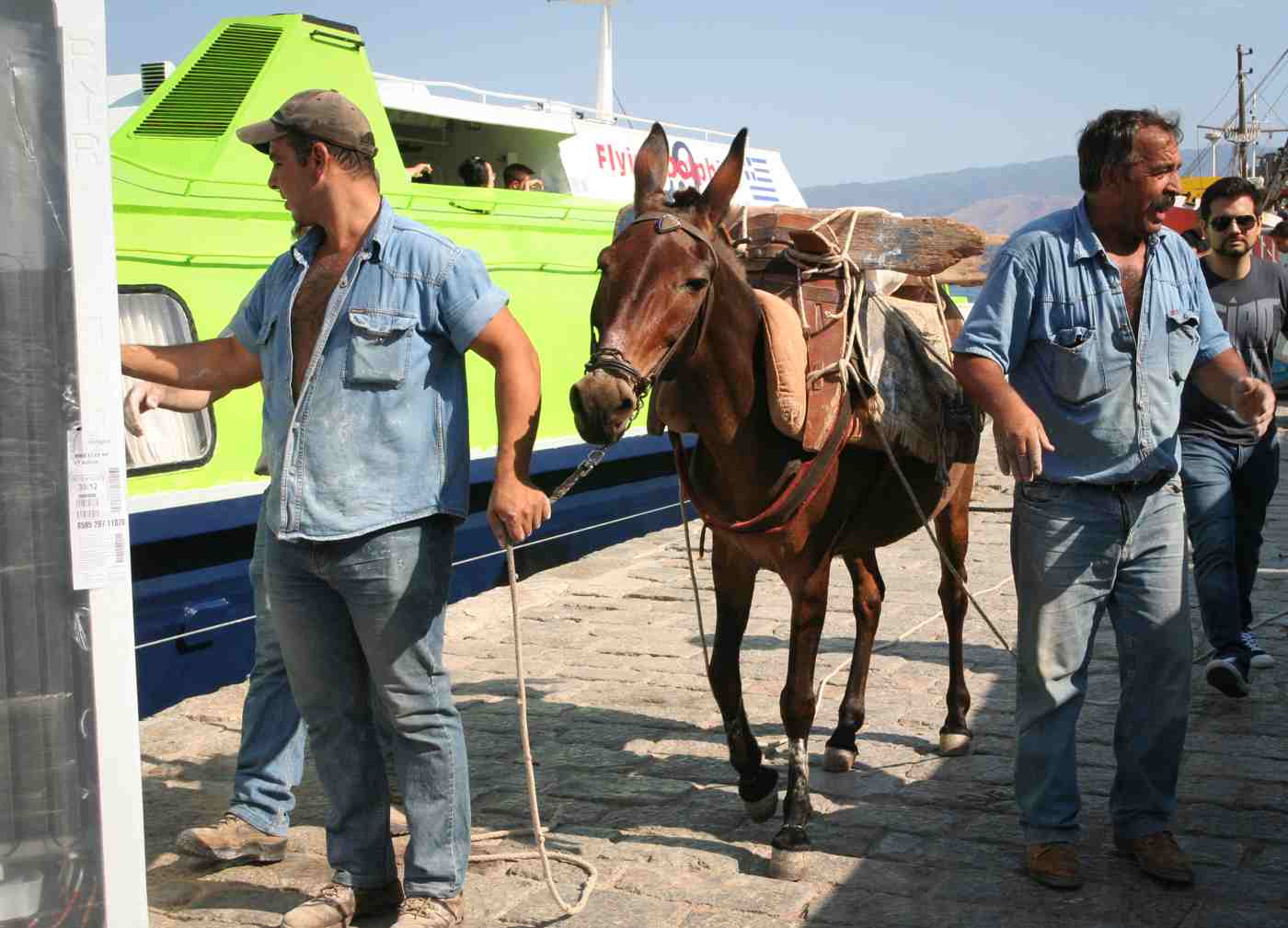
The Hydra donkeys, mules and horses are the beating heart of daily life on the only Greek island where cars are banned. With no vehicles, no scooters and not even bicycles allowed, these hard-working animals. Along with water taxis and people’s own two feet, carry everything and everyone that moves around the island. From the moment you step off the ferry you meet them, lined up along the harbour with their muleteers. Ready to haul luggage, shopping, furniture and building materials up the steep stone lanes. For visitors, the sight of a train of laden mules clip-clopping through the town is one of the most charming and memorable images of Hydra. Plan the whole trip with Greece Tours.
A living link to a way of life that has vanished almost everywhere else.
Hydra is home to the largest herd of working equines in the world, and they give the island much of its unique, timeless character. Understanding the Hydra donkeys, and the mules and horses that work alongside them, adds a great deal to a visit: knowing what each animal does. How you can ride one, where to find them, how they are cared for and the long history behind them. This guide explains why the island depends on its animals, the difference between the mules, donkeys and horses, the work they do. How and where tourists can take a ride or a trek, what it costs, how the animals are looked after.
The deep cultural roots of Hydra’s four-legged transport.
Why does Hydra rely on donkeys and mules?
Hydra relies on donkeys and mules because cars, motorbikes and bicycles are all banned across the island.
The reason Hydra depends on its animals is simple and strictly enforced: motorised vehicles are forbidden everywhere on the island, and so are bicycles. This is not a quaint tourist gimmick but a long-standing law that has preserved the island almost unchanged. Because Hydra rises steeply from its harbour in a maze of stone stairways and narrow cobbled lanes, there in any case be little room for cars. Instead, everything that needs carrying goes by mule, donkey or horse, by handcart, by water taxi around the coast, or on foot.
This car-free rule shapes the whole atmosphere of the island. There is no traffic noise, no exhaust fumes and no danger from vehicles. Only the sound of hooves on stone, the calls of the muleteers and the lapping of the sea. When you arrive at the port, the first thing you see is the line of animals waiting to carry visitors’ bags to their hotels, because there is no other way to get a heavy suitcase up the hill. It is this dependence on the Hydra donkeys and their larger cousins that keeps the island so peaceful and so distinctive.
For the islanders, the animals are not nostalgia but necessity. Every delivery, from a crate of vegetables to a new refrigerator or a load of cement, has to be strapped to an animal’s back and led up through the town. This makes the working equines genuinely essential infrastructure, as vital to Hydra as lorries and vans are to a mainland town. Visitors quickly come to see them not as a curiosity but as the practical, living engine of the island’s daily life.
What is the difference between the mules, donkeys and horses on Hydra?
On Hydra the mules are the powerful heavy haulers, carrying furniture, building materials and luggage, while the horses mainly carry people and lighter loads.
Hydra’s working animals are really a mix of mules, horses and true donkeys, each with its own role. The mules, sturdy crosses between a horse and a donkey, are the backbone of the island’s haulage. Strong and surefooted, they carry the heaviest loads, from suitcases and crates of shopping to washing machines. Furniture and sacks of building sand, balanced expertly in panniers and led in trains up the steep lanes by their muleteers.
The horses tend to be used more for carrying people, whether islanders, visitors or the occasional lighter load such as a couple of suitcases. Taller and faster than the mules, they are also the animals most often used for the organised treks that take riders out beyond the town. Well-groomed and often beautiful, the horses are a familiar and elegant sight around the port and on the paths leading into the hills.
True donkeys, once far more numerous, are now the smallest part of the herd. Less able than the mules to carry the enormous loads the island demands, many are kept today for personal transport or simply as much-loved pets. Even so, the whole mixed herd is affectionately known to visitors as the Hydra donkeys. Together the mules. Horses and donkeys form one of the most remarkable working animal populations anywhere in the world.
What work do the animals of Hydra do?
Hydra’s mules, donkeys and horses carry almost everything on the island: visitors’ luggage from the port to the hotels, daily shopping and food deliveries, rubbish, building materials, furniture and appliances.
The working animals of Hydra do the jobs that vans, lorries and delivery trucks do on the mainland. The most visible task is carrying luggage: when the ferries dock. The muleteers load visitors’ cases and bags onto the mules and lead them up to the hotels and houses scattered across the steep town. Without this service, hauling a heavy suitcase up dozens of stone steps in the heat be a real ordeal. For visitors the mules provide their very first. And very welcome, encounter with the island’s transport.
Beyond luggage, the animals handle the entire logistics of the island. They carry the daily food deliveries to shops, tavernas and homes. Take away the rubbish. Haul the raw materials for every repair and building project, including cement, sand, timber and bricks. When a household needs a new appliance or a piece of furniture, it too is strapped to a mule and walked up through the lanes. This endless, patient carrying keeps the shops stocked, the restaurants supplied and the houses maintained.
The animals also serve people directly. Horses and mules carry those who cannot manage the climb, and they are central to the guided treks and rides that let visitors explore the island on horseback. From the humblest sack of potatoes to a tourist enjoying a scenic ride. The Hydra donkeys and their companions are involved in almost every movement of goods and people, making them the true workforce of the island.
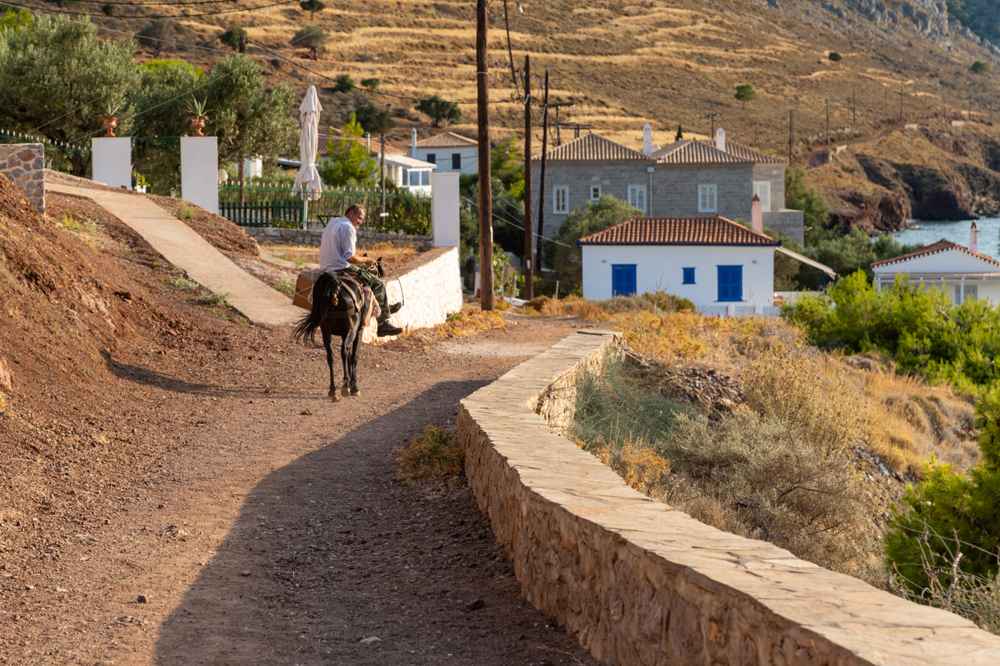
Can tourists ride the donkeys and mules on Hydra?
Yes, tourists can ride Hydra’s mules and donkeys.
One of the most popular things visitors do on Hydra is take a ride on one of the animals. The muleteers who wait at the harbour offer short rides for tourists. It is a fun and authentic way to experience the island’s traditional transport, as well as a practical help for anyone who finds the steep, stepped lanes hard going. Only one person rides each animal, and the muleteer leads the way, so it is straightforward and suitable for most visitors who like to try it.
The rides are modestly priced. A short circuit of around fifteen minutes through the town typically costs about fifteen euros per animal, while a longer outing of roughly twenty-five minutes up to the old wells at Kala Pigadi and back is usually around twenty euros. These short rides are ideal for getting a feel for riding a Hydra mule without committing to a longer excursion. They double as a memorable. Gentle sightseeing tour of the harbour and the edges of the town.
For anyone wanting more than a quick ride, longer excursions can be arranged in advance with the island’s horse-trekking operators, who take riders out on the trails into the hills. Whether you choose a brief harbour ride or a proper trek. Riding is one of the most direct ways to connect with the living tradition of the Hydra donkeys. It makes a notable addition to a day exploring the island.
Where do you find the donkeys and how do you arrange a ride?
You find Hydra’s donkeys, mules and horses right at the main harbour, where the muleteers wait with their animals near the ferry quay.
The easiest place to meet the animals is the harbour itself. As soon as you arrive by ferry, you will see the mules and their muleteers gathered near the quay, ready to carry luggage and offer rides. This is where the working life of the Hydra donkeys is most concentrated. Where you can simply walk up. Speak to a muleteer and arrange a short ride around the town on the spot, agreeing the price before you set off.
The animals are also a constant presence throughout the town, resting in the shade between jobs, tethered along the lanes or making their way up and down the steps with their loads. You will come across them everywhere as you explore. Which makes Hydra one of the places where such working animals are part of the everyday street scene rather than a staged attraction. Watching a laden mule train negotiate a narrow stairway is a sight in itself.
For a longer, organised experience, it is best to book ahead with one of the island’s horse and donkey trekking companies rather than rely on turning up. These operators arrange proper treks with saddles, safety equipment and a guide, and pre-booking ensures an animal and a slot are ready for you. However you arrange it, encountering the animals is effortless on Hydra, where they are woven into the fabric of the port and the town.
What horse and donkey treks are available on Hydra?
Hydra has horse and donkey trekking operators who offer guided treks into the hills and along the coast, with helmets, comfortable western saddles and a guide.
Beyond the short harbour rides, Hydra is home to dedicated horse-trekking businesses that offer a more adventurous way to explore on horseback. These operators keep well-cared-for horses and donkeys and lead guided treks out of the town and into the island’s beautiful interior and coastline. They provide helmets and comfortable western-style saddles. A guide accompanies every ride, so the treks are suitable for beginners as well as more experienced riders who want to cover more ground.
The treks make the most of Hydra’s superb scenery, following old mule paths and trails up into the pine-clad hills and out to panoramic viewpoints. Remote chapels and quiet coves that are hard to reach on foot. Riding one of these routes combines the pleasure of being on horseback with the same landscapes that make walking on Hydra so rewarding, seen this time from the saddle. It is a memorable way to experience the wild, empty parts of the island beyond the town.
It is important to book these excursions in advance rather than expecting to join on the day. The operators can advise on which trek suits your experience and how long to allow, from a gentle introductory ride to a longer half-day out. For animal lovers and anyone seeking a different perspective on the island, a guided trek with Hydra’s horses and donkeys is a real highlight.
How are Hydra’s donkeys and mules cared for?
Hydra’s working animals are cared for by their muleteer owners, on whom the island’s economy depends, and their welfare is watched over by residents and animal charities.
The muleteers have every reason to keep their mules, donkeys and horses fit and healthy, since an injured or exhausted animal cannot work. Most are looked after with real care, well fed, shod and rested between jobs, and owners have a close bond with animals they rely on every day. The health of the herd is, quite literally, the health of the island’s economy and daily life.
Alongside the owners, residents and animal-welfare groups take an active interest in the wellbeing of the Hydra donkeys. Providing veterinary help, water points and shade. Speaking up if any animal is mistreated. This combination of practical self-interest and genuine affection means the working animals are generally in good condition, though, as anywhere. Standards can vary between individual owners. Responsible visitors can help by choosing to ride with those who clearly care for their animals.
Do not encourage an owner to overload a ride, and avoid the hottest part of the day for a long ride where you can. Offering the animals respect, and rewarding the muleteers who keep theirs in good shape. Helps sustain a tradition that is both a working necessity and a much-loved part of Hydra’s identity.
What is the history and cultural role of Hydra’s donkeys?
Hydra’s donkeys, mules and horses have been the island’s transport for centuries, since long before cars existed, and the ban on vehicles has preserved that tradition intact.
The working animals of Hydra are not a recent revival but an unbroken tradition stretching back centuries. In the island’s great age of seafaring and trade, when its captains and merchants built the grand stone mansions that still line the harbour. Goods were already being carried up from the port on the backs of mules and donkeys, just as they are today. The refusal to allow cars has simply kept this centuries-old system alive into the modern age, when it has disappeared almost everywhere else.
This deep continuity gives the Hydra donkeys a strong cultural and symbolic importance. They are one of the enduring images of the island, endlessly photographed by visitors and celebrated by the artists who have made Hydra their home. A mule waiting patiently by a whitewashed wall, or a train of animals climbing a sunlit stairway. Has become an emblem of the island’s timeless, unhurried way of life and its resistance to the rush of the modern world.
For the community, the animals are also a point of pride and identity. Hosting the largest herd of working equines in the world is a distinction the islanders value, and the muleteers’ skills are passed down through families. Far more than a tourist attraction, the Hydra donkeys embody the island’s history, its stubborn independence and its determination to preserve a gentler, more human pace of life.
Can children ride the donkeys on Hydra?
Yes, children can enjoy the short mule and donkey rides on Hydra, which are gentle and led by the muleteer, making them a highlight for families.
For families, a ride on one of the animals is often the most exciting part of a day on Hydra, and the short harbour rides are well suited to children. Because each animal is led at walking pace by an experienced muleteer. Only one person rides at a time, the ride is calm and controlled rather than fast or frightening. Many children are thrilled to sit on a real working mule and be led through the lanes of a car-free island. It turns a simple walk up the hill into an adventure they remember.
Parents still take sensible precautions. Very young children share the experience closely with an adult or be lifted on and off with the muleteer’s help. It is worth making sure a child is comfortable and holding on securely before setting off. The muleteers deal with visitors of all ages every day and will advise on whether a particular animal and route suit your child. It is always worth asking rather than assuming.
For older children and teenagers keen on animals, the longer guided treks offered by the horse-trekking operators can be a notable family outing. Provided the children are confident and the operator judges them ready. Whether it is a five-minute ride along the quay for a small child or a proper trek for an older one. Meeting and riding the Hydra donkeys is an experience that delights younger visitors and gives families a genuine taste of the island’s traditional life.
What tips help for seeing and photographing Hydra’s donkeys?
To see and photograph Hydra’s donkeys, head to the harbour when the ferries arrive, when the animals are busiest carrying luggage.
The best place and time to see the animals in action is the harbour around the arrival of the main ferries, when the mules are loaded with luggage and lead their trains up into the town. This is the liveliest moment of the island’s transport day and the easiest chance to watch the muleteers at work. Early morning is also a good time, when deliveries are made and the light is soft and golden, perfect for photography along the waterfront and in the lanes.
A little courtesy goes a long way. It is polite to ask a muleteer before taking a close photograph of them and their animals, and many are happy to oblige, especially if you have taken a ride. Keep a respectful distance from working animals that are carrying heavy loads or moving through narrow spaces. Both for your safety and so as not to disturb them. Never touch or feed an animal without the owner’s agreement.
For the most atmospheric images, seek out the animals against Hydra’s classic backdrops: a mule beside a blue-shuttered white house. A train of animals on a stone stairway, or a horse silhouetted against the harbour and sea. The gentle light of early morning and late afternoon flatters both the animals and the stonework. With patience and respect, capturing the Hydra donkeys is one of the most rewarding parts of a visit and a notable reminder of this extraordinary car-free island.
Frequently Asked Questions
How much does it cost to ride a donkey or mule on Hydra?
A short ride on a Hydra mule or donkey is inexpensive: a circuit of around fifteen minutes through the town typically costs about fifteen euros per animal. With only one rider per animal, while a longer ride of roughly twenty-five minutes up to the Kala Pigadi wells and back is usually around twenty euros. These prices are for the short rides offered by the muleteers at the harbour, and it is best to agree the fare before you set off. Longer guided treks arranged in advance with the island’s horse-trekking operators cost more, reflecting the saddles. Safety equipment, guide and greater distance involved. Are priced according to the length and type of the excursion.
Are the donkeys and mules on Hydra treated well?
The working animals on Hydra are generally well cared for, because the island’s economy and daily life depend entirely on them. Owners have every reason to keep their mules, donkeys and horses healthy, well fed and rested. Residents and animal-welfare groups also watch over the herd, providing veterinary care, water and shade. As anywhere with working animals, standards can vary between individual owners. Responsible visitors can help by riding with muleteers whose animals clearly look healthy and well kept, treating the animals gently, and not overloading a ride or pushing a tired animal. Choosing to support caring owners rewards good practice and helps sustain the tradition in a humane way.
Can the mules carry heavy luggage and furniture up to the hotels?
Yes, carrying heavy loads is exactly what Hydra’s mules do best. They are the island’s heavy haulers, strong and surefooted enough to carry suitcases, crates of shopping. Furniture, appliances and building materials up the steep stone lanes to the hotels and houses. When you arrive by ferry, the muleteers at the harbour will carry your luggage up to your accommodation for a fee, which is often the only practical way to get heavy bags up the steps. It is a normal and expected service. If you are staying somewhere high in the town it is well worth using the mules rather than struggling with your cases yourself in the heat.
Are there really no cars at all on Hydra?
Yes, Hydra really is car-free: motor vehicles, motorbikes and even bicycles are banned across the island. With only a very small number of essential service vehicles, such as a rubbish truck and an ambulance, permitted for specific municipal duties. For everyone else, getting around means walking, taking a water taxi around the coast, or using the mules, donkeys and horses to carry goods and luggage. This long-standing ban is strictly enforced and is the reason the island has kept its peaceful, timeless character, free of traffic and fumes. It is also precisely why the Hydra donkeys remain so central to daily life, doing the work that cars and vans do everywhere else.
Where is the best place to see the donkeys on Hydra?
The best place to see the Hydra donkeys, mules and horses is the main harbour. Especially when the ferries arrive and the animals are busy carrying luggage and goods up into the town. Here you will find the muleteers with their animals lined up along the quay, the hub of the island’s traditional transport. Beyond the port, you will meet the animals all over the town as they rest in the shade or make deliveries through the lanes. Out on the trails if you take a trek into the hills. For the liveliest scenes and the best photographs, though, the waterfront around ferry times is where the working life of the animals is most on show.
Do you book a horse or donkey trek in advance on Hydra?
For the longer guided treks with Hydra’s horse-trekking operators it is best to book in advance, because places are limited and the animals be prepared and saddled ready for your ride. Booking ahead, through the operator directly or your accommodation. Ensures a horse and a guide are available and lets you choose a trek suited to your experience and the time you have. The short rides offered by the muleteers at the harbour, by contrast. Need no booking. You simply approach them at the port and arrange a ride on the spot, agreeing the price first.
For a quick ride you can be spontaneous, but for a proper trek into the hills, reserve your place beforehand.
What is the best time of day to ride a mule on Hydra?
The best time to ride a mule or take a trek on Hydra is the cooler morning or the late afternoon and early evening. Both for your own comfort and for the animals’ welfare, since the midday summer heat is tiring for horses and mules working the steep lanes. Early in the day the harbour is at its busiest with the animals carrying luggage from the ferries. The light is soft and pleasant for a ride around the town. Late afternoon brings gentler temperatures and lovely golden light as well. Riding at these cooler times is kinder to the animals and far more enjoyable for you.
It is worth planning your ride away from the hottest hours around the middle of the day.