
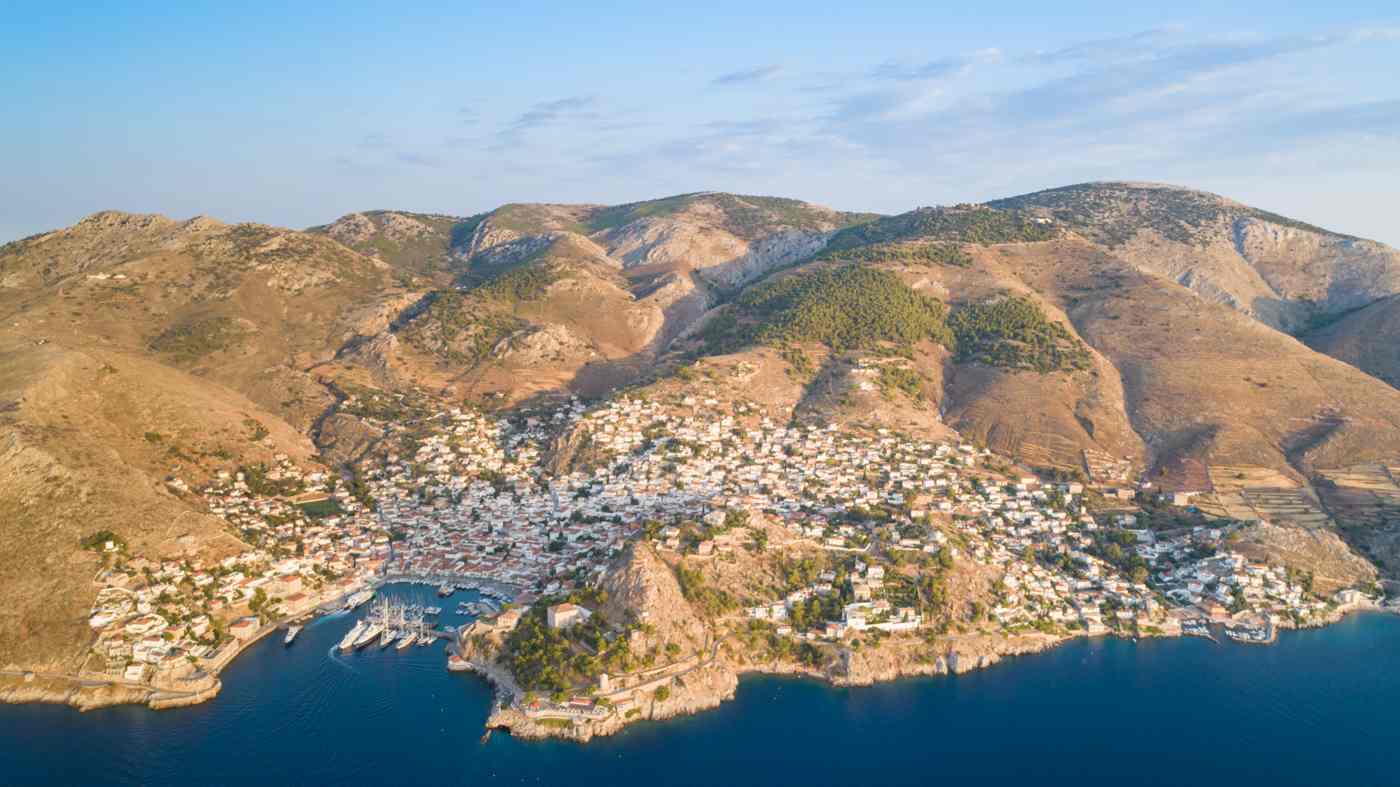
Hydra Town, known to Greeks as Chora, is the island’s capital and only real town, and one of the most beautiful island ports in the whole of Greece. Rising in a stone amphitheatre around a perfect horseshoe harbour, it is a place of grand captains’ mansions, marble-paved lanes, cafes and galleries, and it is entirely car-free. There are no vehicles here at all, so life unfolds at a walking pace, with donkeys and water taxis doing the work that cars do elsewhere. Elegant, lively and timeless, Hydra Town is both the gateway to the island and its greatest single attraction. Plan the whole trip with Greece Tours.
Everything on Hydra begins and ends in the town. The ferries dock at its harbour, the coastal paths and water taxis to the beaches set off from its quay. Its lanes hold the museums. Churches and mansions that tell the island’s remarkable story. Wandering the stepped alleys, watching the harbour life, admiring the neoclassical architecture and swimming off the rocks at the town’s edge are the essential experiences of a visit. This guide covers what Hydra Town is like, its harbour and waterfront, the captains’ mansions, the stone lanes and squares. The cathedral, the museums, swimming and eating in town. How to get around this car-free capital.
What is Hydra Town like?
Hydra Town is a beautiful, car-free harbour capital where stone captains’ mansions rise in an amphitheatre around a horseshoe port. Lively yet elegant, it has cafes, galleries and museums, and everything moves on foot, by donkey or by water taxi.
Hydra Town is the heart and soul of Hydra, and first impressions are unforgettable. As the ferry rounds the headland, the town appears as a curve of grey-stone mansions and white houses climbing the bare hills around a natural harbour, with cannons guarding its mouth and yachts crowding the quay. There are no cars, no scooters and no bicycles anywhere, and this absence of traffic gives the town a calm, graceful atmosphere found almost nowhere else in Greece. It is lively and sophisticated, yet timeless and peaceful at once.
The town is compact and entirely walkable, its life concentrated around the harbour and the maze of lanes climbing behind it. Cafes, tavernas, boutiques and art galleries line the waterfront, while donkeys wait to carry goods up the steps and water taxis buzz across the bay. Behind the quay, marble-paved alleys wind up between the mansions to quiet squares, small churches and viewpoints. Beautiful, car-free and full of history, Hydra Town rewards slow wandering as much as any specific sight, and it is a place to be savoured rather than rushed.
What is the harbour and waterfront of Hydra Town like?
The harbour is the heart of Hydra Town, a horseshoe port lined with cafes, tavernas, boutiques and galleries, busy with yachts, fishing boats, water taxis and donkeys.
The harbour is where Hydra Town lives. The quay curves around the water in a near-perfect horseshoe, lined with cafes and tavernas whose tables spill toward the sea, along with boutiques, jewellers and art galleries. Yachts and fishing boats fill the port, water taxis come and go to the beaches, and lines of donkeys wait patiently to carry luggage and goods up into the town. Old cannons still point out to sea from the harbour entrance, a reminder of the island’s naval past, and the whole scene is one of the most photographed in Greece.
Watching the harbour is an activity in itself and one of the great pleasures of Hydra Town. In the morning the boats unload and the donkeys work. Through the day visitors stroll and swim. And by evening the cafes and bars fill. The light turns golden on the mansions. The town takes on a glamorous buzz. The waterfront is the natural meeting place and the starting point for everything else, from a coastal walk to a boat trip. Simply sitting with a coffee or a drink and watching the life of the port unfold is essential to the Hydra experience.
What are the captains’ mansions in Hydra Town?
The captains’ mansions are grand stone houses built by wealthy sea captains in the 18th and 19th centuries, when Hydra was a rich maritime power. Rising around the harbour, their elegant architecture gives Hydra Town its distinctive, dignified character.
The stone mansions that climb the slopes around the harbour are the defining architecture of Hydra Town. Built in the 18th and 19th centuries, when the island was a wealthy and powerful maritime nation. They were the homes of rich sea-captain and merchant families whose ships traded and fought across the Mediterranean. Solid, grey-stone and often storeys high, with fine doorways, courtyards and painted interiors. These archontika give the town a grandeur remarkable for a small Greek island and speak of a golden age of seafaring wealth.
The names of the great families, such as Koundouriotis, Tombazis, Voulgaris and Kriezis, are woven into the town and its history. Their mansions stand along the waterfront and on the surrounding hills, and several can be visited or admired from outside. The Tombazis mansion now houses a branch of the Athens School of Fine Arts. Linking the island’s grand past to its modern life as an artists’ haven, while the Koundouriotis mansion is a museum. Seeking out these houses and learning who built them turns a walk through Hydra Town into a journey through Greek history.
What is it like wandering Hydra Town’s lanes and squares?
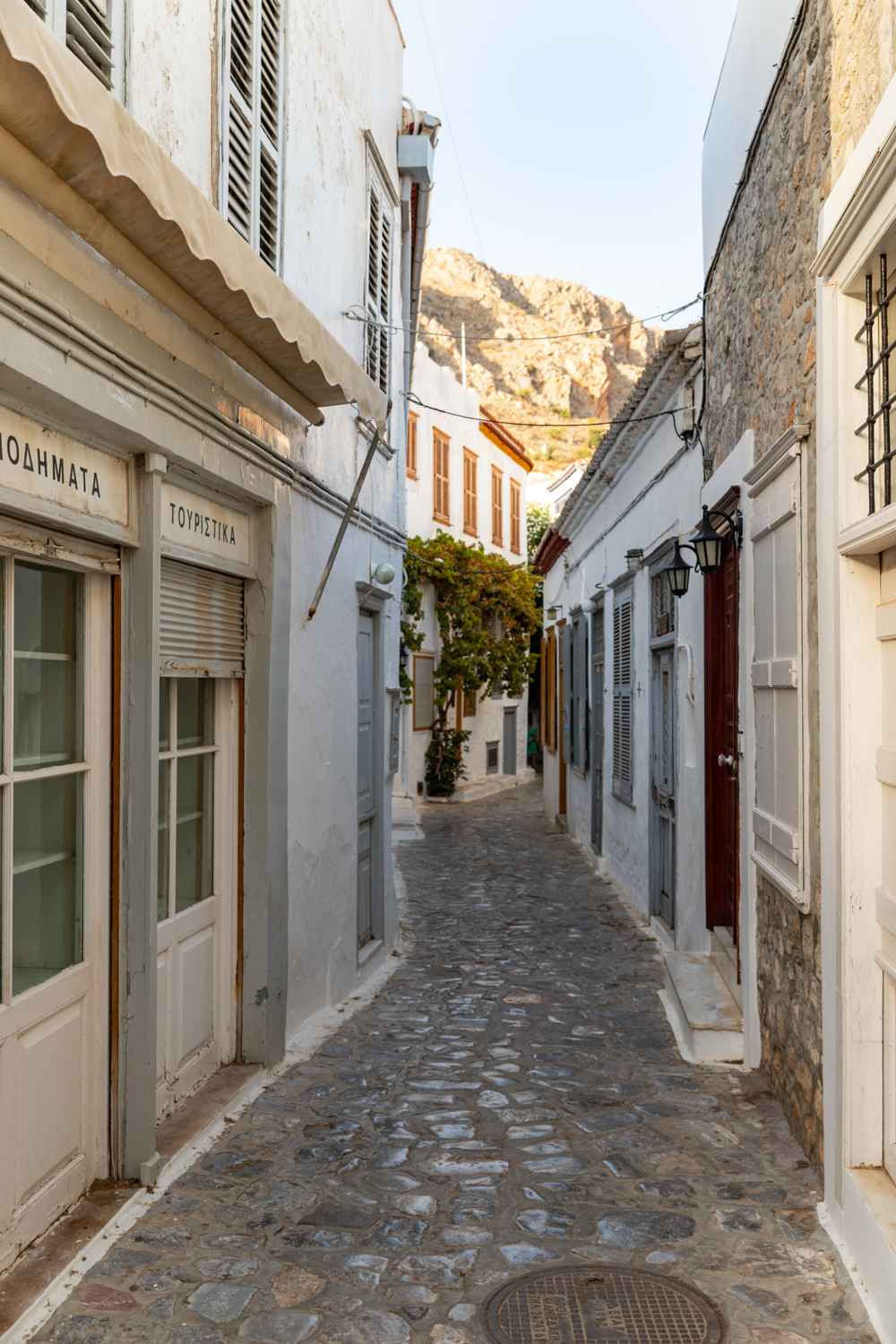
Behind the harbour, Hydra Town is a maze of marble-paved, stepped lanes climbing the hillside between whitewashed houses, flower-filled courtyards, small squares and tiny churches.
Away from the busy waterfront, the back lanes of Hydra Town are a world of quiet beauty. Narrow, stepped alleys paved in stone and marble climb the hillside between the mansions and whitewashed houses, opening onto small squares, flower-filled courtyards and tiny whitewashed churches. Because there are no cars, you can drift through them at leisure, with nothing but the occasional donkey or fellow walker for company. Getting pleasantly lost in this maze, and discovering sudden viewpoints over the harbour and the sea, is one of the simplest and best things to do in Hydra.
The higher you climb, the quieter and more local the town becomes, and the better the views. Cats doze in doorways, bougainvillea spills over walls, and the rooftops and the blue harbour spread out below. This is where you sense the real, lived-in Hydra behind the glamorous quayside, and where the town’s timeless, car-free character is felt most strongly. A slow, aimless walk uphill through the lanes, camera in hand, is a defining Hydra Town experience and reveals the island’s beauty at its most intimate.
What are the cathedral and clock tower of Hydra Town?
The cathedral of Hydra Town, the Dormition of the Virgin Mary, sits just off the harbour in a former monastery, with a beautiful courtyard and a landmark white marble bell tower and clock.
The cathedral of the Dormition of the Virgin Mary is the architectural landmark of Hydra Town, set just back from the harbour. Housed in a former monastery, it is entered through an arched gateway into a peaceful marble-paved courtyard, a cool and quiet retreat from the bustle of the quay. Its most striking feature is the elegant white marble bell tower and clock that rises above the town. A graceful silhouette visible from across the harbour and one of the symbols of the island.
Inside, the church is richly decorated, and the complex houses a small ecclesiastical and Byzantine museum displaying icons, vestments and religious treasures. The cathedral has long been the spiritual heart of the community and a witness to the island’s history. Standing at the centre of the town where the sea captains once worshipped. Stepping into its shaded courtyard and admiring the bell tower is a moment of calm and beauty, and a natural part of exploring Hydra Town.
Which museums can you visit in Hydra Town?
Hydra Town has excellent museums, chiefly the Lazaros Koundouriotis Historical Mansion, a grand restored captain’s house, and the Historical Archives Museum, which tells the island’s maritime story and its major role in the Greek War of Independence.
For its size, Hydra Town has a remarkable concentration of museums, and visiting them deepens any stay. The grandest is the Lazaros Koundouriotis Historical Mansion, one of the finest captains’ houses on the island. Restored and furnished to show how a wealthy Hydriot family lived, with period rooms, costumes and paintings. notable views over the harbour. It combines architecture, history and a viewpoint in a single, memorable visit, and it is the best place to understand the world that built the town.
Down by the waterfront, the Historical Archives Museum of Hydra holds the island’s collective memory, with documents, portraits, weapons and ship models tracing Hydra’s rise as a sea power and its central part in the struggle for Greek independence, led by admirals such as Andreas Miaoulis, whose statue stands on the quay. Together with the Byzantine collection in the cathedral. These museums explain the wealth and heroism behind the town’s beauty. They make museum-going a genuine highlight of Hydra Town rather than an afterthought.
Where can you swim and eat in Hydra Town?
You can swim right at the edge of Hydra Town at the rocky swim spots of Spilia and Hydronetta, with steps into clear water and bars.
You can swim right at its edge. A minutes’ walk from the harbour, the rocky swim spots of Spilia and Hydronetta let you climb down concrete platforms and ledges straight into deep. Clear water, each with a bar for drinks and, at Hydronetta, a famous sunset. These stylish swim-bars, along with the beaches reached by water taxi and the coastal path, mean a day exploring the town can easily be broken with a dip, and the many Hydra beaches are all reached from the port.
Eating and drinking are central to the town’s appeal. The harbour and lanes are packed with tavernas and restaurants serving fresh fish and seafood, Greek classics and more refined cooking, while cafes and bars line the waterfront for a coffee, an ouzo or a cocktail as you watch the boats. In the evening the town has a lively, sophisticated buzz, with bars and clubs that draw a stylish crowd well into the night. From a long seafood lunch to a sunset cocktail and late-night drinks, Hydra Town is as rewarding after dark as by day.
How do you get around Hydra Town?
You get around Hydra Town entirely on foot, as no cars, motorbikes or bicycles are allowed. Donkeys and mules carry luggage and goods up the stepped lanes, and water taxis link the town to the beaches.
Getting around Hydra Town is simple but requires your own two feet, because the island’s total ban on vehicles applies here in full. There are no cars, taxis, buses, scooters or bicycles; instead everyone walks, and the marble-paved lanes and steps climb steeply from the harbour into the town. Donkeys and mules, led by their handlers, do the heavy carrying, transporting luggage. Shopping and building materials up to the houses and hotels. Hiring one to carry bags to your accommodation is part of the Hydra experience.
For getting to the beaches and coves beyond the town, water taxis run constantly from the harbour, quick and scenic, and small boats can be hired too. Within the town itself, though, walking is the only option, so comfortable shoes are essential, especially if your accommodation is high on the hill up steps. This car-free rule is exactly what keeps Hydra Town so quiet, clean and beautiful. Once you accept the walking. Moving around the town on foot becomes one of its great pleasures. Details of reaching the island appear on the page for how to get to Hydra.
Frequently Asked Questions
Is Hydra Town worth visiting?
Yes, Hydra Town is absolutely worth visiting and is one of the most beautiful island capitals in Greece. Rising in a stone amphitheatre around a horseshoe harbour, it is a car-free town of elegant 18th- and 19th-century captains’ mansions, marble-paved lanes, cafes, galleries and museums. Its beauty, history and calm, traffic-free atmosphere have drawn artists and travellers for generations. Whether you come on a day trip from Athens or stay nights, wandering the lanes, watching the harbour. Exploring the museums and swimming off the rocks at the town’s edge make it a highlight of any Greek island trip.
For many, Hydra Town alone is reason enough to visit the island, and it consistently ranks among the most beautiful and photogenic towns anywhere in the whole of Greece.
What is there to see in Hydra Town?
In Hydra Town you can see the beautiful horseshoe harbour with its cafes, yachts, cannons and donkeys. The grand stone captains’ mansions that climb the hills. The cathedral of the Dormition of the Virgin with its marble bell tower and courtyard. And excellent museums. Chiefly the Lazaros Koundouriotis Historical Mansion and the Historical Archives Museum. The maze of marble-paved lanes and squares behind the harbour rewards aimless wandering. The rocky swim spots of Spilia and Hydronetta at the town’s edge are perfect for a dip. Add the art galleries, the statue of Admiral Miaoulis and the lively cafes and bars, and there is far more to see and do than the town’s small size suggests.
How do you get to Hydra Town?
You get to Hydra Town by ferry, as it is the island’s harbour and only port, and the whole island is car-free. Fast ferries and catamarans sail from the port of Piraeus in Athens. Crossing the Saronic Gulf in about one and a half to two hours and docking right at the town’s waterfront. Ferries also reach Hydra from ports in the eastern Peloponnese and from the neighbouring Saronic islands of Poros and Spetses. Because there are no cars, you arrive directly into the heart of the town and everything is then within walking distance. The town is also a very popular day trip and cruise stop from Athens.
It is easy to visit for hours or as the base for a longer island stay.
Are there cars in Hydra Town?
No, there are no cars in Hydra Town, or anywhere else on the island. Motor vehicles, motorbikes and even bicycles are all banned, which is central to the town’s character and charm. Instead, everyone gets around on foot along the marble-paved lanes and steps, while donkeys and mules carry luggage. Shopping and goods up into the town. Water taxis link the harbour to the beaches. The only motorised exceptions are a couple of essential service vehicles. This car-free rule keeps Hydra Town quiet, clean and safe to wander. It is one of the main reasons the town has kept its timeless beauty and elegant.
Unhurried charm while so many other places across the Greek islands have been reshaped by traffic, cars and crowds.