
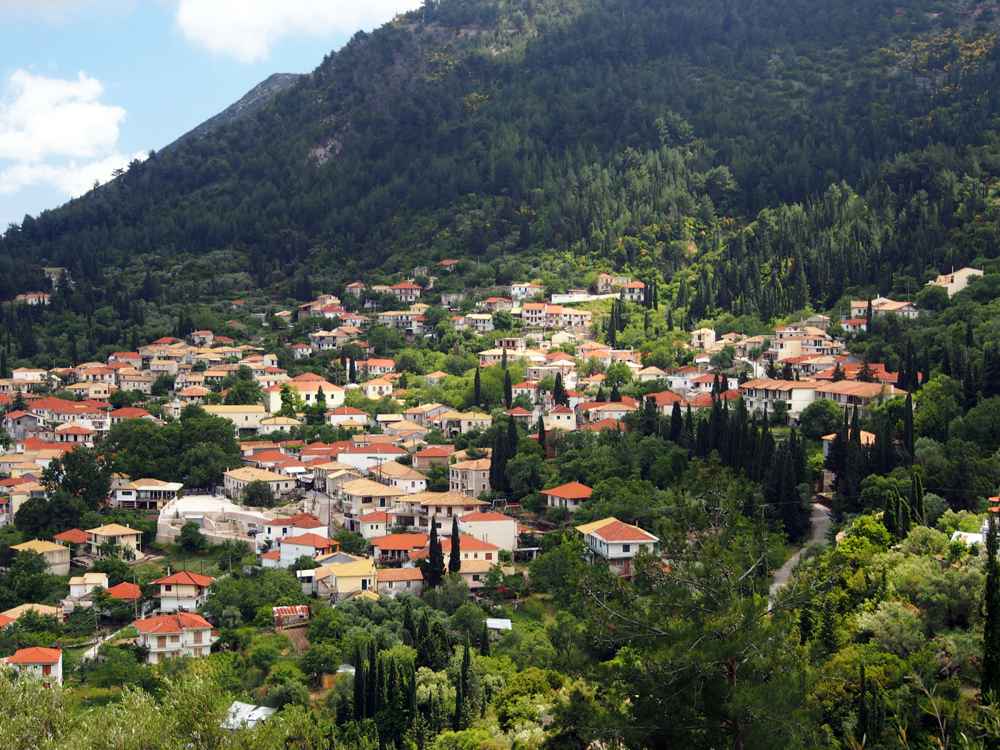
Karya is the best-known mountain village of Lefkada, set in the green centre of the island at some altitude, about 14 km from Lefkada Town. It is the traditional heart of the interior, a place of stone-paved lanes, old houses and shaded squares. Where the coast turns hot and busy in summer, Karya stays cool and quiet in the mountain air. The village is known for its handmade embroidery, its plane-tree square ringed by tavernas, and its small museums. Visitors reach it by a short drive uphill, either as a half-day trip or as a low-cost base for exploring the island’s interior. Plan the whole trip with Greece Tours.
Among the things to do in Lefkada, a visit to Karya offers a different side of the island, away from the beaches and resorts. The village grew around its embroidery tradition, a distinctive needlework technique developed by a local woman, Maria Stavraka, and still made by hand today. Its square fills on summer evenings with people over coffee or tsipouro, and each year the community stages a well-known reenactment of a traditional Lefkadian wedding. Walking paths climb into the hills, linking Karya with the higher village of Englouvi and its lentil fields. This guide covers what to see, where to eat and how to arrive.
What and where is Karya in Lefkada?
Karya is the largest mountain village of Lefkada, in the green centre of the island about 14 km from Lefkada Town. It is the traditional hub of the interior, set among wooded hills at altitude.
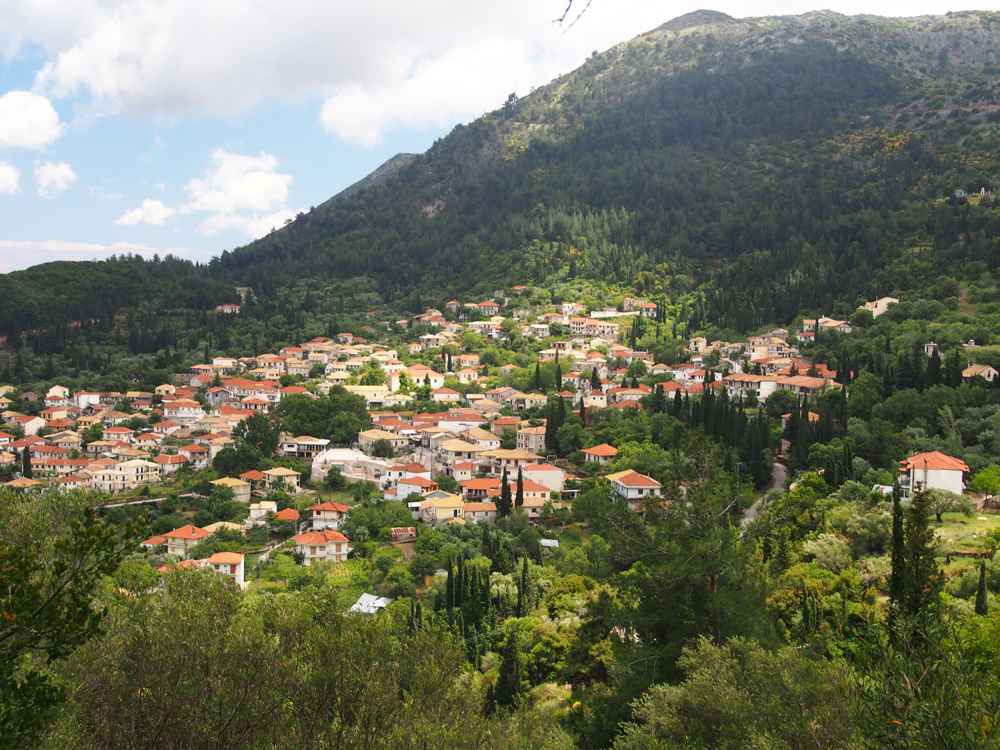
Karya sits near the middle of Lefkada, reached by a road that climbs inland from the coast through olive groves and pine. The village lies at altitude, which keeps its air cooler than the shore even at the height of summer. From Lefkada Town the drive covers about 14 km and takes roughly half an hour on winding mountain roads. Karya has long served as the main settlement of the island’s interior, a market and meeting point for the smaller hamlets around it. Its position among the hills gives wide views over the surrounding slopes and the deep green of the central valleys.
The village keeps the layout of an old mountain community. Narrow stone-paved lanes run between houses of stone and tile, some restored and some worn by age. At its heart lies a broad square shaded by tall plane trees, which acts as the focus of daily life. Around the square stand tavernas, cafes and small shops, many selling the embroidery for which Karya is known. Away from the centre, the streets climb and fall with the ground, opening now and then onto small courtyards and chapels. The overall feel is of a working village rather than a resort, rooted in the land around it.
Karya differs sharply from the coastal towns of Lefkada. The beaches of the west and the resorts near Nydri draw most summer visitors, while the interior stays quiet and green. This contrast is part of the village’s appeal, offering cool air and shade when the coast grows hot and crowded. Farming and craft, rather than tourism alone, still shape the rhythm of the place. Olive trees, gardens and grazing land surround the houses, and the higher slopes carry oak and pine. For travellers who want to see the older, rural side of the island, Karya provides an easy and rewarding contrast to the sea.
Reaching the village is straightforward by car, and the route itself forms part of the visit. The road leaves Lefkada Town and climbs steadily inland, passing smaller villages and long views back towards the sea. Signposts mark the way to Karya, which sits at a natural junction of interior roads. Parking is usually found near the square or along the approach lanes, as the centre itself is compact and best seen on foot. Once arrived, visitors tend to leave the car and walk, since the square, shops and museums lie close together. The journey up rewards travellers with a clear change of scene and climate.
Why is the plane-tree square the heart of Karya?
The plane-tree square is where village life gathers, shaded by old trees and ringed by tavernas and cafes. People sit there over coffee or tsipouro in the cool air, and festivals and markets centre on it.
The square forms the natural centre of Karya, a wide open space beneath several large plane trees. These trees have grown for generations, and their spreading branches throw deep shade across the paving for most of the day. The cool this creates is welcome in summer, when the coast below bakes in the heat. Villagers and visitors alike gather here, and the space serves as meeting point, market and stage in turn. Benches and taverna chairs stand under the leaves, and the sound of water and conversation fills the air. The square gives Karya its focus and much of its character throughout the year.
Around the edges of the square stand tavernas and cafes, their tables spilling out under the trees. Here visitors sit over a slow coffee, a cold drink or a glass of tsipouro, the local spirit. The pace is unhurried, and many people stay for an hour or more simply watching village life pass. Plates of mountain food, grilled meat and vegetables from nearby gardens appear on the menus, though names and prices vary from place to place. The tavernas draw both locals and day trippers, and in the evening the square becomes the social heart of the village. It is the place to pause and rest.
The square also serves as the setting for public life in Karya. Church feasts, markets and the village’s summer festival all use the open space beneath the trees. On ordinary days it stays quieter, a place for older residents to sit and talk and for children to play. Small shops nearby sell embroidery, lace and other crafts, so the square joins commerce with rest. Its position at the meeting of the main lanes means most walks through the village pass across it. For visitors, the square offers the easiest way to feel the character of Karya within a short stay.
Sitting in the square is one of the simplest pleasures of a visit. The shade, the cool air and the slow rhythm make it a natural place to begin or end a walk. From here the folk museum, the shops and the lanes of old houses all lie within a short stroll. Many visitors arrive as a half-day trip from the coast and spend much of their time around the square before exploring further. The setting captures what draws people to the interior of Lefkada: shade, quiet and a sense of tradition. Few leave without pausing under the plane trees at least once.
What is Karya embroidery and who was Maria Stavraka?
Karya embroidery is a distinctive local needlework technique, developed by a village woman named Maria Stavraka. It is worked by hand and sold in the village shops alongside lace and wood carving.
Embroidery is the craft most closely tied to Karya, and it sets the village apart from others on Lefkada. The technique, known locally as Karsaniki needlework, uses fine stitching to build patterns of great detail. Tradition holds that it was developed by a village woman, Maria Stavraka, whose name is remembered as the source of the local style. From her work the craft spread among the women of the village and became a household skill passed down through the generations. The embroidery gave Karya both an identity and a source of income, and it remains a point of pride for the community today.
The needlework is made entirely by hand, a slow process that demands patience and skill. Patterns are worked in thread on cloth, producing borders, motifs and whole decorative pieces. Because each item is stitched individually, no two are exactly alike, and the finest examples take hours to complete. The craft was long a part of daily life in Karya, with girls learning it from mothers and grandmothers. Table linens, cloths and trimmings were among the common products, used at home and offered for sale. The handmade nature of the work is central to its value, distinguishing it from machine-made goods sold elsewhere.
Several shops around the square and along the lanes sell the embroidery today. Alongside it they offer lace and pieces of wood carving, another craft of the mountain villages. Visitors can see the work displayed and buy items directly from the makers or their families. The shops keep the tradition alive as a living trade rather than a museum piece, though the number of practising embroiderers has fallen over time. Prices and stock vary from shop to shop, and it is worth looking in more than one. Buying a piece supports the craft and carries a small part of Karya’s heritage home with the visitor.
The story of Maria Stavraka gives the craft a clear origin and a human face. Her development of the technique turned an ordinary domestic skill into something recognised well beyond the village. Over the generations the embroidery of Karya gained a reputation across Lefkada and among visitors to the island. It became linked with weddings, dowries and the decoration of village homes, part of the fabric of local life. The folk museum in the village preserves examples of the work, showing how it looked in earlier times. Through both shops and museum, the memory of Maria Stavraka and her needlework endures in Karya.
What can visitors see in the museums of Karya?
Karya has two small museums. A folk museum recreates a traditional Karsaniki home and displays the embroidery, while a separate private museum shows phonographs, gramophones and old radios.
The folk museum is the main indoor attraction of Karya and a natural stop for visitors. Inside, it recreates a traditional Karsaniki home, with rooms furnished as they have been in the past. Household objects, tools, furniture and textiles show how village families once lived and worked. Among the displays are examples of the local embroidery, set in the context of the home where it was made and used. The museum gives a clear picture of daily life in the mountain village before modern times. It ties together the craft, the house and the community in one place, deepening a visit to the square outside.
The embroidery holds a central place within the folk museum’s collection. Pieces of Karsaniki needlework are shown so that visitors can study the patterns and stitching up close. Seeing the work displayed helps explain why the craft earned such a reputation across Lefkada. The pieces sit alongside everyday items, making clear how embroidery fitted into the running of a home. For those who have browsed the village shops, the museum adds depth and history to what they have seen for sale. It records the skill of generations of village women and the tradition begun, by local account, with Maria Stavraka in Karya.
A second, private museum offers a very different subject. It gathers phonographs, gramophones and old radios, tracing the history of recorded sound and broadcasting. The collection reflects one person’s interest, and it stands apart from the folk theme of the main museum. Rows of machines from earlier decades show how music and news reached homes before modern technology. For visitors, it makes an unexpected contrast with the embroidery and rural displays elsewhere in Karya. The two museums together give the small village more indoor interest than its size suggest, and both reward a short pause during a walk around the centre.
Together the museums make Karya more than a place to sit and eat. They give context to the crafts on sale and to the village’s long history in the interior of Lefkada. Opening times and any charges are set locally and can change, so it is worth checking on arrival or asking in the square. Both museums lie within easy walking distance of the plane trees, so seeing them takes little effort. For families and for visitors on a half-day trip, they add substance to the outing. The folk and phonograph collections show two sides of village memory, one rural and one modern.
When is the traditional wedding festival in Karya?
Karya holds its best-known festival in summer, a reenactment of a traditional Lefkadian village wedding. The event brings costume, music and dancing to the square and draws visitors from across the island.
The summer festival is the event that fills Karya each year and gives the village wider fame. At its centre is a reenactment of a traditional Lefkadian wedding, staged in local costume with music and dance. The performance follows the old customs of a village marriage, from procession to celebration, played out in the streets and square. Residents take the roles, and the event draws large crowds from around the island and beyond. It keeps alive a memory of village life and marriage customs that has otherwise faded. For visitors present at the right time, it is the most vivid display of Karya’s heritage.
The reenactment turns the whole village into a stage. The procession moves through the stone lanes, and the square fills with onlookers, musicians and dancers in traditional dress. Old wedding rituals are shown in sequence, giving spectators a sense of how such celebrations once unfolded. The embroidery and costume of the region feature strongly, linking the festival to the crafts for which Karya is known. Food, music and dancing continue into the evening under the plane trees. The event is both a performance and a genuine community gathering, and it stands among the better-known summer festivals of the interior of the island.
For travellers, the festival offers a rare chance to see living tradition rather than a display in a case. Those who plan a visit to coincide with it find the village at its most lively and full. The exact date falls in summer, so it is worth asking locally or checking ahead when arranging a trip. Because the event draws crowds, roads and parking around Karya grow busier than usual on the day. Arriving early and continuing on foot is the simplest approach. Even outside the festival, the village keeps reminders of the tradition in its museum, its shops and its costume.
The wedding reenactment connects the festival to the wider culture of Lefkada. Traditional marriage customs, dress and music were once common across the island’s villages, and Karya keeps them in public memory. The embroidery so closely linked with the village had a place in real weddings and dowries, which gives the reenactment added meaning. Through the event, the community both celebrates its past and shares it with visitors. It has become a fixture of the local summer calendar and a reason travellers climb to the interior. For those interested in folk tradition, it ranks among the highlights of a stay near Karya.
What walks and villages lie near Karya?
Karya sits in walking country, with paths through the surrounding hills. The higher village of Englouvi, known for its lentils, lies close by and makes a natural extension to a visit.
Karya lies at the heart of the best walking country on Lefkada. Paths lead out from the village into the hills, following old routes between settlements and fields. The cooler mountain air makes walking here more comfortable than on the coast in summer. Trails vary in length and difficulty, from short strolls to longer climbs onto the higher ground. Along the way walkers pass olive groves, oak and pine, small chapels and open views across the interior. The village makes a natural starting point, with the square as a place to rest before and after. For active visitors, the walks are among the main reasons to come.
Close to Karya stands the higher village of Englouvi, one of the loftiest settlements on the island. Englouvi is known above all for its lentils, grown on the surrounding upland fields and prized across Lefkada. The small crop is harvested by hand in the traditional way and features in local cooking. A walk or short drive links the two villages, making Englouvi an easy addition to a visit to Karya. Its position gives wide views, and its plateau fields present an unusual sight in the mountains. Together the two villages show the farming life of the interior, from craft in one to cultivation in the other.
The paths around the two villages connect to a wider network across the centre of the island. Some routes follow old mule tracks once used to move goods and people between mountain communities. Others climb towards springs, chapels and viewpoints on the higher slopes. Walking these trails gives a sense of how the interior functioned before roads and cars. The landscape changes with height, from cultivated land near the villages to rougher ground above. Good footwear and water are sensible, as the ground can be steep and the sun strong on open stretches. Local advice in Karya helps in choosing a route to match time and fitness.
For visitors the combination of village and countryside defines a trip to Karya. A morning walk to Englouvi, a look at its lentil fields and a return for lunch in the square make a full and easy outing. The interior offers quiet that the busy coast cannot, and the walking opens up scenery few day trippers see. Those based near Nydri or in Lefkada Town can reach the area within a short drive and still enjoy a half-day on foot. The mix of craft, food and landscape makes the hills around Karya rewarding for walkers of most abilities and interests.
How do visitors reach and stay in Karya?
Karya lies about 14 km from Lefkada Town, reached by a short drive up into the hills. Visitors come as a half-day trip or use the village as a cool, low-cost base.
Most visitors reach Karya by car, following the road that climbs inland from the coast. From Lefkada Town the distance is about 14 km, a drive of roughly half an hour on winding mountain roads. The route is well signposted and passes through smaller villages with views back towards the sea. Hire cars are the usual choice, as public transport to the interior is limited and infrequent. Once in the village, the centre is compact and easily covered on foot, so most people park near the square. The drive up forms part of the experience, marking the change from busy coast to quiet hills.
Karya also works well as a place to stay for those who prefer the interior to the coast. Small guesthouses and rooms in the village and nearby offer a quiet, low-cost alternative to the resorts. Waking in the cool mountain air, with the square and its tavernas close by, suits travellers seeking a calmer pace. Anyone weighing where to stay in Lefkada consider the interior for at least part of a trip, alongside the more usual coastal bases. From Karya the beaches and towns remain within easy reach by car, so the village combines quiet nights with day access to the sea.
For those based elsewhere, Karya makes an easy half-day trip. Visitors staying near Nydri, in Lefkada Town or on the west-coast beaches can drive up in well under an hour. A common plan is to arrive in the morning, walk the lanes, see the museum and the shops, and take lunch in the square. The cool air offers relief on the hottest days, when the coast grows crowded and hot. Returning to the coast in the afternoon leaves time for the beach or the harbour. This flexibility makes Karya suit both a full stay and a short excursion from a coastal holiday.
Practical planning for Karya is simple, given its size and character. The village offers tavernas and cafes for food and drink, shops for crafts, and two small museums, all within a short walk. Facilities are modest compared with the coast, in keeping with a working mountain village. It is worth carrying some cash, as small shops and family businesses not take cards, and checking museum times on arrival. Among the range of things to do in Lefkada, a visit to Karya adds a cool, authentic and low-cost contrast to the beaches. Little more is needed than a car, comfortable shoes and time to linger.




Frequently Asked Questions
How far is Karya from Lefkada Town?
Karya lies about 14 km from Lefkada Town, in the green centre of the island. The drive takes roughly half an hour, following a road that climbs steadily inland from the coast through olive groves and pine. The route winds through the hills and passes smaller villages, with long views back towards the sea. Most visitors travel by car or hire car, as public transport to the interior is limited and runs seldom. The climb gains height, so the village sits in noticeably cooler air than the shore. On arrival, the centre of Karya is compact, and parking is usually found near the plane-tree square or along the approach lanes.
From there the shops, tavernas and museums all lie within an easy walk, so a car is best left behind.
What is Karya famous for?
Karya is famous above all for its handmade embroidery, a distinctive local needlework known as Karsaniki. By tradition the technique was developed by a village woman, Maria Stavraka, and it spread among the women of the village as a household skill. The work is stitched by hand and sold in shops around the square, alongside lace and wood carving. Beyond the craft, Karya is known for its plane-tree square, where tavernas and cafes gather under deep shade. The village also holds a well-known summer festival, a reenactment of a traditional Lefkadian wedding staged in costume with music and dance. Two small museums, one recreating a traditional home and one devoted to phonographs and radios, add further interest.
Together these give the largest mountain village of Lefkada its lasting reputation and character.
Is Karya worth visiting on a Lefkada holiday?
Karya rewards a visit for travellers who want to see more than the beaches of Lefkada. The village offers a cool, green contrast to the coast, with shade under old plane trees and quiet stone-paved lanes. Its embroidery tradition, small museums and summer festival give it real cultural interest, while the surrounding hills provide good walking. A half-day trip is enough to see the square, browse the craft shops, visit the folk museum and take lunch. For those who prefer the interior, the village also serves as a low-cost base within easy reach of the sea. The cool mountain air is a particular draw on the hottest summer days, when the coast grows crowded.
Anyone interested in tradition, craft or walking finds Karya a worthwhile addition to a holiday on the island.
What is Karsaniki embroidery?
Karsaniki embroidery is the traditional needlework of Karya, and it takes its name from the village. It is a distinctive hand-stitched technique, worked in thread on cloth to create detailed patterns, borders and motifs. Local tradition holds that it was developed by a village woman, Maria Stavraka, from whom the style spread to other households. Girls once learned the craft from their mothers and grandmothers, and it became a normal part of village life. Because each piece is made by hand, no two are exactly the same, and the finest take hours to complete. Table linens, cloths and decorative trimmings were among the common products.
The embroidery is sold in the village shops and displayed in the folk museum, where visitors can study the stitching and see how it fitted into a traditional home.
Can visitors walk from Karya to Englouvi?
Karya sits in good walking country, and the higher village of Englouvi lies close by. Paths through the hills link the two, and the route can be covered on foot or by a short drive. Englouvi stands among the loftiest settlements on Lefkada and is known for its lentils, grown on the surrounding upland fields and prized across the island. The small crop is harvested by hand in the traditional way and appears in local cooking. A walk between the villages passes olive groves, oak and pine, with wide views over the interior. Good footwear and water are sensible, as the ground can be steep and the sun strong on open stretches.
Combining the two villages makes a full outing, showing craft in Karya and farming in Englouvi, both part of the mountain life of central Lefkada.
Where can visitors eat and shop in Karya?
Karya’s plane-tree square is the centre for both eating and shopping. Tavernas and cafes ring the square, their tables set out under the shade of the old trees, serving coffee, cold drinks, tsipouro and mountain food. Menus draw on local produce, though dishes and prices vary from place to place. Around the square and along the lanes, small shops sell the village’s handmade embroidery together with lace and wood carving. Buying a piece supports the craft and carries a part of Karya’s heritage home. Because many are family businesses, it is worth carrying some cash, as cards not always be accepted. The compact centre means food, crafts and the two museums all lie within a short walk.
Visitors often settle in the square for an hour or more, watching village life pass beneath the plane trees.