
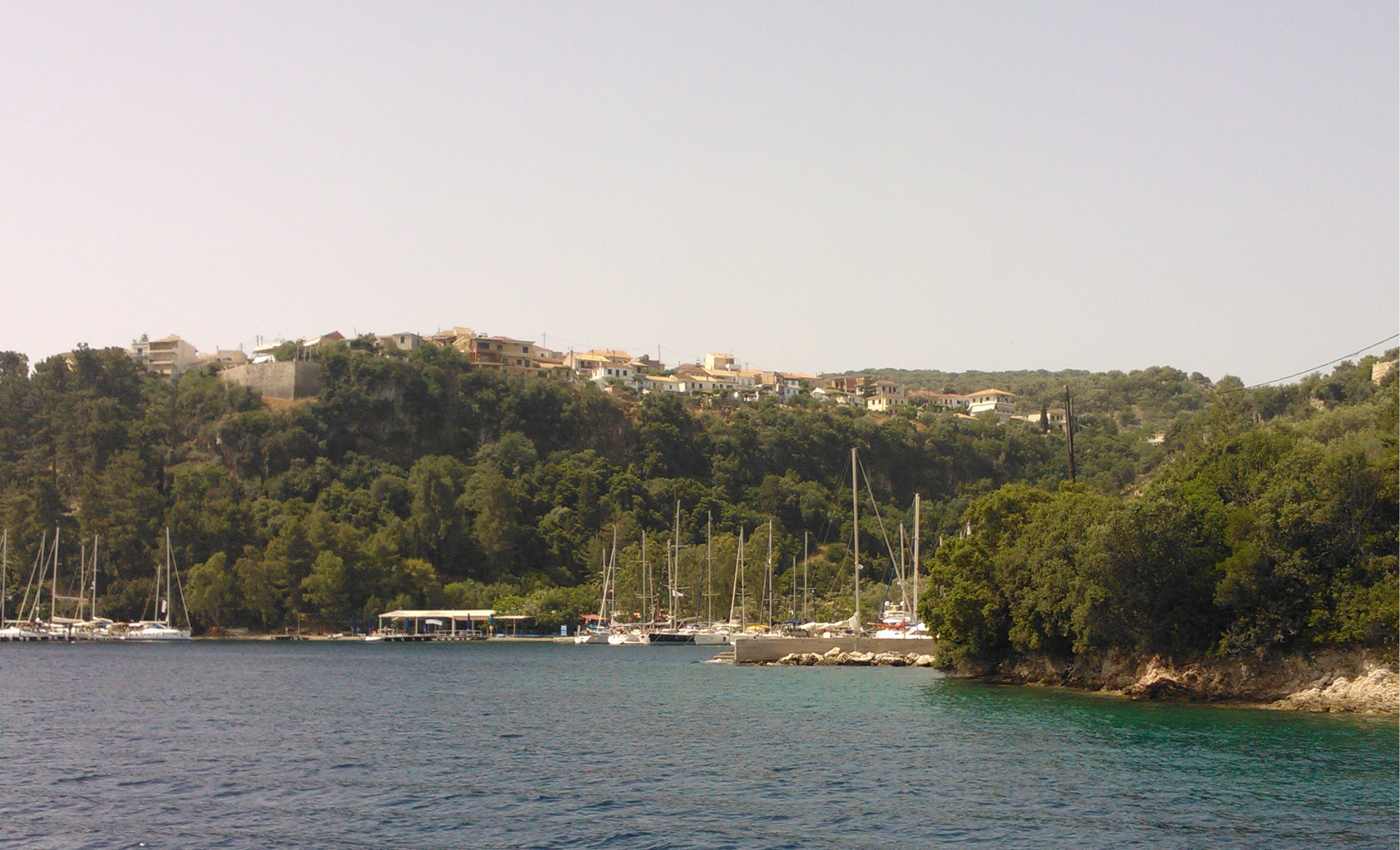
Meganisi is the largest of the small islands scattered off the east coast of Lefkada, a short crossing from the busy waterfront at Nydri. The ferry takes about twenty minutes and lands at Porto Spilia and the sheltered harbour of Vathy. The island stays low-key and quiet, with little of the mass tourism found on larger Ionian destinations. Three villages sit above a deeply indented coast of small bays and pebbled coves. Many travellers arrive only for a day, drawn by the Papanikolis sea cave and the calm water, while others settle in for a slower, unhurried stay near Lefkada. Plan the whole trip with Greece Tours.
The name suits the place, since Meganisi is by far the biggest of the islets in this cluster off eastern Lefkada. Its shape is all long fingers of land and narrow inlets, so the coastline feels far greater than the modest size suggests. Vathy works as the main ferry port, a genuine fishing harbour rather than a resort. Spartochori stands on the cliff above Porto Spilia, an immaculate village of narrow lanes and bougainvillea. Katomeri sits highest of the three. With no buses on the island, visitors walk, hire a car or take a scooter to reach the beaches and the quiet inland corners.
Where is Meganisi and how do you reach it from Nydri?
Meganisi lies just off the east coast of Lefkada. A ferry of about twenty minutes runs from Nydri to Porto Spilia and Vathy, the island’s two arrival points.
Meganisi is the largest of the small islands strung along the east coast of Lefkada, set within a sheltered stretch of the Ionian Sea. The crossing starts at Nydri, the main resort and harbour town on the Lefkada shore, where the ferry berths beside the day-cruise boats. The passage takes around twenty minutes across calm, protected water, threading past the smaller islets that shelter the channel. Two landing points serve the island. Porto Spilia sits beneath the cliff village of Spartochori, while Vathy lies further round in its own deep, narrow inlet. The short hop keeps Meganisi within easy reach of the wider Lefkada holiday area.
The ferry is the practical link, since Meganisi has no bridge and no airport of its own. Travellers reach Lefkada by the causeway from the mainland near Aktion, then drive or transfer south to Nydri to board the boat. Nydri itself is the departure hub for many Lefkada boat trips, so the quay is busy with vessels heading for the surrounding islands and coves. The Meganisi ferry runs as a small vehicle and passenger service, carrying cars, scooters and foot passengers on the brief crossing. Because the distance is short, the schedule allows day returns as well as longer stays for those who want the island’s slower pace.
The setting places Meganisi within a natural amphitheatre of islands east of Lefkada, where Skorpios and other islets break the horizon. From the deck, the view opens onto green slopes rising from the water and the white line of Spartochori along the cliff. The channel stays sheltered, which keeps the crossing steady even when the open sea further out grows livelier. Foot passengers step off at Porto Spilia or Vathy directly into village life, with tavernas and quays close to the ramp. The nearness to Nydri means the island suits both a spontaneous day out and a planned base for exploring this corner of the Ionian.
Distances on Meganisi stay small, which is part of the appeal for anyone arriving from Lefkada. From Porto Spilia the road climbs quickly to Spartochori, then runs on to Katomeri and down towards Vathy on the far side. The whole island measures only kilometres across, so no journey inland lasts long. This compact scale means a day visitor can see the harbours, a village and a beach without rushing. Those who stay find the short roads make evening drives between villages easy. The link back to Nydri anchors the island firmly to the rhythms of the larger Lefkada resort scene.
What is the village of Vathy on Meganisi like?
Vathy is the island’s main harbour, a working fishing port set at the head of a deep inlet. Little chapels flank its entrance, and tavernas, rooms and small beaches sit nearby.
Vathy occupies the head of a long, narrow inlet that gives the village its name, meaning deep. The harbour serves as one of the two ferry arrival points on Meganisi and remains a genuine working fishing port. Caiques and small boats line the quay, and nets and gear lie along the waterfront rather than tourist stalls. The entrance to the inlet is guarded by little whitewashed chapels perched on the low headlands, a common sight in the Ionian. Behind the quay the village rises gently in a cluster of houses. The pace stays slow, and the harbour keeps its everyday role as a base for local fishermen.
The waterfront at Vathy carries a line of tavernas that face the moored boats, serving fish landed close by. Rooms and small guesthouses sit among the houses set back from the quay, giving those who stay a quiet base away from the crowds. Because Vathy is a real port rather than a resort, the atmosphere feels lived-in and unhurried. Evening brings a gentle bustle as boats return and diners gather along the water. Small beaches lie within walking distance of the village, tucked into the folds of the surrounding coast. The setting rewards travellers who prefer a working harbour to a purpose-built seaside strip.
From Vathy the land rises towards Katomeri, the highest of the island’s three villages, only a short distance uphill. This closeness ties the harbour to the inland settlement, and many who stay at Vathy walk or drive the brief climb. The inlet shelters the port from open water, so the harbour stays calm even when the channel outside grows breezy. Yachts occasionally call in, anchoring in the protected bay, yet the numbers stay modest. The chapels at the mouth of the inlet make a well-known image of Meganisi, framing the narrow entrance. Vathy remains the practical heart of island life for residents and visitors alike.
For anyone staying over on Meganisi, Vathy offers a natural centre of gravity in the evenings. The tavernas fill slowly, the light softens over the water, and the harbour settles into its quiet rhythm. Fishing boats set out and return, and the day-trippers who came across from Nydri have mostly gone. This after-hours calm marks the difference between a day visit and a stay, since the island reveals its stillness only once the cruise boats depart. Walkers use Vathy as a starting point for the coastal paths and the small nearby beaches. The village embodies the low-key character that draws people to Meganisi in the first place.
What will you find in Spartochori and Katomeri on Meganisi?
Spartochori stands on the cliff above Porto Spilia, an immaculate village of narrow lanes and bougainvillea, with paths down to Spilia bay and Ai Yiannis beach. Katomeri is the highest village.
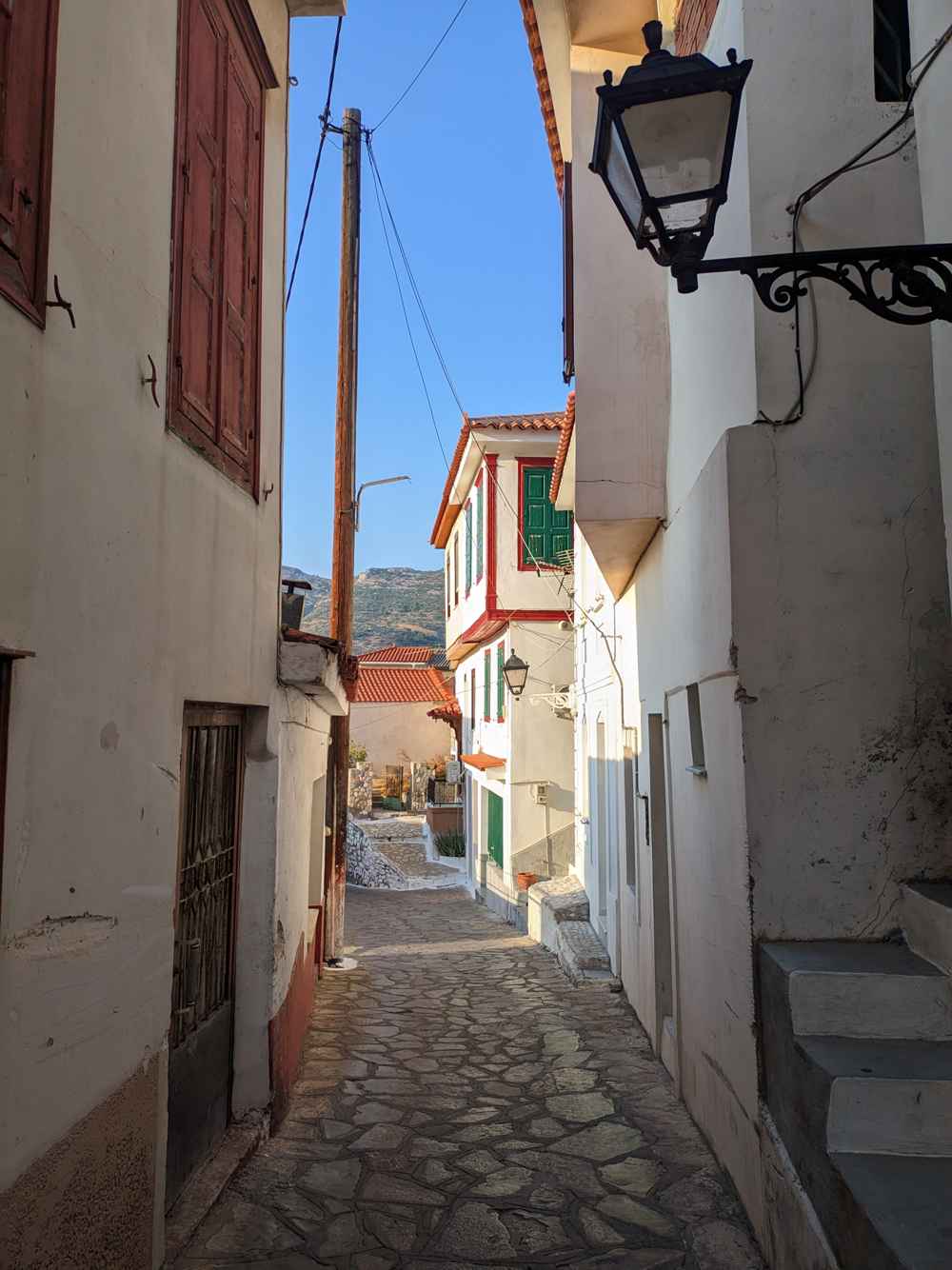
Spartochori perches on the edge of the cliff directly above Porto Spilia, so arrivals by ferry look up at its white houses from the quay. The village is famous among visitors for its immaculate condition, with swept lanes, painted steps and cascades of bougainvillea over the walls. Narrow alleys wind between the houses, too tight for much traffic, which keeps the centre calm and pedestrian. A small square with tavernas sits at the heart of the village, shaded and quiet through the heat of the day. From the clifftop the view stretches back across the channel to Lefkada. Spartochori ranks among the prettiest villages in this part of the Ionian.
Below Spartochori, paths and a short road drop down to the water at Spilia bay, close to the ferry landing at Porto Spilia. From the village a walk leads to the sandy Ai Yiannis beach, one of the more accessible stretches of sand on Meganisi. The descent passes through olive groves and scrub, with the sea opening ahead. These footpaths form part of the pleasure of Spartochori, since the village rewards those who explore on foot. The bougainvillea and the whitewash give the lanes their well-kept look, maintained with obvious care. Many day visitors climb up from the ferry simply to wander the streets and take in the view.
Katomeri stands as the highest of the three villages on Meganisi, set inland and above the coast. Its elevated position gives long views over the surrounding sea and the neighbouring islets, and the air feels fresher than at the harbours. The village keeps the same quiet, traditional character as its neighbours, with modest houses and tavernas. From Katomeri the road descends towards Vathy and its inlet on one side, linking the island’s settlements in a short chain. The three villages together hold most of the island’s small population. Katomeri suits those who want to see Meganisi’s inland face rather than only its harbours and beaches.
The trio of Spartochori, Katomeri and Vathy defines the human geography of Meganisi. Each keeps its own role, with Spartochori the clifftop showpiece, Vathy the working port and Katomeri the high inland village. Short roads and older paths connect them across the narrow island, so moving between them takes little time. This modest scale means a visitor with a car or scooter can see all three in a single unhurried day. The villages share a common look of white houses, small chapels and quiet squares. Together they hold the calm, undeveloped character that sets Meganisi apart from the busier resorts on the Lefkada coast.
Why is the Papanikolis cave the island’s best-known sight?
The Papanikolis sea cave on the west coast of Meganisi is one of the largest in Greece. Reachable only by boat, it is famous as a wartime submarine hideout.
The Papanikolis cave is the single most celebrated natural sight on Meganisi, cut into the rocky west coast of the island. It counts among the largest sea caves in Greece, a vast hollow where the water runs deep into the cliff. The entrance opens straight from the sea, so the only way in is by boat, gliding through the mouth into the shaded interior. Inside, the light shifts through blues and greens as it filters off the water. A small pebbled ledge lies within, and swimmers sometimes slip in for a cool dip. The scale of the chamber is what leaves the strongest impression on first-time visitors.
The cave takes its name from a submarine that, according to local history, sheltered within it during the Second World War. The vessel is said to have hidden in the deep chamber, using the cave’s size and hidden entrance as cover from the enemy. This wartime story gives the cave much of its fame and appears in almost every account of Meganisi. Whether every detail holds exactly, the association has fixed the name firmly to the site. The tale suits the setting, since the cave truly is large enough to conceal a substantial boat. Visitors hear the story retold on the cruises that call at the entrance.
Most travellers reach it on a boat trip rather than overland. The Nydri day cruises that circle the islands off Lefkada commonly include the cave on their route, pausing at the mouth so passengers can look inside. These are among the most popular Lefkada boat trips, pairing the cave with swimming stops in the surrounding bays. The vessels ease into the entrance where the draught allows, then hold in the calm water within. Independent visitors with their own small boat can also make the approach in settled conditions.
The cave anchors Meganisi firmly on the map of things to do in Lefkada, even for those who never set foot in the villages. Many people experience the island only through the cave, viewing it from the deck of a cruise on a day out from Nydri. The dark opening in the pale cliff, the wartime name and the sheer size combine to make it memorable. For travellers who stay on the island, a visit by small boat offers a quieter approach without the cruise crowds. The cave also underlines the island’s rugged, indented coast, where cliffs and hidden inlets shape much of the shoreline away from the harbours.
Which beaches ring the coast of Meganisi?
Small pebble and sand beaches ring the deeply indented coast of Meganisi, among them Limonari, Fanari and Atherinos. The sandy Ai Yiannis beach sits below Spartochori near Porto Spilia.
Meganisi has no single great sweep of sand, and instead offers a scattering of small beaches tucked into the folds of its indented coast. The shoreline bends and turns constantly, forming little bays and coves that shelter quiet pockets of pebble and sand. Limonari is one of the best known, a small cove reached by a short walk or drive from the villages. Fanari and Atherinos add to the choice, each a modest strand set into its own bay. These are the beaches of Lefkada‘s quiet neighbour, calmer and less developed than the famous west-coast strands on the main island. The water stays clear and sheltered.
Ai Yiannis beach, reached on foot or by road from Spartochori, is among the sandier options on the island and lies close to the ferry landing at Porto Spilia. Spilia bay itself provides another easy swimming spot near the same point, within reach of arrivals stepping off the boat. Because the coves lie apart and the island has no bus, each beach feels private, rarely crowded even in high summer. Walkers link some of them by coastal paths through olive and scrub. The lack of large resorts means the beaches keep their natural edges, with facilities beyond the occasional taverna. This simplicity is part of their appeal.
The pebble beaches such as Limonari and Atherinos suit swimmers who value clear, deep water over broad expanses of sand. The stones keep the water especially transparent, since little silt clouds the shallows. Fanari lies in another quiet inlet, reached along the island’s short roads. Many of these bays face east or south, sheltered from the prevailing wind that ruffles the open Ionian. The indented coast means a short drive often uncovers a fresh cove with barely another visitor in sight. For those exploring by scooter or car, hunting out the small beaches becomes a pleasant way to fill a day on Meganisi.
The beaches also change character between a day visit and an overnight stay. In the middle of the day the coves near Porto Spilia see arrivals from the cruises, yet the more distant bays stay quiet even then. By late afternoon, once the Nydri boats have gone, the whole coast empties and the water turns still. Those who stay on the island have the beaches largely to themselves at either end of the day. Because there are no buses, reaching the farther coves relies on a hire car, a scooter or a willingness to walk. The reward is a stretch of shoreline where solitude comes easily.
Should you visit Meganisi for the day or stay over?
Day visitors cross from Nydri on a cruise or the ferry to see the Papanikolis cave and villages. Those who stay experience the island’s true calm once the boats leave.
Meganisi works well as a day trip and as a longer stay, and the two experiences differ sharply. A day visit usually begins at Nydri, either on a scheduled cruise around the islands or on the short vehicle ferry to Porto Spilia and Vathy. Cruises tend to focus on the Papanikolis cave and swimming stops, with only a brief pause in the villages. The ferry gives independent visitors more freedom to climb to Spartochori, find a beach and eat in a harbour taverna. Either way, a day allows a good taste of the island’s quiet mood, its clear water and its clifftop views across to Lefkada.
Staying overnight reveals a different Meganisi, one that only appears after the day boats depart. Rooms and small guesthouses cluster around Vathy and in the villages, offering a modest base rather than large hotels. In the evening the harbours settle, the tavernas fill slowly, and the island returns to its residents. This after-hours stillness is what many people come for, a calm impossible to sense on a rushed day trip. Nights are quiet, with little nightlife beyond a drink by the water. For travellers seeking rest rather than entertainment, the overnight stay delivers the island’s deepest appeal and its slowest, most restful pace.
The choice often depends on what a traveller wants from Lefkada as a whole. Those based at Nydri or elsewhere on the main island can fold Meganisi into a single day among their wider plans, treating it as one of outings. Visitors who prefer a slower holiday sometimes make Meganisi their base, using the ferry to reach the shops and services of Nydri when needed. The short crossing keeps both options open. A day trip favours sightseeing and swimming, while a stay favours quiet, walking and the rhythm of a small island. Neither approach is wrong, and each suits a different kind of visitor.
For a first encounter, many people begin with a day and return later to stay. The initial cruise or ferry ride shows the cave, the harbours and the clifftop village, and often plants the wish to come back for longer. On a second visit the traveller can settle into Vathy or Spartochori, hire a scooter and explore the small beaches at leisure. This pattern reflects the island’s balance between a famous sight and a quiet retreat. Whether chosen for hours or nights, Meganisi rewards visitors who value calm over crowds and a working island over a manufactured resort.
How do you get around Meganisi without buses?
Meganisi has no buses, so getting around means walking, hiring a car or riding a scooter. The island is small enough that no journey between the villages takes long.
Meganisi runs no bus service, so movement around the island depends on private means. Walking suits the short distances between villages and to the nearer beaches, along quiet roads and older footpaths. A hire car brings the fastest reach to the farther coves and the two harbours, and copes easily with the island’s modest hills. Scooters and small motorbikes are a popular choice, well suited to the narrow roads and light traffic. Some visitors bring their own vehicle across on the ferry from Nydri, which carries cars and scooters on the short crossing. The lack of buses shapes how a day on the island unfolds.
The island’s compact size makes the absence of buses far less of an obstacle than it first appears. Only kilometres separate the villages, and the roads that link Porto Spilia, Spartochori, Katomeri and Vathy are short. A drive from one harbour to the other takes only minutes, so a car or scooter opens the whole island in a single day. Walkers can cover the central villages on foot with time to spare, pausing at squares and viewpoints along the way. The gentle scale means no destination lies far off. This closeness is a large part of why Meganisi feels so relaxed.
Footpaths add another layer to getting around, linking the villages to the beaches and coves below. From Spartochori, tracks descend to Spilia bay and Ai Yiannis beach through olive groves and scrub. These paths reward walkers with quiet approaches to the water, away from any road. Because traffic stays light across the island, even the roads make pleasant walking in the cooler parts of the day. Anyone planning to explore the outlying beaches on foot carry water and sensible shoes, since shade grows scarce at midday. The network of lanes and tracks gives the island a walkable feel despite its lack of public transport.
For day visitors arriving by cruise, the question of transport rarely arises, since the boats handle the itinerary. Those who come on the ferry, however, benefit from arranging wheels for the day, whether a car or a scooter hired near Nydri or on the island. Independent travel gives the freedom to seek out the small beaches such as Limonari, Fanari and Atherinos at leisure. Planning ahead matters, as options on a small island stay limited. With a vehicle sorted, the whole of Meganisi lies within easy reach. The lack of buses becomes a quiet advantage rather than a drawback, keeping the roads calm and empty.
What is the food and quiet character of Meganisi near Lefkada?
Meganisi centres its food on the fish of its working harbours and simple taverna cooking. Its quiet, undeveloped character suits travellers seeking calm rather than nightlife near Lefkada.
Food on Meganisi grows naturally from its identity as a working island near Lefkada. Vathy is a genuine fishing port, so fresh fish and seafood feature strongly on the taverna tables along its quay. The cooking stays simple and traditional, built on the day’s catch, local olive oil, vegetables and the usual Greek staples. Tavernas cluster at the harbours and in the village squares, where meals unfold slowly in the shade or beside the water. There are no large restaurants or chains, only small, family-run places. This modest, honest food matches the island’s low-key mood and the rhythm of its harbours and fishing boats.
The character of Meganisi rests on its quiet, and that calm defines the whole experience. With little mass tourism, few large hotels and no buses, the island moves at an unhurried pace throughout the season. Evenings are gentle, centred on a taverna meal and a drink by the harbour rather than bars or clubs. The villages keep their traditional look, with white houses, bougainvillea and small chapels. This stillness is the island’s chief attraction for many, a counterpoint to the busier resorts across the channel. For visitors seeking rest, the peace of Meganisi ranks among its greatest assets, felt most strongly once the day boats leave.
Meganisi fits into the wider range of things to do in Lefkada as its quiet, contemplative option. While the main island offers famous beaches, watersports and lively resorts, its small neighbour offers stillness, walking and swimming in empty coves. Travellers often pair the two, spending active days on Lefkada and a slower day or stay on Meganisi. The short ferry keeps the contrast within easy reach from Nydri. The island suits couples, walkers, sailors and anyone drawn to a working harbour over a manufactured resort. It rewards those content with simple food, clear water and the company of a small, undeveloped island.
For all its calm, Meganisi remains firmly tied to the life of Lefkada across the channel. The ferry from Nydri links it to the shops, transport and services of the larger island, so the quiet never feels isolating. Residents fish, farm and welcome the summer visitors, keeping the villages alive rather than seasonal shells. The island suits travellers who value authenticity and calm above spectacle, who want fresh fish by a working quay and a swim in a silent cove. Meganisi asks little and gives a great deal to those who slow down. It stands as the tranquil, understated corner of the eastern Lefkada seascape.
Frequently Asked Questions
How long is the ferry from Nydri to Meganisi?
The crossing from Nydri to Meganisi takes about twenty minutes across sheltered water. Nydri is the main resort and harbour on the east coast of Lefkada, and its quay serves as the departure point for the short vehicle and passenger ferry. The boat lands at Porto Spilia, beneath the clifftop village of Spartochori, and at the harbour of Vathy further round the coast. Because the channel between Lefkada and Meganisi stays protected by smaller islets, the passage remains calm and steady. The ferry carries cars, scooters and foot passengers, which allows both day returns and longer stays.
The brief crossing keeps the island firmly within reach of the wider Lefkada holiday area, so travellers fold it into a single day out from the mainland resort.
What are the three villages of Meganisi?
Meganisi has three villages: Vathy, Spartochori and Katomeri. Vathy sits at the head of a deep inlet and works as the main fishing harbour and one of the two ferry ports. With little chapels flanking its entrance and tavernas along the quay. Spartochori stands on the cliff directly above Porto Spilia, an immaculate settlement of narrow lanes and bougainvillea, with footpaths down to Spilia bay and the sandy Ai Yiannis beach. Katomeri is the highest of the three, set inland with long views over the surrounding sea. Short roads and older paths connect all three across the narrow island, so a visitor with a car or scooter can see each in a single unhurried day.
Together they hold most of the island’s small population and its quiet, traditional character.
What is the Papanikolis cave on Meganisi?
The Papanikolis cave is a large sea cave cut into the west coast of Meganisi and one of the largest in Greece. Its entrance opens directly from the sea, so the only way in is by boat, gliding through the mouth into a vast shaded chamber where the water runs deep. The cave takes its name from a submarine that, according to local history, sheltered inside during the Second World War, using the cave’s size and hidden entrance as cover. Most visitors reach it on the day cruises that leave Nydri and circle the islands off Lefkada, pausing at the entrance so passengers can look inside. Independent travellers with a small boat can also approach in settled conditions.
The scale of the chamber and the wartime story make it the island’s most celebrated sight.
Are there good beaches on Meganisi?
Meganisi has many small beaches rather than one large strand, tucked into the folds of its deeply indented coast. Limonari, Fanari and Atherinos are among the best known, each a modest cove of pebble or sand set into its own sheltered bay. The sandy Ai Yiannis beach sits below Spartochori near Porto Spilia, and Spilia bay offers another easy swimming spot close to the ferry landing. The pebble coves keep the water especially clear, since little silt clouds the shallows. Because the island has no bus service, reaching the farther beaches relies on walking, a hire car or a scooter, which keeps them quiet even in high summer.
The lack of large resorts means the beaches keep their natural edges, with facilities beyond the occasional taverna nearby.
Can you visit Meganisi as a day trip from Lefkada?
Meganisi makes an easy day trip from Lefkada, and travellers see it exactly that way. The most common route starts at Nydri, either on a scheduled cruise around the islands or on the short vehicle ferry to Porto Spilia and Vathy. Cruises focus on the Papanikolis cave and swimming stops in the surrounding bays, with only a brief pause in the villages. The ferry gives independent visitors the freedom to climb to Spartochori, find a beach and eat in a harbour taverna. A single day allows a good taste of the island’s calm, its clear water and its clifftop views.
Those who want the island’s deepest quiet often return to stay overnight, since the true stillness appears only after the day boats have departed and the harbours settle.
Do you need a car on Meganisi?
Meganisi has no buses, so a car or scooter helps for reaching the farther beaches and the two harbours, though it is not essential for everyone. The island is small, only kilometres across, and the roads linking Porto Spilia, Spartochori, Katomeri and Vathy are short, so drives between the villages take only minutes. Walkers can cover the central villages on foot and follow footpaths down to Spilia bay and Ai Yiannis beach. For the outlying coves such as Limonari, Fanari and Atherinos, a hire car or a scooter makes the day far easier. Some visitors bring their own vehicle across on the ferry from Nydri, which carries cars and scooters.
Day visitors arriving on a cruise rarely need transport at all, since the boats handle the whole itinerary.