
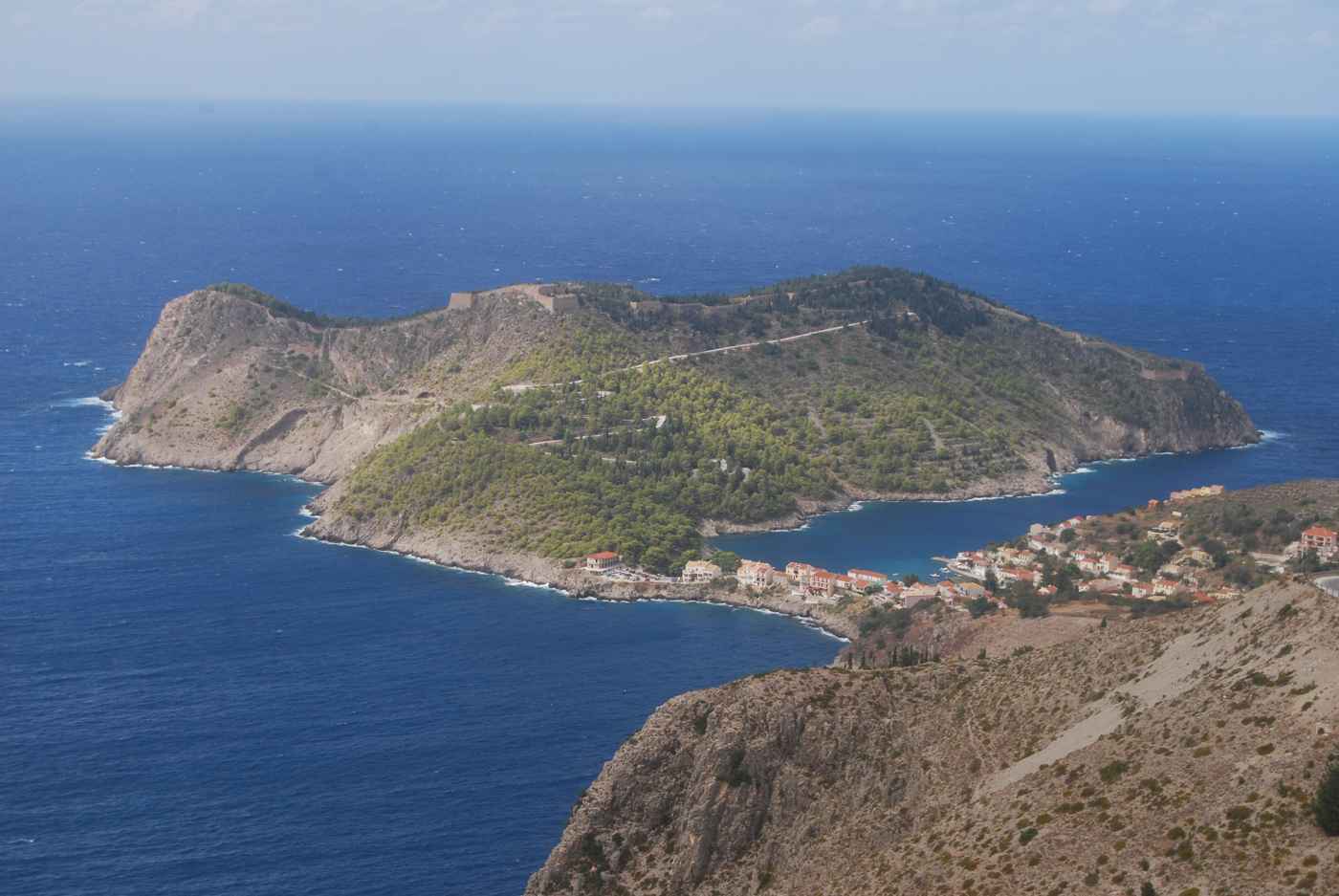
Kefalonia weddings draw couples who want green landscape, small harbour villages and dramatic viewpoints rather than a resort-wedding production line. The largest Ionian island pairs mountain scenery with a coastline of coves and cliff terraces. Ceremonies here feel rooted in a specific place rather than staged on a generic lawn. Couples can hold a civil ceremony at the Argostoli town hall, an Orthodox or Catholic service in a local church, or a symbolic blessing almost anywhere. That range, combined with reliable warm-season weather, is the practical reason the island keeps appearing on shortlists for a small, scenic celebration in Greece. Plan the whole trip with Greece Tours.
Planning a wedding on Kefalonia means separating the legal side from the setting. A legally binding marriage in Greece requires documents, translation, an apostille and a notice period at the town hall, and most visitors hand that process to a local wedding planner. The symbolic route carries no paperwork, which is why it opens up a cliff above Myrtos. A quay at Fiskardo, a beach at Petani or Xi, a villa garden or a Robola vineyard in the Omala valley. This guide covers why the island suits a wedding, the ceremony types, the best settings, the paperwork in general terms, the season, receptions and travel.
Why does Kefalonia suit a wedding?
Kefalonia suits a wedding through green landscape, small harbour villages and dramatic viewpoints. The island offers scenic variety and a settled warm season without the scale of a resort-wedding machine.
Kefalonia works for a wedding because its geography gives couples several distinct backdrops within a short drive. The north holds the harbour villages of Fiskardo and Assos. The west coast has the cliff view over Myrtos and the pale sand at Petani. The interior rises into the Omala valley and its Robola vineyards. This variety means a couple can match the setting to the mood they want, from a quiet quayside dinner to a viewpoint ceremony at sunset. The island rewards a celebration built around its landscape rather than one imposed on a standard venue lawn.
The scale of the island also shapes the experience. Kefalonia is not organised around large resort complexes that process weddings in quick succession, so ceremonies tend to feel individual and unhurried. Small tavernas, boutique hotels and private villas take on receptions, and the pace suits a guest list of family and close friends rather than a crowd of several hundred. Couples who want a low-key celebration in a real village setting find the island fits that brief. The absence of a wedding production line is part of the appeal for visitors choosing here.
Weather is a further practical reason the island suits a wedding. The warm season runs from May to October, giving a long window of dry, settled days for an outdoor ceremony. Sea breezes temper the summer heat on the exposed west-coast beaches, and the interior valleys stay a little cooler. This reliability matters when a ceremony is planned around a viewpoint or a beach at sunset, where rain force a change of setting. A dependable climate lets couples commit to an outdoor plan with reasonable confidence months ahead.
Access rounds out the case. Guests fly into Kefalonia Airport, coded EFL, near Argostoli, with seasonal connections that grow through the summer months. The island is compact enough that guests can reach most ceremony settings and receptions without long transfers, which keeps a multi-day celebration manageable. Argostoli, the capital, provides the registry and town hall for the legal side, along with hotels and services in one central base. The combination of a workable airport, short internal distances and a real administrative centre makes the logistics of a Kefalonia wedding straightforward to organise.
What ceremony types can couples choose on Kefalonia?
Couples choose from three ceremony types on Kefalonia: a civil ceremony at the Argostoli town hall or registry, an Orthodox or Catholic religious service in a church, and a symbolic blessing that carries no legal paperwork.
The civil ceremony is the standard legal route. It takes place at the Argostoli town hall or registry office and produces a marriage recognised in Greece and, through the correct paperwork, abroad. This option suits couples who want their legal marriage to happen on the island itself rather than at home. Because it is an official act, it depends on the full document process, including translation, an apostille and a notice period. A local planner usually coordinates the appointment and the paperwork so the couple can arrive with the legal side already prepared and confirmed in advance.
A religious ceremony is the second route. An Orthodox service in a local church is available to couples who meet the church’s requirements, and a Catholic ceremony is also possible in the appropriate church. Religious ceremonies carry their own conditions, such as baptismal and other church documents, alongside the civil paperwork that gives the marriage legal standing. These services suit couples for whom the faith element is central and who want the setting of a village church. The requirements are more involved than for a civil ceremony, so early planning with someone who knows the local churches is sensible.
The symbolic or blessing ceremony is the third and most flexible route. It carries no legal paperwork, which means it can be held almost anywhere on the island and can be shaped freely around a couple’s wishes. Many visitors treat it as the wedding day itself while completing the legal marriage separately at home, either before or after the trip. Without an official appointment to fix the location, the symbolic ceremony frees couples to choose a cliff terrace, a beach or a vineyard. This flexibility is the main reason it is popular with travelling couples.
Choosing between the types comes down to where the legal marriage happens and how much flexibility the couple wants over the setting. A civil ceremony ties the day to the town hall or registry; a religious ceremony ties it to a church; a symbolic ceremony frees the location entirely. Some couples combine routes, holding the legal formality quietly and staging a larger symbolic celebration in a scenic spot. A local wedding planner can explain which route fits a given timeline and document situation, and can arrange the legal steps whichever type the couple selects.
What is the difference between a legal and a symbolic ceremony?
A legal ceremony creates a marriage recognised by the state and requires documents, translation, an apostille and a notice period. A symbolic ceremony carries no paperwork and no legal standing, so it can be held anywhere.
The legal ceremony is the one that changes a couple’s marital status in law. In Greece it depends on a defined set of documents, including passports, birth certificates and a certificate of no impediment, each translated and authenticated with an apostille where required. A notice period at the town hall precedes the ceremony, and the civil or religious service then produces an official marriage. Because these steps have to align with local procedure, most visitors rely on a planner to gather, translate and submit the paperwork on the correct timeline before the wedding date.
The symbolic ceremony, by contrast, has no legal effect and therefore needs no documents at all. It is a personalised celebration led by a celebrant or officiant of the couple’s choice, with vows, readings and rituals arranged to taste. Because nothing is filed with an authority, there is no notice period and no restriction tying the ceremony to a town hall. Couples who take this route usually complete the binding marriage in their home country, keeping the two events separate. The symbolic day then carries the emotional weight without the administrative constraints of a legal ceremony.
The practical consequence of the difference is location freedom. A legal ceremony is anchored to an approved setting such as the Argostoli registry or a licensed church, whereas a symbolic ceremony can take place on a cliff above Myrtos, on the quay at Fiskardo, on the sand at Petani or Xi, in a villa garden or among the vines of a Robola estate in Omala. Couples who have set their heart on a specific viewpoint often choose the symbolic route precisely because it removes the legal restriction on where the words can be spoken.
Deciding between the two usually starts with a simple question: does the couple need the legal marriage to happen in Greece, or only the celebration? Those who want both handle the full document process and accept the location limits that come with it. Those content to marry legally at home gain complete freedom over the setting on the island. A local planner can map either path. Arrange the legal steps where needed and book a celebrant for a symbolic ceremony. The choice rests on preference rather than on procedural confusion.
Where are the best settings and viewpoints for a Kefalonia wedding?
The best settings include the cliff terrace above Myrtos, the harbour quay at Fiskardo, the beaches at Petani and Xi at sunset, villa gardens, and the Robola vineyards of the Omala valley.
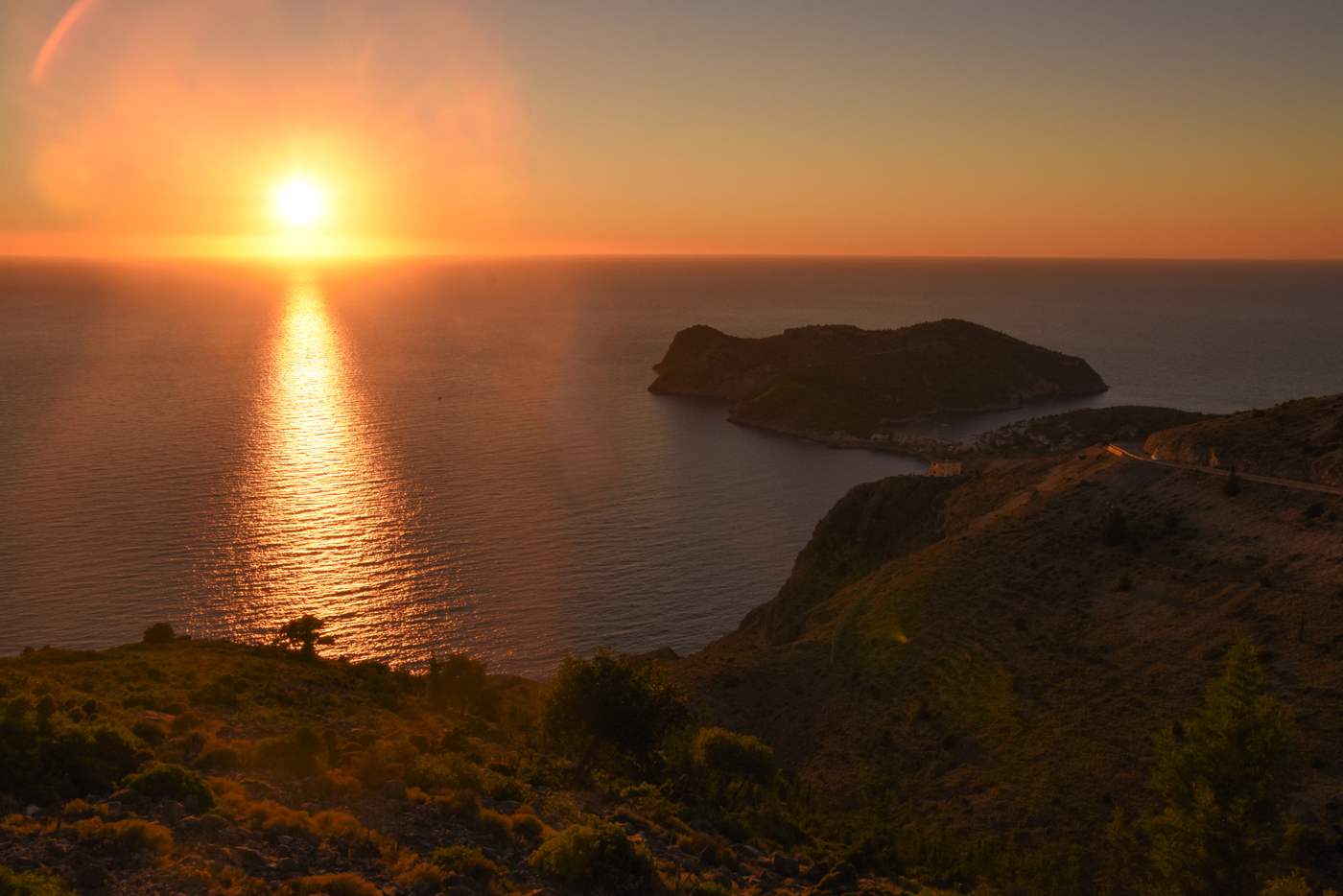
The west-coast viewpoints are the island’s signature settings. The cliff terrace above Myrtos looks down on one of Greece’s most photographed bays, where pale sand meets deep blue water framed by steep green slopes. A symbolic ceremony staged on that terrace gives an elevated backdrop that needs no decoration. Nearby, the hilltop village of Assos sits on a narrow isthmus above a sheltered cove, offering a quieter but equally scenic option. These high vantage points suit couples who want the drama of the coastline rather than the intimacy of a beach at the water’s edge.
The harbour villages provide a different character. Fiskardo, in the north, escaped the worst of the earthquake and kept its old waterfront houses. A ceremony or reception on its quay is set among traditional architecture and moored boats. The scene works well for an evening celebration when the harbour lights come on. This kind of setting suits couples drawn to a lived-in village atmosphere, where the wedding sits within a working port rather than an isolated venue. Fiskardo’s restaurants along the water also make it a natural base for a harbourside reception dinner.
The beaches offer sunset ceremonies at sea level. Petani, on the Paliki peninsula, and Xi, with its distinctive reddish sand, both face west, so a ceremony timed to the evening ends as the sun drops into the Ionian. A beach setting brings the sound of the water into the vows and gives a relaxed, barefoot mood. Because the symbolic route imposes no location limits, couples can hold the ceremony on the sand and move to a nearby taverna afterwards. West-facing beaches are the practical choice for anyone who wants the sunset itself as the backdrop.
Inland, the Robola vineyards of the Omala valley give a wholly different setting. Rows of vines on the slopes below Mount Ainos provide a green, sheltered backdrop away from the coast, and the estates connect the ceremony to the island’s best-known wine. A villa garden is a further private option, letting couples control the whole day within a single property. Between vineyards, villa grounds, harbours, beaches and clifftop viewpoints, Kefalonia covers a wide range of moods. The setting can be matched closely to the celebration a couple has in mind.
What legal paperwork is needed to marry in Kefalonia?
A legally binding marriage requires passports, birth certificates, a certificate of no impediment, official translation and an apostille, plus a notice period at the town hall. A local planner usually arranges the process.
The document set is the starting point for any legal marriage in Greece. Couples generally need valid passports, full birth certificates and a certificate of no impediment confirming they are free to marry. Where either partner has been married before, further documents covering that history are usually required. Because requirements vary with nationality and personal circumstances, the exact list is confirmed case by case. Assembling the correct papers well ahead of the date is the single most important planning task, since missing or incorrect documents are the common cause of delay for a Kefalonia wedding.
Translation and authentication turn those documents into a form the Greek authorities accept. Papers issued abroad typically need official translation into Greek, and many require an apostille, the international certification that validates a document for use in another country. The apostille is obtained in the country that issued the document, not in Greece, so it has to be arranged before travelling. Getting the translation and apostille steps right is where local knowledge pays off, because an authority will reject paperwork that has not been certified in the correct sequence and format.
A notice period at the town hall is the procedural stage that precedes the ceremony. The couple, or their representative, lodges notice of the intended marriage with the local authority, and a set interval passes before the marriage can take place. The specific timing is fixed by procedure and is confirmed locally, so couples plan their arrival and ceremony date around it. This step is why a same-day legal wedding is not possible. The paperwork and the notice have to be completed in the correct order before the registry or church ceremony can go ahead.
Authentication and a local authority on a set timeline, most visitors delegate the whole process to a local wedding planner. A planner confirms the current document list for the couple’s nationality, checks translations and apostilles, lodges the notice and books the town hall or registry appointment. This removes the risk of a document being wrong at the last moment and lets the couple focus on the celebration. For anyone marrying legally on the island, engaging a planner early is the practical way to keep the paperwork on track.
How couples choose a season and a planner?
Couples marry between May and October, with June and September favoured for warm but calmer weather. A local planner handles the legal paperwork, venues and suppliers, so choosing one early is sensible.
The season sets the frame for everything else. Kefalonia’s wedding window runs from May to October, when the weather is dry and warm enough for outdoor ceremonies. Within that window, June and September are the favoured months because they deliver warmth without the peak heat and crowds of high summer. An early-June or September date gives comfortable conditions for guests, softer light for a sunset ceremony and more availability at popular settings. Couples set on a specific viewpoint or villa benefit from choosing one of these shoulder months, when demand on venues and suppliers is a little lower.
High summer remains an option but comes with trade-offs. July and August bring the hottest, busiest conditions, which can be demanding for a midday ceremony and for guests unused to Mediterranean heat. Accommodation and flights are also at their most stretched. Couples who marry then usually schedule the ceremony for late afternoon or early evening to avoid the peak temperature. Weighing the guaranteed warmth of high summer against the calmer feel of the shoulder months is a central seasonal decision. It interacts with how guests are travelling and when they can most easily get away.
A planner is the practical hub of a Kefalonia wedding, especially for visitors. A local planner knows the settings, the churches, the town hall procedure and the reliable suppliers, and coordinates the legal paperwork that a couple cannot easily manage from abroad. Choosing one early matters because the planner shapes the whole timeline, from lodging the marriage notice to booking a celebrant, caterer and photographer. Couples benefit from selecting a planner before fixing the finer details, so that decisions about venue and date are made with local knowledge rather than corrected afterwards.
Matching the planner to the type of wedding is the final piece. A couple planning a full legal ceremony needs a planner comfortable with the document process and the town hall, while a couple wanting a symbolic day on a beach or clifftop needs one strong on settings, celebrants and logistics. Clear communication about the ceremony type, guest numbers and budget lets the planner build a realistic plan. Booking early, in the same period as fixing the season, gives the widest choice of dates and suppliers and reduces the pressure of arranging a wedding at a distance.
What are receptions and travel like for a Kefalonia wedding?
Receptions take place at tavernas, boutique hotels and villas, with local food such as kreatopita and Robola wine. Guests fly into Kefalonia Airport, coded EFL, near Argostoli.
Receptions on Kefalonia lean on the island’s own venues rather than dedicated banqueting halls. Family-run tavernas host relaxed dinners, boutique hotels offer a more structured setting, and private villas let a couple take over a whole property for the day and evening. A harbourside taverna in Fiskardo suits an intimate group, while a villa with grounds handles a larger gathering with space for dining and dancing. The choice of reception venue tends to follow the ceremony setting. A clifftop or beach ceremony often flows into a nearby taverna or a villa within easy reach of it.
Local food gives the reception a strong sense of place. Kreatopita, the island’s traditional meat pie, is a signature dish that reflects Kefalonian cooking, and menus draw on fresh fish, local cheeses and vegetables from the island. Pairing the meal with Robola, the crisp white wine from the Omala valley vineyards, ties the food directly to the landscape guests have seen during the day. Building the reception menu around these local specialities, rather than a generic international spread. Is one of the simplest ways to make a Kefalonia wedding feel grounded in the island itself.
Travel for guests centres on Kefalonia Airport, coded EFL, a short distance from Argostoli. Seasonal flights connect the island with a range of cities across the wedding season, with the widest choice through the summer months. Because the airport sits centrally and the island is compact, transfers to villages, beaches and villas are manageable without long journeys. Advising guests to book flights early, particularly for a peak-summer date, helps secure seats before seasonal demand builds. A single accessible airport keeps the arrival logistics simple compared with destinations that require an onward ferry.
Coordinating the pieces is where a couple ties reception and travel together. A central base, often in or near Argostoli, gives guests hotels, services and easy reach of both the airport and the main ceremony settings. Grouping the ceremony, reception and guest accommodation within a short radius keeps a multi-day celebration relaxed and reduces driving between events. Some couples build in a group dinner the evening before and a slower gathering the day after, using the island’s tavernas. Kept compact, a Kefalonia wedding becomes a short shared holiday rather than a single rushed day.
Frequently Asked Questions
Can a symbolic ceremony be held anywhere on Kefalonia?
A symbolic ceremony carries no legal paperwork, so it can be held almost anywhere on the island. Couples use the cliff terrace above Myrtos, the harbour quay at Fiskardo. The beaches at Petani and Xi at sunset, a villa garden or a Robola vineyard in the Omala valley. Because nothing is filed with an authority, there is no restriction tying the ceremony to a town hall or a licensed venue. The freedom of location is the main reason travelling couples favour the symbolic route. Most complete their legally binding marriage at home, either before or after the trip, and treat the symbolic day on Kefalonia as the wedding celebration itself.
A local planner books the setting, arranges a celebrant and handles the practical details.
Which months are best for a Kefalonia wedding?
The wedding season on Kefalonia runs from May to October, when the weather is dry and warm enough for outdoor ceremonies. Within that window, June and September are the favoured months because they bring warmth without the peak heat and crowds of high summer. These shoulder months give comfortable conditions for guests. Softer light for a sunset ceremony on a west-facing beach such as Petani or Xi. Better availability at popular settings and with suppliers. July and August remain possible but are the hottest and busiest, so couples marrying then usually schedule the ceremony for late afternoon or early evening.
Choosing an early-June or September date, and booking flights and accommodation ahead, tends to give the smoothest experience for a travelling group of guests.
What documents are required for a legal marriage in Greece?
A legally binding marriage in Greece generally requires passports, full birth certificates and a certificate of no impediment confirming that each partner is free to marry. Documents issued abroad usually need official translation into Greek and an apostille, the international certification obtained in the country that issued the document. A notice period at the local town hall precedes the ceremony, so the paperwork and notice have to be completed in the correct order before the wedding date. Where a partner was married before, additional documents covering that history are normally needed.
Couples confirm it case by case, ideally through a local wedding planner who gathers, checks and submits everything on the correct timeline and books the town hall or registry appointment.
How do wedding guests reach Kefalonia?
Guests fly into Kefalonia Airport, coded EFL, which sits a short distance from Argostoli, the island’s capital. Seasonal flights connect the island with a range of cities across the wedding season, and the choice of routes is widest through the summer months. Because the airport is central and Kefalonia is compact, transfers to villages, beaches and villas are manageable without long journeys. A single airport avoids the onward ferry some island destinations require. Couples usually advise guests to book flights early, particularly for a peak-summer date, so seats are secured before seasonal demand builds.
A central base in or near Argostoli keeps guests close to both the airport and the main ceremony settings, which helps a multi-day celebration stay relaxed and easy to coordinate.
What food and wine feature at a Kefalonia reception?
Kefalonia receptions draw on the island’s own cooking rather than a generic international menu. Kreatopita, the traditional Kefalonian meat pie, is a signature dish, and menus include fresh fish, local cheeses and island vegetables. The natural pairing is Robola, the crisp white wine produced in the vineyards of the Omala valley below Mount Ainos. Which ties the meal directly to the landscape guests see during the day. Receptions take place at family-run tavernas, boutique hotels and private villas, so the style ranges from a relaxed harbourside dinner in Fiskardo to a full-day celebration in villa grounds. Building the menu around these local specialities is one of the simplest ways to give the reception a strong sense of place.
It connects the food to the vineyards and villages of the island.
Do couples need a wedding planner on Kefalonia?
A local wedding planner is not strictly required, but most visitors engage one, particularly for a legal ceremony. A planner knows the settings, the village churches, the Argostoli town hall procedure and the reliable local suppliers, and coordinates the paperwork that a couple cannot easily manage from abroad. For a legal marriage, the planner confirms the document list, checks translations and apostilles, lodges the marriage notice and books the registry or church appointment on the correct timeline. For a symbolic ceremony, the planner arranges the setting, a celebrant and the reception logistics. Choosing a planner early matters because they shape the whole plan, from the season and date to the venue and menu.
Clear communication about the ceremony type, guest numbers and budget lets the planner build a realistic and workable schedule.