
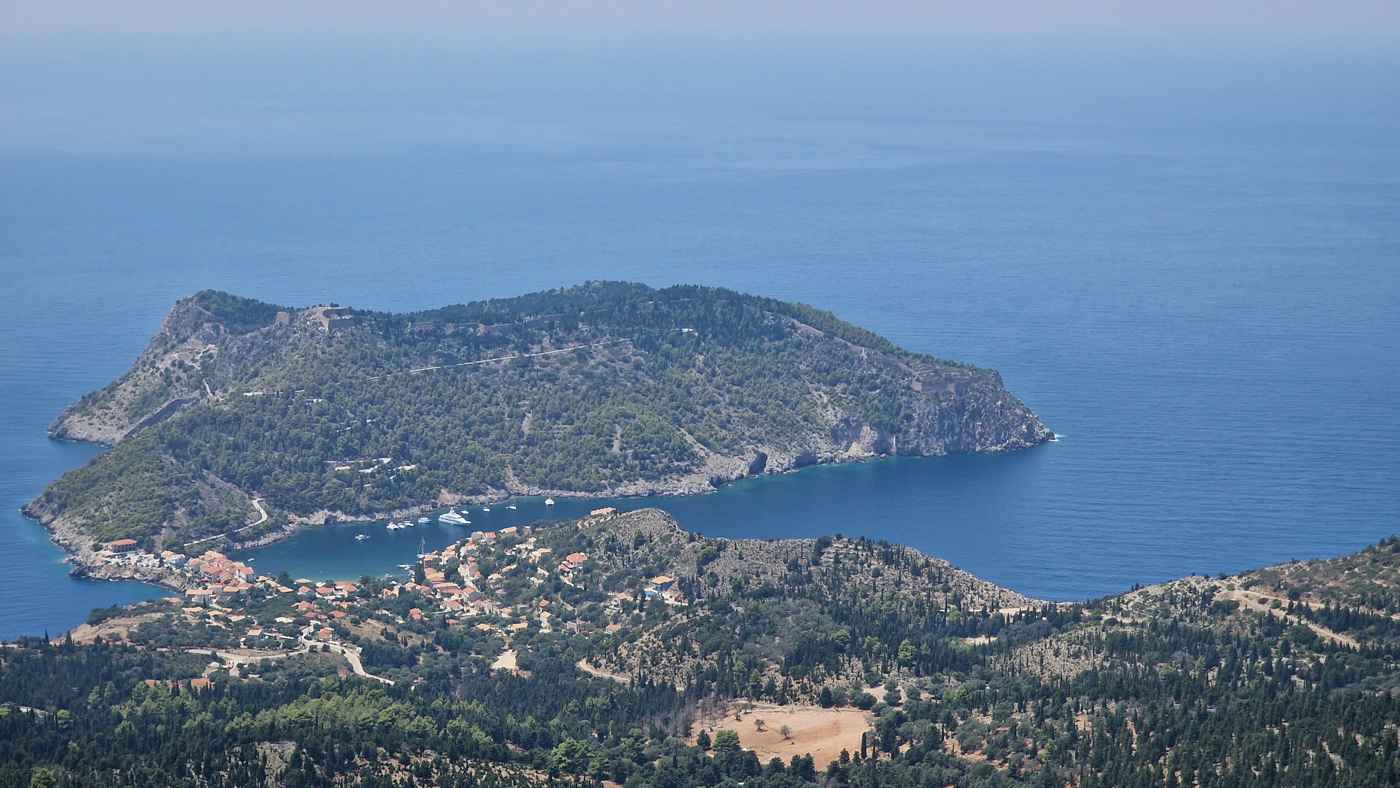
Assos sits on the northwest coast of Kefalonia, about 36 kilometres north of Argostoli. The village stands on a narrow isthmus that ties the main island to a pine-covered peninsula crowned by a Venetian castle. Pastel houses in ochre, pink and blue ring a sheltered cove with a small pebble beach and a short quay of tavernas. A footpath and a narrow road climb from the harbour to the ruined castle walls, which enclose the whole headland. This guide covers Assos Kefalonia in four parts: the village and its setting, the beach and harbour, the castle, and the walk to the walls. Plan the whole trip with Greece Tours.
Assos rewards a slow visit rather than a quick stop. The bay stays calm when the open Ionian runs rough. The tavernas sit steps from the water. The castle gives wide views over the coast toward Myrtos beach, about 8 kilometres south. The village belongs to the northern half of Kefalonia, on the road between Myrtos and Fiskardo. Small in scale, with about 100 year-round residents, Assos keeps the low profile set after the earthquake rebuilt the island. The sections below set out where the village lies, what the cove and harbour offer, the history of the fort, and how to reach the walls.
Where is Assos in Kefalonia and what makes its layout unusual?
Assos sits on the northwest coast of Kefalonia, about 36 kilometres from Argostoli. A narrow isthmus links the village to a pine-covered peninsula, so the settlement wraps around a sheltered cove below a Venetian castle.
Assos occupies a thin strip of land on the northwest coast of Kefalonia, roughly 36 kilometres north of Argostoli by the coast road. The strip is an isthmus about 30 metres wide at its narrowest, and it ties the village to a rounded peninsula that rises to the west. Cars reach Assos on a side road that drops from the main highway near Divarata. The drive from Argostoli takes about 50 minutes, and the same road continues north toward Fiskardo. Visitors leave the highway, wind down a set of tight bends, and arrive at the harbour at the base of the peninsula.
Pastel houses line the shore of Assos in shades of ochre, pink and pale blue, stacked up the low slopes on both sides of the isthmus. The village belongs to the northern half of Kefalonia, a green, mountainous island in the Ionian Sea. The buildings stand only one or two storeys high, a pattern set after the earthquake flattened towns across the island. Around 100 people live here year round, and the number climbs through summer. Bougainvillea and cypress trees frame the lanes, which are too narrow for through traffic and end at the water. A small square sits at the centre, shaded by plane trees, where the road meets the seafront.
Assos grew as a fishing and farming village at the foot of its castle, and it kept that scale into the present. The harbour faces east into a bay, so it stays sheltered from the open Ionian on the far side of the peninsula. Fields and olive groves climb the slopes behind the houses, and tavernas sit near the water. The village sits about 8 kilometres north of Myrtos and about 13 kilometres south of Fiskardo along the coast road. Boats moor along a short quay, and the road ends where the isthmus meets the peninsula and the climb to the castle begins.
Drivers from the airport near Argostoli follow the coast north through Agkonas and Divarata to reach Assos. The turn-off from the main road drops about 4 kilometres down to the harbour, and buses stop on the road above rather than in the village. No fuel station stands in Assos itself, so the nearest pumps sit on the highway near Divarata. Parking spaces are limited along the seafront and the approach road, and drivers often leave the car above and walk down. The last stretch runs past a small chapel and gardens before the houses and the quay come into view at sea level.
What is the beach and harbour at Assos in Kefalonia like?
Assos wraps around a sheltered cove with a small pebble beach at its head. Calm, shallow water fills the bay, and a short quay lined with tavernas edges the harbour where fishing boats and small yachts tie up.
The beach at Assos lies at the head of the cove, a strip of grey and white pebbles about 80 metres long. Water deepens slowly from the shore, so the shallows stay calm and warm through summer. The bay opens to the east, which shelters it from the northwest wind that hits the open coast. Tamarisk trees line the back of the beach and throw shade over the pebbles by midday. No large resort stands here, and the beach carries no organised rows of loungers along its length. Swimmers share the water with small boats that moor a short way out.
Tavernas line the quay at Assos, their tables set out on the waterfront steps from the moored boats. Menus lean on the day’s catch, along with Kefalonian dishes such as meat pie and the local Robola white wine. The harbour stays busy through the evening, when the light turns the pastel houses gold across the cove. A coast road links the village to Myrtos beach, about 8 kilometres south, so travellers often pair the two in one trip. Kayaks and paddleboards launch from the pebbles, and the calm bay suits short paddles out toward the peninsula’s rocky shore. Small shops and a bakery sit among the tavernas, a short walk from the beach.
The cove at Assos gives calm swimming even when the open Ionian runs rough on the far side of the peninsula. Clear water and a rocky seabed near the edges draw snorkellers, who find small fish along the base of the castle hill. Pebbles keep the water clear, since no river or sand clouds the bay. A short swim from the beach reaches the quieter northern corner, below the pines that cover the headland. The sun leaves the cove early behind the high peninsula, so the beach cools in late afternoon while the harbour stays warm. Families gather on the pebbles through the middle of the day.
Amenities at Assos stay small in scale, matched to a village of about 100 residents. A cluster of tavernas, two or three small shops and rooms to rent make up the businesses around the harbour. No bank or large supermarket stands in the village, so visitors stock up in Argostoli or on the way north. Sunbeds appear on a short section of the beach in high summer, while the rest stays open pebble. Drinking water, toilets and a first-aid point sit near the square. Fishing boats land their catch at the quay in the morning, and the tavernas buy their fish straight off the deck.
What is the Venetian castle above Assos in Kefalonia?
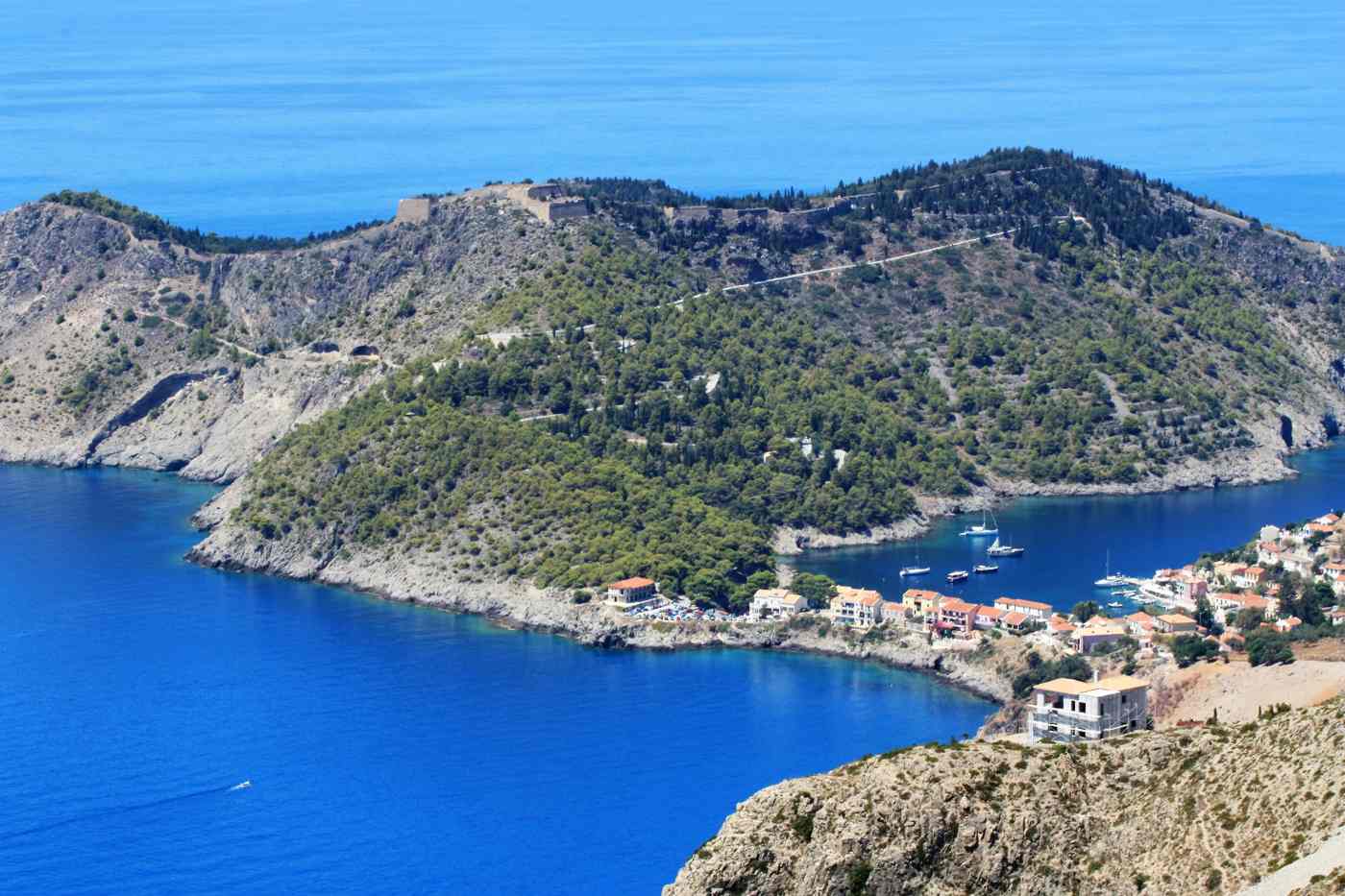
The Venetian castle of Assos crowns the pine-covered peninsula above the village, its walls enclosing the whole headland.
The castle of Assos spreads across the top of the peninsula, one of the largest fortresses in the Ionian Islands. Its walls run for roughly 2 kilometres around the headland, following the line of the cliffs above the sea. Venetian engineers laid out the fort with bastions at the corners and a single main gate on the landward side. The enclosed area covers a wide, sloping plateau of pine and scrub, far larger than the village below. Inside the walls stand the ruins of a governor’s house, barracks and a church, now roofless and overgrown. The scale reflects the fort’s role as a regional stronghold rather than a single tower.
Venice ruled Kefalonia through the late medieval and early modern period, and it built the Assos fort to hold the north of the island. Corsair raids from the sea threatened the coastal villages, so the fortress gave farmers and fishermen a walled refuge. A Venetian provveditore, or governor, lived inside the walls and ran the surrounding district from the fort. The garrison watched the strait between Kefalonia and Ithaca, a route for shipping through the Ionian. Over time the threat faded, the administration moved down to the village and the fort lost its military role. The buildings inside slowly fell into ruin as the garrison shrank.
The earthquake shook the whole of Kefalonia and left the castle’s already ruined buildings in worse condition. For a period before that, the fort had served as a rural prison, whose inmates farmed the land inside the walls and planted trees on the peninsula. The prison closed, and the site was left to the pines and the sea wind. A small church inside the walls, dedicated to a saint, still stands among the ruins and draws occasional visitors. Restoration work has since stabilised sections of the wall and the main gate. The interior stays open ground, crossed by paths between the standing fragments of stone.
Pine trees cover the peninsula inside the castle walls, planted in part during the prison years to hold the soil. The forest now shades the ruins and the paths that cross the headland. Aleppo pines and low scrub grow between the broken walls, and goats graze the open ground in places. From the walls the land drops in cliffs to the sea on the western and northern sides, where the open Ionian meets the rock. The eastern side looks back down over the isthmus, the harbour and the pastel roofs of the village. Little remains intact beyond the outer walls, the gate and the small church.
How do you reach the castle above Assos, and what are the views like?
A footpath and a narrow road both climb from the village to the castle walls above Assos.
The footpath to the castle begins at the north end of the harbour, where a signed track leaves the road. It climbs the side of the peninsula in switchbacks through pine and scrub, gaining about 170 metres of height. The walk up takes roughly 25 to 30 minutes at a steady pace, and the surface is stone and packed earth. Shade from the pines covers long stretches of the route, though the final stretch near the walls runs open in full sun. Walkers reach the main gate on the landward side, then pass through into the wide enclosure. Sturdy shoes help on the loose ground, and water matters in the summer heat.
The road to the castle branches off above the village and loops around the neck of the peninsula. It runs for about 3 kilometres of narrow, partly paved surface to a small parking area near the gate. Cars manage the climb slowly, since the lane is single-track with limited passing places along the cliff edge. The road gives the easier approach for anyone who prefers not to walk the steep footpath. From the parking area a short level track leads through the gate into the fortress grounds. Cyclists also use the road, though the gradient and loose edges make the climb hard work in the heat.
The castle walls give wide views over the bay of Assos and the coastline in both directions. To the south the cliffs of the northwest coast run toward Myrtos, about 8 kilometres away, though the beach itself sits out of sight around a headland. To the north the view reaches along the coast toward Fiskardo and, on a clear day, across the strait to Ithaca. Straight down, the isthmus, the harbour and the pastel village sit far below the walls. The open Ionian fills the western horizon beyond the cliffs. The height and the full circle of walls make the outlook the main reward of the climb.
Entry to the castle grounds carries no gate or ticket, and the site stays open through the day. Early morning and late afternoon suit the climb best, when the sun sits low and the heat eases. The full loop of the walls takes about an hour on foot, over uneven ground and short scrambles. Visitors often combine Assos with Myrtos beach and the village of Fiskardo in a single day along the north coast. No cafe or shop stands inside the walls, so walkers carry their own water and food up the hill. The descent to the harbour returns to the tavernas and the shade of the cove.
How did Assos recover after the earthquake?
Assos rebuilt its pastel houses after the earthquake with French aid, and the village now holds tavernas, rooms and a small harbour without large resorts about 36 km from Argostoli.
Assos lines a narrow isthmus that ties the village to a pine-covered peninsula on the northwest coast. The houses climb the slope in pastel shades of ochre, pink and pale blue, their shutters and balconies facing a sheltered bay. A Venetian castle crowns the headland above, reached by a track that climbs around 30 minutes from the harbour. The village sits about 36 km from Argostoli and around 13 km south of Fiskardo. Bougainvillea and cypress frame the lanes, which stay narrow enough that most visitors walk. The waterfront curves for about 200 metres past small boats moored close to the tavernas.
The earthquake struck the Ionian Islands and flattened most of Kefalonia, yet Assos held together better than its neighbours. Restoration followed with French help, which funded repairs to houses and public buildings and left a plaque recording the effort. Masons rebuilt the pastel facades to their earlier lines rather than replacing them with plain concrete blocks. The result keeps the pre-earthquake character that Fiskardo also preserved further north. Stone walls, tiled roofs and wooden balconies survive along the lanes. Assos today counts a small permanent population, with numbers rising through the warmer months when the rooms and tavernas around the harbour reopen.
Assos works as a quiet base rather than a resort town. No large hotels stand on the isthmus, and accommodation runs to small rooms and studios above the bay. Visitors fill the daytime hours with a swim off the harbour, a walk up to the Venetian castle and a meal at a waterside taverna. The castle walls enclose about 40 hectares of pine and wild flowers, with views over Myrtos and the open sea. The village pairs well with the wider list of things to do in Kefalonia, from Melissani cave to Mount Ainos. Evenings stay calm once the day-trippers drive back up the hill.
The peninsula behind the village belonged to a Venetian garrison that guarded the northwest coast against raiders. A ruined gate, cisterns and chapel remain inside the walls, alongside two abandoned prison buildings from a later era. The isthmus itself measures around 200 metres across, so the sea sits on both sides of the road in. A small square by the water holds a war memorial and a shaded terrace under plane trees. Cats doze on the harbour wall while fishing boats unload in the morning. Assos keeps its scale small on purpose, and the drive down the hill filters out large coaches.
Where can you swim at Assos in Kefalonia?
Assos has a small pebble beach on the north side of its bay, with calm shallow water and shade in the morning; Myrtos beach lies about 8 km south for a bigger swim.
The main swimming spot at Assos sits just north of the harbour, a short strip of pale pebbles backed by trees. The water deepens gently and stays sheltered because the peninsula and castle hill block the open swell. Shade covers the beach through the morning, then moves off by early afternoon. Snorkellers find clear water over rock at each end of the cove. A second entry point lies along the harbour front, where steps and a low wall let swimmers slip in beside the boats. The bay faces roughly east, so the water calms overnight and turns glassy at first light before the day warms.
Myrtos beach lies about 8 km south of Assos, a curve of white pebbles below cliffs between Assos and Divarata. The descent road drops through steep hairpins to a car park behind the sand, and the water shades from turquoise to deep blue. Myrtos ranks among the best known of all Kefalonia beaches, so it draws crowds by midday in summer. The pebbles get large and the shelf drops quickly, which suits confident swimmers more than small children. Assos makes an easy pairing, with a morning swim in its calm bay and an afternoon at Myrtos once the coaches thin out.
North of Assos the coast breaks into small coves reached by boat or on foot. Foki bay sits near Fiskardo, about 13 km north, a pebble inlet shaded by cypress trees beside a spring. Emblisi, also close to Fiskardo, offers white pebbles and clear water in a compact bay. Between these points the shoreline stays rocky, with headlands that shelter tiny swimming spots away from any road. Boat trips from Assos and Fiskardo run along this stretch in calm weather, dropping anchor over sand. The water clarity holds high here because no large rivers reach the sea, and the pebble bottoms keep the shallows free of silt.
Swimmers at Assos bring water shoes because the beach and coves run to pebble rather than sand. Facilities stay minimal, with the harbour tavernas the nearest source of drinks and shade. The small beach holds only a short row of sunbeds, so arriving before mid-morning secures a spot near the water. Currents stay weak inside the bay, though the open sea past the headland picks up wind by afternoon. Children paddle safely along the sheltered north strip while stronger swimmers cross toward the castle rocks. The sea temperature climbs through summer and stays warm into the first weeks of autumn, well after the crowds fall away.
How can you combine Assos with Myrtos beach and Fiskardo?
A single northwest-coast route links all three: Myrtos beach sits about 8 km south of Assos, and Fiskardo lies about 13 km north, so one day covers the trio with short drives between them.
The main northwest coast road strings Myrtos, Assos and Fiskardo along a single 25 km run. Drivers from Argostoli reach Divarata first, then the Myrtos viewpoint and beach turn, followed by the Assos descent and finally Fiskardo at the tip. Starting early at Myrtos beats the midday coaches, then a swim and lunch at Assos fills the middle of the day. Fiskardo works as the late-afternoon stop, with its Venetian harbour and waterfront tavernas. The order reverses easily for anyone based in the north near Fiskardo, who can hit Assos and Myrtos on the way back south. Each hop between the three takes around 15 to 20 minutes by car.
Fiskardo holds the most intact harbour on Kefalonia, since it escaped the worst of the earthquake that levelled other towns. Pastel houses ring a deep inlet where yachts and fishing boats moor side by side. Walking paths lead out to two ruined lighthouses on the headland, one Venetian and one from a later British period. Boats leave Fiskardo for Ithaca and Lefkada across narrow channels, and for swimming coves like Emblisi and Foki nearby. The village runs busier than Assos, with a longer waterfront of tavernas and shops. Its position about 13 km north of Assos makes the pairing natural for a full coast day.
Myrtos beach fills the middle leg of the route with its long pebble curve below near-vertical cliffs. The viewpoint above the beach, on the road near Divarata, frames the whole bay and draws photographers at any hour. Down at sea level the shelf drops fast, so the swim suits adults rather than toddlers. A single car park and a seasonal canteen serve the beach, with no village attached. Assos sits only about 8 km north, close enough that a hot afternoon at Myrtos ends with a calmer swim back in the Assos bay. The two beaches balance each other, one open and dramatic, the other sheltered and small.
One car covers the three stops comfortably in a day, with parking the main constraint at each. Assos has the tightest space, a small lot and roadside slots by the harbour that fill by late morning. Myrtos offers a larger car park behind the sand, though it also reaches capacity in peak weeks. Fiskardo pushes drivers to a car park on the edge of the village, since the harbour lanes stay pedestrian. Fuel up in Argostoli or Sami before the run, because stations along this stretch stay sparse. A boat tour from Fiskardo adds a fourth option, reaching the coves and cliffs that the road cannot.


How do you get to Assos in Kefalonia and where do you park?
Assos sits about 36 km from Argostoli by the northwest coast road, then a narrow winding lane drops to the harbour; parking is limited, so arriving before mid-morning secures a space.
The drive from Argostoli to Assos runs about 36 km and takes around 50 minutes without stops. The route climbs north out of the capital, passes Myrtos viewpoint near Divarata, then reaches the marked Assos turn. A single-lane road then descends the hillside in tight switchbacks toward the isthmus and harbour. The last stretch narrows to one car width in places, with passing bays cut into the slope. Drivers coming from Sami or the east cross the island first, adding around 20 minutes to the trip. The gradient stays steep both down and back up, so low gear on the return keeps the brakes cool.
Parking at Assos concentrates around the small harbour, where around a dozen marked spaces and roadside slots serve the whole village. The lot fills by late morning in summer, and cars then line the descent road on the way in. A short walk from any upper space reaches the waterfront in about five minutes downhill. Larger vehicles struggle on the switchbacks, so coaches often drop passengers at the top and wait. Motorbikes and scooters slot in easily and handle the narrow lane best. Drivers who miss a harbour space park higher on the hill and walk down, then face the climb back up at the end of the visit.
Early arrival solves most of the Assos parking problem, since the first hours after sunrise stay quiet. Cars trickle in from about nine, then coaches and rental fleets crowd the descent through late morning and midday. A visit before nine or after five finds open spaces and cooler light on the pastel houses. Day-trippers thin out by early evening, when the tavernas fill and the harbour turns calm. Anyone staying overnight in Assos skips the timing problem entirely and reaches the beach and castle before the crowds. The village suits a slow half-day, so building the trip around Myrtos and Fiskardo spreads the load across the coast.
Reaching Assos without a car takes more planning, since public buses on this route run rarely. Rental cars, scooters and taxis from Argostoli cover the trip most reliably, and organised coach tours include Assos on northern-Kefalonia itineraries. Boat excursions from Fiskardo and Agia Efimia pass the Assos peninsula and sometimes stop for a swim in the bay. Taxis from Argostoli charge by distance for the roughly 36 km each way, so agreeing the fare before setting off avoids surprises. The winding final lane rewards careful driving over speed, and a full fuel tank matters because the nearest stations sit back toward Argostoli and Sami.
Frequently Asked Questions
Is Assos worth visiting in Kefalonia?
Assos rewards a visit for its pastel harbour, Venetian castle and quiet pace on the northwest coast of Kefalonia. The village sits about 36 km from Argostoli and around 8 km north of Myrtos beach, which makes it an easy add to a coast day. A narrow isthmus ties the houses to a pine-covered peninsula, and the castle walls above enclose about 40 hectares of woodland and sea views. Assos survived the earthquake better than most towns and kept its pre-quake character through a French-backed restoration. The bay offers calm swimming off a small pebble beach, and the tavernas line a short waterfront. No large resorts crowd the isthmus, so the scale stays small.
Visitors who want a slow half-day of swimming, walking and lunch find Assos a strong stop between Myrtos and Fiskardo.
How long do you need in Assos?
Assos suits a half-day of about three to four hours for most visitors. A swim in the sheltered bay, a walk up to the Venetian castle and lunch at a harbour taverna fill that window comfortably. The castle climb takes around 30 minutes each way on a track from the isthmus, plus time to explore the ruined gate, cisterns and chapel inside the walls. Photographers and slow walkers stretch the stop toward a full day, especially when combined with the pastel-house lanes. An overnight stay lets visitors see the harbour empty of day-trippers in the early morning and evening.
Anyone touring the northwest coast usually gives Assos one to two hours between Myrtos beach and Fiskardo, then moves on. The village stays small, so it rarely needs more than an afternoon on a first visit.
Can you visit the Venetian castle above Assos?
The Venetian castle above Assos stays open to walkers on a footpath that climbs from the isthmus. The track rises around 30 minutes to the fortress gate on the pine-covered peninsula, gaining roughly 150 metres of height. Inside the walls stand a ruined entrance, water cisterns, a small chapel and two abandoned prison buildings from a later era. The circuit of walls encloses about 40 hectares, and paths lead to viewpoints over Assos harbour, Myrtos beach and the open Ionian Sea. No entry fee or gate keeper controls access, so visitors come and go freely in daylight. Sturdy shoes help on the loose, stony path, and water matters in summer heat because no shade covers the upper slope.
The Venetian garrison built the castle to guard the northwest coast, and its scale still surprises against the tiny village below.
Is there a beach at Assos?
Assos has a small pebble beach on the north side of its harbour, backed by trees and sheltered by the castle hill. The water stays calm and shallow near the shore, which suits children and easy swimming. Shade covers the beach through the morning, then shifts off by early afternoon, so an early arrival keeps the sun off longer. A short row of sunbeds lines the strip, and the harbour front offers a second entry beside the boats. The bottom runs to pebble, so water shoes help underfoot. For a bigger swim, Myrtos beach sits about 8 km south with its famous white pebbles and turquoise water.
Coves near Fiskardo, such as Foki and Emblisi about 13 km north, add more clear-water options. Assos itself keeps things low-key, with tavernas rather than beach bars along the water.
How far is Assos from Myrtos beach and Fiskardo?
Assos sits about 8 km north of Myrtos beach and about 13 km south of Fiskardo, all linked by the northwest coast road. The drive between Assos and Myrtos takes around 15 minutes, dropping from the coast road down each set of hairpins. Fiskardo lies around 20 minutes further north at the tip of the island, past the turn for Emblisi and Foki coves. Argostoli, the island capital, sits about 36 km away, roughly a 50-minute drive south. This tight spacing lets one day cover Myrtos, Assos and Fiskardo with short hops and swimming stops between them.
Drivers usually start early at Myrtos to beat the coaches, swim and lunch at Assos, then finish at Fiskardo in the late afternoon. Boat trips from Fiskardo also pass the Assos peninsula, adding a sea view of the castle and bay.
When is the best time to visit Assos?
Late spring and early autumn offer the best balance for Assos, with warm sea, open tavernas and fewer coaches than midsummer. May, June and September bring comfortable heat for the castle climb and calm water in the sheltered bay. July and August run hottest and busiest, when the small harbour car park fills by late morning and day-trippers crowd the lanes. An early start before nine or a late visit after five avoids the peak in any month. The sea stays warm from early summer into the first weeks of autumn, well after the crowds fall away. Winter turns quiet, with most rooms and tavernas closed and cool, wet weather on the coast.
Visitors chasing empty pastel lanes and soft light aim for the shoulder months, then combine Assos with Myrtos beach and Fiskardo on the same coast run.