
Agios Stefanos Beach, located on the southwest coast of Kos in Kefalos bay, offers a unique blend of history and natural beauty. The beach features the ancient ruins of two early-Christian basilicas and the nearby Kastri islet, creating a picturesque setting for visitors. Plan the whole trip with Greece Tours.
Visitors to Agios Stefanos can explore the fascinating basilica ruins, swim to the charming Kastri islet, and enjoy the tranquil atmosphere of this less crowded section of Kefalos bay. With its westward-facing orientation, the beach provides striking sunset views over the Aegean Sea.
What makes Agios Stefanos beach in Kos unique?
Agios Stefanos beach on Kos combines ancient history with a quiet shoreline. Visitors explore early-Christian basilica ruins with mosaic floors, swim about 150 metres to the Kastri islet, and watch west-facing sunsets over the Aegean.
Agios Stefanos beach sits on the southwest coast of Kos, at the sheltered end of Kefalos bay. Two early-Christian basilicas from the fifth and sixth centuries stand on the low headland above the sand. Their surviving mosaic floors show geometric patterns, birds, and fish worked in coloured stone. Rows of stone column bases still mark the original nave and side aisles of each church. Archaeologists link the site to a Byzantine settlement that once traded across the Aegean. The ruins carry the name Agios Stefanos, meaning Saint Stephen, after the church that stood here. Interpretive signs on the path name the mosaics and their dating.
This concentration of religious architecture directly beside the water separates the beach from every other bay on Kos and gives the whole cove its identity.
The shore mixes fine sand with bands of shingle, shelving gently into clear water. Agios Stefanos marks the southern end of the long Kefalos sandy strip, which also carries Paradise, Camel, and Magic beaches. This position, about 1 kilometre from the busier organised bays, keeps foot traffic low even in peak summer. Two rows of sunbeds and straw umbrellas line the sand, with a single beach bar behind them. The headland shelters the cove from the afternoon meltemi wind that rakes the north coast. Kefalos village sits about 3 kilometres uphill to the west, its white houses visible from the water.
Drivers reach the sand on a short surfaced track that ends beside the basilica fence, so the walk from parking runs under 200 metres.
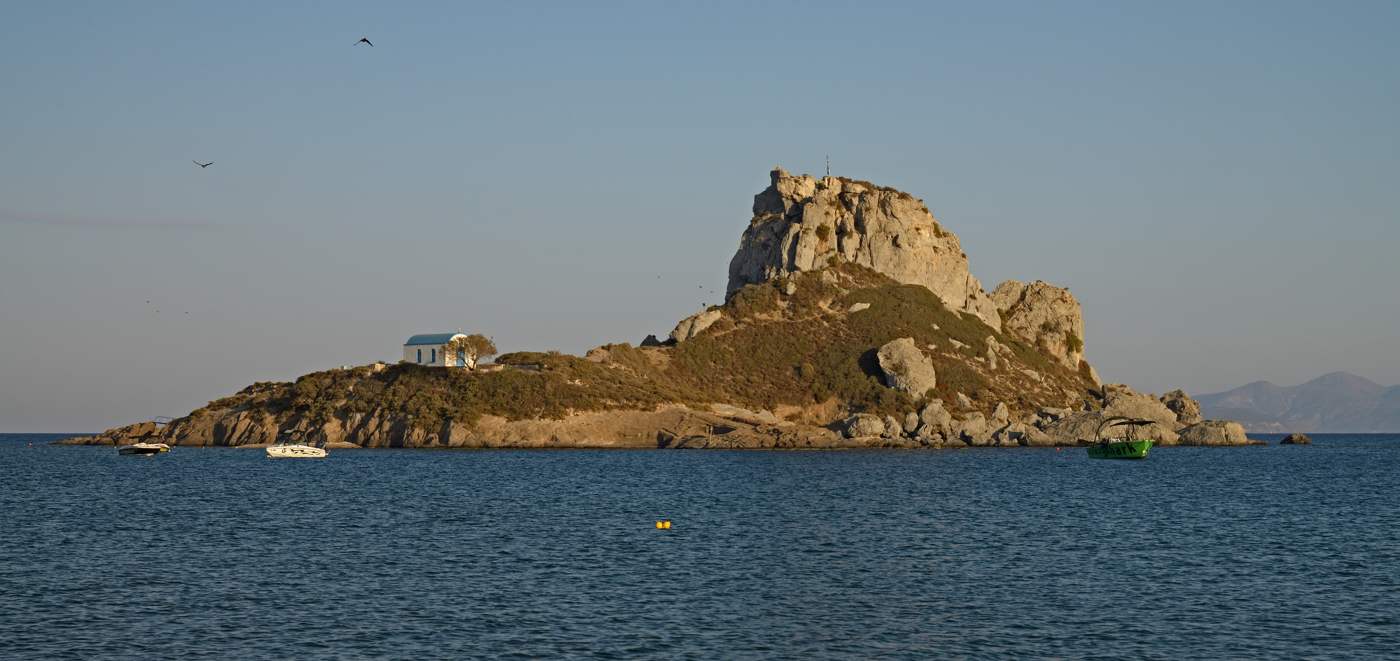
Kastri islet rises about 150 metres offshore, a rocky knob capped by a small white chapel. Strong swimmers cross the channel from the sand in ten to fifteen minutes of steady front crawl. The chapel honours Saint Nicholas, protector of sailors, and stays open to anyone who climbs the rock. Its whitewashed walls and single blue door mark the highest point of the islet. From the top the view runs across Kefalos bay to the Kamari waterfront and the ridge behind Kefalos. Fishing boats sometimes anchor in the lee of the rock, sheltering from open-sea swell. The short crossing turns an ordinary swim into a clear goal, and the chapel gives the effort a destination.
Calm morning water suits the swim best, before the wind builds after midday.
Agios Stefanos faces due west, so the sun drops straight into the sea beyond Kastri. Evening light throws long shadows from the column bases and turns the mosaic fragments amber. The chapel on the islet stands black against the last band of orange over the horizon. Crowds thin after six, leaving the cove to a handful of walkers and photographers. Warm rock along the headland holds the day’s heat well into the evening hours. This mix of ruins, offshore chapel, and open western horizon rewards a slow visit to Kos. Kefalos village, a short drive uphill, keeps tavernas open late for a meal after the light fades.
The beach carries no lighting, so a torch helps on the return path to the car. The uphill road back to Kefalos carries light traffic after dark.
How can visitors explore the basilica ruins at Agios Stefanos?
Visitors explore the basilica ruins along the low headland above Agios Stefanos beach. A short marked path leads past mosaic floors, column bases, and baptistery remains from two fifth and sixth century churches.
The basilica ruins occupy the flat headland dividing Agios Stefanos beach from the next cove. Two adjacent churches, known as Basilica A and Basilica B, date from the fifth and sixth centuries. Their floors survive as panels of mosaic set in coloured limestone and glass tesserae. Designs include interlaced circles, stylised vines, and marine creatures such as fish and waterbirds. Low walls and column stumps outline the three-aisled plan common to early Aegean churches. A separate baptistery with a cross-shaped font sits at the western edge of the complex. Sea salt and sun have faded the brightest colours, yet the pattern lines stay clear.
This cluster records the Christian community that farmed and fished Kefalos bay after the Roman period closed on the island. Excavation left the mosaic floors open to view under the sky.
A gravel path climbs from the beach bar to the fenced archaeological area in under five minutes. Low signboards mark each church and explain the mosaics without charging any entry fee. The route runs across open ground, so a hat and water help in midday heat. Views from the headland take in the full sweep of Kefalos bay and the harbour at Kamari. Column bases and threshold slabs show where doorways and the central nave once stood. The mosaics lie partly under protective gravel, uncovered in the main panels for viewing. Guides based in Kefalos sometimes bring small groups up as part of a village walk.
Fencing keeps feet off the fragile floors, so the patterns stay readable for the next visitor who climbs the path. Wooden posts mark the safe route across the open terrace.
Exploring the site rewards a slow circuit rather than a quick glance from the sand. The two churches sit only 30 metres apart, sharing one raised terrace above the water. Wild thyme, sea squill, and low scrub frame the ruins and scent the air in summer. Lizards move across the warm stone, and cicadas sound from the tamarisk trees along the fence. The terrace gives a clear line down to Kastri islet and its chapel offshore. Morning light rakes the mosaic surface at a low angle and lifts the pattern into relief. Photographers work the site best before the sun climbs high and flattens the colours.
This blend of standing ruin and open sea view sets the headland apart from any indoor museum display in Kos Town.
The basilicas form part of a wider trail of ancient sites across the island. The Asklepion, the healing sanctuary of Asclepius, stands about 4 kilometres southwest of Kos Town. The Plane Tree of Hippocrates shades the harbour square in the capital, about 40 kilometres northeast. Antimachia village, roughly halfway along the road, guards a Venetian castle above the central plain. Combining Agios Stefanos with these landmarks builds a full picture of the things to do in Kos. A single day links the Kefalos ruins with a swim and an afternoon in Kos Town. History-focused visitors often pair the basilicas with the Casa Romana and the castle of Nerantzia.
This spread of periods, from classical medicine to Byzantine faith, marks the depth of the island’s record. Museum labels in Kos Town expand on the Kefalos ruins.
What is the significance of Kastri islet near Agios Stefanos?
Kastri islet anchors the seaward edge of Agios Stefanos bay, crowned by a white chapel to Saint Nicholas. Strong swimmers cross about 150 metres to reach it, gaining views across all of Kefalos bay.
Kastri islet stands about 150 metres off the sand, a compact mass of grey volcanic rock. A single whitewashed chapel to Saint Nicholas caps the summit, visible from the whole beach. The name Kastri, meaning little castle, reflects the rock’s steep sides and fortress-like profile. Waves have cut small caves and ledges into the base where the swell breaks. The chapel holds one icon, lit candles, and a bell that fishermen once rang in fog. Local families row across each December for the feast of Saint Nicholas, patron of the sea. The islet marks the mouth of Kefalos bay, guiding boats between the open Aegean and the sheltered water.
This lone chapel on bare rock gives the view from Agios Stefanos its clear focal point across the channel.
The swim to Kastri covers about 150 metres of open water across a shallow channel. Confident swimmers make the crossing in ten to fifteen minutes when the sea stays calm. A bright swim buoy improves visibility to any passing boat along the busy Kefalos shore. The islet’s landward side offers a low rock shelf for climbing out and resting before the return. From that shelf a rough path of twenty steps reaches the chapel at the top. This crossing ranks among the more rewarding short swims on the Kos beaches. Water shoes protect feet on the sharp rock and the sea-urchin colonies near the base.
Weaker swimmers watch the chapel comfortably from the sand rather than risk the exposed channel in the afternoon wind. Boat traffic stays light along this quiet southern shore.
Kastri carries cultural weight beyond its size as a landmark of faith at sea. Its chapel honours Saint Nicholas, whom Aegean sailors have long treated as their guardian. The single annual liturgy on 6 December draws Kefalos residents across the winter channel by boat. Whitewash on the walls gets renewed each spring, keeping the chapel bright through the tourist season. The rock itself formed from the same volcanic activity that shaped nearby Nisyros and its crater. Sea birds nest on the ledges, and shags dry their wings on the exposed eastern face. This layering of geology, worship, and daily fishing life packs meaning into a rock barely 40 metres wide.
The islet reads as more than scenery once a visitor knows the chapel and its December feast.
Planning a Kastri swim works best around the calm water of early morning. Wind on Kefalos bay usually builds after midday as the meltemi funnels down the coast. Pairing the crossing with a walk to the basilica ruins fills a half day at the cove. The chapel terrace gives a raised platform for photographs back across the sand and headland. Swimmers rest on the rock shelf, then time the return for the flat spell before lunch. Sunbeds on the beach hold gear safely, since the cove stays quiet and watched by the bar staff. This combination of a measured swim, a hilltop chapel, and a shaded return suits active visitors.
A late-afternoon repeat catches the west light striking the chapel wall above the water. Candle smoke marks the walls inside the small chapel.
What facilities are available at Agios Stefanos beach?
Agios Stefanos beach provides sunbeds, umbrellas, and one beach bar behind the sand. Restrooms and refreshment stands sit within walking distance, while Kefalos village, about 3 kilometres away, adds tavernas and shops.
Agios Stefanos runs a modest set of facilities in keeping with its quiet character. Two rows of sunbeds with straw umbrellas line the central sand, rented at about the island rate. A single beach bar behind them serves cold drinks, coffee, and light snacks through the day. The sand-and-shingle mix stays firm underfoot, so wheeled coolers and buggies move across it easily. Freshwater showers stand at the back of the beach for rinsing salt after a swim. Shade beyond the umbrellas comes from a line of tamarisk trees along the rear edge. This restrained setup keeps prices and noise low while covering the basics a beach day needs.
Visitors seeking full water-sports centres head 1 kilometre north to the busier Paradise and Camel beaches on the strip. Beach umbrellas cast enough shade for a full day out.
Restrooms sit beside the beach bar, kept for paying customers and beach users alike. The refreshment stand stocks water, ice cream, and packaged food for anyone skipping a full meal. Parking runs along the surfaced track above the sand, free and rarely full outside August. A short 200-metre walk links the car area to the umbrellas past the basilica fence. No lifeguard works the cove, so families watch their own children in the water. The gentle shelf and clear shallows still make the central sand suited to careful family swimming. This quieter end of Kefalos bay stays calmer than the organised bays a short distance north.
Early arrivals claim the front-row sunbeds, which fill slowly through the late morning even in high season.
Exploring beyond the sand, visitors reach the wider services of Kefalos village in minutes. Kefalos, about 3 kilometres uphill, holds bakeries, mini-markets, a pharmacy, and a fuel station. Its tavernas serve grilled fish, local cheese, and vegetables from the surrounding Kefalos plain. The village square gives a viewpoint over the whole bay, including Agios Stefanos and Kastri islet. Paradise, Camel, and Magic beaches lie within 2 kilometres north for anyone chasing more sand. Bus stops in Kefalos connect the area to Kardamena, Antimachia, and Kos Town along the coast. This spread of nearby services turns a short beach visit into a full day around the bay.
Souvenir shops in the village stock ceramics, thyme honey, and herbs grown on the slopes above the coast. Weekly markets in Kefalos sell produce from the plain below.
Agios Stefanos rewards a visit timed to catch the west-facing sunset from the sand. The beach bar stays open into the evening during the main summer months for sunset drinks. Warm shingle at the water line holds heat well after the sun leaves the sky. The basilica ruins and Kastri chapel stand in silhouette as the last light fades over the sea. Photographers set up near the column bases for a foreground against the orange horizon. This end-of-day window pairs the ruins, the islet, and the open water in one frame. A meal afterwards in Kefalos rounds out the visit once the beach falls dark and quiet.
Torches help on the return path, since the cove and its track carry no street lighting at all. Cool evening air draws walkers along the empty shoreline.
How can visitors reach Agios Stefanos beach in Kefalos bay?
Visitors reach Agios Stefanos by car, scooter, or bus via Kefalos. The beach lies about 40 kilometres southwest of Kos Town, a 50-minute drive, then a short signed track down to the sand.
Agios Stefanos sits at the southwest tip of Kos, inside sheltered Kefalos bay. Drivers follow the main island road southwest from Kos Town for about 40 kilometres. The route runs past the airport at Antimachia and the resort of Kardamena along the south coast. A 50-minute drive brings cars to Kefalos, where a signed track drops to the beach. The final descent covers about 3 kilometres of surfaced road ending beside the basilica fence. Rental cars and scooters are the most flexible way to reach this quieter corner of the island. Fuel stations in Antimachia and Kefalos cover the run in both directions with ease.
The road offers clear views over the Kefalos plain and the bay before the final drop to the sand.
Buses run from the Kos Town station to Kefalos through the main summer season. The ride covers about 40 kilometres and takes close to one hour with village stops. Kefalos serves as the end of the line, from which the beach lies about 3 kilometres downhill. Walking that final stretch takes 35 to 40 minutes on the surfaced access road. Taxis wait in Kefalos square and cover the last leg to the sand in about ten minutes. Bus timetables thin out in the early evening, so late visitors plan the return with care. This public option suits budget travellers staying in Kos Town without a rented vehicle.
Fares stay low, and the route doubles as a scenic run along the island’s southern shore past open fields. Drivers on the same road cover the trip far quicker.
Visitors based in Kefalos reach Agios Stefanos with a short drive, ride, or downhill walk. The village holds a range of rooms, studios, and small hotels above the bay. Staying here places the beach, the ruins, and the tavernas within about ten minutes of each other. Kamari, on the waterfront below Kefalos, adds seafront accommodation closer to sea level. Both bases cut the daily drive that visitors from Kos Town or Tigaki face each morning. A hire car or scooter still helps for reaching Paradise, Camel, and the Kefalos plain villages. This southwest corner works well as a two or three-night stop away from the busy north coast.
Early risers from Kefalos reach the sand before the first buses arrive from Kos Town. Studios above the bay give sea views from the balcony at a lower nightly rate.
Planning a day trip around Agios Stefanos pays off through the string of beaches nearby. The long Kefalos strip holds Paradise, Camel, and Magic beaches within 2 kilometres to the north. Each cove carries its own mix of sand, sunbeds, and water-sports, so a single day covers three. A car or scooter links them in minutes, while walkers use the coast road between bays. Kefalos village anchors the loop with fuel, food, and shade at the midpoint. Kardamena, 15 kilometres east, adds ferry links to the volcano island of Nisyros. This spread of stops turns the drive southwest into a full itinerary rather than one beach.
Sunset over Agios Stefanos closes the loop before the evening return along the south-coast road to town. Fuel stops in Kefalos keep the loop running without delay.
What are the sunset views like from Agios Stefanos beach?
Sunset views from Agios Stefanos face straight west across the Aegean toward Kastri islet. The sun drops behind the open horizon, lighting the basilica ruins and the offshore chapel in warm colour.
Agios Stefanos faces due west, giving the sun a clear drop into open sea each evening. No headland blocks the horizon, so the light falls straight across the water toward the beach. Kastri islet sits directly in that line, its chapel dark against the bright band of sky. The angle turns the sea from blue to copper as the sun approaches the waterline. Summer sunsets here land between eight and half past eight in the evening. Warm colour spreads over the sand, the column bases, and the tamarisk trees at the rear. This unbroken western aspect ranks Agios Stefanos among the strongest sunset points on the Kefalos coast.
Kamari and Kefalos village share the same aspect but lack the ruins and offshore chapel in the frame. Clear skies over the water sharpen the colour each evening.
The quiet setting sharpens the sunset experience along this end of Kefalos bay. Foot traffic drops after six, leaving the cove to walkers, swimmers, and a handful of photographers. Waves fall to a light lap as the afternoon meltemi eases toward dusk. Sound carries clearly then, from the bell on Kastri to voices at the beach bar. Warm shingle at the tide line holds heat for anyone sitting out the last of the light. The basilica terrace above gives a raised platform for a wider view over the water. This calm end-of-day mood turns an ordinary swim stop into a slow evening on the sand.
Families often stay through the colour, then walk up to Kefalos village for a late dinner. The bar dims its music as the light fades over the sea, holding the calm mood.
Photographers work Agios Stefanos hard in the final hour before dark. The column bases and mosaic fragments give a strong foreground against the burning horizon. Kastri islet and its chapel form a natural silhouette in the middle distance offshore. Low side light rakes the sand ripples and the shingle bands into sharp texture. A tripod steadies the long exposures needed as the light drops below the sea. The headland path offers a higher angle that stacks ruins, islet, and sun in one frame. This range of viewpoints, from waterline to terrace, suits both wide scenes and tighter compositions. Clear evenings after a windy afternoon give the cleanest air and the deepest colour over the Aegean here.
Reflections on the wet shingle double the colour in each frame.
Combining the sunset with a meal rounds out an evening at Agios Stefanos. Kefalos village, about 3 kilometres uphill, keeps tavernas open past the last light. Tables on the village edge share the same western view over the bay and open sea. Kamari, down at sea level, sets seafront tables almost at the waterline for a closer angle. A short drive links the beach to either option once the colour fades from the sky. This pairing of ruins, sunset, and a village dinner fills the second half of a beach day. Torches ease the walk back to the car, since the cove and track carry no lighting.
Warm evenings let visitors linger on the sand well after the sun has gone below the sea. Village tables fill early on clear evenings, so arriving before dark secures a seat.
How does Agios Stefanos compare to other beaches in Kefalos bay?
Agios Stefanos stays quieter than Paradise, Camel, and Magic beaches nearby. Its basilica ruins and offshore Kastri chapel add history and a swim target that the busier Kefalos bay beaches lack.
Agios Stefanos holds the southern, quieter end of the long Kefalos bay strip. Paradise, Camel, and Magic beaches lie within 2 kilometres north, each drawing larger summer crowds. Those bays run full water-sports centres, packed sunbed rows, and bars along the sand. Agios Stefanos keeps two sunbed rows, one bar, and a calmer stretch of shore. Foot traffic here stays lower even in August, since no organised sports pull day boats in. The headland shelters the cove from the wind that whips the more open beaches to the north. This contrast makes Agios Stefanos the pick for visitors wanting space over facilities and noise.
Swimmers and readers choose it, while windsurfers and families with teenagers gather up the coast at Paradise. A single base cuts the driving between each stop to minutes.
The basilica ruins give Agios Stefanos a historical layer the neighbouring beaches lack. Paradise and Camel offer sand, water, and hire gear but no standing monument on site. Two early-Christian churches with mosaic floors sit directly above the Agios Stefanos sand. That setting lets a swim and a walk through fifth-century ruins share a single visit. Kefalos bay’s other beaches carry only their sand and their sunbeds by comparison. The ruins draw a slower, history-minded visitor rather than a water-sports crowd. This mix of shoreline and archaeology sets the cove apart along the whole southwest coast. Guides pairing beach time with heritage often route groups here rather than to the busier bays on the strip.
Evening light on the windmill draws walkers up the lanes after dinner.
Kastri islet hands Agios Stefanos a swim target that the other beaches cannot match. The rock and its chapel sit about 150 metres off the sand, drawing strong swimmers across. Paradise and Camel face open water with no such feature to aim for offshore. That short crossing turns a simple swim into a measured goal with a hilltop chapel reward. The islet also blocks part of the swell, keeping the central cove calmer than the exposed bays. Snorkellers work the rock’s base, where the water shelves over ledges and sea-urchin colonies. This offshore focal point deepens the appeal of the cove beyond its sand and ruins.
Weaker swimmers still enjoy the view of the chapel from a sunbed on the quiet beach. Signposts on the coast road mark each cove along the strip.
Weighing the options, Agios Stefanos suits visitors after calm, history, and a clear sunset. Paradise, Camel, and Magic serve those chasing water-sports, beach bars, and a busier scene. The choice comes down to pace rather than distance, since all four sit within 2 kilometres. A single day can sample the lively bays first and finish quietly at Agios Stefanos. The southern cove works best late, when its west aspect and thin crowds come into their own. Its ruins, offshore chapel, and sunset give a fuller experience than sand alone. This role as the reflective end of the strip fixes its place within Kefalos bay.
Families often split the day, mixing the active north beaches with the calm southern cove at dusk. Guided coaches from Kos Town also reach these sites on set routes.
Can visitors combine a trip to Agios Stefanos with other nearby attractions?
Visitors combine Agios Stefanos with Kefalos village, the Paradise and Camel beaches, and boat trips to Nisyros from Kardamena. The compact southwest corner links ruins, sand, and a volcano day within easy reach.
A visit to Agios Stefanos slots neatly into a wider tour of the southwest. The cove sits about 3 kilometres below Kefalos village and 2 kilometres from Paradise beach. Morning suits the ruins and a swim to Kastri while the water stays calm and clear. Kefalos village, uphill to the west, then adds lunch and a viewpoint over the whole bay. A short drive reaches the neighbouring beaches for an afternoon of sand and water-sports. This clustering of sites inside three kilometres cuts driving and packs the day full. The southwest corner rewards a base in Kefalos or Kamari over a long daily run from Kos Town.
Ruins, islet, village, and beaches all fall within a compact loop around the sheltered bay. Warm water off the sand invites a final swim before the light drops.
Kefalos village anchors any tour of this corner with its services and views. Narrow lanes climb between white houses to a windmill and a church at the top. Tavernas serve grilled fish, thyme honey, and vegetables from the Kefalos plain below. The square gives a wide look over the bay, taking in Agios Stefanos and Kastri islet. Bakeries and mini-markets cover picnic supplies for a longer day on the sand. Bus links from the village reach Kardamena, Antimachia, and Kos Town along the south coast. This blend of food, shopping, and outlook makes the village the natural midpoint of a bay tour.
Souvenir shops here stock ceramics and herbs grown on the slopes above the coast near the windmill. Fishermen head out at dawn, leaving the cove to early swimmers.
Beyond the village, the beaches of Kefalos bay give a full afternoon of variety. The strip runs north through Paradise, Camel, and Magic within 2 kilometres of Agios Stefanos. Paradise, also called Bubble beach, sends up gas bubbles from the volcanic seabed near the shore. Camel takes its name from the humped rock on the ridge above the sand. Each bay carries its own sunbeds, bars, and water-sports mix for beach-hoppers. A car or scooter links them in minutes along the coast road above the sand. This chain of beaches lets one day sample calm ruins and busy sports within a short drive.
Walkers use the shoreline paths to move between neighbouring coves without returning to the parked car. The bar serves cold drinks to the small crowd gathered for the colour on the sand.
Wider Kos opens up beyond Kefalos bay for visitors with more time. Kardamena, 15 kilometres east, runs day boats to the volcano crater of Nisyros. Kos Town, about 40 kilometres northeast, holds the Asklepion, the castle of Nerantzia, and the Roman Casa Romana. Mount Dikeos, the island’s high point at about 846 metres, offers trails and the village of Zia. Antimachia, near the airport, guards a Venetian castle above the central plain. A multi-day plan links the Kefalos beaches with these sites across the island. This range, from a quiet cove to a live volcano, marks the spread of a Kos holiday. Ferries from Mastichari on the north coast add Kalymnos as a further day-trip option nearby.
Shoulder-season days shorten the gap between the swim and the sunset window.


What is the best time of day to visit Agios Stefanos beach?
The late afternoon suits Agios Stefanos best. Thin crowds, calm water for the Kastri swim, and the west-facing sunset combine then, though morning offers the flattest sea for the crossing.
Late afternoon brings the strongest mix of conditions to Agios Stefanos. Crowds fall away after the day-trip buses leave Kefalos around four in the afternoon. Lower sun softens the light across the ruins and the sand for easier viewing. Warmth stays in the air and the shingle well past the peak heat of midday. This window suits a slow visit built around the ruins, a swim, and the sunset to come. The beach bar keeps serving into the evening for drinks between the swim and the light. Shade from the tamarisk trees at the rear stretches across the sunbeds by then.
Visitors settling in for the late afternoon secure the calm the cove is known for along this coast. Rope lines sometimes mark the swimming zone off the central sand in summer.
Morning offers the flattest water for the crossing to Kastri islet. Wind on Kefalos bay stays light until the meltemi builds through the middle of the day. Early swimmers reach the rock and its chapel in calm conditions with clear visibility. Cooler air before ten also suits the uphill walk to the basilica ruins on the headland. Fewer sunbeds fill at that hour, so early arrivals claim the front row by the water. Snorkellers find the clearest sea around the islet base before the wind stirs the surface. This early slot rewards active visitors chasing the swim and the ruins over the sunset.
Boats and swimmers share calmer water, and the light stays soft on the eastern faces of the rock. Boat wake from the Kefalos shore reaches the channel on busy days.
The late-afternoon sunset stands as the day’s clear highlight at Agios Stefanos. The west-facing cove sends the sun straight down into the sea beyond Kastri. Colour spreads over the ruins, the sand, and the offshore chapel in the final hour. Summer sunsets land between eight and half past eight, giving a long golden spell first. Photographers gather near the column bases for a foreground against the horizon. Crowds thin further as the light drops, leaving the cove calm for the show. This daily event pulls evening visitors even when they skip the midday beach hours entirely. Warm shingle lets people sit out the colour long after the sun has slipped away below the sea.
Sea grass beds off the sand shelter juvenile fish through the summer.
Timing a full day balances the morning swim against the evening light. Early arrival secures calm water for Kastri and cool air for the ruins on the headland. A midday break in Kefalos village dodges the strongest heat and the afternoon wind. Return to the cove around five sets up the sunbeds for the sunset window. This rhythm covers the swim, the ruins, and the light within a single relaxed day. The beach bar and Kefalos tavernas bracket the visit with drinks and a meal. Spring and autumn shift the sunset earlier but keep the same order of swim then light. Visitors following this pattern draw the fullest experience from a single trip to Agios Stefanos beach.
A whistle on the swim buoy signals any boat crossing the channel.
What visitors know about the swimming conditions at Agios Stefanos?
Swimming conditions at Agios Stefanos stay favourable, with clear water and a gentle shelf. The central cove suits all levels, while the 150-metre crossing to Kastri demands strong swimming and calm sea.
Agios Stefanos offers clear, shallow water over a gently shelving sand-and-shingle floor. Entry stays easy, with the bottom dropping slowly for the first 20 metres offshore. The headland and Kastri islet break much of the open-sea swell reaching the cove. Calm mornings turn the central bay almost flat, suited to careful family swimming. Sea temperature climbs through summer, reaching the low-to-mid twenties Celsius by high season. The clear water gives good visibility for spotting the sandy patches and rocky ledges below. This combination of a soft shelf and sheltered position makes the main sand suited to all levels. Shingle at the tide line means water shoes add comfort for tender feet on entry into the water.
The crossing to Kastri islet raises the demand well above the shallows near the sand. About 150 metres of open water separate the beach from the rock, with no rest halfway. Strong swimmers make the crossing in ten to fifteen minutes when the sea holds calm. Wind after midday pushes chop across the channel and lengthens the swim considerably. A bright swim buoy marks the swimmer to the boats that pass along the Kefalos shore. Crossing with a companion adds a clear safety margin over swimming the channel alone. This exposed leg calls for judgement about the wind and the swimmer’s own range.
Weaker swimmers hold to the sheltered central bay and watch the chapel from a sunbed on the sand.
Snorkelling around Agios Stefanos rewards a mask along the rocky edges of the cove. The clear water gives strong visibility over the ledges near the headland and the islet base. Fish gather where the sand meets rock, feeding among the sea grass and stone. The volcanic geology near Paradise beach sends occasional gas bubbles up through the shallows. Rental gear stays limited at this quiet cove, so snorkellers bring their own mask and fins. The rock at Kastri’s base holds the densest marine life, reachable on the same swim. This underwater layer adds a further draw for water-focused visitors beyond the surface swim.
Urchins cling to the rock ledges, so care and shoes protect feet near the base of the islet.
Beach safety at Agios Stefanos rests on the swimmers, since no lifeguard patrols the cove. Families keep children in the shallow central bay, well inside the sheltered water. The sand-and-shingle floor stays free of sudden drops for the first stretch offshore. Sunbeds and umbrellas give a fixed base to watch the water and store gear. Afternoon wind serves as the main signal to hold off the Kastri crossing until calmer conditions. Freshwater showers at the rear rinse salt after a swim in the clear water. This mix of clear shallows, gentle shelf, and offshore islet covers a broad range of swimmers. Checking the wind before the crossing keeps the swim to Kastri within safe limits for the day.
Frequently Asked Questions
Is there public transport available to Agios Stefanos beach?
Public transport reaches Agios Stefanos through the summer bus service between Kos Town and Kefalos. The route covers about 40 kilometres and takes close to one hour with stops in villages along the south coast. Kefalos marks the end of the line, from which the beach lies about 3 kilometres downhill. Walking that final stretch on the surfaced access road takes 35 to 40 minutes past open fields. Taxis wait in Kefalos square and cover the last leg to the sand in about ten minutes for a small fare. Buses run through the day in high season, thinning to fewer departures in spring and autumn.
Services drop off in the early evening, so visitors relying on the bus plan the return before dusk. The ride passes Antimachia, Kardamena, and the Kefalos plain, doubling as a scenic run across the island. This option suits budget travellers based in Kos Town without a rented car or scooter of their own.
Are there any dining options near Agios Stefanos beach?
Dining near Agios Stefanos centres on Kefalos village, about 3 kilometres uphill from the sand. The village runs tavernas serving grilled fish, octopus, local goat cheese, and vegetables from the Kefalos plain below. Tables on the village edge share a wide view over the bay, Agios Stefanos, and Kastri islet. Kamari, on the waterfront below Kefalos, sets seafront tables almost at the waterline for a closer sea view. The single beach bar behind the sand covers cold drinks, coffee, and light snacks through the day. Bakeries and mini-markets in Kefalos supply bread, pies, and fruit for a picnic on the beach. Prices track the island average, with fish sold by weight and house wine served by the carafe.
Most kitchens open for lunch and again from early evening through the main summer season. This spread of tavernas, seafront tables, and a beach bar covers a full range from a quick snack to a full dinner near the cove. Reservations help on busy August evenings up in the village.
What other activities can visitors enjoy near Agios Stefanos?
Activities near Agios Stefanos run from history and beaches to boat trips and hiking. Paradise, Camel, and Magic beaches lie within 2 kilometres north and add windsurfing, jet-skiing, and paddleboarding. Kefalos village offers lanes to wander, a hilltop windmill, and shops selling thyme honey and ceramics. Kardamena, 15 kilometres east, runs day boats to the volcano crater of Nisyros in the open Aegean. Mount Dikeos, the island’s high point at about 846 metres, carries trails up to the village of Zia. The Asklepion and the castle of Nerantzia in Kos Town, about 40 kilometres away, fill a heritage day. Antimachia guards a Venetian castle above the central plain near the airport.
Snorkellers work the rock base at Kastri islet on the same swim from the beach. Ferries from Mastichari on the north coast reach Kalymnos for a further day-trip. This range covers water-sports, walking, history, and island-hopping within easy reach of the cove.
Is Agios Stefanos suitable for families with children?
Agios Stefanos suits families through its sheltered central bay and gentle shelf into clear water. The sand-and-shingle shore drops slowly for the first 20 metres, giving children a wide safe zone. The headland and Kastri islet block much of the open-sea swell, keeping the cove calm on most mornings. Sunbeds, umbrellas, and freshwater showers give parents a fixed base beside the water. The beach bar behind the sand covers drinks, ice cream, and snacks without a walk to the village. No lifeguard patrols the cove, so parents watch children in the water themselves at all times. The basilica ruins on the headland add a short walk that turns the visit into a history lesson.
Kefalos village, about 3 kilometres uphill, adds tavernas, a pharmacy, and mini-markets for family needs. Quieter crowds than Paradise or Camel beach keep the cove calm for younger children. This mix of safe shallows, shade, and nearby services makes the beach a steady family choice.
What safety precautions swimmers take at Agios Stefanos?
Swimmers at Agios Stefanos take extra care because no lifeguard patrols the quiet cove. The sheltered central bay suits all levels, with a gentle shelf and clear water over sand and shingle. The 150-metre crossing to Kastri islet demands strong swimming and a calm sea free of afternoon wind. Crossing with a companion and towing a bright swim buoy adds a clear safety margin on the exposed channel. Wind that builds after midday serves as the main signal to hold off the swim to the rock. Water shoes protect feet from the shingle and the sea-urchin colonies around the islet base. Families keep children in the shallow central bay, well inside the sheltered water.
Checking the wind and one’s own range before setting out keeps the crossing within safe limits. Rest on the rock shelf at Kastri before the return leg rather than turning straight back. These steps let visitors enjoy the clear water and the swim to the chapel safely.
Are there any cultural events or festivals near Agios Stefanos?
Cultural events near Agios Stefanos centre on Kefalos village and the wider island of Kos. The chapel of Saint Nicholas on Kastri islet holds its feast each 6 December, when Kefalos families row across the winter channel. Summer brings village panigyria, church-name-day festivals with grilled meat, local wine, and traditional dance in the square. Kefalos marks its own saints’ days with music that runs late into the warm evenings. Kos Town, about 40 kilometres northeast, stages concerts and cultural nights around the ancient agora and the castle through the season. The Hippocratic tradition also draws events tied to the Asklepion and the Plane Tree of Hippocrates.
Local calendars posted in Kefalos square list the dates for each feast and performance clearly. Food stalls at these gatherings serve island cheese, honey, and thyme-scented dishes from the Kefalos plain. Joining a panigyri gives a direct look at island customs beyond the beach. This calendar of feasts and festivals adds a cultural layer to a Kefalos visit.
What wildlife can visitors expect to see at Agios Stefanos?
Wildlife around Agios Stefanos concentrates in the coastal and marine zones of Kefalos bay. Clear water over the rocks near the headland and Kastri islet shelters wrasse, bream, and small shoals of fish. Sea urchins and limpets cling to the rock ledges at the base of the islet offshore. Shags and gulls nest on Kastri’s cliffs and dry their wings on the exposed eastern face. The tamarisk trees and scrub behind the sand hold sparrows, warblers, and summer cicadas. Wild thyme, sea squill, and low herbs around the basilica ruins draw bees and butterflies through the warm months. Lizards move across the warm stone of the ruins and the headland during the day.
The volcanic seabed near Paradise beach releases gas bubbles that mark the wider geology of the bay. Snorkellers spot the densest marine life around the rock base at Kastri islet. This mix of fish, seabirds, insects, and coastal plants rewards a slow, quiet visit to the cove.