

Kalymnos rises from the Aegean just north of Kos, separated by a narrow strait that ferries cross in about thirty to forty-five minutes. The island built its identity on sponge diving. An industry that sent generations of Kalymnian men to the seabeds of the Mediterranean and North Africa and left a legacy visible in every corner of Pothia, the bustling port capital. Today limestone cliffs above the west coast draw rock climbers from across the globe, while day-trippers from Kos explore waterfront museums, medieval castles perched on hillsides. The fjord-like inlet of Vathys lined with citrus orchards. Plan the whole trip with Greece Tours.
Boats depart from Mastichari on the northern shore of Kos and from Kos Town, making Kalymnos one of the most accessible Dodecanese neighbours for a single-day visit. The west-coast villages of Myrties and Massouri face the small island of Telendos across a channel narrow enough to swim, and caiques shuttle visitors to Telendos beaches in minutes. A day on Kalymnos combines maritime history, dramatic coastal scenery, and the unhurried rhythm of an island where sponge-fishing boats still tie up alongside climbing-gear shops and waterfront caf\u00e9s.
Which ferries run from Kos to Kalymnos for a day trip?
Passenger ferries connect Mastichari on the north coast of Kos to Pothia, the main port of Kalymnos, in about thirty to forty-five minutes. Additional services link Kos Town to Pothia, taking around one hour depending on the vessel.
Mastichari lies on the northern shore of Kos, roughly twelve kilometres west of Kos Town, and serves as the primary departure point for Kalymnos ferries. The harbour sits in a quiet bay flanked by tamarisk trees, with ticket kiosks lining the waterfront road. Boats leave in the morning and return in the late afternoon, giving day-trippers around six to seven hours on Kalymnos. The crossing takes between thirty and forty-five minutes, depending on sea conditions and the type of vessel.
Passengers stand on open decks or sit in enclosed saloons, watching the rocky profile of Kalymnos grow larger as the ferry cuts through the strait. Mastichari itself offers a handful of tavernas and a long sandy beach, convenient for an early breakfast or a late swim after returning from the island.
Kos Town ferries depart from the main commercial harbour east of the Castle of Nerantzia, sharing berths with larger inter-island ships and catamarans. The journey to Pothia takes around one hour, slightly longer than the Mastichari route because the vessel follows a different course along the eastern coastline of Kos before turning north. Morning departures align with onward connections to other Dodecanese islands, but day-trippers find the schedule tight if they want to explore Kalymnos thoroughly. The advantage lies in avoiding the bus or taxi ride to Mastichari, since Kos Town is the island’s transport hub.
Tickets go on sale at agencies near the harbour and at automated kiosks on the quayside, with fares varying by season and operator.
Winter schedules reduce to two or three crossings per week on both routes, reflecting lower tourist demand and rougher sea conditions in the Aegean. Summer timetables expand to multiple daily departures, particularly from Mastichari, where the short crossing and sheltered waters make the route reliable even in moderate winds. Ferries carry foot passengers, bicycles, and motorcycles, though most day-trippers travel without vehicles because Kalymnos buses and taxis cover the main sights. Advance booking becomes necessary in July and August, when island-hopping tours and climbing groups fill available seats. The return leg typically departs Pothia in the late afternoon, arriving back on Kos before sunset and leaving time for dinner in Mastichari or Kos Town.
Organised day-trip boats also run from Kos Town and Kardamena, combining the Kalymnos crossing with a stop at the tiny islet of Pserimos. These excursions follow a fixed itinerary, spending around two hours in Pothia and one hour on Pserimos before returning to Kos. The schedule suits travellers who prefer guided commentary and a guaranteed seat, but independent ferry passengers gain flexibility to explore Kalymnos at their own pace. The regular passenger ferries accept bicycles for a small supplement, allowing cyclists to ride along the coastal road from Pothia to Massouri or up the valley to Vathys.
Whichever route and vessel you choose, the short crossing underscores how closely the Dodecanese islands cluster, each visible from the next on a clear morning.
What does Pothia on Kalymnos offer to day-trippers arriving by ferry?
Pothia, the capital and main port of Kalymnos, spreads across steep hillsides around a deep natural harbour lined with neoclassical mansions painted in ochre, blue, and pink.
The ferry docks at the central quay, and passengers step onto a promenade that curves around the harbour basin. Pothia rises in tiers, with narrow streets climbing toward the ridge where windmills and chapels punctuate the skyline. The town grew wealthy on sponge diving in the nineteenth and early twentieth centuries, and that prosperity shows in the three-storey mansions with wrought-iron balconies and shuttered windows. Many buildings display Italian architectural influence, a legacy of Dodecanese rule under Italy between the two world wars. The waterfront road, lined with plane trees and oleanders, runs past ticket offices, bakeries selling sweet cheese pies, and stores stacked with natural sponges in every size.
The atmosphere blends working-port bustle with small-town calm, fishing nets drying beside caf\u00e9 tables and scooters parked against painted bollards.
The Maritime Museum occupies a neoclassical building near the centre of the harbour and chronicles Kalymnos’s sponge-diving history through photographs, diving suits, and equipment. Displays explain the techniques divers used, descending to depths of thirty to forty metres with primitive air pumps and heavy helmets. The industry peaked before the Second World War, when Kalymnian sponge fleets worked the coasts of Libya, Tunisia, and Egypt. Overfishing and disease decimated Mediterranean sponge beds, and synthetic sponges eroded the market, but Kalymnos retains its identity as the sponge island. The museum also covers the island’s maritime trade, shipbuilding traditions, and emigration waves to the United States and Australia.
Entry costs a nominal fee, and the collection takes around forty-five minutes to see, making it an ideal first stop after disembarking.
The Cathedral of Agios Christos stands a short walk inland from the harbour, its twin bell towers visible from the ferry as you approach Pothia. The interior features a carved wooden iconostasis, frescoes, and silver votive offerings left by sailors and divers. The square outside fills with locals in the early evening, children playing around a fountain while their parents chat on benches. Side streets radiating from the cathedral climb past grocery shops, pharmacies, and small hotels, their balconies draped with bougainvillaea. The upper neighbourhoods offer views over the harbour and across the strait to Kos, the island’s flat northern coastline a pale line on the southern horizon.
Walking these lanes gives a sense of everyday Kalymnian life, far removed from the tourist-focused waterfronts of larger islands.
Sponge shops cluster along the harbour promenade, their windows piled with natural sponges in shades of honey, cream, and tan. Vendors explain the grading system, from fine silk sponges for cosmetic use to coarser varieties for cleaning. Prices remain lower than in Kos or Rhodes because Kalymnos is the source, though bargaining is less common than in Turkish markets. Caf\u00e9s and tavernas occupy the ground floors of the neoclassical buildings, tables spilling onto the pavement under awnings. Menus feature octopus, grilled sardines, and local cheeses, with lunch service running from midday to mid-afternoon.
The harbour hums with activity when ferries arrive and depart, but between crossings the waterfront settles into a quieter rhythm, fishermen mending nets and shopkeepers sweeping their doorsteps. Pothia gives day-trippers a concentrated taste of Kalymnian culture within a compact, walkable area.
How does the sponge-diving heritage shape Kalymnos today?
Sponge diving defined Kalymnos economically and culturally for over a century, sending fleets across the Mediterranean and creating a diaspora in Florida, Australia, and beyond. Natural sponges remain a signature product, sold in Pothia shops and exported worldwide.
Kalymnian divers pioneered deep-water sponge harvesting in the nineteenth century, using weighted suits and air hoses to reach depths that free divers not. The work carried enormous risk, with decompression sickness, or the bends, crippling or killing divers who ascended too quickly. Pothia’s cemetery holds memorials to men lost at sea or paralysed by diving accidents, and older residents remember grandfathers who spent their lives in wheelchairs after a final dive. The sponge fleets operated from spring to autumn, sailing to North African coasts where sponge beds thrived in warm, clear waters. Entire families depended on the harvest, women managing households and businesses while men spent months at sea.
The industry peaked in the early twentieth century, when Kalymnos sponges commanded premium prices in European and American markets.
Disease struck Mediterranean sponge populations in the middle of the twentieth century, wiping out beds from Greece to Libya and collapsing the market. Synthetic sponges, cheaper and more uniform, captured the mass market, leaving natural sponges as a niche product. Kalymnos adapted by diversifying into fishing, tourism, and eventually rock climbing, but the sponge-diving legacy persists in the island’s identity. Pothia’s annual Sponge Week festival in late spring celebrates the heritage with traditional music, dance, and demonstrations of old diving equipment. Statues of divers in bronze helmets stand in public squares, and the Maritime Museum preserves the tools and photographs that document the trade. Older men still gather in harbour caf\u00e9s to swap stories of the sponge boats.
Their hands gesturing to illustrate the size of a prized catch or the depth of a dangerous dive.
Natural sponges from Kalymnos and other Aegean islands still reach international markets, valued by artisans, painters, and consumers who prefer organic materials. Harvesting continues on a smaller scale, with divers using scuba gear and adhering to quotas designed to protect remaining beds. The sponges sold in Pothia shops come from Greek waters and imports from the Caribbean and the Red Sea, blended to meet demand. Quality varies by species and processing, with silk sponges prized for their softness and durability. Shopkeepers demonstrate how to prepare a new sponge, soaking it in water and squeezing out sand and organic matter until it softens.
The trade no longer dominates the economy, but it anchors Kalymnos’s brand, distinguishing the island from beach-resort neighbours and giving visitors a tangible connection to maritime history.
Rock climbing emerged as a new economic pillar in the late twentieth century, when European climbers discovered the island’s limestone crags and began developing routes. The sport attracts a different demographic than traditional beach tourism, with climbers staying for weeks in guesthouses around Massouri and Armeos, patronising local tavernas and gear shops. Climbing festivals and competitions bring international attention, and guidebooks catalogue over three thousand routes ranging from beginner-friendly slabs to overhanging endurance tests. The transition from sponge diving to climbing reflects Kalymnos’s ability to reinvent itself while honouring its past. The same rugged coastline that sheltered sponge boats now offering vertical challenges to athletes from around the world.
Day-trippers from Kos witness both legacies, sponge shops in Pothia and climbers chalking their hands on the cliffs above Massouri, two chapters of the same island story.
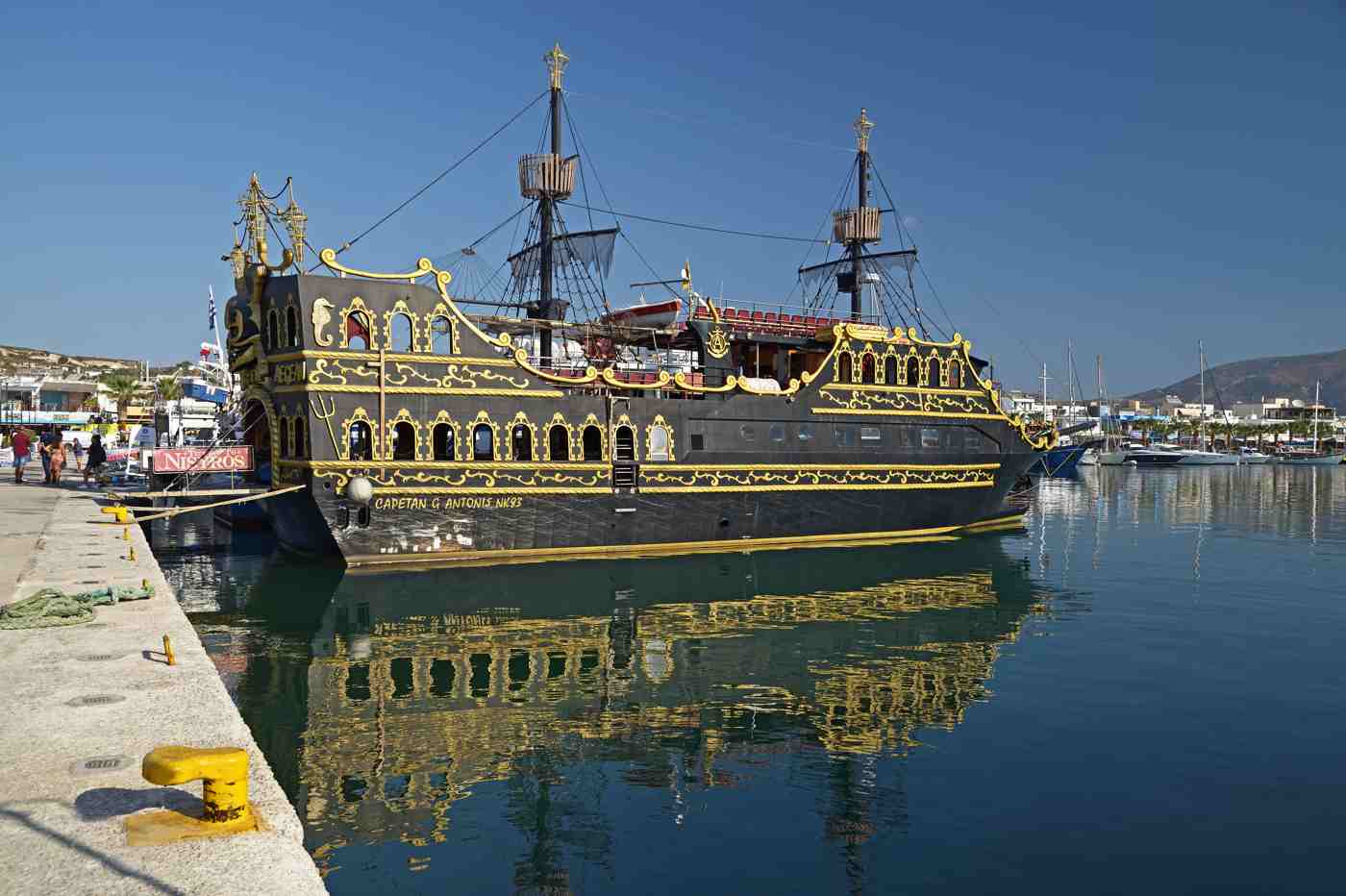
What does the Castle of Chrysocheria reveal about Kalymnos history?
The Castle of Chrysocheria, also called Pera Kastro, crowns a rocky hill above Pothia and served as the island’s fortified capital during the medieval period.
The castle sits roughly two kilometres northwest of Pothia’s harbour, accessible by a steep footpath that begins near the upper edge of town. Stone steps wind through scrub and cypress trees, passing abandoned terraces where villagers once grew barley and pulses. The fortifications date to the Byzantine era, with later additions by the Knights of St John, who controlled the Dodecanese in the fourteenth and fifteenth centuries. Walls of rough-cut limestone follow the natural contours of the hill, enclosing an area large enough to shelter the island’s entire population during pirate attacks. The main gate, reinforced with a pointed arch, opens onto a cobbled lane that climbs toward the summit.
Wildflowers sprout from cracks in the masonry, and lizards dart across sun-warmed stones, the only movement on quiet afternoons.
Inside the walls, the remains of stone houses cluster along narrow alleys, their roofless rooms open to the sky. Kalymnians lived here from the medieval period until the eighteenth century, when piracy declined and the population moved down to the coast to be closer to the harbour and sponge-fishing boats. The houses are small, typically one or two rooms with vaulted ceilings and niches for storage. Some retain traces of plaster and the blackened stones of cooking hearths. The layout reflects a tight-knit community, neighbours sharing walls and courtyards, every building oriented to maximise shade and catch the breeze.
Walking these lanes evokes the island’s precarious past, when survival depended on early warning of approaching ships and the strength of defensive walls.
Nine chapels dot the castle grounds, each dedicated to a different saint and decorated with faded frescoes. The Church of Panagia stands near the centre, its interior cool and dim, icons propped on a wooden altar. Local families maintain the chapels, lighting candles and sweeping floors before feast days. The frescoes, though damaged by weather and time, depict biblical scenes and saints in the stylised forms of Byzantine art, their gold halos flaking but still visible. These chapels served the spiritual needs of the castle’s residents, who attended services and celebrated festivals within the safety of the walls. The tradition continues in a modest way, with a liturgy held once a year in the main church.
Drawing elderly Kalymnians who remember grandparents born in the castle before the final families moved to Pothia.
The summit offers sweeping views over Pothia’s tiered neighbourhoods, the harbour basin, and the channel separating Kalymnos from Kos. On clear days the mountains of Kos rise to the south, and the Turkish coast appears as a hazy line to the east. The vantage point explains the castle’s strategic value, sentries able to spot approaching vessels hours before they reached shore. Sunrise and sunset paint the limestone walls in shades of rose and amber, and the climb becomes a pilgrimage for photographers and history enthusiasts. The round trip from Pothia takes around ninety minutes, including time to explore the chapels and houses, making it a manageable excursion for day-trippers who arrive on the morning ferry.
The castle stands as a monument to resilience, its stones recording centuries of raids. Occupations. The slow return of peace that allowed Kalymnians to descend to the sea and build the town that welcomes ferries today.
Why has Kalymnos become a world destination for rock climbing?
Kalymnos offers over three thousand climbing routes on compact limestone crags that rise directly from the sea or overlook valleys and bays. The rock features pockets, tufas, and overhangs, with grades spanning beginner to elite.
Limestone dominates Kalymnos geology, the island’s cliffs sculpted by millennia of wind, rain, and tectonic uplift. The rock forms steep walls and overhanging faces riddled with pockets and solution holes, creating holds that range from finger-sized dimples to bucket jugs. Tufas, calcite formations that drip down the rock like frozen waterfalls, add three-dimensional features rare in other climbing areas. The combination produces routes that demand technical footwork, endurance, and creative problem-solving, appealing to climbers who tire of straightforward crack or slab climbing. Most crags lie within a short walk or drive from the west-coast villages of Massouri, Armeos. Myrties, with parking areas and clear trails leading to the base of the cliffs.
Approach times rarely exceed twenty minutes, allowing climbers to maximise time on the rock.
The climbing season runs year-round, though spring and autumn bring the most comfortable temperatures. Summer heat makes midday climbing punishing on sun-exposed walls, but shaded sectors and early-morning or evening sessions remain popular. Winter sees occasional rain, but dry spells between storms offer cool, crisp conditions ideal for hard routes. The accessibility and variety attract climbers from across Europe, North America, and Asia, with guesthouses and apartments in Massouri catering specifically to the climbing community. Gear shops rent equipment, sell guidebooks, and provide beta on current conditions, while tavernas offer high-calorie meals tailored to athletes.
The infrastructure developed organically as word spread through climbing networks, transforming a quiet fishing village into a hub where chalk-dusted ropes and quickdraws hang from balconies.
Route development began in the late twentieth century when Italian and French climbers explored the island and bolted the first lines. Local enthusiasm grew as Kalymnians recognised the economic potential, and the municipality supported bolt replacement, trail maintenance, and the publication of comprehensive guidebooks. Today the route database includes single-pitch sport climbs, multi-pitch adventures, and deep-water solos where climbers ascend sea cliffs without ropes, falling into the Aegean if they slip. Grades range from beginner-friendly 4s and 5s to cutting-edge 9as that test the world’s strongest climbers. The density of routes means that a climber can spend weeks on the island without repeating a line, sampling different styles and difficulties across a dozen sectors.
The climbing community on Kalymnos fosters a culture of sharing, with climbers swapping tips at caf\u00e9s and forming impromptu partnerships at the crags. Annual festivals and competitions draw professionals and amateurs alike, the island’s compact size creating a festival atmosphere where everyone crosses paths. Local families have embraced the influx, learning enough English and Italian to communicate with visitors and adapting menus to include vegetarian and vegan options popular among climbers. The sport coexists peacefully with traditional fishing and tourism. The same waterfront that once launched sponge boats now hosting climbers rinsing gear in the sea after a day on the rock.
For day-trippers from Kos, watching climbers on the overhanging walls above Massouri offers a glimpse of Kalymnos’s modern identity, as distinctive as the sponge-diving heritage and equally rooted in the island’s dramatic landscape.
What beaches and coastal scenery await on the west coast of Kalymnos?
The west coast of Kalymnos faces the islet of Telendos across a narrow channel, with pebble and sand beaches at Myrties, Massouri, and Melitsachas backed by climbing crags and tamarisk trees.
Myrties lies roughly eight kilometres northwest of Pothia, reached by a winding road that crosses the island’s central ridge. The village stretches along a waterfront promenade lined with tavernas, guesthouses, and small hotels, their terraces overlooking the channel to Telendos. The beach is a mix of sand and smooth pebbles, sloping gently into water that glows turquoise in the morning light. Tamarisk trees provide patches of shade, and sunbeds cluster near the tavernas, available for a small fee or free with a drink purchase. The setting is intimate, the channel narrow enough that swimmers can see details on Telendos’s rocky slopes. Fishing boats and water taxis bob at moorings, their painted hulls reflected in the still water.
Myrties serves as the main base for climbers, but day-trippers find it equally appealing for a swim and a leisurely lunch.
Massouri adjoins Myrties to the north, the two villages blending into a continuous strip of development along the coast. The beach here is slightly wider, with more sand and fewer pebbles, and the water remains shallow for metres, ideal for families with young children. Behind the beach, limestone cliffs rise abruptly, their overhanging faces dotted with bolted routes and the bright specks of climbers’ shirts. The juxtaposition of vertical rock and horizontal sea defines the Massouri landscape, a visual drama that changes with the light. Morning sun illuminates the cliffs in warm tones, while afternoon shadows deepen the pockets and tufas.
Tavernas along the waterfront serve grilled fish, Greek salads, and cold beer, their menus displayed on chalkboards propped against oleander bushes. The atmosphere is relaxed, the pace slow, the only urgency the catch the last ferry back to Pothia.
Melitsachas beach lies a short walk north of Massouri, quieter and less developed, with a narrow strip of sand and pebbles beneath a low cliff. The beach attracts climbers who want to rinse off after a session on the nearby crags and locals who prefer a less crowded spot. The water is exceptionally clear, revealing rocks and seaweed on the bottom, and the swimming is excellent. A single taverna operates at the southern end, its tables shaded by a pergola draped with grapevines. The road continues north past Melitsachas toward the village of Emborios, but most day-trippers turn back here, retracing the coastal route to Myrties and the ferry dock.
The entire west-coast strip spans less than three kilometres, easily covered on foot or by scooter, with each beach offering a slightly different character and view.
Telendos rises across the channel, a small island separated from Kalymnos by a narrow strait that legend says was created by an earthquake in antiquity. The islet measures roughly three square kilometres, with a single village of whitewashed houses, tavernas, and ruins of early Christian basilicas. Caiques shuttle passengers from Myrties to Telendos in about ten minutes, running frequently during the day and into the evening. The crossing costs a nominal fare, and the boat ride itself is a pleasure, the water calm and the views shifting as you move between the islands. Telendos offers additional beaches, hiking trails.
A slower pace even than Kalymnos, making it a popular half-day excursion for those who want to escape the already modest bustle of Myrties. Sunset from the Myrties waterfront, with Telendos silhouetted against the orange and pink sky. Provides a fitting close to a day trip from Kos, the light fading as ferries prepare for the evening return crossing.
How does the Vathys valley differ from the rest of Kalymnos?
Vathys is a fjord-like inlet cutting deep into the eastern side of Kalymnos, its steep slopes planted with citrus orchards and vegetable gardens watered by natural springs.
The road to Vathys leaves Pothia heading north, then turns east to climb over a low saddle before descending into the valley. The landscape shifts abruptly from scrub-covered slopes to terraced groves of lemon, orange, and mandarin trees, their glossy leaves bright against the pale limestone. Springs emerge from the base of the cliffs, feeding irrigation channels that crisscross the valley floor. Farmers cultivate tomatoes, cucumbers, and herbs in small plots, selling produce at roadside stands or in Pothia’s market. The fertility of Vathys made it a vital food source for Kalymnos, especially during periods when the island’s population swelled with sponge-diving families.
The valley retains its agricultural character, a patchwork of green fields and orchards framed by barren ridges.
The inlet itself is long and narrow, resembling a Norwegian fjord in miniature, with steep walls rising on both sides and the sea penetrating nearly two kilometres inland. The water is calm and shallow near the head of the bay, where a small beach of sand and pebbles provides a swimming spot. Fishing boats tie up at simple wooden jetties, their nets spread to dry on the shore. The village of Rina occupies the southern side of the inlet, a cluster of houses and tavernas shaded by plane trees. The northern side, called Platanos, mirrors Rina with its own tavernas and a small chapel.
The two settlements face each other across the water, connected by the road that loops around the head of the bay. The setting is tranquil, the only sounds the rustle of leaves, the lap of water, and the occasional put-put of a fishing boat’s engine.
Tavernas in Vathys specialise in fresh fish and seafood, the catch brought in daily by local boats. Menus feature grilled octopus, fried red mullet, and shrimp saganaki, served with salads made from valley-grown vegetables and bread baked in wood-fired ovens. Dining tables line the waterfront, shaded by reed canopies or the spreading branches of old trees. The pace is unhurried, meals stretching over two or three hours as diners watch the light change on the water and the hills. Prices are moderate, and the quality high, making Vathys a favourite lunch stop for visitors who rent a car or scooter to explore beyond Pothia.
The valley’s microclimate keeps temperatures degrees cooler than the coast, a welcome relief on hot summer days.
The drive back to Pothia offers views over the valley and the inlet, the citrus groves a vivid green against the grey-brown hills. Side roads lead to smaller coves and chapels, but most day-trippers stick to the main route, conscious of the ferry schedule. Vathys provides a counterpoint to the climbing crags and sponge-diving heritage. Showcasing Kalymnos’s agricultural roots and the ingenuity of islanders who coaxed abundance from a landscape that appears barren at first glance. The valley’s beauty is quiet and understated, a place where the rhythm of farming and fishing continues much as it has for centuries. Insulated from the seasonal ebb and flow of tourism by the steep hills that cradle the inlet.
What does the islet of Telendos offer to visitors from Kalymnos?
Telendos is a small island separated from Kalymnos by a narrow channel, reachable by caique in about ten minutes from Myrties.
The caique crossing from Myrties to Telendos runs frequently throughout the day, the small wooden boats shuttling passengers back and forth as demand dictates. The journey takes around ten minutes, the boat cutting across the channel’s calm water with the limestone cliffs of Kalymnos receding behind and the village of Telendos growing larger ahead. The channel is so narrow that strong swimmers cross it, though most visitors prefer the convenience and low cost of the boat. The fare is nominal, paid directly to the captain, and the boats accommodate bicycles and small luggage. The crossing itself is a pleasure, the water clear enough to see the rocky bottom and the occasional fish darting through the shallows.
Arrival at Telendos feels like stepping back in time, the waterfront quiet and the village compact, everything within a short walk.
The village of Telendos spreads along the eastern shore facing Kalymnos, a single street lined with whitewashed houses, tavernas, and a few small guesthouses. The population dwindles to around fifty or sixty in winter, swelling to a few hundred in summer when seasonal workers and visitors arrive. There are no cars, the island’s narrow paths suited only to foot traffic and the occasional donkey. The pace is profoundly slow, the loudest sounds the clatter of plates in a taverna kitchen and the cry of gulls overhead. Tavernas serve simple meals, grilled fish and Greek salads eaten at tables set on the sand, the water lapping metres away.
The setting is idyllic without being manicured, a working fishing village that happens to welcome visitors rather than a purpose-built resort.
Beaches on Telendos are small and pebbly, tucked into coves along the eastern and northern coasts. Hokhlaka beach lies a short walk north of the village, a crescent of smooth stones beneath a low cliff, with tamarisk trees providing shade. The water is exceptionally clear, ideal for snorkelling, and the beach rarely crowded. Further north, Paradise beach offers a longer stretch of pebbles and deeper water, accessible by a footpath that climbs over a rocky headland. Both beaches have a single taverna or beach bar, serving drinks and light snacks. Swimming off Telendos feels private and unhurried, the absence of jet skis and loud music a relief for visitors seeking quiet.
The island’s small size means that every beach is within a twenty-minute walk of the village, making it easy to explore several in a single visit.
Ruins of early Christian basilicas dot the island, remnants of a larger population that lived here before the medieval period. The most prominent site stands on a terrace above the village, its stone foundations and column bases visible among the scrub. Archaeologists date the basilica to the fifth or sixth century, part of a network of religious buildings that served the Dodecanese during the Byzantine era. The ruins are unfenced and free to explore, though little remains beyond the ground plan and scattered architectural fragments. Hiking trails climb from the village to the ridge that forms Telendos’s spine, offering panoramic views over Kalymnos, the channel, and the open Aegean to the west.
The climb takes around forty-five minutes, the path steep and rocky in places, but the summit rewards effort with a 360-degree vista. Day-trippers from Kos who make the crossing to Telendos gain a glimpse of Dodecanese life at its most elemental. An island where time moves to the rhythm of the sea and the seasons.
What practical tips help plan a successful Kalymnos day trip from Kos?
Check ferry schedules in advance, especially outside peak summer, and aim for the earliest departure from Mastichari or Kos Town to maximise time on Kalymnos. Bring cash, as not all tavernas and shops accept cards.
Ferry schedules vary by season, with multiple daily crossings in summer and reduced service in winter. Timetables are posted at ticket offices in Mastichari and Kos Town, and online booking platforms provide up-to-date information, though purchasing tickets in person on the day of travel remains common. The earliest morning departure from Mastichari typically leaves around eight or nine, arriving in Pothia by mid-morning and allowing a full day on Kalymnos. The return crossing usually departs between four and six in the afternoon, giving day-trippers around six to eight hours on the island. Missing the last ferry means an unplanned overnight stay.
Confirm the return time when you buy your outbound ticket and set a phone alarm to remind yourself to head back to the port with a comfortable margin.
Cash remains the preferred payment method in Kalymnos tavernas, shops, and ticket kiosks, particularly outside Pothia. Automated teller machines are available in Pothia near the harbour, but bringing sufficient euros from Kos avoids the search for a machine or pay withdrawal fees. Small denominations are useful for ferry tickets, museum entry, and caique fares to Telendos. Credit cards are accepted at larger hotels and restaurants. Relying solely on plastic can lead to awkward moments when a taverna owner apologises and points to a cash-only sign. Carrying a mix of notes and coins ensures smooth transactions and shows respect for local business practices.
Footwear matters on Kalymnos, where cobbled streets, stone steps, and rocky paths are the norm. Comfortable walking shoes or trainers with good grip make exploring Pothia and climbing to the castle safer and more pleasant. Flip-flops or sandals suffice for the beach but prove inadequate for the steep trail to Pera Kastro or the uneven lanes of the old town. If you plan to visit Telendos or the west-coast beaches, pack swimwear, a towel, and sunscreen in a small daypack. A hat and sunglasses protect against the strong Aegean sun, and a refillable water bottle keeps you hydrated during walks.
The island has limited shade in areas, so dressing in light, breathable fabrics and applying sunscreen regularly prevents discomfort and sunburn.
Renting a scooter or car on Kalymnos expands your range, allowing visits to Vathys, the west-coast beaches, and more remote corners of the island. Rental agencies operate near the Pothia ferry dock, and rates are reasonable for a full day. An international driving licence is technically required, though enforcement varies. The roads are generally well-maintained, but routes are narrow and winding, demanding cautious driving. Alternatively, local buses connect Pothia to Myrties, Massouri, and Vathys, with schedules timed to ferry arrivals and departures. Taxis wait at the port and can be hired for a fixed rate to tour the island or shuttle between specific points.
Walking suffices for exploring Pothia and the castle, but reaching the west coast or Vathys on foot is impractical within a day-trip timeframe. Whichever transport you choose, the compact size of Kalymnos means that even a short visit touches on the island’s diverse landscapes and cultural layers. From sponge-diving heritage to climbing crags to the quiet beauty of Telendos across the water.
How does a Kalymnos day trip compare to other island excursions from Kos?
Kalymnos offers a blend of cultural depth, natural beauty, and active pursuits that distinguishes it from other Dodecanese day trips. The sponge-diving heritage and rock-climbing scene provide unique angles absent from volcanic Nisyros or beach-focused Pserimos.
Nisyros, another popular day trip from Kos, centres on its active volcanic crater and the medieval village of Mandraki, offering a dramatically different experience from Kalymnos. The volcano draws visitors interested in geology and dramatic landscapes, while Kalymnos appeals to those curious about maritime history, traditional industries, and outdoor sports. Nisyros ferries depart from Kardamena on the south coast of Kos. A longer journey than the Mastichari-Kalymnos route. The island’s compact size means that most visitors see the main sights in hours.
Kalymnos, larger and more varied, rewards a full day of exploration, with enough beaches, villages, and historical sites to fill an itinerary without redundancy. The Nisyros day trip suits travellers fascinated by volcanic phenomena, while Kalymnos attracts those seeking a richer cultural narrative and more diverse activities.
Pserimos, a tiny islet between Kos and Kalymnos, is often included in organised boat tours that combine it with a Kalymnos stop. Pserimos has a single sandy beach, a handful of tavernas, and a population that swells from a few permanent residents to hundreds of day-trippers when tour boats arrive. The appeal is simplicity and relaxation, a swim and a meal in a tranquil setting, but the island lacks the historical depth and variety of Kalymnos. Visitors who want more than a beach day find Kalymnos more satisfying, with its museums, castles, climbing crags, and the option to explore Telendos. The independent ferry to Kalymnos also offers more flexibility than a packaged tour.
Allowing you to set your own pace and skip the group-tour constraints of fixed schedules and guided commentary.
Day trips to the Turkish coast, particularly Bodrum, depart from Kos Town and offer a cross-cultural experience, with Ottoman architecture, bustling bazaars, and a different culinary tradition. The logistics are more complex, requiring passport control and customs clearance, and the crossing takes longer than the Kalymnos ferry. Bodrum appeals to travellers interested in Turkish culture and history, while Kalymnos remains firmly within the Greek Dodecanese context. Its sponge-diving past and Byzantine ruins part of the same cultural continuum as Kos. The choice depends on whether you want to venture beyond Greece or delve deeper into the island-hopping experience.
Kalymnos provides continuity with things to do in Kos, extending themes of ancient history, maritime heritage, and Aegean landscapes without the border-crossing formalities.
Within the Dodecanese, Kalymnos stands out for its dual identity as a traditional sponge-fishing island and a modern adventure-sports destination. The juxtaposition of elderly men selling sponges on the Pothia waterfront and young climbers chalking their hands at the crags creates a dynamic cultural mix rare on smaller islands. The infrastructure supports both independent travellers and those on organised tours, with reliable ferries, English-speaking locals, and a range of dining and transport options. The island’s size strikes a balance, large enough to offer variety but small enough to explore in a day. For visitors based on Kos who want to experience another Dodecanese island without committing to an overnight stay, Kalymnos delivers a concentrated dose of history. Scenery.
Local character, the short ferry ride opening a window onto an island that has reinvented itself while honouring the sea that shaped its past.
Frequently Asked Questions
How long does the ferry from Kos to Kalymnos take?
The ferry from Mastichari on the north coast of Kos to Pothia, the main port of Kalymnos, takes about thirty to forty-five minutes, depending on the vessel and sea conditions. Ferries from Kos Town to Pothia take around one hour, following a slightly longer route along the eastern coast of Kos before turning north. Both routes operate daily during the summer season, with crossings that allow day-trippers to spend six to eight hours on Kalymnos. Winter schedules reduce to two or three crossings per week, and rough weather can delay or cancel departures. Tickets are sold at kiosks in Mastichari and Kos Town, with fares varying by operator and season.
The short crossing makes Kalymnos one of the most accessible Dodecanese islands from Kos, closer and quicker to reach than Nisyros or Rhodes.
What are the main things to see in Pothia on a day trip?
Pothia, the capital of Kalymnos, offers the Maritime Museum, which chronicles the island’s sponge-diving history through photographs, diving suits, and equipment, taking around forty-five minutes to explore. The Cathedral of Agios Christos stands a short walk inland, its twin bell towers and carved iconostasis worth a brief visit. The waterfront promenade is lined with neoclassical mansions painted in pastel colours. Sponge shops selling natural sponges in every grade. Caf\u00e9s where you can watch ferries and fishing boats come and go. The Castle of Chrysocheria, also called Pera Kastro, crowns a hill about two kilometres northwest of the harbour. Reached by a steep thirty-minute climb that rewards visitors with panoramic views, nine chapels. The ruins of medieval houses.
The compact layout of Pothia allows you to cover the main sights on foot within hours. Leaving time for lunch at a harbour taverna and a swim at the west-coast beaches.
Can you visit Telendos from Kalymnos on a day trip from Kos?
Telendos is reachable by caique from Myrties on the west coast of Kalymnos, a crossing that takes about ten minutes and runs frequently throughout the day. Day-trippers from Kos who arrive on the morning ferry to Pothia can take a bus, taxi, or scooter to Myrties. Make the short boat trip to Telendos. Still return to Pothia in time for the afternoon ferry back to Kos. The islet has one village, tavernas, pebble beaches, and hiking trails, offering a slower pace and quieter atmosphere than Kalymnos. The round trip from Pothia to Myrties, across to Telendos. Back takes around three to four hours.
Including time to swim and explore, making it a manageable addition to a Kalymnos day trip. The caique fare is nominal, and the boats accommodate foot passengers and bicycles, allowing flexibility in how you spend your time on the islet.
Is Kalymnos suitable for families with children on a day trip?
Kalymnos suits families with children, offering calm beaches, short travel distances, and a relaxed atmosphere. The west-coast beaches at Myrties and Massouri have shallow water and sand-and-pebble shores, ideal for young swimmers, and tavernas along the waterfront provide high chairs and child-friendly menus. The Maritime Museum in Pothia engages older children with diving equipment and historical photographs. The caique crossing to Telendos adds a sense of adventure without requiring long hikes or strenuous activity. The climb to the Castle of Chrysocheria is steep and challenge very young children, but the lower streets of Pothia are flat and easy to navigate with a pushchair. Ferries from Mastichari to Pothia are short enough that children remain entertained.
The compact size of Kalymnos means that you can adjust the itinerary on the fly. Adding or skipping stops based on energy levels and interest. The island lacks the theme parks and playgrounds of larger resorts, but its beaches, boats, and castles provide natural entertainment.
What you bring on a Kalymnos day trip from Kos?
Bring cash for ferry tickets, taverna meals, museum entry, and caique fares to Telendos, as businesses on Kalymnos do not accept credit cards. Comfortable walking shoes are essential for exploring Pothia’s cobbled streets and climbing to the Castle of Chrysocheria, while swimwear, a towel, and sunscreen allow you to enjoy the west-coast beaches. A hat, sunglasses, and a refillable water bottle protect against the strong Aegean sun, and a small daypack holds everything without being cumbersome. If you plan to rent a scooter or car on Kalymnos, carry your driving licence and any necessary international permits. A camera or smartphone captures the views from the castle, the colourful waterfront, and the Telendos crossing.
Snacks are available in Pothia and at beach tavernas, but bringing a light snack for the ferry or a mid-morning break can be convenient. Check the return ferry time when you buy your ticket and set a reminder to avoid missing the last boat back to Kos.
How does the sponge-diving history of Kalymnos compare to other Greek islands?
Kalymnos is the most famous sponge-diving island in Greece, its economy and culture shaped by the industry to a degree unmatched elsewhere in the Aegean. While other islands, including Symi and Hydra, also harvested sponges, Kalymnos developed the largest fleet and the deepest expertise, sending divers to North African coasts and exporting sponges worldwide. The island’s Maritime Museum preserves the most comprehensive collection of diving equipment and historical records in the Dodecanese. The annual Sponge Week festival celebrates the heritage with traditional music and demonstrations. The decline of natural sponge beds and the rise of synthetic alternatives hit Kalymnos harder than other islands, forcing a more dramatic economic transition.
The sponge trade continues on a smaller scale, but the legacy remains central to the island’s identity, visible in the shops, monuments, and stories that define Pothia. Visiting Kalymnos offers the most authentic and detailed encounter with this unique chapter of Greek maritime history.
What is the best time of year for a Kalymnos day trip from Kos?
Spring, from April to early June. Autumn, from September to October, offer the best conditions for a Kalymnos day trip. With warm but not extreme temperatures, calm seas, and fewer crowds than peak summer. Ferry schedules are frequent, tavernas and shops are open, and the island’s landscapes are at their most photogenic, wildflowers blooming in spring and the light soft and golden in autumn. Summer, from July to August, brings the highest temperatures and the busiest beaches, with ferry seats filling quickly and the west-coast villages crowded with climbers and tourists. Winter, from November to March, sees reduced ferry service, cooler weather. Some businesses closed.
But the island retains its charm for travellers who enjoy quiet exploration and don’t mind occasional rain. The short crossing from Mastichari means that even a winter day trip is feasible if the weather cooperates. How to get to Kos influences the timing of your Kalymnos visit, as international flights to Kos peak in summer and taper off in winter, aligning with the broader tourism season across the Dodecanese.