
The Durrells in Corfu tells the story of the real Durrell family, who lived on the island during the interwar years and inspired Gerald Durrell’s My Family and Other Animals and the hit ITV series. This guide covers the family’s story, the TV filming locations such as Kalami, Danilia and Corfu Town, and how to visit them. Plan the whole trip with Greece Tours.
Following the Durrells is a charming way to explore the island, a literary thread in the wider Corfu tours and travel guide. The family settled on the green east coast. The sections below cover the trail.
Who were the Durrells?
The Durrells were a British family, the widowed Louisa Durrell and her four children Larry, Leslie, Margo and Gerald, who moved from England to Corfu and stayed for the interwar years. Their island life inspired Gerald Durrell’s memoir My Family and Other Animals.
The Durrells’ Corfu years became a literary legend. Mrs Louisa Durrell sought a cheaper, sunnier life and brought her children to the island. The eldest, Lawrence (Larry), pursued writing, and the youngest, Gerald, fell in love with the island’s wildlife. That passion shaped Gerald’s life as a naturalist and zoo founder. He later turned those carefree, sun-drenched years into his autobiographical trilogy, above all My Family and Other Animals.
Lawrence wrote his own Corfu book, Prospero’s Cell, at Kalami. The family’s affectionate, comic portrait of island life made Corfu famous to generations of readers, set within the wider things to do in Corfu. Larry, Leslie and Margo each add colour to the story, from Larry’s grand ideas to Margo’s sunbathing and Leslie’s guns. The ITV series brought the whole family to a new audience.
What is the ITV series about?
The Durrells is a popular ITV television series, broadcast over four seasons and based on Gerald Durrell’s Corfu trilogy. Filmed on the island, it follows the family’s warm, comic adventures and renewed interest in the Durrells’ Corfu.
The television series carried the Durrells’ story to millions. The ITV drama ran for four seasons and dramatised the family’s life on Corfu with warmth and humour. Its sun-soaked scenery sparked a wave of visitors keen to walk in the family’s footsteps. The interior scenes were recreated in UK studios. The exteriors were shot at genuine Corfu locations, from the Old Town to the green east coast, so most of what viewers see can be found on the island.
The blend of real history and screen romance makes the Durrells a rewarding theme for a trip, set out alongside the guide to Corfu Town. The series takes liberties with the true timeline and characters, yet it captures the spirit of the memoirs. The filming locations sit scattered across the island, and each one rewards a visit.
What are the main filming locations?
The main filming locations are Danilia Village, the recreated old town, the villa near Kontokali and Gouvia that served as the family home, Corfu Town, Kontokali Bay and Agni Bay. Kalami Bay is the real-life home of the Durrells.
The series turned corners of Corfu into its world. Danilia Village, a private recreation of an old Corfiot village near Gouvia, stood in for the town across the show. The family’s rustic villa with blue shutters, in the Kontokali and Gouvia area, became their beloved home on screen. That villa is a private residence and not open to the public. Corfu Town features throughout, its Venetian streets and the Palace of St Michael and St George, today the Museum of Asian Art, doubling as the bank.
Kontokali Bay and the idyllic Agni Bay provided coastal scenes, set out alongside the guides to Kontokali and Agni Bay. The show’s crews prized the calm water and green hills of the north-east coast. These same bays remain working fishing spots with tavernas at the shoreline. Kalami holds the real story that first drew the family to this coast.
Where did the Durrell family actually live?
The Durrell family lived in rented villas around the east coast of Corfu, not one single house. Gerald’s memoir describes the Strawberry-Pink Villa, the Daffodil-Yellow Villa and the Snow-White Villa, set in the green countryside north of Corfu Town.
Gerald names three homes in his memoir, and readers often hunt for them. The Strawberry-Pink Villa sat near Perama, south of Corfu Town, close to the sea. The family later moved to the Daffodil-Yellow Villa and then the Snow-White Villa as the household grew. Each move brought new neighbours, animals and comic scenes into the books.
These houses differ from the villa used on screen in the ITV series, which sits in the Kontokali and Gouvia area. Real-world addresses stay private, and the pink villa near Perama draws curious readers who admire it from the road. The gap between page, screen and map is part of the fun of following the Durrells, set out alongside the guide to Perama. Kalami adds the fourth and most visited home.
What is Kalami and the White House?
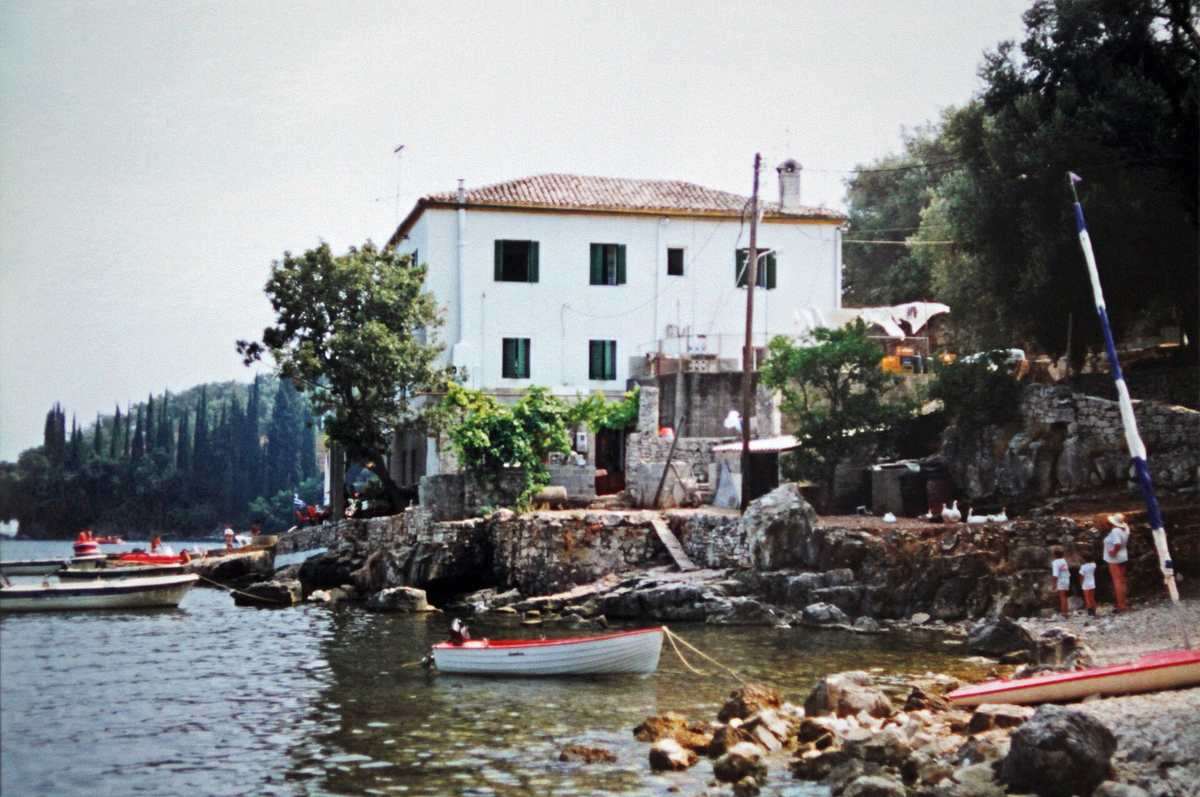
Kalami Bay, on the north-east coast, is where Lawrence Durrell lived in the house known as the White House, which still stands above the bay. Now a taverna with rooms, it lets visitors eat where Durrell wrote Prospero’s Cell.
Kalami is the heart of the real Durrell story. On the beautiful north-east coast, the picturesque pebble bay was home to Lawrence Durrell and his wife Nancy. They lived in the White House overlooking the water, where Lawrence wrote Prospero’s Cell. Gerald spent time there among the wider family. The White House still stands at the end of the bay and now serves as a charming taverna with rooms.
Visitors dine or stay where the famous family lived, with tables set almost over the sea. A scenic coastal walk links Kalami with the coves of Kerasia and Agni, following in the Durrells’ footsteps, set out alongside the guide to Kalami. The bay stays calm and clear, ideal for a swim after lunch. Touring the wider set of locations is easy to arrange from here.
Which Gerald Durrell books tell the Corfu story?
Gerald Durrell’s Corfu story fills three books, the Corfu Trilogy: My Family and Other Animals, Birds, Beasts and Relatives, and The Garden of the Gods. Lawrence Durrell’s Prospero’s Cell adds an adult, poetic view of the island.
My Family and Other Animals is the most loved of the three. It mixes family comedy with vivid natural history, drawn from Gerald’s boyhood roaming the olive groves and shore. Birds, Beasts and Relatives and The Garden of the Gods continue the same warm, funny thread. Together the trilogy forms the core source for the ITV series.
Lawrence Durrell’s Prospero’s Cell offers a different tone entirely. Written at the White House in Kalami, it reads as a lyrical travel diary of the north-east coast. The two brothers give readers both the child’s wonder and the writer’s reflection. Reading either book before a trip deepens the connection to the places on the trail.
How do you visit the Durrells’ Corfu?
You visit the Durrells’ Corfu by exploring Corfu Town and the Museum of Asian Art, dining at the White House in Kalami, and walking the north-east coast to Agni and Kerasia. Guided tours run in town, and a hire car reaches the coast.
Following the Durrells makes a lovely itinerary. In the capital, a guided Durrells-themed walking tour brings the show’s town locations to life. The route takes in the Venetian lanes, the Liston arcade and the palace that played the bank. On the north-east coast, lunch or a stay at the White House in Kalami offers a tangible link to the family. The scenic walk to Agni and Kerasia retraces their footsteps along the shore.
Danilia is a private film set, and the TV villa a private home, so both are admired from a distance rather than visited. A hire car or a private tour makes linking the coastal sites easy, set out alongside the guides to Corfu car rental and a Corfu itinerary. Two full days let travellers cover both the town and the north-east coast without rushing. The questions below cover the points travellers ask most.
How do you plan a self-guided Durrells day trip?
Plan a self-guided Durrells day trip by basing yourself in Corfu Town, hiring a car, and booking a White House lunch ahead. Start in the Old Town, then drive north to Kontokali, Gouvia, Kalami and Agni.
A self-guided route gives travellers freedom and pace. Morning suits Corfu Town, when the Venetian streets and the Museum of Asian Art stay quiet and cool. A short drive north reaches Kontokali and Gouvia, where the on-screen villa and Danilia sit behind private gates. The road then climbs and dips along the green coast toward Kalami.
Lunch at the White House rewards the drive, with the pebble bay below the terrace. An afternoon swim and the coastal path to Agni round out the day, set out alongside the guide to Kassiopi further north. Sturdy shoes help on the shoreline path, and an early booking secures a sea-view table. This loop shows the family’s Corfu in one relaxed day.
What is Danilia Village and why does it matter?
Danilia Village is a private recreated Corfiot village near Gouvia, built as a film and event set, which stood in for the old town in the ITV series. It sits behind gates and is not a public attraction, so visitors view it from outside.
Danilia is the show’s most recognisable single location. The set recreates cobbled lanes, a village square, shopfronts and a church in a convincing old-Corfu style. Production designers dressed it to match the streets of Gerald’s memoir. On screen it reads as the bustling town where the family shops and gossips.
The site stays private and hosts themed events rather than open tours, so the gates mark the limit for most travellers. Curious fans photograph the entrance and the wooded setting from the lane near Gouvia, set out alongside the guide to Gouvia. Corfu Town’s real streets give the closest public equivalent of the Danilia look. The town’s Venetian core supplied the show’s genuine exteriors.
When is the best time to follow the Durrells trail?
The best time to follow the Durrells trail is late spring or early autumn, when the weather stays warm, the sea is swimmable, and the coastal roads and tavernas are open without peak crowds. The wildlife Gerald described is most active in spring.
Spring brings the Corfu of Gerald’s memoir to life. Wildflowers cover the hills, tortoises and lizards emerge, and birdsong fills the olive groves. The north-east coast stays green, and the White House terrace catches the mild sun. Early autumn offers warm sea, quieter lanes and open tavernas along the Kalami coast.
High summer works too, though the town grows busy and the roads to Kalami carry more traffic. An early start beats both the heat and the crowds at the coastal bays. The Durrells trail suits a relaxed pace in any warm month, set out alongside the guide to the best time to visit Corfu. Sturdy shoes and an early lunch booking make the day run smoothly.
What else do fans ask about The Durrells in Corfu?
Where was The Durrells filmed in Corfu?
The Durrells was filmed at real Corfu locations including Danilia Village, the family villa in the Kontokali and Gouvia area, Corfu Town and its Museum of Asian Art, Kontokali Bay and Agni Bay. Interior scenes were recreated in UK studios.
Can you visit the White House in Kalami?
You can visit the White House in Kalami, where Lawrence Durrell lived and wrote Prospero’s Cell. It still stands above the bay and now serves as a taverna with rooms, so you can eat or stay where the famous family lived, a genuine piece of Durrell history on the north-east coast.
Is the Durrells’ TV villa open to visitors?
The villa used as the family home in the ITV series, in the Kontokali and Gouvia area, is a private residence and not open to visitors. Danilia Village, used as the show’s town, is also private, so both are admired from outside rather than toured.
Is The Durrells based on a true story?
The Durrells is based on the true story of the Durrell family and Gerald Durrell’s Corfu Trilogy. The ITV series compresses the timeline and reshapes characters for drama, yet the family, the island setting and the comic spirit of the memoirs are real.
How do you reach Kalami and the north-east coast?
You reach Kalami and the north-east coast by hire car, private transfer or the green intercity bus from Corfu Town. The drive follows a scenic coastal road through Kontokali, Gouvia and Kassiopi, so a car gives the freedom to stop at each Durrells location along the way.