
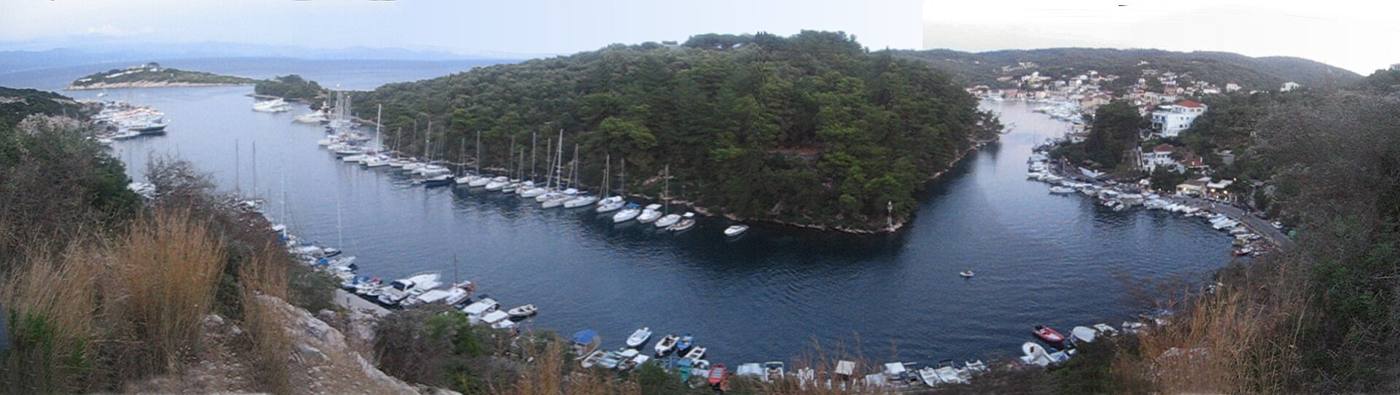
The history of Paxos reaches from myth to the present day, and has shaped the small, green island we see today. According to legend, Paxos was created when the sea god Poseidon struck Corfu with his trident, breaking off a piece of land as a peaceful retreat. In more solid history, the island came under Venetian rule in 1386 and remained so for over four centuries, an era that transformed its architecture. Its way of life and, above all, its landscape, as the Venetians introduced the vast olive groves that still cover the island. This guide traces the history of Paxos: its myth, its ancient and Venetian past. The story of its olive trees, the castle guarding Gaios. Plan the whole trip with Greece Tours.
How the past shapes the island today.
Here you will find the history of Paxos: the myth of its creation, the long era of Venetian rule. The planting of its famous olive groves, the castle of Agios Nikolaos off Gaios. How this past shaped the island today.
What is the history of Paxos?
Paxos has a long history, from ancient times through four centuries of Venetian rule, which began in 1386 and shaped the island profoundly, to British protection and union with Greece.
The history of Paxos and Antipaxos stretches back to antiquity, though the island’s most formative era came much later. Small and lying just south of Corfu, Paxos shared the fortunes of the Ionian islands, passing through the hands of rulers over the centuries.
The decisive period began with Venetian rule in 1386, which lasted for over four hundred years and left a deep mark on the island’s architecture, agriculture and way of life. Like the rest of the Ionian, Paxos was never conquered by the Ottomans, which sets its history apart from much of Greece.
What is the myth of how Paxos was created?
According to Greek mythology, Paxos was created when the sea god Poseidon struck Corfu with his trident, breaking off a piece of land to form a small, private island retreat for himself and his wife Amphitrite, away from the busier.
The most charming story about the origin of Paxos comes from Greek mythology rather than history. It tells that the sea god Poseidon, wanting a peaceful, private retreat for himself and his wife Amphitrite. Struck the southern tip of Corfu with his mighty trident, breaking off a piece of land that became the separate island of Paxos.
This myth captures something of the character of the island, small, quiet and set a little apart, as if made for tranquillity and escape. The trident of Poseidon even appears as a symbol associated with Paxos.
Was Paxos ruled by Venice?
Yes, Paxos was ruled by Venice for over four centuries, from 1386 onwards.
Venetian rule is the single most important chapter in the history of Paxos, beginning in 1386 and lasting for more than four hundred years, until the fall of the Venetian Republic at the end of the eighteenth century. Along with the other Ionian islands, Paxos was firmly part of the Venetian world for this long era.
The influence of Venice can still be seen and felt across the island. In the style of its older houses and churches, in place names and traditions. Above all in the landscape. The Venetians brought a degree of security and order that allowed the island to develop and its population to prosper through agriculture.
Why is Paxos covered in olive trees?
Paxos is covered in olive trees because the Venetians introduced large-scale olive cultivation in the sixteenth century, even paying islanders to plant them.
The endless olive groves that cover Paxos are the most visible legacy of its Venetian past. In the sixteenth century the Venetians encouraged the inhabitants to plant olives on a huge scale. It is said the islanders were even paid for every olive tree they planted.
The result can be admired today: the whole island is, in effect, one vast olive grove. With an estimated three hundred thousand trees, many of them dating back four hundred years or more to that Venetian era. The thin soil on the slopes is held in place by dry-stone retaining walls stretching for thousands of metres, a remarkable feat of traditional labour.
What is the castle of Agios Nikolaos on Paxos?
The castle of Agios Nikolaos is a ruined Venetian fortress on the little islet of the same name, across the channel from Gaios.
Guarding the harbour of Gaios, on the little wooded islet of Agios Nikolaos across the narrow channel from the town, stand the ruins of a Venetian castle. Built in 1453, during the Venetian era, it was raised to defend the island’s main harbour and its people against the pirates and raiders that plagued these seas.
The castle still stands guard proudly over Gaios, its old walls a picturesque and historic feature of the beautiful harbour setting. Together with the monastery on the neighbouring islet of Panagia, it frames the approach to the town and adds a strong sense of history to the scene.
What historic sights can you see on Paxos?
On Paxos you can see the ruined Venetian castle of Agios Nikolaos off Gaios, the monastery on the Panagia islet, old Venetian-style houses and churches in the villages, the lighthouse and ruined fortress at Lakka, and the ancient olive groves.
For a small island, Paxos has a good scattering of historic sights that reveal its past. The most prominent are the two islets off Gaios: Agios Nikolaos, with its ruined fifteenth-century Venetian castle. Panagia. Crowned by a monastery, which together guard the harbour and are steeped in history.
In the villages, the older Venetian-style stone houses, the narrow lanes and the traditional churches, such as the church of Ypapanti at Lakka dating from the eighteenth century, all speak of the island’s past. Lakka also has a nineteenth-century stone lighthouse and the remains of an old fortress where villagers once sheltered from pirates.
How has its history shaped Paxos today?
The history of Paxos, above all its Venetian centuries, has shaped the island we see today: the olive groves that cover it and give its famous oil, the character of its villages and harbours, the castle at Gaios, and the.
The Paxos of today is very much a product of its history, and especially of the long Venetian era. The olive groves introduced in that period still cover the island, providing its celebrated olive oil and giving the landscape its distinctive green. Terraced character. That the island’s economy and scenery alike remain rooted in that past.
The villages, with their Venetian-style houses and churches, the ruined castle guarding Gaios. The old fortifications and lighthouses. All carry the marks of the island’s story and add depth and character to a visit. Even the peaceful, unspoilt atmosphere reflects a history apart from the mainland, never under Ottoman rule.
Frequently Asked Questions
How old are the olive trees on Paxos?
The olive trees on Paxos are remarkably old, with many dating back around four hundred years or more, to the era of Venetian rule when large-scale olive cultivation was introduced. In the sixteenth century the Venetians encouraged the inhabitants to plant olives on a huge scale. It is said they were even paid for every tree planted. Spurring a great wave of cultivation. Today the whole island is, in effect, one vast olive grove of an estimated three hundred thousand trees, the oldest with thick, gnarled trunks that have stood for centuries. They are supported by dry-stone retaining walls stretching for thousands of metres across the terraced slopes.
Together the ancient trees and old walls form a living monument to the history of Paxos. Still producing the prized olive oil for which the island is famous.
Was Paxos ever ruled by the Ottomans?
No, Paxos was never conquered or ruled by the Ottoman Empire. In this it shares the distinctive history of the Ionian islands. Which sets them apart from most of the rest of Greece. While much of the Greek mainland and the Aegean spent centuries under Ottoman rule, Paxos and its Ionian neighbours were instead under Venice for over four hundred years, from 1386 until the fall of the Venetian Republic, followed by brief French rule and then British protection, before uniting with Greece in the nineteenth century. This unbroken line of Western European rather than Ottoman rule shaped the island’s architecture, agriculture and traditions, giving Paxos strong Venetian influences quite different from those found elsewhere in Greece.
When did Paxos become part of Greece?
Paxos became part of the modern Greek state in the nineteenth century, along with the other Ionian islands. After more than four centuries of Venetian control, which ended with the fall of the Venetian Republic at the close of the eighteenth century, the Ionian islands passed through a period of French rule and then came under British protection as the United States of the Ionian Islands. During the nineteenth century the islanders increasingly sought union with Greece, achieved when the British ceded the islands, and Paxos, with Corfu and the others, was united with Greece.
Its long centuries under Venice and Britain, rather than the Ottomans, mean the island came to Greece with a distinctive heritage still visible today.