
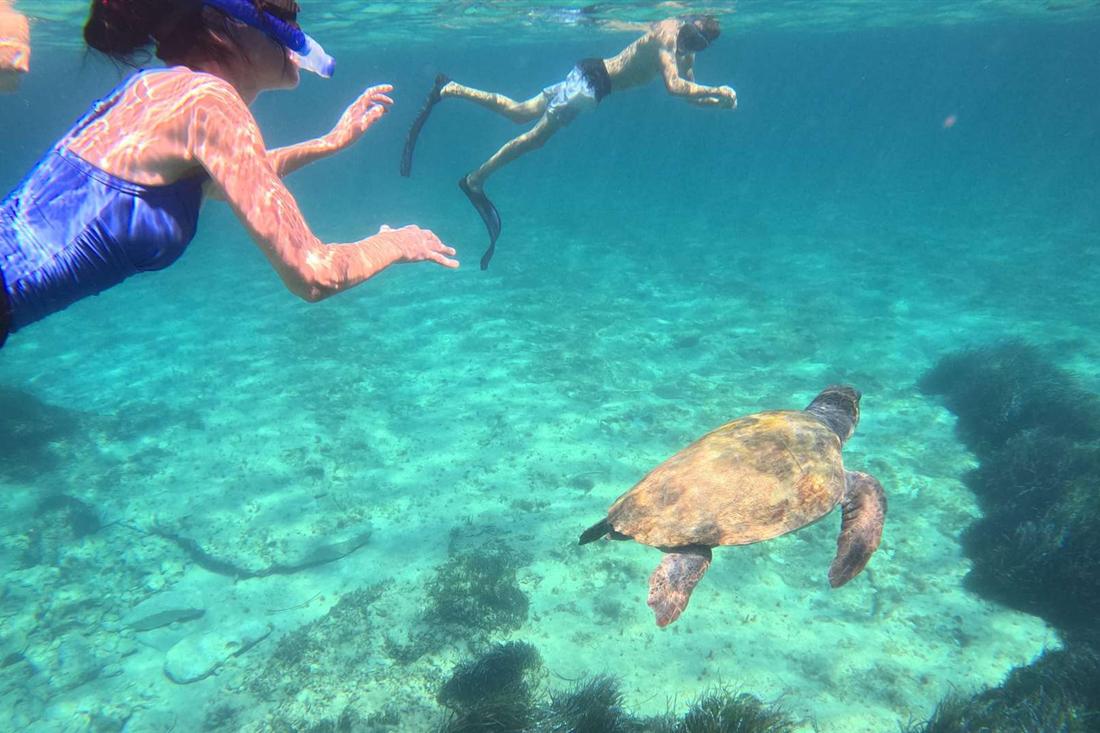
Paphos snorkeling takes you from a sculpture park in town to the coves of Coral Bay, the Edro III shipwreck, the turtle reefs and the clear bays of the Akamas peninsula. Explore more water days across the island with Greece Tours.
This guide covers the tours you can book, the shore spots, the wrecks, the turtles, the season, the gear and the safety rules.
What is Paphos snorkeling?
Paphos snorkeling is swimming with a mask, snorkel and fins in the clear shallow water of the Paphos coast in western Cyprus. It runs from a sculpture park beside the old town to the coves of Peyia, the bays of the Akamas and the reefs where sea turtles feed.
The coast that frames Paphos snorkeling is rocky, sheltered and warm. Rocky headlands and sea caves line the shore north and south of Coral Bay, and the sea off the Akamas peninsula holds protected turtle nesting beaches, so the water stays clean and full of life.
Snorkeling in Cyprus ranks high among the Mediterranean destinations, and Paphos snorkeling shares that reputation. Cyprus and Greece are the only places in that sea with a good chance of swimming alongside sea turtles, and two species live around the island: the green turtle and the loggerhead.
Paphos snorkeling comes in three forms. You can swim from the shore at a beach or cove, join a guided tour that includes the mask, fins and a guide, or take a boat trip with a swim stop at a reef or lagoon. Each form suits a different budget and a different level of confidence in the water.
This page covers all three. It compares the tours you can book, the shore spots, the wrecks, the turtle reefs, the season and the safety rules. For the wider picture of the island, our Cyprus tours page places Paphos snorkeling next to the other water, mountain and heritage days.
Which Paphos snorkeling tours can you book?
GetYourGuide sells a turtle-watching snorkeling trip with sea scooters and guides, a guided turtle snorkeling tour with GoPro videos, turtle-watching cruises and swim cruises, and glass-bottom boat trips with a swim stop. Viator adds a discover scuba tour, turtle trips and shipwreck cruises.
We ranked the products that name snorkeling, turtles or a swim stop in Paphos by review count and starting price. The turtle-watching snorkeling trip with sea scooters and guides sits at the top of the Paphos snorkeling list on GetYourGuide, and the guided turtle snorkeling tour with GoPro videos follows.
Cruises make up the second group of Paphos snorkeling products. GetYourGuide lists a turtle-watching sunset cruise, a swim cruise with turtle watching, drinks and an Aperol, and a turtle-watching cruise that combines a snorkeling adventure with the sunset.
Viator lists the same sea scooter trip under its own code, plus the Atlantis turtle-watching cruise with a snorkeling adventure, a turtle-watching sunset sail with an open bar, and the Paphos Yellow Submarine cruise with swimming and drinks.
Shipwreck products form the third group of Paphos snorkeling tours. Viator sells a full-day tour from a shipwreck to the Blue Lagoon and a boat tour to the Edro III shipwreck, and a family tour from Paphos adds sea caves, the wreck, a donkey farm and a cat park.
Check each listing for the current rate, the length of the water time and the pick-up point before you book Paphos snorkeling.



Where can you do Paphos snorkeling from the shore?
The shore spots near Paphos are the snorkeling park at the Municipal Baths in Kato Paphos, the long crescent of Coral Bay, the coves of Peyia and the pebble beach at White River. The Akamas bays lie further north, with rougher roads.
Paphos snorkeling starts in town. The first snorkeling park in Cyprus lies inside the protected area of the Municipal Baths in Kato Paphos, and it offers a free-diving experience to visitors and locals alike.
Coral Bay is the classic beach for Paphos snorkeling north of the city. It lies about 11 km from Paphos and forms a crescent of soft white sand 600 metres long, closed in by two limestone headlands. The beach holds the Blue Flag of the European Union, and the headlands and their sea caves give snorkelers rock to explore on both sides.
Peyia, the municipality around Coral Bay, lies on steep coastal hills 14 km from Paphos, at the point where the Akamas peninsula begins. Its coast holds a string of coves, so a hire car or a taxi gives a Paphos snorkeling day plenty of choice within a short drive.
White River Beach lies a little further north, at the entrance to the Akamas. Its Greek name, Aspros Potamos, comes from a sand bar under the water that cuts across the bay like a white river in the sea. The small pebble beach is visible from the top of the cliff and lies about 20 minutes by car from Paphos harbour.
Roads change as you head north. Snorkel Around the World warns that the road to White River Beach is rough, so a sturdy vehicle or an all-terrain vehicle suits the last stretch, and the sea there stays calm and shallow enough for a first swim.
What is the Paphos snorkeling park?
The Paphos snorkeling park is the first snorkeling park in Cyprus. It lies in the protected area of the Municipal Baths in Kato Paphos and holds three larger-than-life shell sculptures under the surface, made by the local artist Yiota Ioannidou, with a smaller group of sea urchin shells above the waterline.
The park mixes art with marine life for Paphos snorkeling in town. The three shell compositions sit close together below the surface, so a swimmer finds them one after another, and the sea urchin shells among the rocks above the water introduce the idea on land.
The designers of this Paphos snorkeling site chose the shell for a reason. In myth, the goddess Aphrodite emerged from the foam of the sea on a shell, and since ancient times the shell has stood for fertility and birth, much like an egg. The sculptures pay tribute to the myths of Paphos.
The sculptures are made of environmentally friendly concrete and follow the guidelines of the Barcelona Convention, which protects the Mediterranean Sea against pollution. Their geometric form and inner structure attract marine organisms, so the park works as a natural system for the conservation and breeding of marine life.
The park suits Paphos snorkeling for guests who want to stay in town. It needs no boat, and it lies in Kato Paphos, the lower town that also holds the archaeological park, so a morning swim fits before a visit to the mosaics.
Can you do Paphos snorkeling with turtles?
Yes. Green and loggerhead turtles live along the west coast of Cyprus, and guided turtle trips from Paphos harbour swim to the turtle reefs. The beaches north of the city are nesting grounds, so the shore swim is secondary and the guided trip gives the better chance.
The nesting beaches explain why turtles stay near Paphos snorkeling sites. Loggerhead and green turtles lay their eggs on the beaches north of Paphos from late spring until August, and the main nesting site is Lara Bay on the Akamas peninsula. The EU Natura 2000 network protects two of these beaches.
Lara Bay is for learning, not for swimming. Snorkeling Report notes that the bay is not really recommended for snorkeling, but visitors can see the Lara Bay Turtle Conservation Station, where a hatchery guards the eggs.
The right way to meet adult turtles during Paphos snorkeling is a boat trip. Snorkeling Report advises booking a tour to Turtle Reef, and the majority of these trips leave from Paphos port. A guide knows where the animals feed on a given day and keeps the group at a respectful distance.
Sightings depend on the season. Turtles appear regularly in June, and the numbers reach their peak from August to October. Even then, a Paphos snorkeling trip cannot promise a sighting, because the turtles are wild.
Visit Pafos describes a long-standing turtle conservation project in the region, and divers meet turtles swimming or resting under rocky ledges and reefs.
What can you see during Paphos snorkeling?
Paphos snorkeling shows shoals of sea bream and wrasse, damselfish, trumpet fish, octopus and cuttlefish, with occasional groupers, moray eels and parrotfish. Divers also report barracuda, stingrays and seals at the deeper sites, and sea turtles at the reefs.
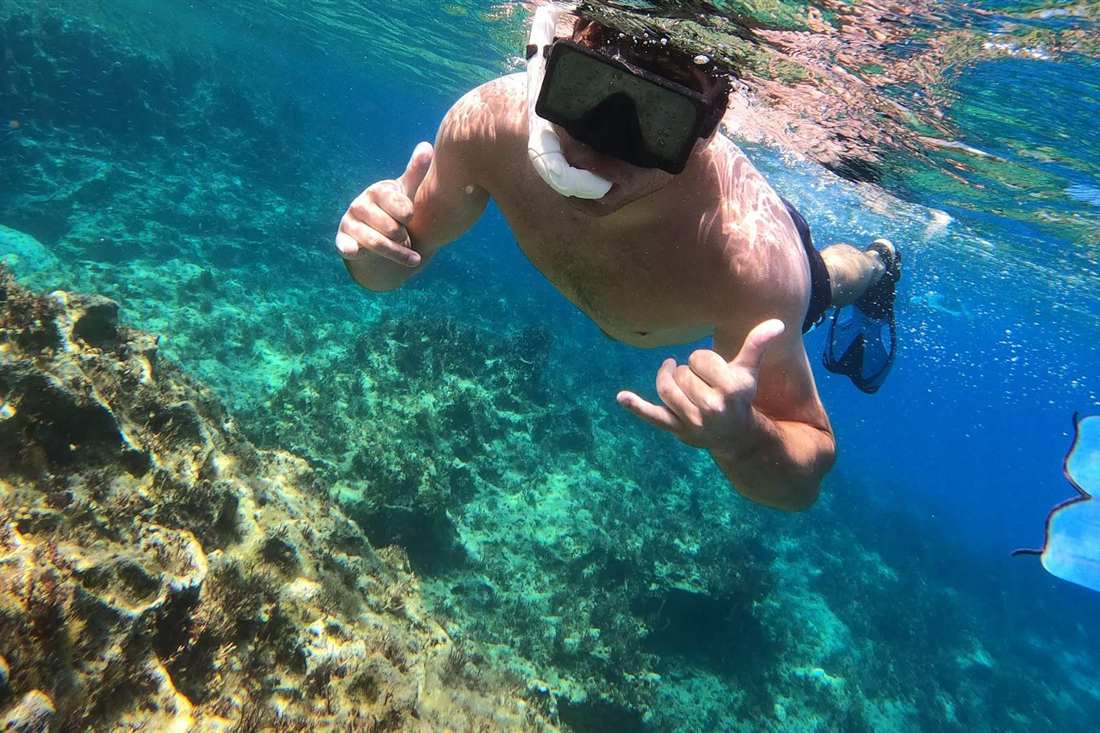
The common fish of Paphos snorkeling are easy to name. Snorkeling Report lists multiple species of sea bream and wrasse, plus salema and damselfish, among the common marine life of the waters of Cyprus, and nearly 300 species live in the shallows.
Rarer fish add interest to Paphos snorkeling. The dusky grouper, the Mediterranean moray and the parrotfish turn up less frequently, and the report adds octopus, cuttlefish, sea anemones and red starfish to the list.
Trumpet fish are a favourite of Paphos snorkeling in the Akamas. Snorkel Around the World singles them out at Manolis Bay, since they change colour to match their background, which makes them a game of hide and seek for children.
The dive sites around Paphos give Paphos snorkeling guests a longer list. Visit Pafos names wrasse, bass, bream, blennies and sea cucumbers at the Stage, octopus and macro life at the harbour of Agios Georgios, barracuda and moray eels at the Bay, and the occasional seal and stingray.
The bulk of that life sits close to rocks and sea grass. A calm swim along a rocky ledge shows more than a swim over open sand, so look for cracks, overhangs and the edge of the sea grass beds.
Can you try Paphos snorkeling at the Edro III shipwreck?
Yes. The Edro III, an 83-metre cargo ship, lies against the rocks near Peyia about twenty yards from the coast. A storm wedged it onto a reef in the winter of 2011. Snorkelers swim around it in calm weather, and sea caves lie along the coast north of the wreck.
The wreck at this Paphos snorkeling site has a short, clear history. The freighter carried grain, lost its steering during a winter storm in 2011 and ended up stuck on a reef against the coast, with no loss of life. It has stayed on the rocks since then.
Snorkeling Report says the wreck rests off the rocks about twenty yards from the shore, and that underwater caves along a mile of coastline north of the wreck can be explored when the sea conditions allow it.
The wreck is also a dive site beside the Paphos snorkeling shallows. Visit Pafos describes two anchor chains running out in opposite directions from the ship, and both have turned into small ecosystems. Two separate reefs hold barracuda, bream, wrasse, octopus and the occasional stingray.
Respect the wreck. Swim there only in calm weather, keep a safe distance from the metal and ask a local guide or dive centre about the day’s conditions.
The wreck is also a landmark of the coast road. Jeep tours from Paphos stop there on the way to the Akamas, and our Paphos jeep safari page lists the safaris that stop there.
What is the Vera K wreck?
The Vera K is an 86-metre freighter of Lebanese origin that ran aground off Cyprus in 1972. The army used it for target practice, and in 1974 the authorities blew it up as a danger. It now rests in an 11-metre crater, about 20 minutes by boat from Paphos harbour.
The wreck belongs to boat trips, not to shore swims. Visit Pafos describes it as a boat dive, frequently combined with the Amphorae Cave, and parts of the bridge and the large engine block are still visible on the seabed.
Glass-bottom and semi-submarine boats show it from above. Musement describes a semi-submarine cruise from Paphos that visits shipwrecks, and a sunset cruise that visits the Vera K shipwreck, spots turtles and swims at Atlantis Beach.
Other wrecks lie off the Paphos snorkeling coast. The White Star, a former Russian fishing boat, sank in 2007 near the municipal beach of Geroskipou at 14 to 18 metres, and the Laboe, a cruise vessel of 1940 built in Germany, sank in 2014 as an artificial reef at Moulia with a maximum depth of 26 metres.
Those two wrecks suit divers. Snorkelers stay with the shallow sites and with the boat trips that view the Vera K from the surface and add a swim stop in clear water.
Which Akamas bays suit Paphos snorkeling?
The Akamas bays reached from Latchi suit Paphos snorkeling for clear water and quiet coves: Manolis Bay, the Baths of Aphrodite beach and the Blue Lagoon. Boats from Latchi harbour or a 4×4 on the dusty coast road reach them.
The Akamas peninsula, home to the wildest Paphos snorkeling, covers 230 square kilometres at the north-west tip of Cyprus. A national park protects its wooded hills, and untouched creeks follow one another along the rugged coast, so the water here stays among the cleanest on the island.
Manolis Bay, a favourite for Paphos snorkeling, lies inside the nature reserve, next to the Blue Lagoon. The seabed of white sand gives the water a sheltered turquoise colour, and the bay is not shallow, since the depth drops quickly to about 5 metres. Snorkelers swim around the caves or over the sandy bottom.
The Baths of Aphrodite beach sits near Latchi. Little sandy coves nestle among rugged cliffs, and schools of fish pass close to the rocks. The rocky sections have shallow water that suits beginners, while strong swimmers find enough to see.
No road reaches the heart of the peninsula, and certain roads on the maps are not sealed. A 4×4 or a boat from Latchi harbour is the simple way in, and Latchi is also the departure point of the lagoon cruises.
These bays sit on the routes of the safaris and cruises that start in Paphos. For the lagoon itself, the Paphos Blue Lagoon tour page weighs each way to get there.
Can you try Paphos snorkeling at the Blue Lagoon in Akamas?
Yes. The Blue Lagoon in Akamas is a sheltered bay of clear turquoise water that every Blue Lagoon cruise uses for a swim stop. Boats supply masks and floats, and the water is calm enough for beginners to float and look down at the rock and the fish.
The lagoon works as a Paphos snorkeling stop on almost every trip from Latchi. Operators give guests a long swim there, and the bay is framed by rock formations that shelter it from the open sea.
Gear for Paphos snorkeling is on board at the lagoon. The Paphos Jeep Safari cruise lists snorkels, masks and floats on the boat, and a bus-and-boat trip lists snorkeling masks and life jackets in its inclusions, so a visitor does not need to bring equipment.
Other tours expect your own mask. The Latchi barbecue trip asks guests to bring a mask, so check what the listing includes before you pack.
A guest who wrote about a Blue Lagoon cruise with Paphos Sea Cruises said that the lifeguard on board made non-swimmers feel safe enough to float in the sea. That detail shows how the better boats handle weaker swimmers: with a crew member in the water and flotation aids on hand.
The lagoon is also a good place to look for small fish. Gorgo Travel lists colourful fish, sea turtles and even dolphins among the marine life of the Blue Lagoon.
What is the Paphos eco snorkeling adventure?
The Paphos eco snorkeling adventure is a guided tour of the Paphos Marine Park that lasts from 2 to 4 hours, with experienced instructors and an eco-friendly approach. The guide explains the marine life, and with luck you spot a turtle or two.
Musement sells this tour, and it starts at Poseidonos Avenue 1 in Kato Paphos. The listing promises experienced and knowledgeable instructors, an eco-friendly and sustainable experience and an English-speaking guide for all nationalities.
The rules of this Paphos snorkeling tour are clear and useful. There is no minimum age, but every guest needs basic swimming skills in water too deep to stand in, and a person over 18 must supervise every child at all times. The tour is not suitable for guests who cannot swim.
The listing asks guests to bring bathing gear and sunscreen. Cold water comes with the tour, and the schedule depends on the weather, with times given as approximate.
Cancellation is simple. Musement refunds the full price if you cancel at least 24 hours before the start, and it adds no extra booking fee.
This tour fits a first-time swimmer who wants teaching rather than a crowded boat. A guide in the water keeps a Paphos snorkeling group together, shows the sea life and watches the conditions.
What is a sea scooter snorkeling trip?
A sea scooter snorkeling trip gives each guest a small electric scooter that pulls them through the water while a guide leads the group to the turtle reef. GetYourGuide sells it as the top Paphos snorkeling product, and Viator lists the same trip under its own code.
The idea is simple. A small scooter pulls each swimmer through the water, and a guide leads the group towards the turtle reef.
The title on GetYourGuide names the main promises of this Paphos snorkeling trip: turtle watching, snorkeling and sea scooters with guides. Viator’s version describes a turtle-watching snorkeling sea scooter trip with a guide.
A second guided Paphos snorkeling trip focuses on the record of the day. The Paphos guided turtle snorkeling tour promises GoPro videos, so guests leave with footage of the reef.
Ask the operator about the swimming level that this Paphos snorkeling trip expects, and tell the crew about any health condition before you book.
Can you try Paphos snorkeling on a boat trip?
Yes. Glass-bottom boats, turtle-watching cruises, swim cruises, sunset cruises and Blue Lagoon trips all include swim stops where guests snorkel in clear water. Atlantis Beach, Ricco’s Bay and the Blue Lagoon are named stops on the Paphos routes.
A boat trip is the easiest form of Paphos snorkeling for families and groups. The crew provides life jackets, the boat is the base, and the swim stop comes after a short sail along the coast.
GetYourGuide lists three glass-bottom options that include a swim: a trip with swimming and snorkeling, the yellow boat with a swim stop and a cruise with a fun slide. Each one pairs a view of the reef through the hull with a dip in the sea.
Musement names the swim spots for Paphos snorkeling on its cruises. The semi-submarine cruises swim at Atlantis Beach, and the Jolly Roger pirate cruise for families stops for snorkeling at Ricco’s Bay, with face painting and limbo dancing on board.
The cruises with turtle watching mix the two goals of Paphos snorkeling. The Atlantis turtle-watching cruise and the swim cruise with drinks and an Aperol both list the turtles, a swim and a drink, so the day suits a slower pace.
Our Paphos boat trip page covers each cruise from the harbour in detail, and this page focuses on the water time.
Can you try scuba diving after Paphos snorkeling?
Yes. Viator sells a half-day Discover Scuba Diving tour in Paphos for beginners, and the coast holds more than 15 named dive sites, and a number of them sit beside the snorkel spots at Coral Bay, White River, the Edro III wreck and the harbour of Agios Georgios.
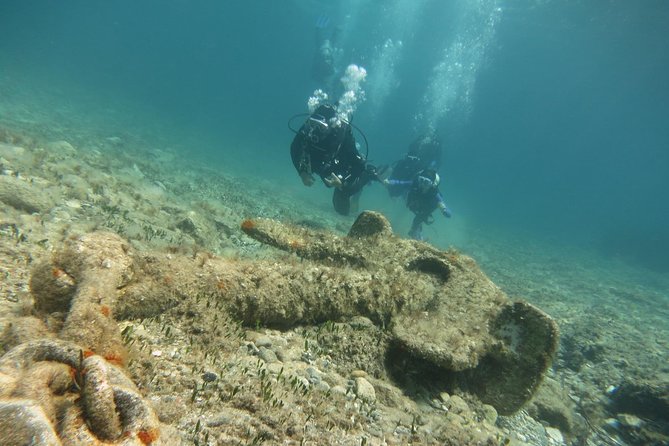
Scuba diving is the natural next step after Paphos snorkeling. Visit Pafos describes calm, warm water that suits both experienced divers and first-timers, with amphorae, stone anchors, underwater caves, tunnels and wrecks to find.
The Discover Scuba Diving tour is the entry point. Viator lists it as a half-day tour for first-time divers, and it ranks among the top water products of Paphos.
The shore dive sites reuse the same coves as Paphos snorkeling. White River has a gentle slope into the water and a gradual decline that suits all levels, with gullies to 24 metres deep and a maze of swim-throughs, small caves and caverns.
The Amphitheatre lies just after Coral Bay and Coralia beaches. It takes its name from a natural amphitheatre of sea-carved rock steps, at 12 metres, and it offers three diving areas from the shore with excellent visibility.
Paphos snorkeling covers the shallow tops of these sites. A swim over the rocks above a dive site shows the same fish as the divers see, and a guide can point you to the cove that suits your level.
Which dive sites sit near Paphos snorkeling spots?
The Witches Cauldron, the Stage, Cynthiana, Leonardo Cypria Bay, Pistol Bay, Queens Bay, the Sea Caves and Saint George Caves all lie on the coast between Coral Bay and Agios Georgios. Visit Pafos lists The Bay, Queens Bay and Cynthiana among the sites that suit first-time or newly qualified divers.
The Witches Cauldron is a hole 10 metres deep, reached from a sandy shelf where waves break against the back wall. Divers see tiered walls of nooks and crannies with trumpet fish, sea hares and different types of wrasse.
The Stage takes its name from a large overhang with a hole in its centre, which lights up when the sun shines through it. Bass, bream, blennies and sea cucumbers live here, with the occasional turtle, seal and stingray.
Cynthiana lies in front of a hotel, in its own natural lagoon, and reaches 18 metres. Queens Bay, in front of Theo’s Sunset Beach Village, has an easy entry on a flat sandy seabed, and newly qualified divers favour it.
Leonardo Cypria Bay, called The Bay, has a maximum depth of 6 metres and a walk-in entry from the beach. It suits training, and its marine life includes ornate and rainbow wrasse, sea bass, octopus and moray eels.
The Sea Caves site lies near the harbour of Agios Georgios and runs from 12 to 36 metres. The Saint George Caves offer swim-throughs, arches, large caves and even a blowhole, and a wall drops to 50 to 60 metres behind the island of Saint George.
When is the right season for Paphos snorkeling?
The season for Paphos snorkeling runs from June to October, when the sea is warm, calm and clear. The sea reaches 22 to 26C in that period and up to 28C or more in July and August. Turtles show regularly in June and in their greatest numbers from August to October.
The air is hot during the Paphos snorkeling season. Snorkel Around the World gives an average of 22 to 32C from June to October, and up to 35C in July and August, when the sea warms to about 28C.
Snorkeling Report goes slightly higher for the water. It says the temperature can reach 30C in August and September, and that the sea is calmest in these months.
Crowds follow the heat to Paphos snorkeling beaches. The report warns that the shore gets very crowded in July and August, so snorkeling is less pleasant when a crowd shares the water. An early start helps.
Snorkel Around the World prefers the middle of autumn. The weather is not too hot, the sea is pleasantly warm, and the island is less crowded than in the main season, so October suits a quiet Paphos snorkeling holiday.
Outside June to October, snorkeling remains possible in the shallows, but both sources suggest a wetsuit. Rough seas cancel boat trips, and the Latchi barbecue boat refunds the full price when it cancels for bad weather, so keep the dates flexible.
What gear do you need for Paphos snorkeling?
For Paphos snorkeling you need a mask, a snorkel, fins if you want to cover distance, sunscreen, a towel and a swimsuit. A rash vest or a wetsuit helps outside the warm months. Tours and boats list their own inclusions, so check each listing for masks and fins.
Check each Paphos snorkeling listing for what it includes. The musement eco tour lists bathing gear and sunblock as things to bring, the Latchi barbecue boat asks guests to bring a mask, and the bus-and-boat Blue Lagoon trip lists masks and life jackets among its inclusions.
A mask is the key item. Test the fit of your mask before you head out, in the shallows or at home.
Fins suit longer swims. Pack a pair for shore swims at Coral Bay and White River, while a boat swim stop at anchor needs a mask and a life jacket.
Protect your skin from the sun on the water. Apply sunscreen before you enter the sea, and wear a rash vest for long Paphos snorkeling swims.
Water shoes help on the rocks. Gorgo Travel lists water shoes as helpful for walking on rocky areas, and White River has a small pebble beach.
Is Paphos snorkeling safe?
Paphos snorkeling is safe in calm weather when you follow basic rules: swim with a partner or a guide, wear a life jacket if you are not confident, stay away from rocks and boats, and check the sea before you enter. The water is calm and warm in summer.
Weather decides the day for Paphos snorkeling. Snorkeling Report says wave conditions limit access to the underwater caves near the Edro III, and musement states that its tour is subject to weather conditions, so operators cancel or move trips when the sea turns rough.
Skill matters too in Paphos snorkeling. The musement tour requires basic swimming skills in water too deep to stand in, and it excludes non-swimmers, while the better cruise boats carry a lifeguard and flotation aids for weaker swimmers.
Depth surprises first-timers at Paphos snorkeling bays such as Manolis. Manolis Bay drops quickly to 5 metres, so a swimmer who expects a shallow bottom needs a life jacket and a position near the boat or the shore.
Wrecks and caves need care. Snorkeling Report says the caves near the Edro III open to swimmers only when sea conditions allow, so beginners join a guided trip instead of swimming alone at those sites.
Tell someone where you are going. Shore swimmers pick a calm day, stay inside the bay and avoid swimming alone.
Is Paphos snorkeling suitable for children and beginners?
Yes, with supervision. Musement sets no minimum age for its eco snorkeling tour, though an adult over 18 must supervise every child at all times and children need basic swimming skills in deep water. Calm shallow coves such as White River suit first swims.
Start Paphos snorkeling in shallow water. White River Beach has calm water and shallow areas where first-timers swim around, and the rocky sections at the Baths of Aphrodite beach are shallow enough for beginners.
Boats suit families. On the Super Jumbo St. Raphael I, children and less confident swimmers borrow life jackets, noodles and flotation aids at no charge, and an extended platform with steps eases entry to the water.
Families have a pirate option. The Jolly Roger cruise offers face painting, limbo dancing and a snorkeling stop at Ricco’s Bay, so the swim forms part of a bigger story.
Check the age rules. Paphos Jeep Safari and Zsolt’s tours list child prices, while the musement jeep safari excludes infants under 3, so read each listing before you book a trip with children.
Keep the first swim short, and give children a break on the beach or the deck after each dip.
How do you respect the turtles during Paphos snorkeling?
Keep your distance from turtles, never touch, chase or feed them, keep to the marked paths on nesting beaches, take your litter home and use reef-friendly sunscreen. Cyprus protects its turtle beaches, and the Akamas and Lara Bay are conservation areas.
Turtles are wild animals. Sea turtles count as a vulnerable species on the Cyprus coast, and monk seals share the waters of the Akamas, so a good snorkeler watches from a distance and lets the animal surface to breathe.
Nesting beaches need quiet. Turtles lay their eggs on the beaches north of Paphos from late spring until August, and Lara Bay runs a hatchery that protects the eggs, so keep to the marked paths and leave the sand as you found it.
The snorkeling park shows the idea of care. Its sculptures use environmentally friendly concrete that follows the Barcelona Convention, and the project works as a natural system for the breeding and conservation of marine life.
Take only photos. Leave shells, sea urchins and old pottery on the seabed, since the coast holds stone anchors and amphorae.
Leave the water clean. Carry a small bag for litter, rinse sunscreen off on land when you can and choose products that suit a marine park, so the next swimmer finds the same clear water.
How do you reach the Paphos snorkeling spots?
Coral Bay lies about 11 km north of Paphos by road, Peyia 14 km north-west, White River about 20 minutes by car from the harbour, and the Akamas bays by 4×4 or boat from Latchi. The snorkeling park lies at the Municipal Baths in Kato Paphos.
A hire car gives full freedom for Paphos snorkeling. The coast road runs north from Paphos through Kissonerga to Coral Bay and Peyia, and the drive to White River takes about 20 minutes from the harbour.
Without a car, tours collect guests at their hotels. Paphos Jeep Safari and Zsolt’s 4×4 Adventures pick guests up at their accommodation, and bus-and-boat trips use a coach to Latchi.
Latchi is the base for Paphos snorkeling in the Akamas. Boats leave its harbour for the Blue Lagoon, Manolis Bay and the Baths of Aphrodite, and the village is the gateway to the national park.
The drive north changes with the road. Past White River the surface turns rough, and Snorkel Around the World advises a sturdier vehicle for the last stretch to the beach.
Kato Paphos has its own harbour bus station, so a swim in town needs no car.
How does Paphos snorkeling compare with Ayia Napa and Protaras?
Paphos offers wrecks, sea caves, turtle reefs and wild Akamas bays on the west coast. Ayia Napa and Protaras on the south-east tip hold Green Bay, Konnos Beach, Fig Tree Bay and the Museum of Underwater Sculpture. Each side suits a different kind of trip.
Snorkeling Report calls the area around Cape Greco the snorkeling hotspot of Cyprus. It names gin-clear rocky coves, an underwater museum and one of the leading places in the Mediterranean to swim with sea turtles.
Green Bay in Protaras is the favourite spot of the east. A rocky cove with sea grass beds, it holds green turtles that are easy to spot, plus underwater statues and rocky beds full of fish. Turtles also visit Sirena Bay, Kalamies Bay and Konnos Beach.
Fig Tree Bay offers a small island in the middle of the bay, about a hundred yards from the shore, with shallow rocky beds. Nissi Beach in Ayia Napa has a small island too, and the Museum of Underwater Sculpture Ayia Napa opened in 2021 with more than 90 statues at different depths.
The Blue Lagoon at Cape Greco draws the largest number of visitors on that coast, and cars reach it. The west coast Blue Lagoon in Akamas needs a boat or a 4×4, which keeps it wilder.
Pick the coast that matches your base. Paphos and Coral Bay guests stay on the west coast for wrecks and caves, while guests in Ayia Napa and Protaras find the cruises of the east on our Ayia Napa boat trip and Protaras boat trip pages.
Which Paphos snorkeling trip suits you?
Pick a shore swim for a free, flexible morning, an eco tour for teaching, a sea scooter trip for the turtle reef, a glass-bottom or sunset cruise for families and couples, and a jeep or boat day for the Akamas bays and the Blue Lagoon.
Each Paphos snorkeling choice answers a different need:
- Free and close: the snorkeling park at the Municipal Baths in Kato Paphos, or Coral Bay from the beach.
- Learning: the 2 to 4 hour eco snorkeling tour in the Paphos Marine Park, with an instructor.
- Turtles: the sea scooter trip or the guided turtle tour with GoPro videos.
- Families and couples: glass-bottom boats, sunset cruises with turtle watching and swim cruises with drinks.
- Wild bays: the Akamas by jeep, boat or both, with a swim at the Blue Lagoon.
- Next step: a half-day Discover Scuba Diving tour for guests who want to go deeper.
Length is the second filter for Paphos snorkeling. The musement eco tour lasts 2 to 4 hours, the sea scooter trips fit into half a day, and the jeep and cruise days fill a whole day from hotel pick-up to the evening.
Group size is the third filter for Paphos snorkeling. Private 4×4 days carry one party, the cruise boats carry larger groups, and the guided snorkeling tours keep a guide close to the swimmers.
How do you plan a day of Paphos snorkeling?
Plan an early start, pack your gear and sunscreen, choose one main water activity per day, add a lunch stop in Latchi, Coral Bay or Kato Paphos, and keep a spare day for weather. Book guided trips ahead in July and August.
Start Paphos snorkeling with the morning. The sea is calm and the beaches are quiet early in the day, and Snorkeling Report warns that July and August are crowded, so an early swim avoids the crowd.
Build the day around one main Paphos snorkeling swim. A turtle trip or a Blue Lagoon day fills the morning and early afternoon, and a second activity, such as a walk through the Tombs of the Kings or the mosaics of Kato Paphos, fits the evening.
Eat near the water. Latchi harbour has seafood tavernas, Coral Bay has restaurants along its beach, and Kato Paphos has cafés around the harbour and the castle.
Keep a spare day for Paphos snorkeling weather. Musement cancels or moves its eco tour when the sea turns rough, and wave conditions limit the Edro III caves, so a flexible week gives you a second chance.
Our Paphos tours page lists the city walks, site visits and day trips that fill the days between the swims.
What do travellers ask about Paphos snorkeling?
Where do you start Paphos snorkeling?
Coral Bay and the coves of Peyia suit shore swims, the Akamas bays suit boat and jeep days, and turtle trips leave from Paphos harbour.
Can you see turtles during Paphos snorkeling?
Yes. Green and loggerhead turtles live along the coast, and guided turtle trips from the harbour swim to the reefs, with the highest numbers from August to October.
Do you need to be a strong swimmer for Paphos snorkeling?
Basic swimming skills are enough for shallow coves. The musement eco tour needs basic skills in deep water, and non-swimmers join a boat with life jackets.
Is there a snorkeling park in Paphos?
Yes. The first snorkeling park in Cyprus lies at the Municipal Baths in Kato Paphos, with three shell sculptures under the surface.
Which month suits Paphos snorkeling?
June to October, with warm calm water. October suits guests who want fewer people in the sea.