
Getting from Milos to Paros means a ferry from the port of Adamas. Taking under two hours on a fast boat or around two to three hours on a conventional ferry. Plan the crossing with ferries, tours and tickets from My Greece Tours.
This short crossing is an easy island-hopping step in the Milos travel guide. The sections below cover how to get from Milos to Paros, the ferry times and operators, the fares, the ports, and whether to combine the two islands.
How do you get from Milos to Paros?
Milos and Paros connect only by ferry, with no other direct link between the two Cycladic islands. Boats leave from the port of Adamas on Milos and arrive at Parikia, the capital and main port of Paros.
High-speed catamarans make the crossing in about 1 hour 45 minutes, while conventional ferries take roughly 2 to 3 hours. The route runs daily, more frequently in summer. As Paros lies relatively close to Milos, this is one of the shorter and easier Cycladic crossings, making island hopping simple. Milos and Paros both lie in the Cyclades, in the central Aegean, and the only direct way to travel between them is by sea. Every ferry departs from Adamas, the main port of Milos, and arrives at Parikia, the capital and principal port of Paros, on the island’s west coast.
Two kinds of boat serve the route. High-speed catamarans cover the distance in under two hours, around an hour and three-quarters, prioritising speed. While larger conventional ferries take roughly two to three hours but cost less and ride more steadily. The route runs daily, with more frequent crossings in the summer high season and a reduced schedule outside the peak months. Because Paros lies relatively close to Milos, this is one of the shorter and more convenient Cycladic crossings. Far quicker than the longer hops to Naxos or Crete, which makes it especially easy to combine the two islands on an island-hopping trip. The ferry is the natural and only practical way to connect them.
The questions below cover what travellers ask most.
What are the ferry times and operators?
The Milos to Paros ferry takes from about 1 hour 45 minutes on a high-speed boat to around 2 to 3 hours on a conventional ferry.
SeaJets runs fast catamarans, reaching Paros in roughly 1.5 to 2 hours, while Blue Star Ferries operates larger conventional vessels. In summer there is typically a daily sailing on each, with the first ferry leaving Milos around 7.30am and the last by mid-afternoon. Off-season sailings are fewer, so check the timetable when planning a trip outside the peak months and book ahead. Crossing times depend on the type of boat, and a couple of operators serve the route. The fastest option is SeaJets, whose high-speed catamarans reach Paros in around an hour and three-quarters to two hours, the choice for travellers who want the quickest passage.
The slower, cheaper alternative is Blue Star Ferries, which runs larger conventional vessels that take roughly two to three hours but offer more deck space and a steadier ride. In the summer there is generally a daily crossing on each operator.. With the first ferry leaving Milos around half past seven in the morning and the last departing by the mid-afternoon, giving a reasonable choice within the day. The frequency rises at the height of the season, with extra sailings, and drops outside it, so anyone travelling in spring or autumn can confirm the current schedule.
Given how short the crossing is, even the conventional ferry makes an easy half-day trip, while the fast boat gets you there in well under two hours, suiting tight connections. The questions below cover what travellers ask most.
How most does the ferry cost and how do you book?
A Milos to Paros ferry ticket starts around €12 to €30 on a conventional boat. While a high-speed catamaran costs more, often €40 to €90 depending on class, with premium seats higher.
Fares rise in peak summer and for reserved seats, so book online in advance, especially in July and August when sailings sell out. Arrive at Adamas port at least an hour before departure, or longer with a vehicle, and keep your ticket and ID handy for boarding. Fares vary with the type of boat, the class of seat and how early you book. A basic ticket on a conventional ferry can start as low as around twelve to thirty euros, the budget choice. While the faster catamarans cost more, ranging from roughly forty euros up to ninety or so for premium seating, reflecting the time they save.
Prices climb in the peak summer months and for reserved or upgraded seats, so booking early pays off in both price and availability. The simplest way to book is online in advance through a ferry-booking website that shows all operators and live schedules side by side. Which is wise in July and August when the popular sailings fill up days ahead. On the day, plan to be at the port of Adamas at least an hour before departure as a foot passenger. Or ninety minutes to two hours ahead if you are bringing a car. Keep your ticket and passport or ID ready for boarding.
It is one of the cheaper and easier island hops from Milos. The questions below cover what travellers ask most.
What are the ports like at each end?
Ferries leave from Adamas, the main port and lively hub of Milos, where boat tours and buses also depart, close to the capital Plaka.
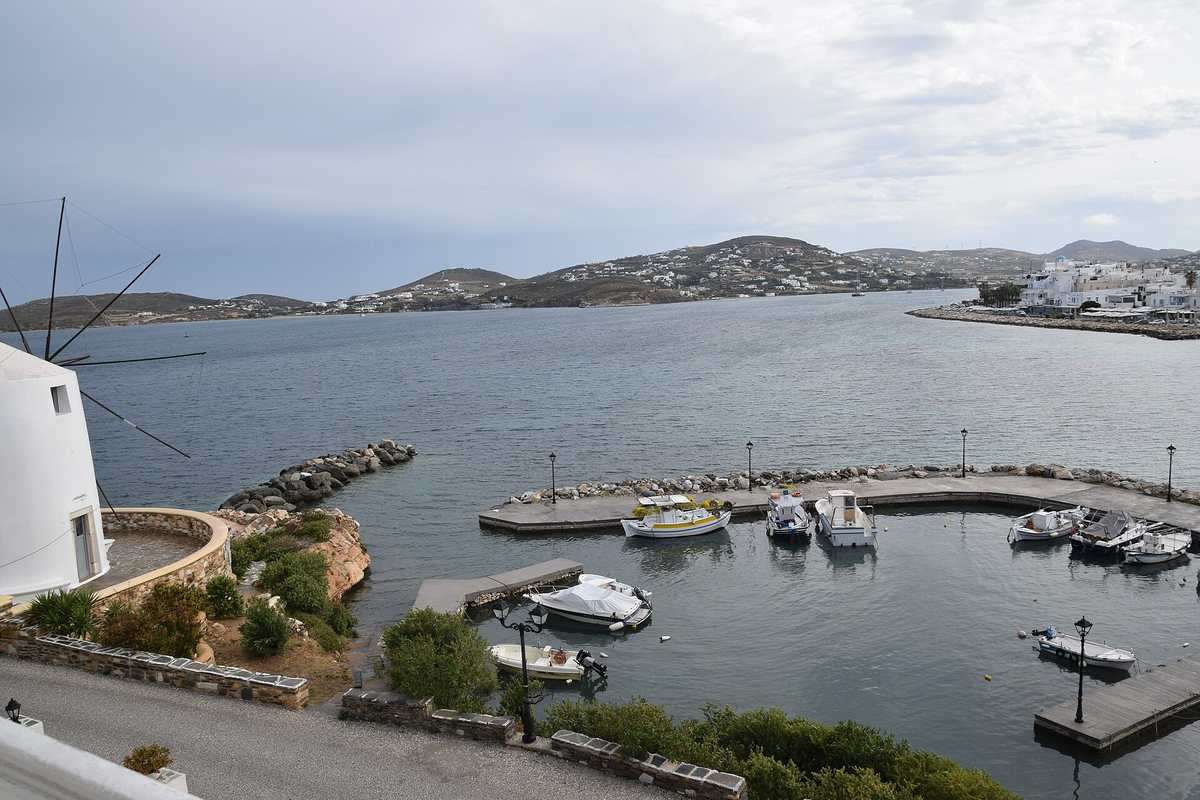
They arrive at Parikia, the capital and main port of Paros, where you step off the boat right into the town.. With its old quarter, windmill, churches, tavernas and onward transport close by. Both ports are central and convenient, with no awkward transfers, so the Milos to Paros crossing is simple and direct at each end. Knowing the ports at each end helps the journey run smoothly. On Milos, ferries depart from Adamas, the island’s main port and busy hub. Where the boat tours and the local buses also operate and where car rental offices and tavernas cluster.
Set conveniently close to the capital of Plaka, so reaching it is easy from anywhere on the island.
On Paros, the boats dock at Parikia, the island’s capital and main port, right in the heart of the town. You step off the ferry into Parikia itself.. With its whitewashed old quarter, its landmark windmill by the harbour, the great Byzantine church of Panagia Ekatontapyliani, tavernas, shops and onward buses and rentals all within easy reach. Unlike islands where the port lies far from the towns, Parikia puts you straight into the action, so there is no awkward transfer on arrival. With both ports central and convenient, the Milos to Paros crossing is simple and direct at each end, leaving only the short ferry itself to plan.
The questions below cover what travellers ask most.
For the wider trip, see the related Milos to Naxos ferry, plan your arrival with how to get to Milos. Check the best time to visit Milos, and map out a Milos itinerary.
Should you combine Milos and Paros?
Yes, Milos and Paros combine especially well, thanks to the short ferry of under two hours. They offer different experiences: Milos for its colourful volcanic beaches, sea caves and boat trips, Paros for its lively towns, sandy beaches, windsurfing and nightlife.
Paros also sits at the heart of the Cyclades ferry network, making it a handy hub for onward travel to Naxos, Mykonos or Santorini. The short crossing makes Milos and Paros an easy and rewarding pair on a longer island-hopping itinerary. Pairing Milos and Paros makes an excellent Cyclades trip, and the short, frequent ferry between them makes it one of the easiest island hops in the region. The two islands complement each other rather than repeat, so visiting both gives variety within a relaxed itinerary.
Milos is the island of colourful volcanic beaches, dramatic sea caves and boat trips to spots like Kleftiko, scenic and laid-back. Paros is livelier and more developed, with attractive towns at Parikia and Naoussa, long sandy beaches, excellent windsurfing and a busier nightlife, while keeping its Cycladic charm. A real bonus is that Paros sits at the very crossroads of the Cyclades ferry network. So it works as a hub for onward connections to Naxos, Mykonos, Santorini and beyond. This makes Milos and Paros a natural and rewarding pair, easily linked in under two hours and easily extended into a longer multi-island adventure across the Aegean. The questions below cover what travellers ask most.
A handful of practical points smooth this short hop. Even on the conventional ferry the crossing is brief, so a basic deck ticket suits most travellers, though a reserved seat is worth it on busy summer sailings. Pack a small bag with water and a light layer, keep valuables with you, and arrive in good time at Adamas, as boarding closes before departure. Because Paros is such a well-connected hub, it is easy to check onward sailings to Naxos, Mykonos or Santorini at the same time as you book the Milos leg.
The short Milos to Paros crossing makes it one of the most flexible island hops, easy to slot into a relaxed Cyclades route. Whether you take the quick catamaran or the slightly slower conventional boat, you arrive in central Parikia ready to explore.. With onward ferries to the rest of the islands close at hand.
Frequently Asked Questions
What is the ferry duration from Milos to Paros?
A SeaJets high-speed catamaran covers the route in about 1 hour 45 minutes, or roughly 2 to 3 hours on a conventional Blue Star ferry. Boats leave from the port of Adamas on Milos and arrive at Parikia, the capital of Paros. The route runs daily, more frequently in summer, with the first ferry around 7.30am and the last by mid-afternoon. It is one of the shorter Cycladic crossings, making island hopping easy.
How most is the Milos to Paros ferry?
A ticket from Milos to Paros starts around €12 to €30 on a conventional ferry, while a high-speed catamaran costs more, often €40 to €90 depending on class. Fares rise in peak summer and the cheapest seats sell out, so booking online in advance is recommended, especially in July and August. As the crossing is short and frequent, it is one of the cheaper and easier island hops from Milos.
Is Milos close to Paros?
Yes, Milos is relatively close to Paros, with a ferry crossing of under two hours on the fast boat, making it one of the shorter Cycladic hops. The two islands combine easily, with Milos offering colourful volcanic beaches and sea caves and Paros its lively towns, sandy beaches and windsurfing. Paros also sits at the heart of the Cyclades ferry network, so it is a convenient hub for onward travel to Naxos, Mykonos or Santorini.