
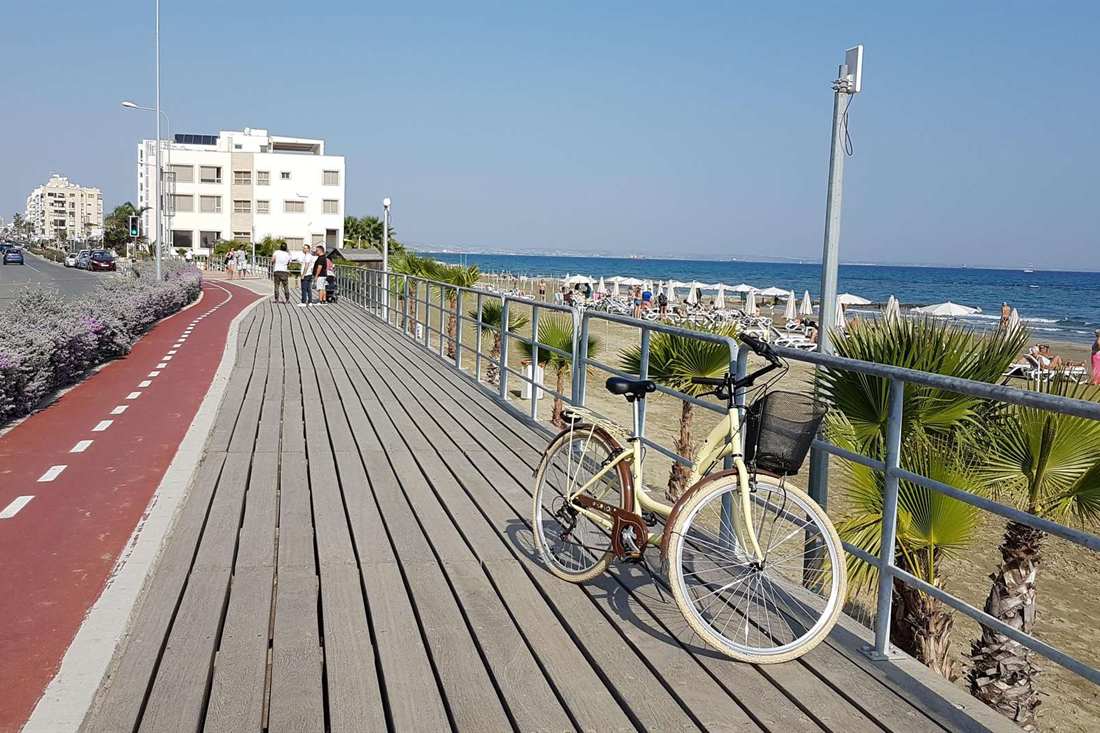
A Larnaca e-bike tour is a guided ride on two wheels past the Salt Lake, its mosque and the old town of Larnaca in Cyprus. More rides and day trips sit on our Greece Tours homepage.
The sections below answer what a Larnaca e-bike tour books, sees and needs, from the lake birds to the road rules.
What is a Larnaca e-bike tour?
On a Larnaca e-bike tour, you ride around a city on the southeast coast of Cyprus. The bicycle has an electric motor that assists the pedalling. That lets a rider cover greater distances and steeper hills without high physical effort.
Larnaca, also spelled Larnaka, is the capital of the Larnaca District. Wikipedia ranks it as the third largest city in the country, after Nicosia and Limassol. The city has a seaport and a marina. It gives its name to the primary airport of Cyprus, which stands in the neighbouring village of Dromolaxia.
Wikipedia sorts e-bikes into two groups. Pedelecs need the rider’s pedal power, and a sensor reads the pedalling speed, the force, or both. Throttle bikes run the motor from a handlebar grip, like a moped. Both groups keep the pedals, unlike electric motorcycles and e-scooters. A Larnaca e-bike tour on a pedelec keeps the rider pedalling.
The European Union sets the limits. A pedal cycle counts as electrically assisted when its motor has a continuous rated power of 250 W or less. The motor must cut off when the rider stops pedalling. It also fades out before the bike reaches 25 km/h.
Wikipedia calls this the de facto EU definition. Cyprus is an EU member state, and each member country writes the requirements into its own national legislation. A motor above 250 W that keeps pushing past 25 km/h makes an S-pedelec. Wikipedia says those bikes are sometimes classed as mopeds or motorcycles.
The same page calls the e-bike an adaptive technology for weaker, older, disabled or inexperienced riders. A University of Tennessee study cited there compared three ways of moving. Riding an e-bike took 24% less energy than a conventional bicycle and 64% less than walking. Weigh those figures when you choose between a Larnaca e-bike tour and a walk.
Which Larnaca e-bike tour can you book?
The tour you can book here is a GetYourGuide listing titled Larnaca: Salt Lake and Cultural Highlights Guided Bike Tour. It lasts 2.5 hours and runs with a guide. The listing files it under the category guided tour.
The summary on the listing names four stops. Riders cycle along the Finikoudes Promenade, visit the Medieval Castle, and see Hala Sultan Tekke and the Kamares Aqueduct. The title adds the Salt Lake. Later sections of this guide cover each stop.
The title calls it a guided bike tour, and the summary says cycle. Neither names an e-bike. Ask the operator about the bike type before you book a Larnaca e-bike tour from this listing.
The listing shows English, German and Arabic, with English as the default. The booking form takes 1 to 40 adults. Bookings close 30 minutes before the start, and the listing marks free cancellation. The rating is 4.3 stars from 4 reviews.
Three other Cyprus bike listings sit on GetYourGuide. Paphos: Forest E-Mountain Bike Tour names an e-mountain bike in its title. Nicosia: Walled City Bike Tour and Nicosia: Old Town & City Highlights Bike Ride run in Nicosia. It is the capital and largest city of Cyprus.
Of the four listings, only this one is set in Larnaca. That makes it the closest match for a Larnaca e-bike tour. For trips beyond the saddle, browse our Cyprus tours.
What does a Larnaca e-bike tour show at the Salt Lake?
A Larnaca e-bike tour reaches a network of four salt lakes to the west of Larnaca. Three of the lakes connect with each other. The complex lies just off the road to Larnaca International Airport. Wikipedia calls it a distinctive landmark of the area.
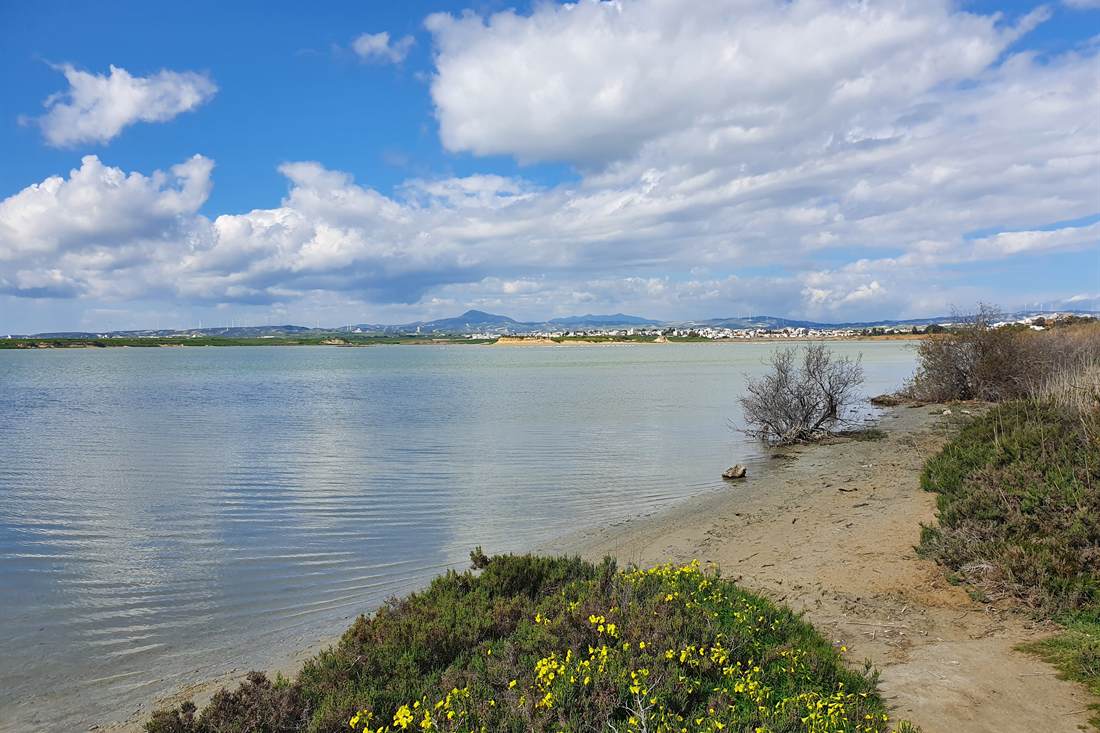
Aliki is the largest lake, and Orphani, Soros and Spiro follow in that order of size. Wikipedia gives the total water surface as 2.2 square kilometres. Only the Limassol Salt Lake is larger among the salt lakes of Cyprus. The page also names the complex as a major wetland of the island.
The look of a Larnaca e-bike tour at the lake changes with the year. In winter the lake fills with water. In summer the water evaporates. It leaves a salt crust behind, along with a grey haze of dust. Wikipedia explains the salt with seawater that seeps through the porous rock between the sea and the lake.
Four protections cover the complex that a Larnaca e-bike tour visits. It is a Ramsar wetland and a Natura site. It is also a Special Protected Area under the Barcelona Convention and an Important Bird Area. The Council of Ministers declared it a protected area in nineteen ninety-seven.
Hala Sultan Tekke stands on the west bank of the lake. Wikipedia calls it a mosque and takya, and tekke is the Turkish word for a lodge. The shrine gives a Larnaca e-bike tour a second subject beside the water. Our Larnaca tour page covers it as one stop among the town’s other sights.
The complex holds a mosque, a mausoleum, a cemetery and living quarters for men and women. An Ottoman inscription above the garden gate credits a governor of Cyprus with the building. The site is a listed Ancient Monument.
The shrine that a Larnaca e-bike tour passes honours Umm Haram, called Hala Sultan in Turkish tradition. She was the wife of Ubada bin al-Samit, a companion of Muhammad. Accounts place her death in the first Arab conquest of Cyprus, between 647 and 649. They say she fell from her mule during a siege and was buried where she died.
A large Late Bronze Age town stood to the west of the shrine. At that time the lake was open to the Mediterranean and acted as a sheltered harbour. The main export of the town was copper. It also made purple-dyed textiles, using dye from the murex sea snail. The ancient name of the town is still unknown.
Why do flamingos winter on the lake beside a Larnaca e-bike tour?
Between 2,000 and 12,000 greater flamingos spend the winter months on the Salt Lake, according to Wikipedia. They feed on the brine shrimp Artemia salina in the salty water. The lake itself fills with water in the same winter months.
The winter months bring the flamingos. The time of year therefore decides what a Larnaca e-bike tour sees on the water. The species is the greater flamingo, Phoenicopterus roseus. Wikipedia calls it the largest flamingo species, 110 to 150 centimetres tall and 2 to 4 kilograms in weight.
The lake is 1 metre deep, says the Wikipedia infobox. The greater flamingo lives in mudflats and shallow coastal lagoons with salt water. It stirs up the mud with its feet and sucks water through its bill. It filters out small shrimp, brine shrimp and other crustaceans. It feeds with its head down.
The pink colour comes from carotenoid pigments in the organisms of the feeding grounds. The wing coverts are red and the flight feathers are black. The bill is pink with a black tip, and the legs are pink. The call is a goose-like honking.
Wikipedia reports recent evidence that overturns an older belief. The greater flamingo does not only stop over at the lake. It also breeds on the wetland, so the lake beside a Larnaca e-bike tour is a nesting ground as well.
Wikipedia lists 85 species of water birds at the lake, with populations between 20,000 and 38,000. The wetland is one of the important migratory passages through Cyprus. The named species include:
- common crane
- Kentish plover
- black-headed gull
- black-winged stilt
- Eurasian stone-curlew
- spur-winged lapwing
- Cyprus wheatear
- Cyprus warbler
Birdwatchers come to the lake to see the pink flocks gather in its centre. A Larnaca e-bike tour in the winter months falls in the flamingo season on the lake.
Which town sights line a Larnaca e-bike tour?
Four sights anchor the town stretch: the Finikoudes promenade, Larnaca Castle, Saint Lazarus Church and the Kamares Aqueduct. Wikipedia names all four as Larnaca landmarks. The GetYourGuide abstract for the guided bike ride names three.
The Finikoudes promenade runs along Athenon Avenue on the seafront. Palm trees line both sides, and the name is Greek for palm trees. Wikipedia calls it the signature promenade of Larnaca. The abstract tells riders to cycle along it, so know this stop before a Larnaca e-bike tour.
Skala is the quarter that holds the promenade, the castle and the old Turkish quarter with its great mosque. The Mackenzie Beach area lies there too. The name Skala comes from a French phrase for a landing stage. A Larnaca e-bike tour inside Skala covers two of the four sights, the promenade and the castle.
Larnaca Castle stands on the southern coast and was built to defend the coast and the harbour town. In the Ottoman period the commercial port lay at Skala, the shore just south of the castle. The abstract says riders visit the Medieval Castle, so the fort is the medieval stop of a Larnaca e-bike tour.
Archaeological research points to the late 12th century for the first Byzantine fort near the harbour. After the Genoese took Famagusta, Larnaca grew into a main port of the Kingdom of Cyprus. In the late 14th century, under King James I, the small fort became a stronger castle. In the 18th century it was abandoned.
Later the building served as an artillery station and a prison. After independence it became a museum, and the Department of Antiquities owns it. The western room shows early Christian, Byzantine and post-Byzantine pieces. Byzantine wall paintings fill the central room. The eastern room holds medieval pottery, utensils and weapons. The courtyard is now an open-air theatre for 200 people.
The Church of Saint Lazarus goes back to the late 9th century and belongs to the Church of Cyprus. A Larnaca e-bike tour that adds this church reaches a building from that century. It stands over the reputed second tomb of Lazarus of Bethany. Eastern Orthodox tradition calls him the first bishop of Kition, now Larnaca.
In 890 a tomb in Larnaca was found with the words “Lazarus, four days dead, friend of Christ”. Emperor Leo VI moved the remains to Constantinople in 898. As recompense, he had the church built over the tomb.
Three aisles divide the interior of the 31.5 by 14.5 metre building. Under Frankish and Venetian rule it turned Roman Catholic, and a Gothic stone portico rose on the south side. In the first years of Ottoman rule it became a mosque. The Ottomans sold it back to the Orthodox in the late 16th century.
- The wood-carved iconostasis dates from the late 18th century.
- A fire in nineteen seventy damaged much of the interior.
- Workers found a marble sarcophagus under the altar with human remains, identified as part of the saint’s relics.
The abstract does not name the church, so confirm the stop with the operator before a Larnaca e-bike tour. Pano Lefkara, another Larnaca District site, lies on the southern slopes of the Troodos Mountains, off the Nicosia-Limassol highway. A Lefkara tour covers that village, and this page stays in town.
How does the Kamares Aqueduct fit a Larnaca e-bike tour?
The Kamares Aqueduct stands just outside Larnaca, near the old road to Limassol. Wikipedia dates it to the middle of the 18th century. It supplied the town with fresh water for nearly two centuries. The guided bike abstract tells riders to admire it.
The aqueduct has a second name, the Bekir Pasha Aqueduct, after Ebubekir Pasha. He was the Ottoman beylerbey of Cyprus and paid for it. Kamares is also the name of a Larnaca neighbourhood. On a Larnaca e-bike tour, the arches are the sight outside the town centre.
The water came from the river at Arpera. Between the overland stretches it ran through a long tunnel served by about 250 air wells. In the 19th century the British traveller Sir Samuel Baker saw that the wells sit at lower and lower levels. Gravity alone moved the water to Larnaca.
Cut stone arches carry the channel across the valley at the village of Çiftlik Paşa near Larnaca. The arches are lit at night. A Larnaca e-bike tour that stops here sees the structure that carried water to the town.
Riders on a Larnaca e-bike tour who look at the arches see one stretch of that gravity line. Ebubekir Pasha placed the water system, its fountains and wells, and a flour mill under a waqf. He established it for their upkeep. The waqf drew its income from a farm at Arpera, mulberry gardens and a vineyard.
The aqueduct was restored in two rounds in the 19th century. It stayed in active use until nineteen thirty-nine. A five-year conservation project on the Çiftlik Paşa span began in the late 20th century. These works keep the arches standing for a Larnaca e-bike tour today.
Where can you ride an e-bike along the Larnaca coast?
Larnaca has a seaport, a marina and beaches, and hire shops across the district rent e-bikes. Operators list coastal routes next to inland ones. A Larnaca e-bike tour runs on your own plan or with a guide.
Mackenzie Beach hosts a windsurfing centre and an extreme sports centre. Larnaca draws windsurfers from around the world, especially in autumn. Pick autumn if watching the sails is part of your Larnaca e-bike tour.
bFlex calls the Larnaca District a start point. The area joins coastal access, rural roads, historic villages and easy links toward the mountains. Its rentals include electric city bikes and trekking e-bikes. It says a trekking e-bike suits Tochni and the district, where roads are relaxed and climbs are gentle.
Larnaca Pro Cycle runs a shop in Larnaca close to the main airport, hotels and restaurants. It delivers hire bikes to your hotel and sets each bike to your measurements. Its page says e-bikes are available for groups, which suits a group Larnaca e-bike tour.
Online hire runs in whole days, and a pick-up and drop-off on the same day count as one day. The booking form takes up to 14 days. Longer hire goes through the shop by phone or email. Start and end times run from 9:00 am to 6:00 pm.
The shop also offers maps for riders who go out in their own group. It stays on call for any issues. A self-guided Larnaca e-bike tour can start with a map from the counter.
One e-bike on the shop’s list is the Romet Proeco Easy. Its page names a 374 Wh battery, a rear-hub motor and five assist modes, from cruising to tackling hills. The page lists seven gears and an aluminium frame.
Activate Cyprus runs an eight-day coast tour on electric assist bicycles. A private driver collects guests at the airport and takes them to Tochni, a village in the Larnaca region. Day three runs 37 km along the coast with 270 m of total ascent. The group passes the Neolithic site of Tenta and reaches Amathous after 25 km.
Riders who want an engine instead of a pedal motor can compare the Larnaca quad tour on our site.
When is a Larnaca e-bike tour cooler to ride?
A Larnaca e-bike tour runs coolest from December to March, when daily highs average 17.1 to 19.9 degrees Celsius. June to September climb to 30.6 to 33.3 degrees, according to the airport figures in Wikipedia’s Larnaca article.
April and November sit between the seasons, with average highs of 23.0 and 23.3 degrees. Late spring reaches 27.0 degrees, and October reaches 28.3 degrees. A Larnaca e-bike tour in those months meets highs between 23.0 and 28.3 degrees.
July averages a high of 33.0 degrees and August averages 33.3. The record high for June is 41.5 degrees, which is also the record for the whole year. Average lows hold at 22.6 degrees in July and 23.0 degrees in August.
A Larnaca e-bike tour meets 3,348 hours of sunshine in an average year. July holds the top monthly total at 394.4 hours. December holds the lowest at 177.1 hours, and January follows with 181.4 hours.
Humidity runs lowest in October at 60 percent. It runs highest in December and January at 72 percent. The yearly average is 66 percent.
Winter brings the rain. December averages 95.4 mm, January 83.2 mm and February 47.4 mm, the three heaviest months of the year. A winter Larnaca e-bike tour meets that rain, while July averages 0.7 mm and August only 0.4 mm.
The Activate Cyprus coast tour lists March to June and September to December as its touring periods. In the airport table, the highs for those months run from 18.9 degrees in December to 31.4 degrees in September. Use that spread when you choose the month for a Larnaca e-bike tour.
Who can ride on a Larnaca e-bike tour?
Adults aged 70 and younger can book the guided Salt Lake and cultural highlights ride. The GetYourGuide booking widget sells one ticket type, Adult, and a note under it sets the upper age. It shows no child ticket.
The widget labels the Adult ticket “Age 70 and younger”. Its note adds that ages older than 71 are not permitted. The two lines leave age 71 open. A 71-year-old rider needs to ask the operator before booking a Larnaca e-bike tour.
Families with children need to ask the operator before they book, because the widget offers an Adult ticket only. ListNRide, a booking site for Cyprus bike tours, asks for each rider’s height at checkout. The provider then sets up one bike in the right frame size in advance.
ListNRide rates its Viator listing named Larnaca Salt Lake and Cultural Highlights Bike Tour as easy. bFlex says beginners can rent electric city bikes or trekking e-bikes for easier routes. It adds that a guided tour suits beginners because the route can be matched to the rider’s level.
A Cyprus visitor guide on Politis names the groups that feel heat harder. They are older people, young children, pregnant women, and people with heart, respiratory or other long-term conditions.
In a heatwave advisory, the Health Ministry told people with chronic illnesses to consult their doctor about specific measures. It named respiratory and cardiovascular conditions as examples. Ask a doctor before a Larnaca e-bike tour if that describes you.
Which road rules and gear apply on a Larnaca e-bike tour?
Cyprus drives on the left, and its law makes a helmet mandatory for every cyclist. Wikipedia counts Cyprus among five countries that require and enforce helmets for all cyclists. Add a hat, sunglasses, sunscreen and water to the kit.
Three EU members, Cyprus among them, keep traffic on the left, Wikipedia says. The Cyprus Police tell cyclists to stay on the left side of the road. The same advice asks cyclists to obey the Road Traffic Code, signs and traffic lights. It also asks them to use bicycle lanes wherever these are available.
Wikipedia notes that the EU rule for this bike class asks for no helmet. Cyprus goes further: Wikipedia lists its helmet rule as mandatory for everyone. Cyprus Mail reports that cyclists on park paths, such as the Grammiko in the capital, are fined without a helmet. Ask the operator which helmet comes with a Larnaca e-bike tour.
For a Larnaca e-bike tour, the police advice for cyclists lists a protective helmet, light-coloured clothes and a reflective vest. It also asks for front and rear lights that are switched on. The aim is that passing drivers see you, especially at night and in the early morning.
Dress for a Larnaca e-bike tour in light, loose-fitting, pale clothes made from natural materials, as the Health Ministry advises. It adds a hat, sunglasses and sunscreen. A Politis visitor guide says sunscreen is important but not the only protection against the Cyprus sun.
Bring water to a Larnaca e-bike tour. The Politis guide tells visitors to carry water when they leave their hotel or apartment. It says to drink small amounts regularly instead of waiting for strong thirst. The Health Ministry asks for plenty of fluids all day, thirsty or not.
What do riders ask before a Larnaca e-bike tour?
Riders ask six things: the helmet, drivers, sunscreen, the breeze, heat signs and alcohol. Each answer below comes from the Cyprus Police, the Health Ministry, ListNRide or the Politis visitor guide.
Does a Larnaca e-bike tour include a helmet?
ListNRide states that bike, helmet and basic protection are included in the tour price on its Cyprus bike tours. Check the inclusion list on the booking page of the tour you pick.
How must drivers treat cyclists on a Larnaca e-bike tour?
The Cyprus Police tell drivers to approach and overtake cyclists carefully and to keep appropriate distances. Overtaking on a turn is prohibited. So is overtaking when the driver is not sure it is safe.
Which spots do riders miss with sunscreen?
The Politis guide names the ears, neck, shoulders, feet and the backs of the legs. It says to apply sunscreen before going outside and to reapply it after swimming, sweating or using a towel.
Does a breeze on the bike keep the heat away?
A breeze hides the heat. The Politis guide says a light breeze can make the heat seem less serious than it is. It names tiredness, dizziness, headache and nausea as what the heat can bring on.
What are the signs of heat exhaustion?
The Health Ministry lists a severe headache, dry mouth, intense thirst, weakness, extreme fatigue, dizziness and faintness. Stop a Larnaca e-bike tour at these signs. Move the rider to a cool or shaded area and give water if they are conscious. Call 112 if symptoms worsen or heatstroke is suspected.
Can alcohol wait until after a Larnaca e-bike tour?
Yes. The Politis guide says alcohol can worsen dehydration and make it harder to notice when the body struggles. The Health Ministry asks people to avoid excessive alcohol and highly caffeinated drinks.