
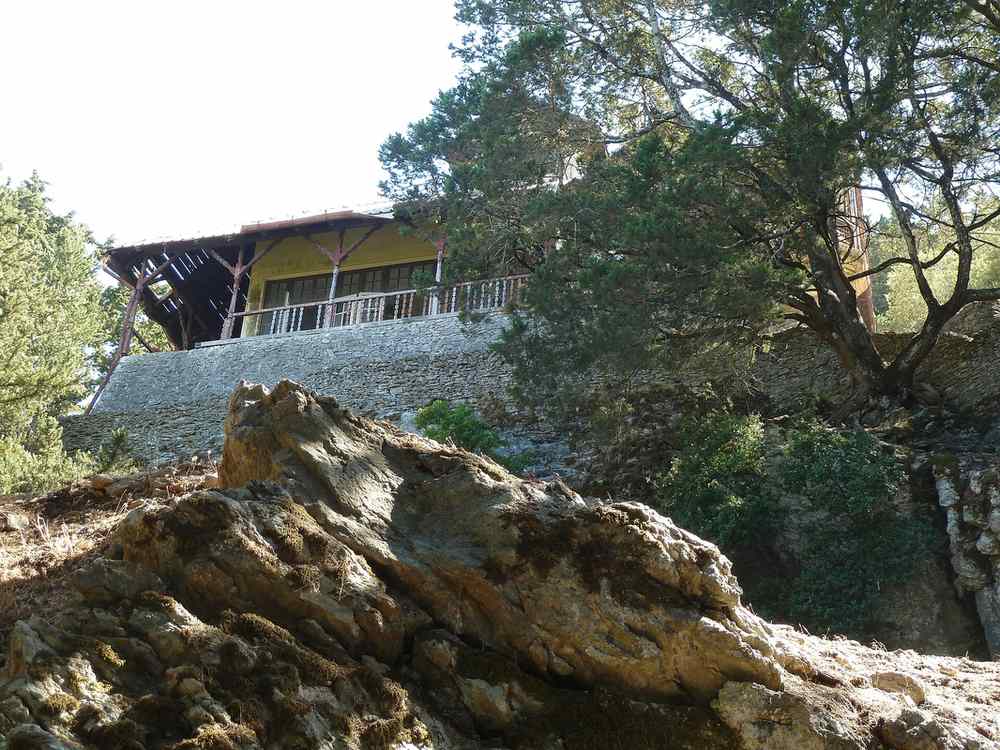
Eleousa is one of the most atmospheric and least-commercialised places in the interior of Rhodes, a semi-abandoned model village set among the pine forests of the north-central highlands. It was built during the Italian occupation of the Dodecanese as a planned farming settlement called Campochiaro, and its grand rationalist public buildings, now weathered and partly decaying, still ring a wide central square. A large circular ornamental stone fountain sits at the heart of the village, sheltering the rare endemic Gizani freshwater fish, while a small chapel stands nearby beneath the slopes of Profitis Ilias. The setting is quiet, green and intensely photogenic, far from the coastal resorts most visitors know. You can reach it easily by hire car, and you can plan the wider trip with My Greece Tours.
Eleousa rewards travellers who want history, nature and atmosphere rather than beaches, and it pairs naturally with the highland sights of inner Rhodes covered in our Rhodes travel guide. The sections below cover what Eleousa actually is and its Campochiaro origins, the rationalist architecture you will see around the square, the Gizani fish and the fountain ecosystem, how to reach the village and combine it with nearby sights, and practical advice for a rewarding, respectful visit.
What is Eleousa in Rhodes and why was it built?
Eleousa is a semi-abandoned model village in the wooded highlands of north-central Rhodes, founded during the Italian occupation as a planned agricultural colony named Campochiaro. It was designed to settle farming families on the fertile uplands, and its formal civic core still survives, though much of it now stands quiet and decaying.
The village belongs to a wider story of how the Italian administration reshaped rural Rhodes, draining and cultivating the interior and establishing organised settlements to anchor a farming population in the hills. Campochiaro was conceived as a complete community rather than a hamlet that grew by accident, so it was given a square, public buildings, a fountain and a clear geometric plan from the outset. That intent is exactly what makes Eleousa so striking today, because you are not looking at an ordinary Greek village that emptied gradually but at an entire designed settlement whose original purpose faded once the occupation ended and the surrounding economy changed.
Walking through Eleousa now, you sense both ambition and abandonment in the same breath, as imposing facades face an empty plaza shaded by tall trees. A handful of residents and seasonal visitors keep parts of it alive, yet the dominant mood is one of gentle, melancholic decay that photographers and history-minded travellers find irresistible. Understanding the Campochiaro origin helps you read every building you pass, from the scale of the square to the deliberate symmetry of the layout. Our guide to things to do in Rhodes covers how this inland heritage fits the wider island, and the next section covers the architecture around the square.
What does the architecture around the Eleousa square look like?
The square at Eleousa is framed by large public buildings in the Italian rationalist and colonial idiom, with clean lines, symmetrical facades and once-formal proportions. Today they are weathered, shuttered and partly ruined, their plaster cracked and windows empty, which gives the whole ensemble a haunting, cinematic quality.
These structures were built to project order and permanence, the architectural language the Italian administration used across the Dodecanese to signal a modern, governed landscape. At Eleousa that vocabulary appears in the long horizontal massing of the civic blocks, the regular rhythm of openings and the way the buildings address a single central space rather than a winding street. Even in decay the design reads clearly, and you can still make out the intended hierarchy of the village core, with the most prominent facades commanding the plaza. The contrast between the confident geometry and the creeping damage is precisely what makes the place so memorable to wander.
Because the buildings are largely unrestored, the experience is raw and unmediated, with no ticket booths or barriers separating you from the fabric of the settlement. You can stand in the empty square, look up at the faded grandeur and imagine the working community it was meant to house. Light filtering through the surrounding pines changes the mood through the day, and early morning or late afternoon flatter the textures of stone and peeling render. Our guide to nearby Psinthos covers another inland village with a very different, livelier character, and the next section covers the fountain and its rare resident fish.
What is the round fountain and the Gizani fish at Eleousa?
At the centre of Eleousa stands a large circular ornamental stone fountain, or pond, built as part of the original village plan. It is best known today as a refuge for the Gizani, a small endemic freshwater fish found only on Rhodes, which makes the basin a genuinely important little wildlife habitat.
The Gizani is a protected species native to the island’s streams and springs, and its presence in the Eleousa fountain turns an ornamental feature into something rare and significant. The fish is small and unobtrusive, so you will need to watch the calm water patiently to spot it, but knowing that this modest pool shelters a creature found nowhere else on Earth changes how you see the village entirely. The fountain also reflects the surrounding buildings and trees, giving photographers a natural focal point and underlining how thoughtfully the original square was composed around water as well as architecture.
Because the Gizani is vulnerable, the fountain is a place to observe gently rather than disturb, and you should never introduce anything to the water or attempt to handle the fish. The combination of a designed civic basin and a protected endemic species captures Eleousa’s twin appeal of human history and quiet natural value in a single spot. It is also a reminder that the highland interior of Rhodes holds ecological treasures alongside its monuments. Our guide to the famous Valley of the Butterflies covers another fragile inland habitat worth respecting, and the next section covers how to reach Eleousa and link it with nearby sights.
How do you get to Eleousa and what is nearby?
Eleousa sits in the forested hills of north-central Rhodes and is realistically reached only by car, as public transport is sparse in the interior. The drive through the pines is part of the pleasure, and the village pairs easily with several major highland attractions within a short distance.
A hire car gives you the freedom to follow the winding inland roads at your own pace, and Eleousa makes an excellent anchor for a day exploring the green heart of the island. The village lies on the wooded slopes below the island’s highest peaks, so the approach itself feels remote and scenic, with shade and birdsong replacing the coastal glare. There is no entrance fee and you are free to wander the square and lanes, which means you can arrive flexibly and stay as long as the light and your curiosity hold. Bring water and sensible shoes, since facilities in the village are very limited.
Eleousa’s location makes it ideal for combining with the surrounding sights into one satisfying loop through the uplands. The towering peak of Profitis Ilias rises just above the village, while the lush oasis of the springs lies a short drive away and the celebrated butterfly gorge is also within easy reach. Our guide to Mount Profitis Ilias covers the forested summit area above Eleousa, and the next section covers practical advice for making the most of your visit.
What practical tips help you enjoy a visit to Eleousa?
Eleousa is free, unguarded and atmospheric, so the best visits combine respect for a fragile place with a relaxed, unhurried mindset. Go early or late for the finest light, tread carefully around the decaying buildings, and treat the fountain and its endemic fish as the protected habitat they are.
Because the public buildings are unrestored and partly ruined, you should admire them from sensible distances rather than entering unstable structures, both for your own safety and to avoid further damage. The village is quiet and largely uncommercial, so do not expect shops, cafes or facilities on the scale of the coast, and plan to bring what you need. The mood is contemplative, and travellers who slow down to absorb the silence, the pines and the faded grandeur come away far more rewarded than those who rush through for a single photograph. Photographers in particular should allow extra time for changing light across the square.
Eleousa works best as one stop in a thoughtful day through the interior, paired with the forest, springs and gorge that surround it, and it suits travellers who value heritage and nature over nightlife. Combining it with nearby highland sights turns a brief curiosity into a memorable half-day or full day in the green heart of Rhodes. Our guide to the Seven Springs covers the shaded oasis nearby that pairs perfectly with Eleousa. Plan your visit and tours through our Rhodes travel guide.
Frequently Asked Questions
Is Eleousa in Rhodes worth visiting?
Eleousa is well worth visiting for travellers who enjoy history, atmosphere and quiet natural beauty rather than beaches and resorts. It offers a rare combination of attractions in one small place, including the planned Italian-era origins of the Campochiaro settlement, imposing rationalist public buildings in evocative decay, a large ornamental fountain that shelters the endemic Gizani fish, and a serene pine-forest setting in the highland interior. The village is free to wander and never crowded, which gives it a contemplative, almost cinematic quality that photographers and curious travellers find unforgettable. Because it sits close to Mount Profitis Ilias, the Seven Springs and the Valley of the Butterflies, it slots naturally into a wider day exploring the green heart of the island. If your idea of a good trip includes heritage, nature and a sense of discovery away from the tourist crowds, Eleousa earns its place on your itinerary.
What is the Gizani fish and why does it matter?
The Gizani is a small freshwater fish that is endemic to Rhodes, meaning it lives naturally nowhere else in the world. It inhabits the island’s streams, springs and pools, and a population survives in the large circular fountain at the centre of Eleousa, which turns an ornamental basin into a genuinely valuable habitat. As a protected species, the Gizani is vulnerable to changes in water quality, habitat loss and disturbance, so its presence makes Eleousa a place to observe with care rather than interfere with. Visitors should watch the calm water patiently to glimpse the fish, never introduce anything to the pool, and never attempt to handle or feed the animals. The Gizani is a quiet symbol of how the highland interior of Rhodes holds ecological treasures alongside its built heritage, and respecting it is part of visiting Eleousa responsibly. Seeing a creature unique to this single island gives the modest fountain a significance far beyond its size.
How do you reach Eleousa and what should you bring?
Eleousa lies in the forested hills of north-central Rhodes, and the practical way to reach it is by hire car, since public transport through the interior is limited and infrequent. The drive itself, winding up through pine forest below the island’s highest peaks, is part of the experience and feels pleasantly remote compared with the busy coast. There is no entrance fee and no ticket office, so you can arrive when it suits you and wander the square and lanes freely. Because facilities in the village are very limited, you should bring water, sensible walking shoes, sun protection and anything else you might need for a few hours away from shops and cafes. It is best to admire the decaying buildings from safe distances rather than entering unstable structures. Combining Eleousa with nearby Mount Profitis Ilias, the Seven Springs and the Valley of the Butterflies makes a rewarding loop through the green highland interior of Rhodes.