
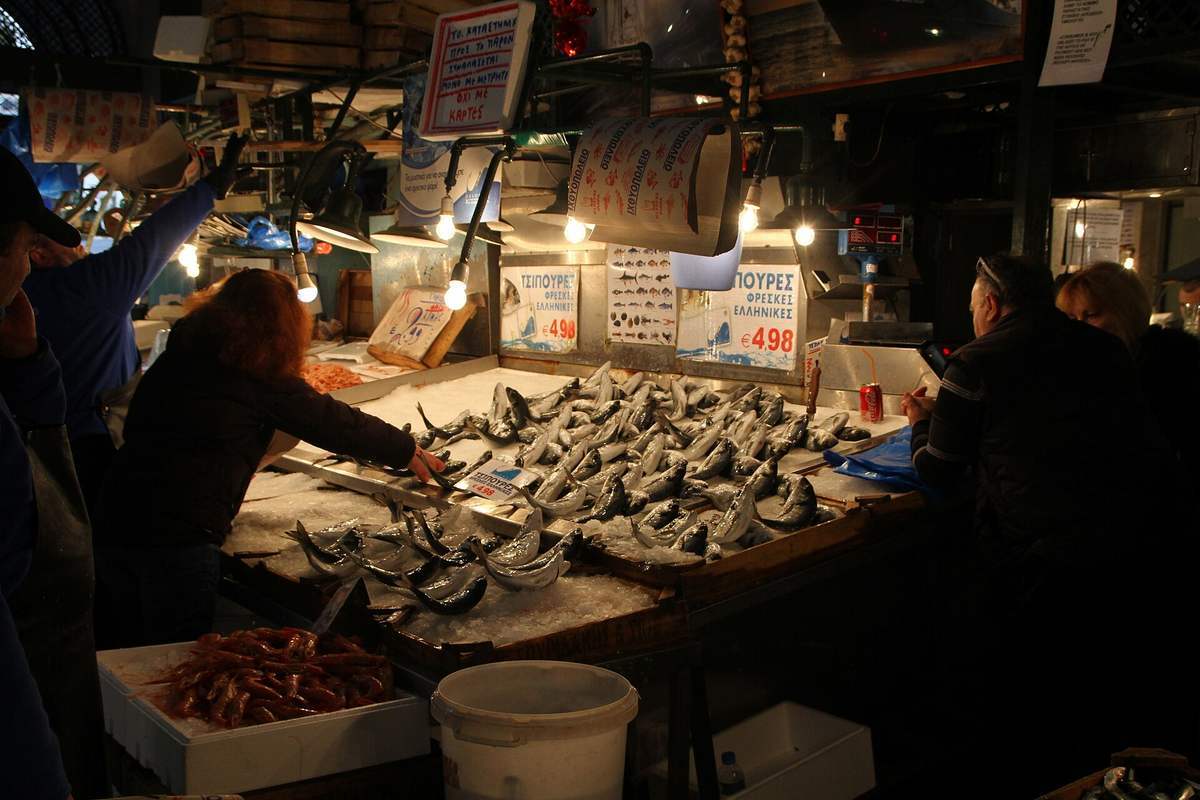
The Central Market of Athens, the Varvakeios Agora on Athinas Street, is a vibrant, historic food market of shouting fishmongers, butchers, spice shops and old tavernas, a feast for the senses. Plunge into authentic Athens alongside skip-the-line sightseeing tickets and tours from My Greece Tours.
This sensory landmark is an authentic highlight of the Athens travel guide. The sections below cover what the market is, its history, the fish, meat and produce halls, the spice and grocery streets, the historic tavernas, and how to visit.
What is the Central Market of Athens?
The Central Market of Athens, known as the Varvakeios Agora, is the city’s great central food market, a bustling, historic complex on Athinas Street between Omonia and Monastiraki. It comprises a covered meat hall, a vast fish market plus an open-air fruit and vegetable section, surrounded by streets of spice, nut and grocery shops. Loud, colourful and authentic, it has fed Athens since 1886 and is a thrilling sensory experience for food lovers.
For travellers seeking the authentic, beating heart of everyday Athens, far removed from the polished tourist sites, the Central Market is an unmissable and exhilarating experience. Officially the Varvakeios Agora, and also called the Varvakios, it is the great central food market of the city, a large and historic complex straddling the busy Athinas Street that runs between Omonia Square and Monastiraki, right in the centre. The market is organised into distinct sections: a grand covered hall housing the meat market, the kreatagora, with its rows of butchers; an enormous fish market, the psaragora, at its heart, packed with fishmongers; plus an open-air fruit and vegetable section, the lachanagora, nearby, while the surrounding streets are crammed with shops selling spices, nuts, cheeses, herbs and groceries.
Loud, crowded, pungent and utterly authentic, alive with the shouts of vendors and the bustle of shoppers, the market has fed the people of Athens continuously since the 1880s and remains a genuine working market rather than a tourist attraction. For food lovers and the curious, a visit is a thrilling immersion in the real life of the city. It is Athens with its apron on. Its long history adds depth to the spectacle.
What is the history of the Varvakeios market?
The Varvakeios Central Market has operated continuously since 1886, when its handsome market building was completed, replacing earlier makeshift markets. It is named after Ioannis Varvakis, a great 18th to 19th-century national benefactor of Greece. For well over a century it has been the place where Athenians from every suburb come to buy the best meat, fish, cheese and spices, making it a living institution woven into the daily and culinary life of the city.
The Central Market carries a rich history that adds to its atmosphere, having served the city for well over a century in the same location. The market building was constructed in the 1870s and 1880s and opened for business in 1886, replacing the earlier, more makeshift trading places, including a warren of wooden stalls that had grown up among the ancient ruins until a fire destroyed them, giving Athens at last a proper, purpose-built central market. It takes its name, Varvakeios, from Ioannis Varvakis, a celebrated merchant, patriot and one of the great national benefactors of Greece in the late eighteenth and early nineteenth centuries, whose legacy funded public works in the young nation.
Since its opening, the market has been a cornerstone of Athenian life, the place to which generations of Athenians have travelled from every corner and suburb of the city to stock up on the freshest fish, the best cuts of meat, cured delicacies, cheeses, herbs and spices, and to grab a bite in its tavernas. This continuity of more than a hundred and thirty years makes the market a living institution, deeply woven into the daily rhythm and culinary identity of Athens. It is history you can taste and smell. The fish market is its dramatic centre.
What are the fish, meat and produce halls like?
The heart of the market is the spectacular fish hall, where dozens of fishmongers display glistening fresh fish, octopus, prawns and seafood on beds of ice amid lively shouting and haggling. The adjoining meat hall is a dramatic sight of hanging carcasses and butchers at work, while the open-air fruit and vegetable market nearby overflows with colourful seasonal produce. Together these halls offer an intense, vivid and unforgettable feast for all the senses.
The core of the Central Market experience lies in its great halls, each a vivid spectacle in its own right. Most dramatic is the fish market, the psaragora, which forms the bustling heart of the complex, where dozens upon dozens of fishmongers preside over long marble slabs piled high with glistening fresh fish, octopus, squid, prawns, mussels and every kind of seafood laid out on crushed ice, the air filled with the smell of the sea and the energetic cries of vendors calling out their prices and haggling with customers; it is loud, wet, theatrical and thrilling. Adjoining it, the covered meat market, the kreatagora, presents an equally dramatic, if not for the squeamish, sight of whole carcasses hanging from hooks and skilled butchers cleaving and trimming at their blocks, a scene unchanged for generations.
Just outside, the open-air fruit and vegetable market, the lachanagora, offers a gentler but no less colourful display, with stalls overflowing with seasonal produce, fruits, vegetables, olives and greens, bright and fragrant. Wandering between these halls, assailed by colour, sound and aroma, is an intense and unforgettable sensory journey into the real Athens. It is raw, vivid and alive. The surrounding streets add aromatic riches.
What can you buy in the spice and grocery streets?
The streets around the market, especially Evripidou Street, are lined with wonderful traditional shops selling spices, herbs, nuts, dried fruits, teas, cheeses, olives and Greek delicacies. Evripidou is famous for its cured meats like pastourma and sujuk, and for its heady aromas of spices. These atmospheric old grocers and delis are perfect for buying authentic Greek and Eastern Mediterranean flavours and edible souvenirs to take home, deepening the market experience.
The Central Market does not end at the halls, for the warren of streets surrounding it, above all the celebrated Evripidou Street, forms an aromatic extension of the market that is a delight to explore and a treasure trove for food shopping. Evripidou in particular is famous throughout the city as the street of spices, its old-fashioned shops spilling over with sacks and jars of colourful spices, dried herbs, teas, nuts, dried fruits and pulses, filling the air with an intoxicating, exotic fragrance that transports you across the Eastern Mediterranean. The same streets are renowned for their traditional delicatessens and grocers selling cured and smoked meats, especially the spiced, garlicky pastourma and the sausage-like sujuk, a legacy of the Asia Minor culinary tradition, alongside a wonderful array of Greek cheeses, olives, honey, herbs and other delicacies.
These characterful, often family-run old shops are the perfect place to buy authentic Greek flavours and edible souvenirs to carry home, from a bag of Greek mountain tea to a wedge of cheese or a packet of saffron. They round out the market beautifully. After all this, you will be hungry. The market’s tavernas are legendary.
What are the historic market tavernas like?
Hidden within and around the Central Market are some of the oldest and most authentic tavernas in Athens, traditionally serving the market workers and night owls around the clock. They are famous for hearty, no-frills Greek fare, above all patsas, a restorative tripe soup, alongside grilled meats, stews and mezedes. Eating in these atmospheric, well-worn institutions, surrounded by the market’s bustle, is a genuine and memorable taste of old Athenian life.
One of the great rewards of a visit to the Central Market is the chance to eat in its legendary tavernas, some of the oldest, most authentic and most characterful eating houses in all of Athens, tucked into and around the market halls. Traditionally these tavernas served the market’s army of porters, butchers, fishmongers and traders, as well as late-night revellers, and several kept long or even round-the-clock hours to feed them, giving them a unique, timeless atmosphere far from any tourist polish. Their signature dish, and a true Athenian institution, is patsas, a rich, restorative tripe soup traditionally eaten to revive the body, often in the small hours, and reputed to cure a hangover, a recipe with roots in the Eastern tradition brought by the Asia Minor refugees.
Alongside it, these tavernas dish up hearty, honest, no-nonsense Greek cooking, from grilled and roasted meats to comforting stews, pulses and mezedes, washed down with wine. To sit and eat in one of these well-worn old institutions, the famous Ipiros among them, surrounded by the noise and bustle of the market, is to step into another era and savour the genuine soul of old Athens. It is dining as living history. Visiting the market is easy and central.
How do you visit the Central Market?
The Central Market lies on Athinas Street between Omonia and Monastiraki, a short walk from both metro stations on lines 1, 2 and 3. It is open daily except Sunday, from early morning until late afternoon, and is busiest and most atmospheric in the morning. Entry is free. Wear comfortable shoes, watch your belongings in the crowds, and come hungry. It combines easily with a walk through Psiri, Monastiraki and the central streets.
Visiting the Central Market is easy, free and rewarding, and it sits right in the heart of the city within a short walk of the main sights. The market stretches along Athinas Street, the broad avenue linking Omonia Square to the north with Monastiraki Square and the Acropolis view to the south, so it is reachable in just a few minutes on foot from the Omonia or Monastiraki metro stations, served by lines 1, 2 and 3, placing it conveniently on any central walking route. The market is open daily except Sunday, generally from early in the morning until the late afternoon, and it is at its busiest, liveliest and most atmospheric in the morning hours when the trading is in full swing, so an early visit is best.
Entry costs nothing, and you are free to wander the halls and streets soaking up the spectacle. A few practical tips help: wear comfortable, closed shoes as the fish market floors can be wet, keep an eye on your bag and valuables in the dense crowds, and come with an appetite to enjoy the tavernas and the food shopping. The market combines naturally with a stroll through nearby Psiri, Monastiraki and the central streets. The surrounding neighbourhood is part of the Psiri guide. The questions below cover the points visitors ask most.
Frequently Asked Questions
What is the Varvakeios market in Athens?
The Varvakeios Agora is the Central Market of Athens, the city’s great historic food market on Athinas Street between Omonia and Monastiraki. Open since 1886, it comprises a covered meat hall, a vast fish market plus an open-air fruit and vegetable section, surrounded by spice and grocery streets and famous old tavernas. It is a vivid, authentic sensory experience for food lovers.
Is the Athens Central Market worth visiting?
Yes, the Central Market is well worth visiting for an authentic taste of everyday Athens. Its dramatic fish and meat halls, colourful produce stalls, aromatic spice streets and legendary old tavernas serving dishes like patsas tripe soup offer a thrilling, free sensory experience far from the tourist trail, ideal for food lovers and the curious. It is busiest and best in the morning.
When is the Central Market of Athens open?
The Central Market of Athens, the Varvakeios, is open daily except Sunday, generally from early in the morning until the late afternoon. It is busiest, liveliest and most atmospheric in the morning, when the trading is in full swing, so an early visit is recommended. Entry is free, and it lies centrally on Athinas Street between the Omonia and Monastiraki metro stations.