
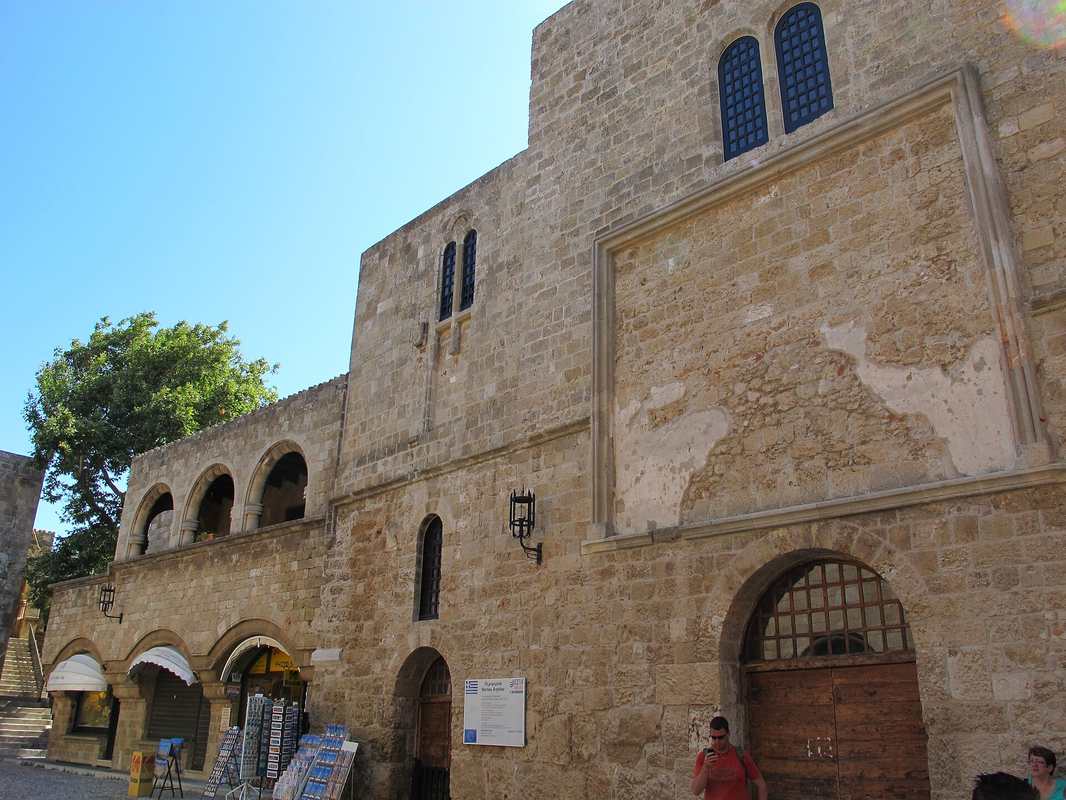
The Byzantine Museum of Rhodes occupies one of the most storied buildings in the walled Old Town: the medieval church of Panagia tou Kastrou, Our Lady of the Castle. This is the oldest and largest Byzantine church surviving inside the fortifications, and its stone shell has carried the town’s changing faiths for centuries, standing in the Collachium, the inner quarter that the Knights of Saint John reserved for themselves near the harbour gates. Inside, the museum gathers Byzantine and post-Byzantine religious art drawn from churches across Rhodes and the wider Dodecanese, so that a single Gothic-vaulted room speaks for the sacred art of a whole archipelago. It is a small, atmospheric, ticketed collection where the building itself is arguably the largest exhibit. This guide is published by My Greece Tours.
The museum sits within easy reach of the other headline monuments of the medieval quarter, so it pairs naturally with a wider walk through the Rhodes travel guide and its clustered attractions. The sections below cover the building and its layered history, the collection of icons and detached wall paintings, the Gothic-vaulted interior, the museum’s place in the Collachium, and the practicalities of planning a visit around it.
What is the Byzantine Museum of Rhodes housed in?
The Byzantine Museum of Rhodes is housed in the medieval church of Panagia tou Kastrou, Our Lady of the Castle. It is the oldest and largest Byzantine church in the Old Town, a substantial stone structure whose walls and vaults now frame a collection of sacred art rather than an active congregation.
The choice of building is not incidental. Panagia tou Kastrou was raised as a Byzantine church, the principal Orthodox place of worship inside the citadel, and its scale reflected that standing. When you step through the door you are entering a monument that predates most of what surrounds it, a survivor of the era before the Knights of Saint John reshaped the town in their own image. The museum uses the nave, aisles and vaulting as its galleries, so the exhibits are read against masonry that is itself many centuries old. The effect is that the container and the contents belong to the same world of Byzantine and post-Byzantine devotion, each explaining the other.
This layering makes the museum a natural first stop before the grander secular monuments nearby. Our guide to Rhodes Old Town covers the walls, gates and cobbled lanes that enclose the church, and the next section covers the building’s remarkable sequence of faiths, from Orthodox church to Catholic cathedral to Ottoman mosque and finally to museum.
How did the building change through Byzantine, Knights and Ottoman rule?
The building passed through three religions before becoming a museum. It began as the Byzantine Orthodox church of Panagia tou Kastrou, was converted into the Catholic cathedral of the Knights of Saint John, and later served as a mosque under Ottoman rule, each era leaving marks on its fabric.
Few monuments carry their history so legibly. Under the Knights the Orthodox church was adopted as the Latin cathedral of the town, and Gothic vaulting was introduced to suit western liturgy and taste, giving the interior the pointed, ribbed character it still shows. When Ottoman rule followed, the cathedral was turned into a mosque, and the building absorbed yet another set of adaptations. Each conversion added rather than erased, so today the walls read as a palimpsest of Orthodox, Catholic and Islamic use. That is why the structure is treated as an exhibit in its own right: it records, in stone, the successive powers that governed the Old Town and the sacred purposes they gave to a single space.
Understanding this sequence helps make sense of the whole Knights’ quarter, where the same military order that ran the town also reshaped its churches. Our guide to the Palace of the Grand Master covers the fortress-residence at the head of the same quarter, and the next section covers the collection of icons and detached wall paintings that the museum has gathered inside these much-altered walls.
What icons and frescoes does the collection contain?
The collection is devoted to Byzantine and post-Byzantine religious art: painted icons and detached wall paintings, or frescoes, lifted from churches across Rhodes and the wider Dodecanese. These works span the Orthodox devotional tradition of the islands and are displayed against the church’s own historic interior.
The heart of the museum is its sacred painting. Panel icons show the saints, feasts and Virgin-and-Child compositions of the Orthodox tradition, worked in the gold-ground manner that carried on long after the Byzantine period into what scholars call post-Byzantine art. Alongside them hang detached wall paintings, frescoes carefully removed from the plaster of churches elsewhere on Rhodes and the neighbouring Dodecanese islands and remounted for display. Bringing these fragments together allows a single small museum to represent the religious art of a scattered archipelago, rescuing images that might otherwise have decayed in remote or ruined chapels. The result is intimate rather than encyclopaedic, a concentrated survey of island piety rather than a vast national gallery.
This religious collection is a useful counterpoint to the town’s other museum of antiquities. Our guide to the Archaeological Museum of Rhodes covers the ancient and classical finds displayed in the medieval Hospital of the Knights, and the next section covers the Gothic-vaulted interior that gives the Byzantine Museum its distinctive character.
Why is the Gothic-vaulted interior worth seeing in itself?
The interior is worth seeing because its Gothic vaulting, added when the church became the Knights’ Catholic cathedral, blends western medieval architecture with an originally Byzantine church. The pointed, ribbed ceilings create an atmospheric shell that frames the icons and frescoes and rewards looking upward as much as at the walls.
Many visitors remember the space as much as the exhibits. The ribbed Gothic vaults spring from the older Byzantine structure, so the eye reads two architectural languages at once: the massing of an Orthodox church and the soaring, pointed geometry the western Knights preferred. Light falls into the aisles in a subdued, devotional way, and the stone surfaces carry the wear of centuries of changing use. Because the museum is small, you can take time with the architecture without the crowds of the larger sites, tracing how the vaulting was fitted to the earlier walls. The building rewards a slow circuit, head tilted back, as much as a study of the paintings hung within it.
The interior also sets the museum apart from the ceremonial, secular grandeur elsewhere in the quarter. Our guide to the Street of the Knights covers the famous inn-lined avenue that climbs through the Collachium, and the next section covers the museum’s location near the harbour gates and how to fit a visit into a day in the Old Town.
Where is the museum and how do you plan a visit?
The Byzantine Museum stands in the Collachium, the Knights’ inner quarter of the Old Town, near the harbour gates and within a short walk of the Palace of the Grand Master and the Street of the Knights. It is a small ticketed museum, so check current opening hours before you go.
The location makes the museum easy to string into a wider day. The Collachium was the quarter the Knights kept for their own administrative and religious buildings, and Panagia tou Kastrou sits among them near the gates that open toward the harbour, so you can reach it soon after entering the walled town. Because the collection is compact, a visit need not take long, which makes it a natural pairing with the grander monuments a few minutes’ walk away rather than a full morning on its own. Signage inside explains the building’s history and the paintings, and the atmosphere rewards an unhurried look even when time is short. Treat it as one considered stop on a route through the medieval streets rather than a destination in isolation.
As a small, ticketed museum its opening days and hours can vary by season, so it is worth confirming the current schedule before setting out rather than relying on fixed times. For ideas on combining it with boat trips, guided walks and the rest of the medieval quarter, see our overview of things to do in Rhodes, which sets the museum in the context of a wider itinerary. Plan your visit and tours through our Rhodes travel guide.
Frequently Asked Questions
Is the Byzantine Museum of Rhodes worth visiting?
For anyone interested in Orthodox religious art or the layered history of the Old Town, the Byzantine Museum rewards a visit. Its appeal is twofold: the collection of Byzantine and post-Byzantine icons and detached frescoes gathered from churches across Rhodes and the Dodecanese, and the building itself, the medieval church of Panagia tou Kastrou. Few museums let you study sacred paintings inside a monument that was successively an Orthodox church, a Catholic cathedral and an Ottoman mosque. Because it is small and atmospheric rather than exhaustive, it suits travellers who prefer a concentrated, contemplative stop to a sprawling gallery. It also pairs neatly with the larger monuments of the Knights’ quarter, so it fits easily into a wider walk through the medieval streets without demanding a whole morning of its own.
How long does a visit to the Byzantine Museum take?
Because the collection is compact and housed in a single historic church, most visitors find that a focused stop of well under an hour covers the icons, the detached wall paintings and the Gothic-vaulted interior comfortably. The museum is not large, so it does not call for the extended time you might give the Palace of the Grand Master or the archaeological collections nearby. That modest scale is part of its character: it works best as one measured stop on a route through the Old Town rather than a standalone destination. Those with a particular interest in Byzantine and post-Byzantine painting, or in the architecture of a church that changed faiths so many times, may linger longer to trace the detail. Since it is a small, ticketed museum, checking the current opening hours in advance helps you slot the visit into your day.
Where exactly is the Byzantine Museum within Rhodes Old Town?
The museum stands inside the walled medieval town, in the Collachium, the inner quarter that the Knights of Saint John reserved for their own religious and administrative buildings. Panagia tou Kastrou sits near the harbour gates, so it is one of the first significant monuments many visitors reach after entering from the port side of the fortifications. It is within a short walk of the Palace of the Grand Master and the Street of the Knights, which makes it straightforward to combine all three in a single circuit of the quarter. The Old Town’s lanes are compact and walkable, and the church’s scale means it is easy to pick out among the surrounding medieval buildings. Approaching from the harbour gates and working inward through the Collachium is a natural way to include it on a day exploring the fortified town.