
Athens ATV Tour
An Athens ATV tour is a guided off-road ride on forest and mountain tracks just outside the city, driven on a quad bike or a two-seat buggy. Greece Tours lists each Athens ATV tour on sale, from the fir forests of Mount Parnitha to the sea views of Mount Kouvaras in east Attica.
A day on an Athens ATV tour swaps marble ruins for gravel tracks, pine resin and open ridges above the Attica basin. The ride comes in three formats on two mountains, and each one runs with a safety briefing, a helmet and a guide at the front of the line. Drivers carry a valid driving licence, and passengers ride with a driver.
What is an Athens ATV tour?
An Athens ATV tour is a guided off-road ride on forest and mountain tracks just outside the city. Riders drive a quad bike or a two-seat buggy behind a leader, on dirt roads that ordinary cars and tour coaches do not use.
Each Athens ATV tour starts at a base on the edge of the mountains rather than in the historic centre. A guide leads the group in single file along gravel roads, firebreaks and forest tracks, stopping at viewpoints where the Attica basin opens out below. Most of the time goes to driving, with short breaks for photos, water and a look at the landscape. The pace follows the slowest driver, so first-timers keep up with confident riders.
The appeal is contrast. Central Athens is marble, traffic and museums, while the mountains around it hold fir forest, wild herbs, deer and quiet ridges. The ride reaches that second landscape a short transfer from the central hotel districts, without a rental car or a mountain route to plan. It suits travellers who have already seen the Acropolis and want an outdoor activity that feels far from the city grid.
Which Athens ATV tour formats are on sale?
Three Athens ATV tour formats are on sale: a 650cc ATV ride on Mount Parnitha, a 1000cc two-seat buggy ride on Mount Parnitha, and a guided buggy tour on Mount Kouvaras in east Attica, near Porto Rafti, with views over the sea.
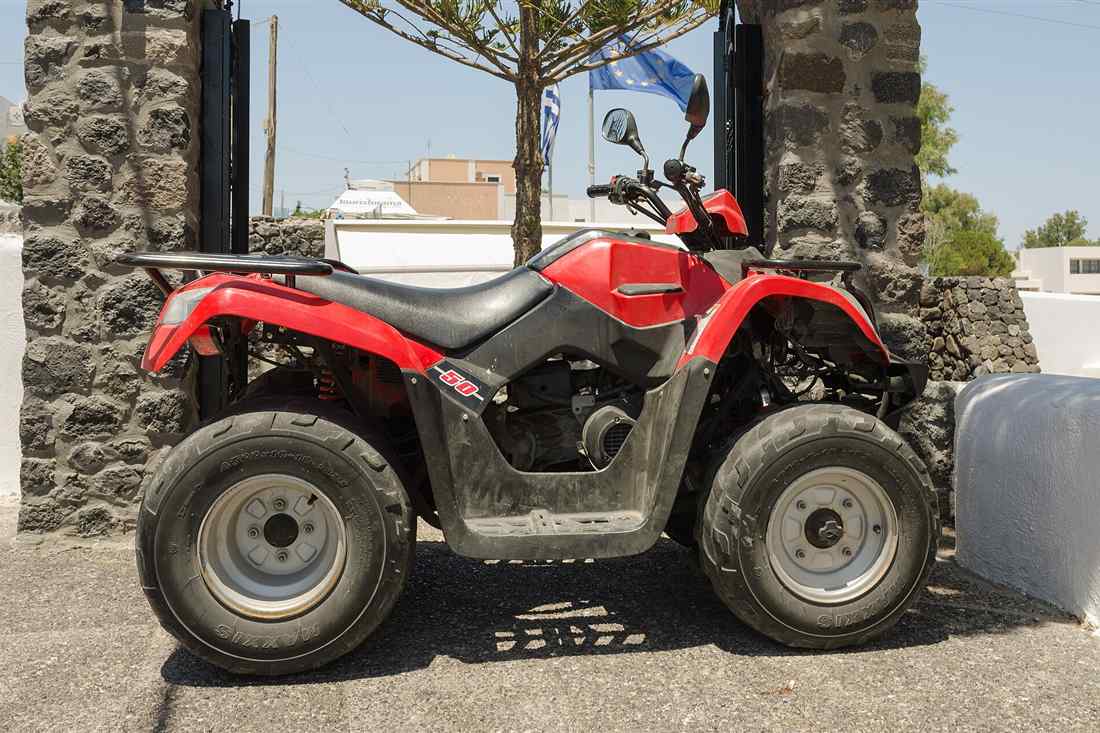
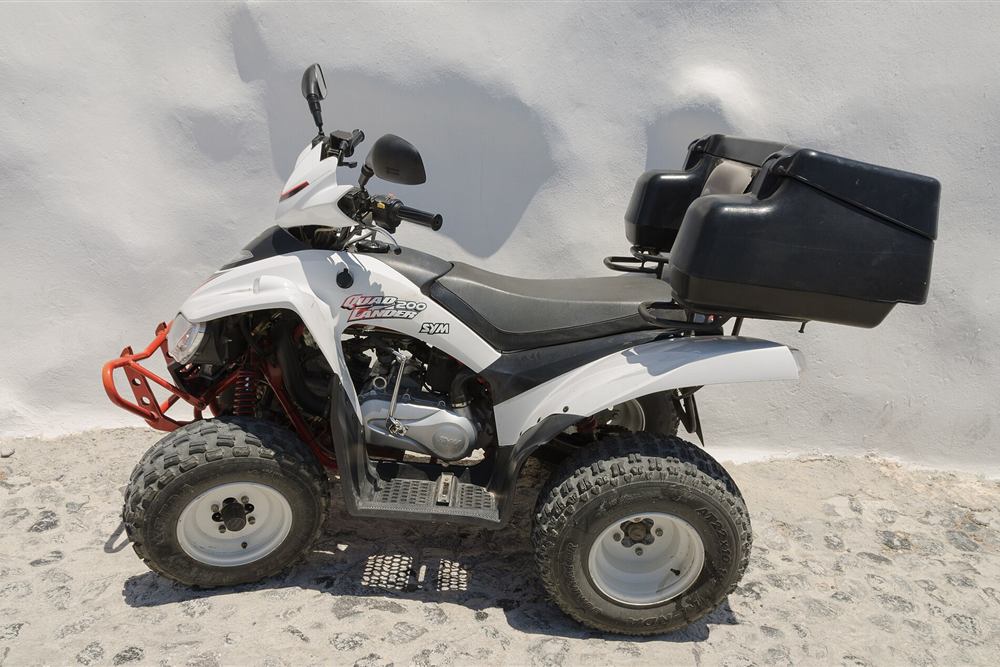
The two Parnitha formats share the same mountain north of Athens and the same forest roads, but they use different machines. The 650cc ATV is a quad bike with handlebars, where the driver sits astride the seat and steers with the arms and body. The 1000cc buggy is a small off-road car with a steering wheel, two seats side by side and a frame around the cabin. Both formats run with a guide at the front.
The Mount Kouvaras format moves the ride to the other side of Attica. Kouvaras stands between Keratea and Porto Rafti, and its tracks look east over the Aegean rather than north over forest. This tour uses buggies, so it follows the same logic as the 1000cc Parnitha format, with a different backdrop of scrub, rock and coastline. The tour listing states the machine, the meeting point, whether pickup from central Athens is included and the total time of each ride.
- Parnitha 650cc ATV – a quad bike with handlebars on fir forest tracks.
- Parnitha 1000cc buggy – a two-seat buggy with a steering wheel on the same mountain.
- Kouvaras buggy – a guided buggy ride in east Attica with Aegean views.
How does an ATV compare with a buggy on an Athens ATV tour?
An ATV is a quad bike steered with handlebars, with the rider sitting astride and exposed. A buggy is a small car with a steering wheel, seat belts and a roll cage, and it carries a passenger beside the driver.
Riding position is the main difference. On an ATV the driver shifts weight on bends and climbs, and the machine responds to the body as well as the handlebars. That feel attracts riders who have driven a motorbike or a scooter. In a buggy the driver sits low, belted into a seat, and steers much like a car, so the controls feel familiar from the first minute of the ride.
The passenger seat decides a lot for couples. A two-seat buggy puts both people side by side, sharing the same view and able to talk at stops, and the listing states whether the driver role can swap during the ride. First-timers who have never ridden a motorbike find the buggy easier to handle, while riders who want the classic quad feel pick the 650cc ATV for the Parnitha ride.
- Controls – handlebars on the ATV, a steering wheel in the buggy.
- Protection – a helmet on the ATV, a roll cage and seat belts in the buggy.
- Seating – one rider on the ATV, two people side by side in the buggy.
- Best fit – motorbike riders on the ATV, couples and first-timers in the buggy.
Where does an Athens ATV tour ride on Mount Parnitha?
The Parnitha Athens ATV tour rides the forest roads of Mount Parnitha, the highest mountain in Attica, inside a national park north of Athens known for fir and pine forest, red deer and wide views over the Attica basin.
Mount Parnitha is the green wall on the northern edge of the city. Its upper slopes carry Greek fir, a tree that grows at altitude and gives the mountain a cool, alpine feel that surprises visitors who know Athens only from summer streets. Lower down, Aleppo pine takes over. An Athens ATV tour climbs through both belts, so the air changes and the temperature drops as the tracks gain height.
Red deer live in the park, and riders sometimes spot them near clearings or crossing a track at the edge of the trees. The viewpoints look south over the whole Attica basin, from the city blocks to the Saronic Gulf on a clear day. The former royal estate of Tatoi lies at the eastern foothills, and a stop there fits a day on the same side of the city as the Parnitha ride.
What does the Mount Kouvaras buggy tour show of east Attica?
The Mount Kouvaras Athens ATV tour shows the dry, rocky hills of east Attica between Keratea and Porto Rafti, on tracks that look out over the Aegean Sea, the bays of the coast and the islets offshore on a clear day.
Kouvaras is a different landscape from Parnitha. Instead of fir forest, the slopes carry low scrub, thyme, sage and scattered pine, with bare rock on the ridges. The tracks open up early, so the sea stays in view for much of the ride. This Athens ATV tour suits riders who want the open horizon and the colour of the Aegean rather than the shade and enclosure of a mountain forest.
East Attica also puts the ride close to the coast. Porto Rafti is a bay town with a long waterfront, and Keratea is an inland town on the road towards Lavrio and Sounio. After a buggy ride on Kouvaras, the beaches of the east coast and the Temple of Poseidon at Sounio sit on the same side of Attica, which makes the buggy ride easy to pair with a swim or a sunset stop.
Who can drive and ride on an Athens ATV tour?
A valid driving licence is required to drive on an Athens ATV tour, and passengers ride with a licensed driver. Age limits, licence categories and passenger rules differ between tours, so check the tour listing before booking.
The licence rule exists because the machines are motor vehicles with real power. A 650cc ATV and a 1000cc buggy both reach speeds that call for road experience, even on a dirt track. Staff check the licence at the base before the ride starts, and a rider without one travels as a passenger. The listing for each Athens ATV tour names the licence it accepts, so read that line before booking.
Passenger seats suit families and couples where only one person holds a licence or wants to drive. In the buggy, the passenger sits beside the driver behind a seat belt; on an ATV, a passenger seat depends on the machine and the listing. Children and teenagers ride as passengers where the tour allows it, and the minimum age for this Athens ATV tour sits in the listing rather than in a general rule.
What happens in the safety briefing on an Athens ATV tour?
The safety briefing on an Athens ATV tour covers the controls, the helmet and goggles, following the leader, speed on gravel and keeping distance, and it takes place at the base before anyone drives onto the mountain tracks.
The guide starts with the machine: throttle, brakes, gears where they apply and the engine stop. Then comes the kit. Every rider wears a helmet, goggles protect the eyes from dust and grit, and closed shoes are required because feet sit close to the footrests and pedals. On a buggy, the seat belt goes on before the engine starts. None of this is optional on an Athens ATV tour, and staff check each rider before departure.
The riding rules are simple. Follow the leader and stay on the line the guide takes, since the edges of forest tracks hold loose stones and soft shoulders. Keep a clear gap to the machine in front so the dust settles and braking space stays open. Gravel reduces grip, so speed comes down before bends, not in them. Riders who follow these rules find the ride relaxed rather than tense.
- Helmet – worn by every rider, fastened before the engine starts.
- Goggles – keep dust and grit out of the eyes on dry tracks.
- Closed shoes – protect the feet near the pedals and footrests.
- Distance – a clear gap to the machine in front at all times.
When is the best season for an Athens ATV tour?
Spring and autumn are the most comfortable seasons for an Athens ATV tour. Summer rides work best in the morning, before the heat and dust build, and winter rides on Parnitha run in cool mountain air, with snow on the higher slopes on some days.
Athens summers are hot and dry, and by midday the tracks throw up thick dust behind every machine. A morning start keeps the ride cooler, and the air on Parnitha stays fresher than in the city. In July and August, Attica’s forests carry a high fire risk. On days of very high risk the authorities close some forest areas, and the Athens ATV tour changes route to stay out of them.
Winter brings the opposite picture. The tracks are damp rather than dusty, the air is clear, and the views over the Attica basin reach further. Snow falls on the upper slopes of Parnitha on some winter days, which gives the fir forest an alpine look. A winter ride on the mountain calls for warm layers and gloves. The Athens in winter page covers what else the city offers in the cold months.
What do riders wear and bring on an Athens ATV tour?
Riders on an Athens ATV tour wear long trousers, closed shoes and sunglasses, and bring a scarf or buff for dust, a bottle of water and a light jacket in the cooler months. Loose items stay in a zipped pocket or a small bag.
Long trousers protect the legs from hot engine parts, branches at the edge of the track and stones thrown up by the machine ahead. Closed shoes with a firm sole give grip on the footrests or pedals, and sandals or flip-flops do not meet the closed-shoe rule. A scarf or buff pulled over the nose and mouth keeps dust out of the lungs on dry summer tracks. Sunglasses help when the goggles come off at a stop.
Water matters more than riders expect, because dust and sun dry the throat fast. A light jacket earns its place from October to April, when the air on the ridges turns cool and wind cuts through a T-shirt. Pale clothing shows dust but stays cooler in summer. Phones and cameras belong in a zipped pocket, since a phone dropped on a gravel track rarely survives an Athens ATV tour intact.
- Long trousers – cover the legs against heat, stones and branches.
- Closed shoes – give grip on the pedals and footrests.
- Scarf or buff – filters dust on dry tracks.
- Water – replaces fluid lost to sun and dust.
- Light jacket – blocks wind on cool ridges.
Which other Athens activities pair with an ATV ride?
An Athens ATV tour pairs with a visit to Tatoi or a hike on Parnitha on the northern side, and with the beaches of east Attica, Sounio or a day trip to Marathon or Lavrio on the eastern side of the region.
The ride fills part of a day, which leaves the rest free for a second activity in the same area. After a Parnitha Athens ATV tour, the northern suburbs offer shaded cafés and the Tatoi estate at the foot of the mountain. After a Kouvaras ride, the coast lies close: Porto Rafti bay, the beaches towards Lavrio and the Temple of Poseidon at Sounio for sunset. Pairing by geography cuts the time spent in traffic.
For longer stays, the ride slots into a wider plan of excursions. The day trips from Athens page groups the classic routes, from Delphi to the Saronic islands, and the ATV ride adds an off-road day to that list. Travellers with teenagers find that a morning of driving balances days of museums and ancient sites, and it gives the group a shared story that has nothing to do with marble.
How does an Athens ATV tour compare with an e-bike, a segway or a hike?
An Athens ATV tour covers rough mountain tracks with engine power and little physical effort. An e-bike ride and a segway tour explore the city at street pace, and a hike on Hymettus or Parnitha trades speed for silence and close contact with the landscape.
The e-bike and the segway belong to the city. A segway tour glides past the monuments of the centre on paved streets, and an Athens bike tour links neighbourhoods, parks and sights with pedal assist. Both come with a guide who explains the history of the places they pass. The Athens ATV tour does the opposite: it leaves the monuments behind and trades commentary for terrain, engine sound and mountain air.
Hiking reaches the same kind of landscape as the ATV, at walking speed. Trails on Mount Hymettus start close to the eastern suburbs, and the paths on Parnitha climb through fir forest to rocky summits. A hike asks for fitness and time, while an Athens ATV tour covers more ground with less effort and adds the fun of driving. Active travellers combine both on different days of the same stay.
- ATV or buggy – mountain tracks, engine power, low physical effort.
- E-bike – city streets and parks, light pedalling with assist.
- Segway – paved central streets, standing ride, guided commentary.
- Hiking – mountain trails, walking pace, full physical effort.
Is an Athens ATV tour worth it?
An Athens ATV tour is worth it for travellers who want an active break from monuments and museums. It reaches the fir forests of Parnitha or the sea views of Kouvaras, with a guide, a safety briefing and no route to plan.
The ride delivers something the centre of Athens does not: open ground, forest air and the feel of a machine under control on gravel. It suits licensed drivers who enjoy motor sport, couples who share a buggy, and families where one adult drives and the others ride along. It suits less those who dislike dust, noise or heat, and those travellers find an e-bike or a hike a closer match than a quad or a buggy.
The practical checks are few and clear. Confirm the licence rule, the minimum age and the pickup arrangement on the listing, pick the machine that fits the group, and dress for dust and sun. Choose a morning slot in summer and watch for fire-risk notices in July and August. With those points settled, an Athens ATV tour adds a different side of Attica to a trip built around ancient Athens.
Frequently Asked Questions
Is a driving licence required for an Athens ATV tour?
Yes, a valid driving licence is required to drive on an Athens ATV tour. Passengers without a licence ride with a licensed driver. The accepted licence categories and the minimum age differ between tours, so check the tour listing before booking a seat.
Is a buggy or an ATV easier for first-timers?
A buggy suits first-timers on an Athens ATV tour, because it has a steering wheel, seat belts and a roll cage, and it drives much like a car. The 650cc ATV suits riders who have handled a motorbike or a scooter before.
Where do Athens ATV tours take place?
Athens ATV tours take place on Mount Parnitha, the highest mountain in Attica, north of the city, with 650cc ATVs and 1000cc buggies, and on Mount Kouvaras in east Attica, near Porto Rafti, where a guided buggy tour looks over the Aegean.
What is the best time of day for an Athens ATV tour in summer?
Morning is the best time for an Athens ATV tour in summer. The air is cooler, the dust is lighter and the sun is lower than at midday. On days of very high fire risk, the authorities close some forest areas and tours change route.
Does an Athens ATV tour include pickup from central Athens?
Some Athens ATV tour listings include pickup from central Athens, and others give a meeting point at the base, north of the city for Parnitha or in east Attica for Kouvaras. The listing also states the total time, so check it before booking.