
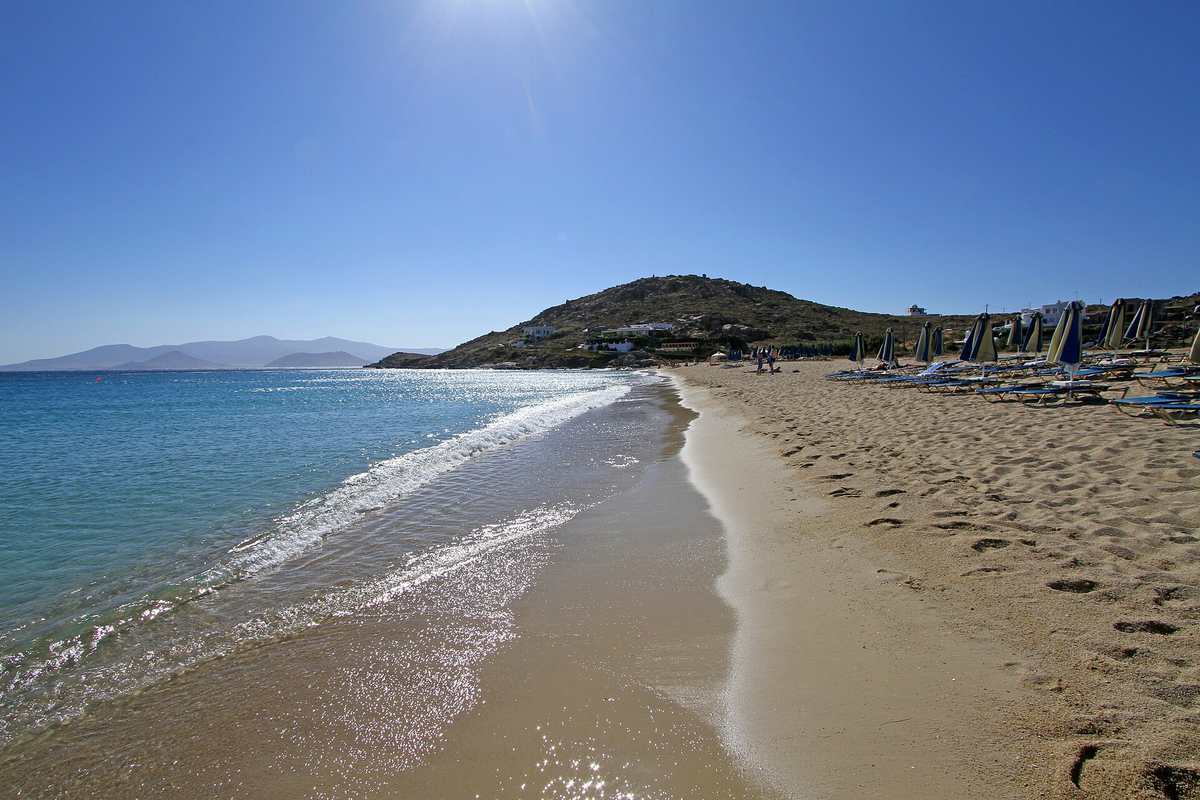
Agios Prokopios is one of the most famous and best-loved beaches on Naxos, the largest island in the Cyclades. It stretches along the island’s sheltered west coast just a couple of kilometres south of Naxos Town, offering a long ribbon of fine golden sand backed by low dunes and a small holiday resort. The water is shallow, clear and a striking shade of turquoise, which is why the beach is repeatedly ranked among the finest in Greece. Families, couples and independent travellers all find their own corner here, from organised sunbed rows to quieter open sand. A wide range of visitors reach it as part of a wider island itinerary, and you can arrange a guided tour of Naxos through My Greece Tours.
This page is a practical, first-hand style overview of Agios Prokopios, written to sit alongside our wider Naxos travel guide so you can plan the whole trip in one place. The sections below cover what and where the beach is, what the sand and water are actually like, the facilities and resort behind it, the neighbouring Alyki salt lagoon and Agia Anna, and exactly how to get to Agios Prokopios from Naxos Town.
What and where is Agios Prokopios beach?
Agios Prokopios is a top-ranked long sandy beach on the west coast of Naxos, roughly five to six kilometres south of Naxos Town.
The beach sits on the gentle western flank of Naxos, the side that looks out toward Paros across a narrow channel and stays protected from the strong northerly meltemi wind for most of the season. Getting there from Naxos Town takes only ten to fifteen minutes by car. The beach functions almost as the town’s own seafront while still feeling like a proper resort in its own right. A low headland separates it from the harbour, and once you round it the coastline opens into a broad, shining arc of sand.
The setting is open and sunny, with pale hills rising gently behind and the sea shelving out so slowly that the shallows seem to glow in the light.
Agios Prokopios is often listed as the first in the famous run of southwest beaches that continues through Agia Anna and on to the vast expanse of Plaka. Together these form the heart of the island’s coastline and are a large part of why so a wealth of travellers put the beaches of Naxos at the top of their Cyclades wish list. The name comes from a small chapel dedicated to Saint Prokopios that stands near the shore, a reminder that this was a quiet fishing and farming coast long before tourism arrived. Understanding where it sits is only half the picture, though; what really draws people is the character of the sand and sea themselves.
What is the beach itself like?
The beach is a long, wide strip of fine pale-gold sand meeting exceptionally clear, shallow turquoise water. The sea shelves very gently, so it stays waist-deep well offshore, making it calm and safe for children while the sand stays soft and clean underfoot.
Agios Prokopios runs for roughly a kilometre and a half, giving it enough room to feel spacious even in high summer. The sand is genuinely fine and pale, closer to soft powder than coarse grit. It slopes so gradually into the sea that you can wade out a long way before the water reaches your chest. That gentle shelving is the beach’s defining feature: it produces a wide band of luminous shallows in shades of aquamarine and pale jade that photograph beautifully and feel wonderfully warm by midsummer. The swimming is calm and reassuring, which is a large part of why families return to this stretch year after year because the water is protected and rarely rough.
The overall quality here is high, and the beach has repeatedly earned Blue Flag recognition for its clean water, safety and services. Early morning and late afternoon are especially lovely, when the light turns the sand honey-coloured and the crowds thin out. The far end tends to stay quieter and more natural, so walkers and swimmers who want space can simply keep strolling until the sunbeds give way to open sand. With such an inviting stretch of coast, it is no surprise that a small, easy-going resort has grown up right behind it to serve the people who come to enjoy it. The beachfront here holds the island’s best luxury hotels in Naxos, steps from the sand.
What facilities and resort does Agios Prokopios have?
Agios Prokopios is well organised, with sections of sunbeds, umbrellas, beach bars and watersports alongside quieter free stretches. Behind the sand lies a small, relaxed resort village of hotels, studios, apartments, tavernas, cafes and mini-markets, everything a beach holiday needs.
The central part of the beach is neatly organised, with tidy rows of sunbeds and straw umbrellas that you can rent for the day, usually with drinks and snacks brought to your lounger. A handful of beach bars and tavernas line the shore, so cold coffee, a light lunch or an evening cocktail are never far away. There are showers and easy access points along the front. Simply walk toward the ends, where the organised areas thin out and the beach reverts to its natural state if you prefer a towel on open sand. Watersports such as stand-up paddleboarding and canoeing appear in season, though the calm water keeps the atmosphere gentle rather than adrenaline-fuelled.
Set just back from the sand is the resort of Agios Prokopios itself, a compact, low-rise cluster of hotels, family-run studios and self-catering apartments threaded with small streets. You will find bakeries, mini-markets, tavernas serving fresh fish and Naxian specialities, and casual cafes, all within an easy walk of your sunbed. It is lively without being brash, popular with couples and families who want the beach on their doorstep yet still close to town. Beyond the buildings, nature reasserts itself quickly, because immediately behind the resort lies a very different and a great deal of quieter landscape well worth exploring. Reach the quieter southern coves on an ATV and quad rental from the resort strip.
What is near Agios Prokopios — the lagoon and Agia Anna?
Just behind the beach lies the Alyki salt lagoon, a shallow wetland where migrating birds and, in season, flamingos gather.
Tucked immediately behind the resort is the Alyki salt lagoon, a shallow saltwater wetland that gives this coast a surprising wild side. The lagoon is an important stop for migrating birds, and in the cooler months you may spot flamingos wading through the pink-tinged shallows along with herons, ducks and a spread of waders. Reeds and low scrub fringe the water, and quiet tracks skirt the edge, making it a peaceful place for an early-morning stroll away from the beach crowds. It is a gentle reminder that Naxos is far more than sunbeds, and that even a busy resort beach can sit right beside a protected natural habitat teeming with life.
Continue south along the sand and you soon reach Agia Anna, so close that a wealth of people simply walk between the two. Agia Anna keeps the feel of a small fishing village, with a tiny harbour where colourful boats bob, family tavernas serving the morning’s catch, and a relaxed, unhurried mood. Its beach flows on almost seamlessly from Agios Prokopios and leads toward the long dunes of Plaka beyond, so the whole southwest coast reads as one glorious sweep of sand. Knowing what surrounds the beach makes planning easier, and the last practical question is simply how to reach it in the first place.
How do you get to Agios Prokopios beach?
Agios Prokopios is very easy to reach. Frequent local buses run from Naxos Town in around ten to fifteen minutes, and the beach is a short drive, taxi or scooter ride away.
The simplest option is the local KTEL bus. Shuttles regularly between the port in Naxos Town and the southwest beaches throughout the day in high season, stopping at Agios Prokopios, Agia Anna and Plaka. The ride takes only about ten to fifteen minutes, and buses are frequent enough that you rarely wait long, making a car unnecessary for a straightforward beach day. Renting a car or scooter gives you the freedom to combine the beach with inland villages and other coves. There is parking near the resort if you would rather explore more widely. A taxi from town is quick and inexpensive if you are travelling with luggage or arriving after the buses have stopped for the evening.
For a car-free adventure you can walk the coast from Agia Anna to Agios Prokopios in just a couple of minutes, or stroll the whole golden run down toward Plaka at your own pace. Aim for a morning arrival in peak season to claim a good spot, or come in late afternoon for softer light and thinner crowds; the calm, shallow water is inviting from spring through autumn. The beach pairs naturally with a broader day of sightseeing, so browse our guide to the best things to do in Naxos to build the perfect itinerary around it. Plan your visit and tours through our Naxos travel guide.
Frequently Asked Questions
Is Agios Prokopios beach good for families with young children?
Yes, Agios Prokopios is one of the best family beaches on Naxos, and its layout is a big part of the appeal. The sand is soft and fine rather than pebbly, so it is comfortable for bare feet and for building sandcastles. The sea shelves so gently that the water stays shallow for a long way out. That means small children can paddle and splash safely under supervision without any sudden drop-offs, and the sheltered west-coast position keeps the sea calm and rarely rough. Practical facilities help too: you will find rentable sunbeds and umbrellas for shade, beach bars and tavernas for snacks and drinks, and showers along the front.
Studios and mini-markets sits right behind the beach, everything a family needs is within an easy walk. The frequent bus link to town makes days out simple even without a car because the resort of hotels. All of this together makes it a reassuring, low-stress choice for parents travelling with little ones.
How far is Agios Prokopios from Naxos Town, and is a car needed?
Agios Prokopios lies roughly five to six kilometres south of Naxos Town along the sheltered west coast, which works out to about a ten to fifteen minute journey by road. A car is genuinely not necessary for a beach day here, because the local KTEL bus runs frequently between the town port and the southwest beaches throughout the high season, stopping at Agios Prokopios on the way to Agia Anna and Plaka. The fare is modest and the service is reliable, so a wide range of visitors happily skip renting a vehicle altogether.
That said, a car or scooter is handy if you want to explore beyond the beach, reaching Naxos’s mountain villages, the marble quarries or more remote coves at your own pace. There is parking near the resort. Taxis are also readily available from town and are quick and affordable. This is useful if you are carrying beach gear, travelling with children, or heading back after the last bus has run for the day.
What is the salt lagoon behind Agios Prokopios, and can you visit it?
Behind Agios Prokopios lies the Alyki salt lagoon, a shallow coastal wetland that forms a striking contrast with the busy beach in front of it. Historically these salt pans were worked to harvest sea salt, and today the lagoon survives as an important refuge for wildlife. It is best known for its birdlife: during the cooler migration months you may see flamingos wading through the shallows, their pink plumage vivid against the water, along with herons, ducks and assorted waders that stop here to feed and rest. You can absolutely visit, and it makes a lovely, peaceful counterpoint to a day on the sand. Quiet tracks and paths run along the edges of the lagoon.
An early-morning or late-afternoon walk is ideal for birdwatching and photography when the light is soft and the air is cool. Please keep to the paths, avoid disturbing the birds and take any litter away with you, since the area is a fragile natural habitat that deserves gentle, respectful visitors.