
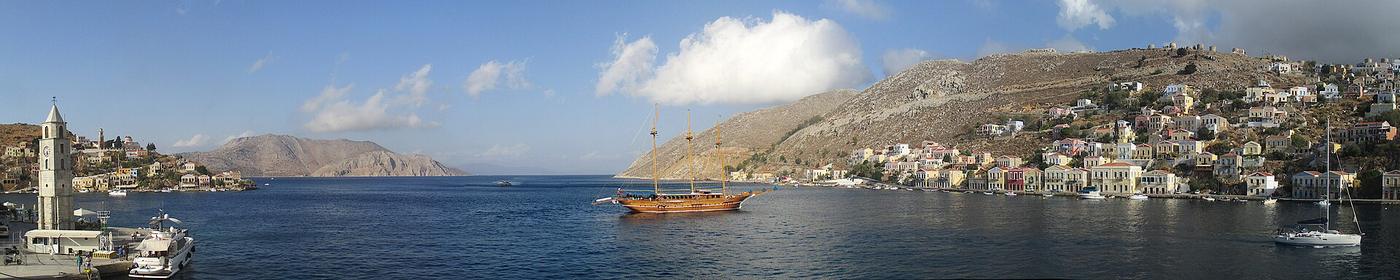
Symi carries a history that reaches from Homeric legend to the present island. The small Dodecanese island lies between Rhodes and the Turkish coast, and its rocky harbour has drawn sailors and traders across every age. Its story runs through the ships of Troy, the Dorian settlers, the Rhodian state, Roman and Byzantine rule, the Knights of Saint John, the Ottoman sponge trade, the neoclassical golden age, Italian occupation and the final union with Greece. This guide follows that long line era by era. Each section takes one period and sets out the concrete record: the rulers, the trades, the buildings and the events that shaped the island. The whole account moves in order from the earliest myth to the tourism that sustains the island now.
The long past of Symi still stands in plain sight around its harbour. The tiered neoclassical mansions rose from sponge and shipping wealth, and the medieval castle crowns the hill where the ancient town once stood. Layer on layer, the island holds the marks of each ruler who held it. The pages that follow trace those layers from the bottom up. They begin with the ships King Nireus sent to Troy and end with the emigration and tourism of recent generations. Every period left something on the ground, in the stone of the town or the memory of the sea trade. The reader can follow the whole record and see how one small island gathered so deep a past on its rock.
What is the earliest recorded history of Symi in Homer’s Iliad?
Symi enters recorded history in Homer’s Iliad, which lists the island among the forces that sailed to Troy. King Nireus led its ships, and the poem remembers him as the handsomest of the Greeks who came to Troy after Achilles.
Homer’s Iliad gives the island its first place in written memory. The catalogue of ships in the poem names the contingents that joined the Greek campaign against Troy. Symi stands among them, sending its own squadron under its own king. That single entry ties the island to the oldest surviving epic of the Greek world. The mention is brief, yet it fixes the island inside the heroic tradition from the start. The poem treats the island as an established community, able to fit out ships and send men to a distant war. This early notice sets the pattern for the whole history that follows. The island’s fortunes rested on the sea and on the boats it launched from its shore, and the epic records that maritime role.
King Nireus stands at the centre of the island’s Homeric fame. The poem names him as the leader of the island’s ships and praises his looks above every other Greek at Troy, ranking him second only to Achilles. His squadron was light beside the great fleets of the mainland kings. The verses grant him beauty rather than martial power. His slender force added only a small line of hulls to the campaign. That portrait has followed the island ever since. Nireus became the island’s founding figure, the named hero who carried its banner to the walls of Troy. The link between the ruler and the island gave later generations a proud thread reaching back into the age of gods and heroes.
The Homeric notice reflects a real island already peopled in the age it describes. Settlement on the rocky heights and around the harbour reached back into deep antiquity by the time the poem took shape. The island’s poor soil pushed its people toward the sea from the beginning, so shipping and trade defined the community early. Legend also linked the island to figures of the wider Greek mythic world, tying its name to gods and founding heroes. These stories gave the small island a dignity beyond its size. The mythic frame mattered, since ancient communities read their standing partly through such descent. Symi entered history already claiming a heroic past, and that claim shaped how later ages remembered the rock that sits between Rhodes and the mainland shore.
The ancient settlement grew on the hill that the castle would later crown. That height gave a defensible site above the harbour, with clear views over the sea approaches. The people of the island built their town there and worked the water below. The Homeric age thus opened a continuous story of habitation on the same commanding ground. Control of the harbour and the heights decided the island’s safety through every later period. The pattern set in these earliest centuries held for thousands of years: a fortified town on the summit and a working port at its foot. This deep root explains why the island’s history reads as one long chain. The story runs unbroken rather than as a set of separate episodes on unconnected ground.
How did the ancient town of Symi and its Dorian and Rhodian era develop?
The ancient town of Symi stood on the hill later crowned by the castle, and the island belonged first to the Dorian Greek world. Symi then fell within the Rhodian state, sharing the language, cults and trade of the Dorian communities around Rhodes.
The town of the classical island occupied the summit above the harbour. Its people built their houses, temples and defences on that height, using the natural strength of the rock. The port below served the fishing and trading that fed the community. Ancient authors record the island under the same name it carries today, marking it as a known point in the Aegean sea lanes. The settlement pattern joined a fortified upper town to a working shore, the arrangement that endured for the whole of its later history. Remains and references place the island firmly within the settled Greek world of the eastern Aegean. The classical island was a small but recognised polity, tied by sea to the larger centres around it.
The island belonged to the Dorian branch of the Greek people. Dorian settlers spread across the southeastern Aegean, and the islands off the Anatolian coast fell within their world. The people of the island spoke the Dorian dialect and kept the cults and customs of that group. This placed the island inside a broad cultural family that reached across Rhodes, Kos and the neighbouring shores. The Dorian identity shaped its early institutions and its ties to the wider region. The island did not stand alone but formed one node in a network of related communities. That web of shared blood, speech and worship drew the island naturally toward Rhodes. The great Dorian power rose close at hand and came to dominate the surrounding waters that the island depended on.
The island passed under the control of the Rhodian state. Rhodes united its own cities and extended its rule over the smaller islands and the mainland coast opposite, forming a strong maritime power. Symi fell within this Rhodian sphere and followed the fortunes of the larger island. Rhodian rule linked the community to one of the wealthiest trading states of the Greek world. The island shared in the sea commerce that made Rhodes rich and famous across the Mediterranean. This tie set a lasting direction, since the island’s history stayed bound to Rhodes through Roman, Byzantine and medieval times. The bond with the great neighbour became the frame within which the smaller island lived. Age after age, the rock’s fortunes followed those of Rhodes across the water.
The ancient island lived from the sea rather than the land. Its thin soil yielded little grain, so its people turned to fishing, shipping and the trade that passed through the Aegean. Sponge gathering along its own shores and the coasts nearby already formed part of that economy in ancient times. The harbour handled the goods that its boats carried between ports. Sanctuaries and cult sites served the community, following the Dorian religious tradition. This sea-based way of life fixed the island’s character for the whole of its history. Every later age repeated the same balance of a poor land and a rich maritime trade. The classical foundation set the terms on which the island would rise and fall through every ruler who came after it.
What happened to Symi under Roman and Byzantine rule?
Symi passed under Roman power together with Rhodes and the region, then entered the Byzantine Empire as Roman rule shifted east. The island stayed a small maritime community, tied to Rhodes and exposed to the raids that troubled the medieval Aegean.
Roman power reached the eastern Aegean and drew the island into its sphere. Rome first worked through Rhodes, its regional ally, and later brought the whole area under direct imperial control. Symi followed Rhodes into the Roman order, as it had followed it before. Roman rule brought long stretches of peace to the sea lanes, which favoured the trade the island lived on. The island stayed a minor community within a vast empire, its life still centred on the harbour and the boats. Roman authority governed from afar, and the island kept its local character under the wider imperial frame. The sea trade continued along the old routes, now protected by the reach of Roman law across the whole Mediterranean world that the empire held.
Roman rule in the east grew into the Byzantine Empire over the centuries. The eastern provinces kept the Roman state alive under Greek speech and the Christian faith, and the island belonged to that continuing realm. Byzantine authority governed the Aegean islands as part of its naval and provincial system. Symi remained within this world, a Christian island tied to the church and the empire. The faith took deep root, and monasteries and churches began to mark the island’s ground. The Byzantine centuries wove the island into the religious and administrative order of the eastern empire. This long period fixed the Orthodox Christian identity that the island has carried ever since. Every later ruler who came and went across its harbour found that faith already settled on the rock.
The middle Byzantine centuries exposed the island to danger from the sea. Arab fleets raided across the Aegean, and later pirates preyed on the island communities. The fortified town on the height gave the people their refuge in these threatened times. The island’s small size and open position made it vulnerable, so defence returned to the old summit stronghold. The community drew close to Rhodes and the imperial navy for protection. These insecure centuries reinforced the pattern of a guarded upper town above a working port. The island endured through raid and recovery, holding to its rock and its boats. The medieval Aegean was a hard sea, and the island survived by the same means it had always used: the height, the walls and the ships.
Byzantine control over the island weakened as the empire declined. The central power lost its grip on the distant islands, and the Aegean fell open to new forces from the west. Italian and crusading powers pressed into the region as Byzantine strength ebbed. The island, tied as ever to Rhodes, followed the larger island toward its next masters. The stage was set for the arrival of the Knights of Saint John, who would take Rhodes and its dependencies. The long Roman and Byzantine age thus closed with the island passing from the eastern empire toward a western military order. This handover opened one of the most marked chapters in the island’s history. The record of that chapter still stands, written into the stone of the island’s castle.
How did the Knights of Saint John fortify and govern Symi?
The Knights of Saint John took Symi in the medieval period and held it as a dependency of their Rhodian state. They rebuilt the Kastro on the old summit, and the island served the order as a base for ships and trade.
The Knights of Saint John seized Rhodes in the medieval period and took the surrounding islands with it. Symi passed into their hands as part of that conquest and became a dependency of the Knights’ Rhodian state. The order was a military brotherhood of western Christian nobles, sworn to fight and to hold the eastern frontier. Their rule brought the island under a disciplined power based on the great island close by. They ruled through the same maritime frame that every earlier master had used. The Knights valued the island for its harbour, its sailors and its yards. Their arrival opened a chapter still written across the summit, where the Kastro of Chorio preserves the walls that the order raised above the town.
The Knights refortified the castle on the hill above the harbour. They built strong walls on the old acropolis, the same height the ancient town had used, and set their arms over the gate. The castle guarded the town and gave refuge against the raids and fleets that crossed the sea. Its position commanded the harbour and the approaches, holding the island’s key point in trained hands. The order stationed its garrison there and ran the island’s defence from the summit. The medieval walls joined a line of fortification reaching back to antiquity on the same rock. The castle became the hard core of the island under the Knights. From that stronghold their disciplined force held the community and its port.
The Knights governed the island as a working part of their sea state. The order granted the community rights and eased burdens in return for the ships and sailors it supplied. The island built and crewed boats for the trade and the defence of the Rhodian domain. Its yards and its seamen made it useful to a power that lived by the sea. The people kept their Orthodox faith under the Catholic order, and daily life carried on around the harbour and the fields. The bond with Rhodes, already ancient, took a new military form under the Knights. The island served as one link in the chain of strongholds by which the order held the eastern Aegean. That chain faced the rising power on the mainland east.
The rule of the Knights on the island lasted through the late medieval period. The order held Rhodes and its dependencies against repeated pressure from the growing Ottoman power on the mainland. The island shared in the tension of that long frontier, standing close to the Anatolian coast. The Knights finally lost Rhodes to the Ottomans after a great siege, and their dependencies fell with it. Symi passed from the western order to the Ottoman Empire, its next and longest-lasting master. The castle they built remained, a lasting mark of their time above the town. The handover from the Knights to the sultans opened the age in which the island’s sponge wealth would rise to its height. A distant imperial crown now held the rock and its harbour.
What did Ottoman rule and the sponge privileges bring to Symi?
Ottoman rule brought Symi a special status in return for sponges. The island delivered sponges to the sultan’s court and, in exchange, kept trading privileges, local self-government and light taxation. That bargain let the community prosper and its sea trade expand.
Ottoman rule set the island on a favourable footing from the start. The sultans granted the sponge islands of the Dodecanese special privileges in return for a yearly tribute of sponges to the court. Symi delivered its finest sponges to the palace and, in exchange, won rights that lifted it above ordinary subject status. The island governed its own affairs through local councils and paid a fixed, light tax rather than heavy imperial dues. This bargain gave the community room to trade, build and grow. The arrangement rested on the one product the island supplied in abundance from its own waters. Sponge wealth thus bought a measure of freedom, and that freedom in turn let the sponge trade expand across the wider sea and beyond.
The privileged status shaped daily life across the island. Local notables ran the community’s affairs, managed its taxes and dealt with the imperial authorities on the island’s behalf. This self-government spared the people the direct weight of provincial rule and kept decisions in local hands. The security of the arrangement encouraged investment in boats, trade and building. Merchants and captains grew wealthy on the sponge and cargo trade that the privileges protected. The population climbed as the economy expanded under the shelter of the sultan’s grant. The island became one of the richer communities of the Ottoman Aegean, a self-run society of sailors and traders. The special deal with the empire underpinned the long rise that reached its peak in the neoclassical age.
The sponge trade drove the whole Ottoman-era economy of the island. The waters around the island and along the North African coast yielded the sponges that the divers brought up by breath and, later, by machine. The account of Symi sponge diving traces how the fleet worked those distant beds through the diving season. The catch came home to be cleaned, sorted and shipped to buyers across the Mediterranean and Europe. The trade tied the island to markets far beyond the Aegean and filled its harbour with boats. Sponge income paid for the ships, the houses and the tribute that secured the island’s rights. The single product of the seabed carried the island’s fortunes through the whole of the imperial age.
Trade and shipbuilding rose together with the sponge wealth. The island’s yards built the caiques and sponge boats the fleet needed, and its captains carried cargo for hire across the region. The harbour handled goods moving between the Dodecanese, the Anatolian ports and destinations far to the south. This broad sea commerce grew under the stability that the Ottoman privileges provided. The community turned its earnings into a larger fleet and a fuller treasury. The island reached a standing out of all proportion to its rocky ground, a busy maritime centre under a land empire. The Ottoman centuries laid the base of wealth on which the great building age would rise. Sponge and shipping money soon reshaped the whole face of the harbour town below the castle.
Why was the nineteenth century the golden age of Symi?
The nineteenth century was the golden age of Symi because sponge diving, shipbuilding and trade reached their height. That wealth built the neoclassical mansions of the harbour and swelled the population far beyond today’s, making the island one of the Aegean’s busiest ports.
The nineteenth century carried the island’s sea economy to its highest point. Sponge diving, shipbuilding and trade all reached their peak together in the same generations. The fleet grew large and ranged far, the yards worked without pause, and the sponge catch filled the harbour with wealth. The population rose to a figure far above the count of the present island, packing the slopes above the port with people. The community stood among the leading maritime centres of the eastern Aegean. This concentration of trade, skill and money marked the summit of the island’s whole history. The wealth of these generations still shapes how the island looks. The great houses and the busy quays of that age set the pattern the visitor sees along the harbour today.
The wealth of the golden age built the neoclassical town that still climbs the hillsides. Sponge and shipping money paid for tall mansions with painted facades, pediments and fine detail, raised in tiers above the water. The harbour front of Symi Town and Gialos took the form that draws visitors now, a bowl of coloured houses rising from the sea. Merchants and captains competed to build, and the result was a dense neoclassical townscape unusual for so small an island. The mansions displayed the fortunes their owners had won from the sea. The stone of the golden age has outlasted the trade that paid for it. The town stands as the clearest record of the wealth that the sponge and shipping boom created.
Shipbuilding matched the sponge trade in the golden age. The island’s yards launched the boats that carried both the divers and the cargo, and the fleet grew to rank among the strongest of the Dodecanese. Captains born on the island’s streets sailed its ships to distant ports and brought the profits home. The population swelled as work drew people to the harbour and the slips. Sailmakers, rope makers, smiths and caulkers filled the waterfront trades that the boats required. The whole community lived from the sea and prospered by it in these generations. The island supported a fleet and a population that its bare land never fed. The wealth its boats and divers drew from the water held the whole crowded town aloft.
The golden age reached beyond trade into the life of the whole community. Sponge and shipping money paid for churches, schools and public buildings alongside the private mansions. The wealthy families supported learning and the arts, and the island grew into a place of standing in the Aegean. The harbour bustled with boats, cargo and the daily work of a rich port. This prosperity rested entirely on the sea, and its height marked the moment before the long decline. The forces that would shrink the island still lay ahead, and for these generations the community lived at its fullest. The neoclassical town, built in the wealth of this age, remains the lasting monument. It records the summit of the island’s fortunes on the water for every later visitor.
How did Italian rule change Symi in the early twentieth century?
Italian rule brought Symi under a new European power that took the whole Dodecanese from the Ottoman Empire. Italy governed the islands as a colonial possession, ended the old Ottoman privileges, and held Symi until the upheavals of the Second World War.
Italy took the Dodecanese from the Ottoman Empire in the early twentieth century. A war between the two powers ended with the islands passing into Italian hands, and Symi came under Italian control with its neighbours. The change moved the island from a fading Ottoman order to an ambitious European state. Italy held the whole island group as a colonial possession, ruling from Rhodes as the Knights and the sultans had before. The island’s ancient tie to Rhodes thus continued under yet another master. The people found themselves subjects of a distant European crown rather than a sultan. This shift opened the last foreign chapter in the island’s history. The decades of Italian rule ran on through the tense years that led up to the Second World War.
Italian rule ended the special privileges the island had held under the Ottomans. The self-government and the light taxation that had sheltered the community gave way to direct colonial administration. The Italians governed firmly and reshaped the islands to serve their own aims. The sponge trade, already under pressure, lost the favoured status that had protected it for centuries. The old bargain of sponges for freedom no longer held under the new rulers. These changes weighed on an economy already strained by wider shifts in shipping and diving. The loss of the privileges marked a turn in the island’s fortunes. The special standing that had underpinned its long rise through the Ottoman age was stripped away under the colonial hand of Italy.
The Italian decades coincided with the start of the island’s long population loss. The sponge trade weakened as the beds thinned and as engines and steel changed the wider world of shipping. Work grew scarce on the island, and its people began to leave in search of a living abroad. Emigration carried island families to distant cities and across the sea to new countries. The crowded slopes of the golden age started to empty as the young departed. The colonial rulers offered no cure for the decline of the old sea trades. The island that had swelled with sponge wealth now entered a long contraction. The Italian period saw the first heavy waves of the emigration that reshaped the whole community over the century.
Italian rule left its own marks on the islands during these decades. The administration built roads, offices and public works, and stamped its architecture on parts of the Dodecanese. Rhodes carried the heaviest print of the Italian presence, while smaller islands felt it in lighter measure. The rulers governed the group as a unit, binding the islands together under one colonial hand. This shared status would matter at the war’s end, when the whole Dodecanese moved together toward Greece. The Italian period held the island through the tense years before the wider conflict. The occupation ran on until the Second World War broke the Italian hold. The island then passed into the turmoil that ended foreign rule across the Dodecanese for good.
What role did Symi play at the end of the Second World War?
Symi held a decisive place at the close of the Second World War, since the German surrender of the Dodecanese was signed on the island. That act ended the occupation of the whole island group and cleared the way for their union with Greece.
The Second World War swept the Dodecanese into its final campaigns. Italian rule collapsed partway through the conflict, and German forces moved to seize the islands. Fighting and hardship reached the island group as the war turned. The islanders lived through occupation, shortage and the disruption of their sea trade during these hard years. Control of the Dodecanese was contested as the powers fought for the eastern Mediterranean. The island shared the suffering of a region caught between armies. The old maritime economy, already weakened, was battered further by the blockade and the danger of wartime. The war brought the foreign rule of the islands toward its violent close. The island stood at the very centre of the act that would end it across the whole group.
The German surrender of the Dodecanese was signed on the island at the war’s end. The act that handed the whole island group over from German control took place on this small island, giving it a fixed place in the record of the war. The signing closed the occupation of the Dodecanese and marked the end of foreign military rule across the group. The island thus carried a weight in the war’s conclusion far beyond its size. The event tied the small harbour to a turning point in the history of the wider region. The surrender on the island opened the short passage between the end of occupation and the long-sought union of the islands with the Greek state that followed.
The war left the island and the Dodecanese exhausted. Years of occupation and blockade had drained the community and deepened the decline of the sponge and shipping trades. Emigration continued as families sought safety and work away from the battered islands. The population fell further from the heights of the golden age. The physical island survived, its town and castle still standing above the harbour, but its economy lay in a weakened state. The end of the war brought relief from occupation yet left hard years of recovery ahead. The island entered the postwar period stripped of its old wealth, holding to its harbour and its emptying streets. The surrender signed on its ground had ended one ordeal and opened the road toward Greece.
The end of the war reopened the question of the islands’ future. The Dodecanese had passed from Ottoman to Italian to German hands across the century, always ruled from outside. With the occupation ended, the path lay open for the islands to join the Greek nation at last. The population of the Dodecanese was Greek in speech, faith and identity, and union with Greece answered a long desire. The island stood ready to leave foreign rule behind for the first time in its recorded history. The surrender on its ground had cleared the last occupier from the group. The stage was set for the formal act that would bind the Dodecanese, and the island with them, firmly to the Greek state.
How did Symi unite with Greece and become the modern island?
Symi united with Greece after the Second World War, when the Dodecanese formally joined the Greek state. Emigration and the decline of the sponge trade shrank the island’s population, and tourism now sustains the community that lives around its harbour and neoclassical town.
The Dodecanese united with Greece in the years after the Second World War. The islands, held from outside through their whole recorded past, joined the Greek state and ended centuries of foreign rule. Symi entered Greece together with its neighbours in this act of union. The event fulfilled the national identity the islanders had always carried in speech and faith. For the first time the island belonged to the Greek nation rather than to a distant empire or crown. Union brought the island into the political life of modern Greece and its region. The long chain of outside rulers, running from Rhodes and Rome through the Knights, the sultans and the Italians, closed at last. The island took its place as Greek soil in the Aegean.
Emigration and the fall of the sponge trade reshaped the modern island. The sponge beds had thinned, disease had struck the harvest, and engines and modern gear had changed diving beyond the old ways. The trade that had built the island’s wealth declined past recovery. Work grew scarce, and generations of islanders left for the cities of Greece and for countries overseas. The population fell far below the crowded figure of the golden age, and streets and houses stood empty. The mansions of the sponge era remained, but the trade that had raised them was gone. The modern island emerged smaller and quieter. Its harbour no longer held the diving fleet that had once filled it through the working season of the year.
Tourism now sustains the island in place of the old sea trades. Visitors come for the neoclassical harbour, the painted mansions and the clear water of the coves around the coast. The town that sponge wealth built has become the island’s main draw, and its setting supports the community through the visitor season. Boats carry travellers to the beaches and to the great monastery at the island’s southern end. The service of these visitors provides the work that fishing and sponging once gave. The island has turned its inherited town and its sea into the base of a new economy. Tourism holds the community together where the sponge trade left off, keeping the harbour alive and the mansions cared for through the year.
The modern island lives among the marks of its whole history. The castle of the Knights crowns the hill where the ancient town once stood, and the neoclassical mansions recall the sponge age below. The harbour still works, now with visitors’ boats beside the fishing craft. The island keeps its Orthodox faith, its festivals and its ties to the sea that shaped every age of its past. A smaller community than in the golden age holds the town and its heritage. The layers of Homeric legend, Dorian settlement, Byzantine faith, Knightly walls and sponge wealth all remain in view. The island carries its long history openly, a small Dodecanese rock whose stones record the ships of Troy, the Knights, the divers and the union with Greece.
Frequently Asked Questions
Who was King Nireus of Symi?
King Nireus was the ruler who led the island’s ships to Troy in Homer’s Iliad. The poem lists his small squadron among the Greek forces and praises him as the handsomest of the Greeks who came to Troy after Achilles. His fame rests on beauty rather than on military power, since the verses grant him looks above every other Greek while noting his light force of ships. Nireus became the island’s founding hero, the named figure who ties the island’s history to the oldest Greek epic and to the heroic age of Troy.
When did the Knights of Saint John rule Symi?
The Knights of Saint John ruled the island through the late medieval period, after they seized Rhodes and its surrounding islands. The order held the island as a dependency of its Rhodian state and fortified the Kastro on the summit above the harbour. Their rule lasted until the Ottomans took Rhodes after a great siege, when the island passed with it to the sultans. The walls the Knights raised on the castle hill remain the clearest mark of their time on the island. They stand above the town where the ancient settlement once stood on the same rock.
Why was Symi wealthy under Ottoman rule?
Symi grew wealthy under Ottoman rule because of a bargain built on sponges. The island supplied its finest sponges to the sultan’s court and, in return, kept trading privileges, local self-government and light taxation. That special status let the community trade, build ships and expand its sea commerce with security. Sponge diving, shipbuilding and trade drove the economy, and the profits paid for the growing fleet and the rising town. The privileged deal with the empire underpinned the long rise that reached its height in the neoclassical golden age of the island.
What was the golden age of Symi?
The golden age of the island was the nineteenth century, when sponge diving, shipbuilding and trade reached their peak together. The wealth of those generations built the neoclassical mansions that climb the hillsides above the harbour and swelled the population far above the figure of the present island. The fleet ranged across the eastern Mediterranean, and the yards launched boats without pause. The town that visitors see today took shape in this age, its tiered painted houses rising straight from the sea. The neoclassical harbour remains the lasting monument to the summit of the island’s fortunes on the water.
How did Symi become part of Greece?
Symi became part of Greece after the Second World War, when the Dodecanese formally united with the Greek state. The islands had been ruled from outside through their whole recorded history, passing from Rhodes and Rome through the Knights, the Ottomans and the Italians. The German surrender of the Dodecanese was signed on the island at the war’s end, which cleared the way for union. The islands, Greek in speech and faith, then joined the nation together. The act ended centuries of foreign rule and gave the island its place as Greek soil in the Aegean.
Why did the population of Symi decline?
The population of the island declined because the sponge trade collapsed and work grew scarce. The sponge beds thinned, disease struck the harvest, and engines and modern diving gear changed the trade beyond the old ways. The industry that had built the island’s wealth fell past recovery. Generations of islanders left for the cities of Greece and for countries overseas, and the crowded slopes of the golden age emptied. Wars and the loss of the old privileges added to the pressure. The modern island holds a far smaller community than the harbour once supported at its height.
What sustains Symi today?
Tourism sustains the island today in place of the sponge trade that once built its wealth. Visitors come for the neoclassical harbour, the painted mansions and the clear water of the coves around the coast. The town that sponge money raised has become the island’s main draw, and boats carry travellers to the beaches and to the great monastery at the southern end. The service of these visitors provides the work that fishing and sponging once gave. Fishing and the sea still play their part, yet the inherited town and its setting now anchor the island’s whole economy.