
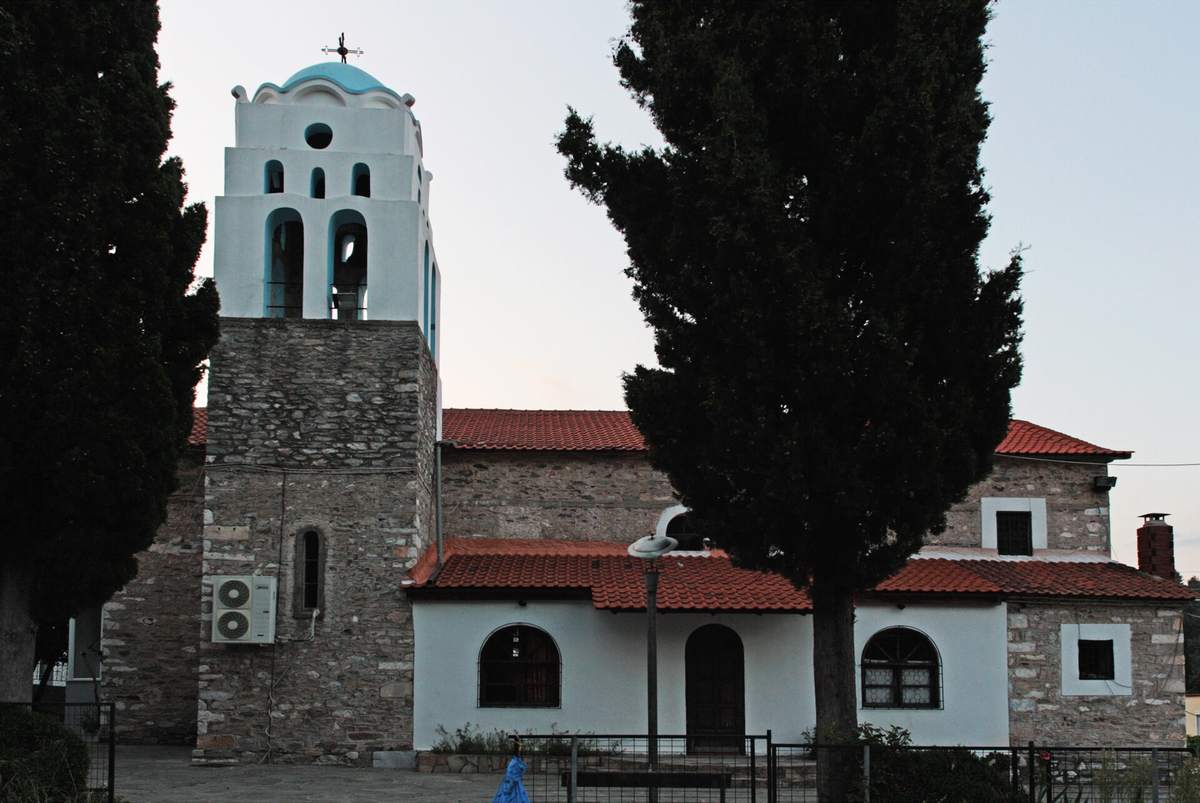
Potamia is a mountain village on the north-east slopes of Mount Ipsarion in Thassos. Stone and whitewashed houses spread up a green valley below the island’s highest peak. The village sits above Skala Potamia and Golden Beach, a short drive inland from the east-coast resorts. Running water and cooler evenings mark its mountain setting. A church and a plane-tree square anchor the centre, where tavernas serve mountain food. Potamia is the birthplace of the sculptor Polygnotos Vagis, and a museum in the village shows his work. Walkers know the village as the main trailhead for the climb up Ipsarion. Plan your visit to the village and the wider island with My Greece Tours.
Potamia rewards travellers who want a green, higher counterpoint to the beach resorts. The village lies close to the coast, near enough for a morning on the sand and an afternoon among stone houses. The sections below cover what makes the village special, where it sits and how to reach it, the Polygnotos Vagis Museum, the plane-tree square at its heart, the trail up Mount Ipsarion, the link to the coast at Golden Beach, and the neighbouring villages worth pairing with it. Each answer stays practical, so you can plan a half-day or a longer stop. Explore guided options and island transfers through Thassos tours before you set out.
What makes Potamia village in Thassos worth a visit?
Potamia is a mountain village on the north-east slopes of Mount Ipsarion. Stone and whitewashed houses climb a green valley below the island’s highest peak, and cooler evenings set it apart from the coastal resorts.
Potamia stands on the north-east slopes of Mount Ipsarion, the highest peak on Thassos. The village grew as a mountain settlement, and its layout still follows the old pattern. Houses press up the green valley, mixing bare stone walls with whitewashed fronts. Gardens and orchards fill the gaps between the lanes, fed by water off the heights. The dense, vertical plan gives Potamia a character unlike the flat beach villages nearby. Visitors climbing from the square soon reach viewpoints over the valley and the sea. This blend of altitude, stone and greenery marks the village as one of the most distinctive inland spots on the island.
Water shapes daily life in Potamia more than in most villages on Thassos. Streams run down from Ipsarion through the valley, and the sound of moving water carries along the lanes. The name of the village itself points to this feature, as Potamia relates to the Greek word for river. Green gardens thrive on the steady supply, keeping the slopes lush through the dry season. Fountains and channels once served every household, and a number of them still flow beside the streets. This constant water is the reason the valley stays green while the coast turns dry. The setting explains both the cooler air and the farming that sustained the village.
Evenings in Potamia carry a different mood from the beaches below. Cooler air settles as the sun drops behind the ridge, drawing diners to the tavernas near the square. Stone walls hold a soft warmth from the day, and lamps light the narrow lanes. The village keeps a quiet rhythm through the evening, with tables filling under the plane tree. Mountain food arrives from the kitchens, cooked in the old island style. This mix of cool air and slow dining explains why travellers climb up from the coast after a day on the sand. Potamia offers a change of pace without asking visitors to travel far from the shore.
Stone and whitewash together define how Potamia looks. Builders raised the houses from local rock, then washed the fronts white against the grey. Wooden balconies and shutters add colour along the lanes. Homes here have stood for generations, repaired rather than replaced, which keeps the old street plan intact. This continuity is why the village reads as genuine rather than staged. Walkers who follow the lanes upward find quiet courtyards, small chapels and sudden views across the valley. The green backdrop of the slopes frames every corner. Potamia rewards slow exploration, and its built character stands among the reasons it remains a favourite inland stop on Thassos.
Where is Potamia and how do you reach the village?
Potamia sits inland on the east coast of Thassos, a short drive up from Skala Potamia and Golden Beach. A car reaches the village easily along the paved road that climbs the valley below Mount Ipsarion.
Potamia lies inland from the east-coast resorts, set in the valley above the bay. Down at sea level, Skala Potamia serves as the nearest coastal base, with its harbour and tavernas. The long sweep of Golden Beach runs just south of the harbour, drawing families to this side of the island. The road up from the shore climbs through olive groves and pine, gaining height quickly. Drivers reach Potamia without difficulty, as the route is paved and signed. This close link between beach and mountain village lets visitors combine sand and stone in a single, easy day.
A car is the simplest way to reach Potamia and to explore beyond it. The island ring road runs along the east coast, and a marked turning leads up into the valley. Drivers who book Thassos car rental at the port gain the freedom to time their trip. Parking sits near the edge of the village, since the inner lanes are narrow and steep. Visitors then continue on foot toward the square. Reaching the village early rewards travellers with quiet lanes before the day warms. Potamia works well as one stop on a wider east-coast drive along the shore.
Potamia rises in the valley below Mount Ipsarion, the highest peak on Thassos. This position gives the village its cool air and its green setting. The mountain feeds the streams that keep the gardens lush, while the open aspect catches sea breezes. Walkers use the village as a threshold between the cultivated lower slopes and the wild uplands above. The valley narrows as it climbs, funnelling water and shade toward the houses. The setting explains both the village climate and its long life as a refuge from the coast. Height, water and shelter together shaped where Potamia grew.
Distances on this side of Thassos are short, which makes Potamia easy to fit into a day. The drive up from the shore takes only minutes, and the port town lies within comfortable reach along the ring road. Buses serve the coast road, though a car gives the most freedom to pair the village with beaches and viewpoints. Signage points clearly toward the valley from the main junctions. Travellers based anywhere on the east coast can add Potamia to a morning or afternoon plan. This central, reachable position keeps the village firmly on the island touring routes.
Who was Polygnotos Vagis and what does his museum show?
Polygnotos Vagis was a sculptor born in Potamia. The Polygnotos Vagis Museum in the village displays his bronze and stone works, and it is the main reason this small mountain settlement holds a museum of its own.
Polygnotos Vagis was born in Potamia, and the village claims him as its most famous son. He worked as a sculptor, shaping figures and forms from bronze and stone. His birthplace in the mountain village ties his art to this green valley below Ipsarion. The museum that carries his name stands in Potamia and gathers a body of his work. For a settlement of this size, holding a dedicated art museum is unusual. This link between a working sculptor and his home village gives Potamia a cultural weight beyond its quiet lanes. Visitors come for the stone houses and stay for the art.
The Polygnotos Vagis Museum sits within the village, close to the everyday life of the square and lanes. Inside, the collection shows the sculptor’s bronze and stone pieces, ranged for visitors to study at close hand. The works trace the forms and faces that occupied him across his career. Seeing them in his birthplace adds meaning that a city gallery could not match. The museum gives travellers a reason to climb inland beyond the beaches. A visit pairs well with a walk through the stone streets outside. The building keeps the memory of the Potamia sculptor alive for each new season of guests.
Sculpture in bronze and stone asks for a slow, close look, and the museum allows it. Each piece rewards a pause, turning the visit into more than a quick stop. The materials themselves, hard rock and cast metal, echo the stone houses of the village around them. This harmony between the art and its setting deepens the experience. Families find the museum a cool, calm break from the midday sun. Students of art trace the sculptor’s hand across the works on show. Potamia thus offers a rare blend of village life and gallery, drawing a different visitor from the beach crowds below.
The museum anchors Potamia on the cultural map of Thassos, not only its walking routes. Guides and island tours often include the village for this reason. A stop here shows how a small mountain community produced an artist of note. The collection turns a scenic detour into a lesson in Greek sculpture. Visitors leave with a sense of the valley as a place of making, not just of farming and views. This cultural draw sets Potamia apart from the purely scenic villages nearby. The sculptor and his museum remain central to why the village earns a place on any east-coast itinerary.
What stands at the centre of the village square?
A church and a broad plane tree anchor the square at the heart of Potamia. Tavernas set their tables in the shade, serving mountain food, while running water keeps the centre cool through the day.
The square forms the natural first stop for anyone arriving in Potamia. A broad plane tree spreads overhead, dropping the temperature on the hottest afternoons. The village church rises nearby, its bell marking the hours and the feast days. Tables from the surrounding tavernas fill the space beneath the branches. The square follows the slope of the valley, so steps and low walls break it into corners. Water runs close by, adding its sound to the shade. Sitting here with a cold drink gives the clearest sense of how the village lives around its centre. The plane tree and the church together frame the heart of Potamia.
The church gives the square its landmark and its calendar. Its bell tower stands above the rooftops, guiding visitors through the lanes. Generations have gathered here for worship, weddings and festivals. The building crowns the centre with a form that stands out against the stone houses. Feast days fill the square with families returning from across the island. The church anchors the village not only in faith but in memory, holding the story of the community. Travellers who pause at the door sense how closely worship and daily life sit in a Greek mountain village. The square and its church cannot be separated.
Tavernas around the square serve the mountain food that defines the village kitchen. Cooks work in the old island style, using local oil, vegetables and slow-roasted meat. Tables under the plane tree fill at lunch and again in the cool evening. Diners taste dishes that suit the higher, greener setting rather than the coast. The steady water and shade make the square usable even at midday. Cats doze on the warm stone while owners tend their tables. This compact, walkable core means visitors see the best of Potamia without a long climb. Food, as much as the view, keeps travellers lingering in the square.
Evening changes the square of Potamia again. Lamps switch on among the branches, and the tavernas shift from coffee to dinner. Cooler air pulls families and visitors out to the tables, and the space fills with quiet talk. Water keeps running through the night, its sound clearer once the day bustle fades. Lit from below, the plane tree and the church tower stand out against the dark hillside. This nightly rhythm has held for generations, and it draws diners up from the coast. The square proves that Potamia offers as much after sunset as it does under the midday sun.
Why is Potamia the trailhead for Mount Ipsarion?
Potamia sits at the foot of the climb to the Ipsarion summit, the highest point on Thassos. The main trail leaves the village and rises through pine and springs into the open uplands above.
Potamia sits at the threshold of the island’s finest walking country. The main path toward Mount Ipsarion leaves the village and climbs into the pine forest that clothes the slopes. The route gains height steadily, passing springs and shaded clearings. Walkers set out early from the square, using the cool morning before the sun climbs. The village makes a natural base, with tavernas for breakfast and water to fill bottles. Reaching the higher ground opens views across the whole east coast and out to sea. This role as the main trailhead is one reason walkers choose Potamia over the coastal resorts.
The walking from Potamia suits a range of abilities. Shorter loops explore the pine woods and terraces just above the village, taking an hour or two. Longer routes press on toward the Ipsarion ridge, a full day for fit walkers. Springs along the way provide cool water, and the shade of the forest tempers the heat. A marked path guides the main climb, though a map and sturdy footwear help on the rougher sections. Starting from the village keeps the approach gentle at first. Potamia thus opens the mountain to casual strollers and serious hikers alike, each finding a route to match the day.
Water shapes the climb from Potamia as much as it shapes the square. The same streams that green the valley rise on these slopes, and they cross the paths in places. Walkers pass mossy outcrops and small pools in the shade of the pines. This steady water keeps the forest green well into the dry season. Filling a bottle at a spring is part of the rhythm of a day on the mountain. The cool, wet gullies contrast with the bright, open ridge higher up. Setting out from Potamia, walkers follow the water upward from the valley streams to the heights that feed them.
Timing turns a walk from Potamia into a real pleasure. Early starts beat the heat and win the clearest views before haze builds over the sea. Spring and autumn bring cooler air and green slopes, ideal for the longer climb. Sturdy shoes, water and sun cover prepare walkers for the exposed upper section. Returning to the village square for a late lunch rewards the effort under the plane tree. The pairing of a morning climb and an afternoon in Potamia makes a full, balanced day. This rhythm of ascent and rest keeps drawing walkers back to the village season after season.
How does Potamia connect to the coast at Golden Beach?
Potamia sits a short drive above the coast at Skala Potamia and Golden Beach. The village and the shore share one valley, so visitors move between mountain lanes and sand in a matter of minutes.
Potamia and the coast below share a single stretch of valley on the east side of Thassos. The village looks down toward the bay, where the harbour of Skala Potamia meets the sea. The long sweep of Golden Beach runs south of the harbour, backed by pine and tamarisk. A short paved road ties the two together, climbing from sand to stone in minutes. This closeness lets visitors split a day between beach and mountain with ease. Travellers often base themselves on the coast and drive up to the village for the evening. The link between shore and slope defines how this corner of the island works.
The shore gives Potamia its warm, bright counterpoint. Skala Potamia offers a harbour, tavernas and easy swimming, while Golden Beach provides the long sand that families favour. Days often begin at sea level, with a morning on the beach before the heat peaks. The drive up to Potamia then brings cooler air and shade for the afternoon. This vertical rhythm, from sand to valley, suits the island’s climate. The two settlements share a name and a history, bound by the road between them. Splitting time this way gives visitors both the sea and the mountain within a single base.
The valley itself carries water from Potamia down toward the coast. Streams off Ipsarion feed the gardens of the village, then run on toward the plain behind the beach. This flow greens the whole descent, so the drive passes olive groves and orchards. The link is more than a road; it is a living valley shared by village and shore. Farmers work the terraces between the two, growing the produce that fills the tavernas. Visitors who drive the route see how the mountain sustains the coast below. The water that cools Potamia ends its journey near the sand of Golden Beach.
Pairing Potamia with the beach turns a seaside holiday into a fuller trip. A single day can join a morning swim, a mountain lunch and an evening in the square. The short distance removes any need to choose between sand and stone. Cooler nights in the village balance the bright heat of the shore. Local food, from grilled fish on the coast to slow-cooked meat in the village, ties the day together. Travellers who move between the two carry home a richer sense of Thassos. Potamia and its coast work best seen as one connected place, not two separate stops.
Which villages sit close to Potamia?
Panagia sits just above Potamia, sharing the same green valley below Mount Ipsarion. The two traditional villages pair naturally in one trip, and together they show the inland face of Thassos away from the resorts.
Potamia pairs naturally with the other traditional villages of Thassos. Panagia sits just above it, higher in the same green valley below Ipsarion. A short drive links the two, so travellers often see them together. The pair share a setting of stone houses, running water and cool mountain air. Visiting them in turn shows how the inland communities of the island grew and endured. Each keeps its own square, church and character. Building a day around Potamia and its neighbour reveals the inland face of Thassos, far from the busy beaches. The two villages form the heart of this green corner of the east coast.
Panagia rewards the short climb from Potamia with its own quiet charm. The village spreads across the higher slope, framed by orchards and the rising heights of Ipsarion. Its lanes and square echo those of its lower neighbour, though the setting feels steeper. A shaded square with running fountains sits at its centre. Walkers also use Panagia as a gateway to the same mountain trails. Seeing both villages in one trip highlights how each adapted to its place on the slope. Potamia and Panagia together form the traditional core of this part of the coast, worth a slow half-day of wandering.
The wider inland of Thassos holds more villages worth a detour from Potamia. Theologos, the old island capital in the south, preserves stone mansions and a long main street. Reaching it takes a longer drive, crossing toward the far side of the island. Its tavernas are known for slow-roasted meat cooked in old ovens. A trip there pairs well with a morning in Potamia and an afternoon exploring the old capital. Together these villages tell the story of how Thassos lived away from the sea. The inland settlements reward travellers ready to leave the beaches behind for a day.
Planning a village circuit around Potamia turns a beach holiday into a fuller journey. A single day can join the plane-tree square, the museum and the neighbouring village up the valley. Adding the old capital on another day widens the picture to the whole island. Cool evenings in the mountain villages balance the bright heat of the shore. Local food, from honey and walnuts to slow-cooked meat, ties the route together. Travellers who explore beyond the beaches carry home a richer sense of Thassos. Potamia, at the heart of this green valley, makes an ideal place to begin such a journey.
Frequently Asked Questions
Is Potamia worth visiting on Thassos?
Potamia is well worth a visit for travellers who want a mountain counterpoint to the beaches. The village offers stone and whitewashed houses in a green valley, a plane-tree square, running water and cooler evening air. Its short distance from Golden Beach makes it easy to combine sand and mountain in one relaxed day.
How do you get to Potamia in Thassos?
Potamia is reached by a short, paved drive up from Skala Potamia and Golden Beach on the east coast. A car is the simplest option, taking only minutes from the shore. Parking sits at the edge of the village, and visitors continue on foot into the narrow, climbing lanes toward the square.
Who was Polygnotos Vagis?
Polygnotos Vagis was a sculptor born in Potamia. He worked in bronze and stone, and the village keeps his memory through the Polygnotos Vagis Museum. The collection displays his sculptures in his birthplace, giving this small mountain settlement a cultural draw that sets it apart from the beach villages on the coast below.
What is there to see in Potamia village?
Potamia holds a plane-tree square, a village church, tavernas serving mountain food and the Polygnotos Vagis Museum. Stone and whitewashed houses climb the green valley below Mount Ipsarion, fed by running water off the heights. The village also serves as the main trailhead for the climb to the Ipsarion summit.
Can you hike Mount Ipsarion from Potamia?
Potamia is the main trailhead for the climb to Mount Ipsarion, the highest peak on Thassos. The path leaves the village and rises through pine forest and springs into the open uplands. Early starts and sturdy footwear are advised, and the village square makes a welcome place to rest afterwards.
Which villages are near Potamia?
Panagia sits just above Potamia, higher in the same green valley below Mount Ipsarion, and the two pair well in one trip. Theologos, the old island capital in the south, makes a rewarding second stop. Together these traditional villages reveal the inland character of Thassos, away from the coastal resorts.