
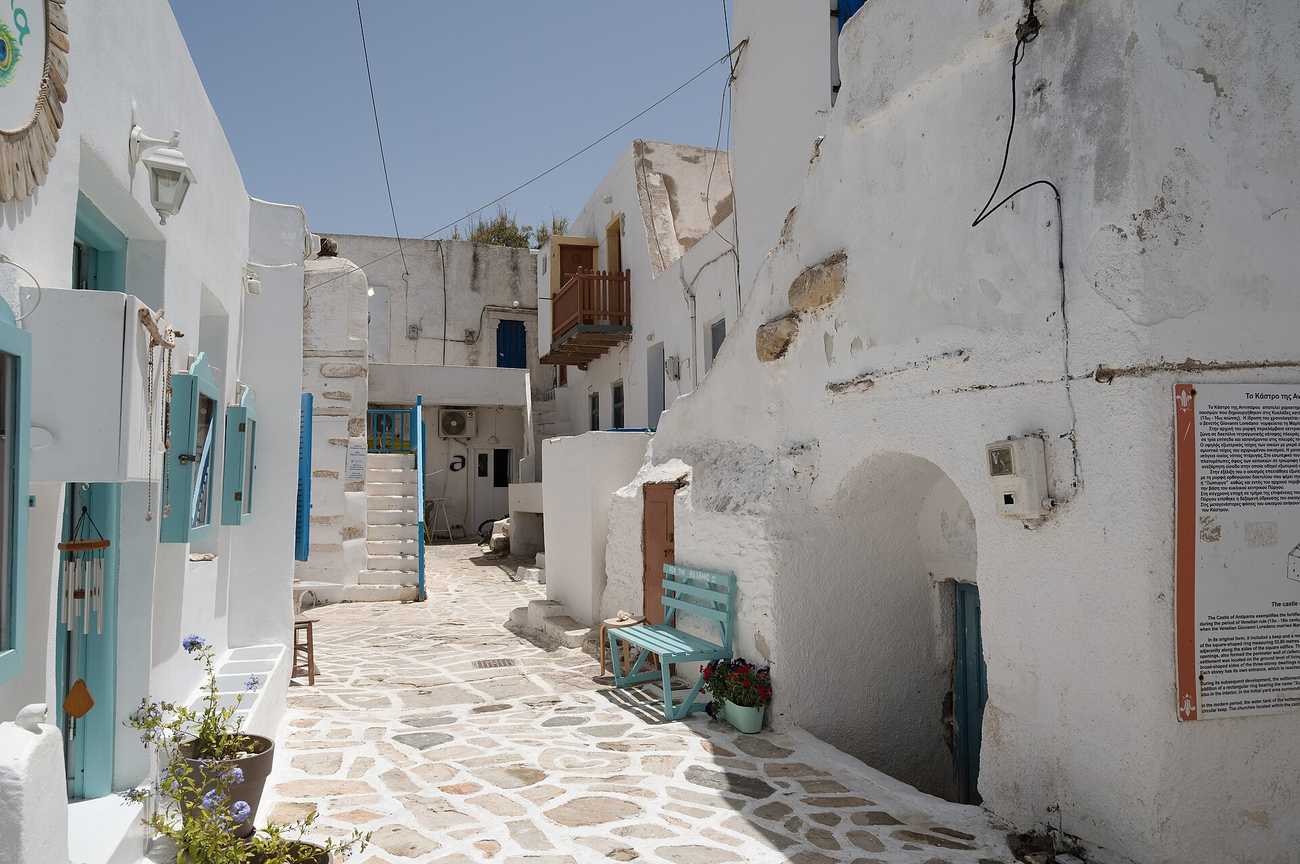
Antiparos town, known as the Chora, is the island’s whitewashed heart, set right by the port. A lively pedestrian main street runs up from the waterfront, lined with cafes, tavernas, shops and bars, shaded by trees and bright with flowers. At its centre stands the great sight of the town, a medieval Venetian castle, a fortified settlement of old stone houses built around a central tower. Wander the whitewashed lanes of the quiet Cycladic island with My Greece Tours.
The town joins classic Cycladic charm to a rare medieval heart, all within an easy stroll of the port and the beaches. A whitewashed main street, a Venetian castle, good dining and a relaxed evening buzz make it the natural base for a stay. The sections below cover the town itself, the Venetian castle, the main street and dining, the nightlife, and what lies nearby. Set the town in context with our Antiparos travel guide.
What is Antiparos town like?
Antiparos town, the Chora, is a whitewashed Cycladic village by the port, with a lively pedestrian main street of cafes, tavernas and shops. At its heart stands a medieval Venetian castle. Compact and charming, it is the island’s centre and natural base.
The town, or Chora, is the only real town on the island, and it sits right by the port where the ferries arrive. It is a classic Cycladic settlement of whitewashed houses, blue shutters and narrow lanes, bright with bougainvillea and shaded by trees. From the waterfront, a pedestrian main street runs up into the town, forming its lively spine, lined with cafes, tavernas, bakeries, shops, galleries and bars. Cars are kept out of the heart of the town, so it is a place for strolling, browsing and lingering. Compact and easy to explore on foot, the town has a relaxed, welcoming charm that draws visitors back each evening.
At the town’s core, set back from the main street, stands its great historic treasure, the Venetian castle, a fortified medieval village within the town. Around it, the modern town spreads in whitewashed lanes and small squares down to the sea. The port, the shops, the tavernas and the nearest beaches all lie within an easy walk, making the town the natural base for a stay on the island. Its combination of Cycladic beauty, a medieval heart and an easy, sociable atmosphere gives it real character. From here it is a short step to the sand, and the town sits close to the family bays of the Antiparos beaches just to the south.
The town works as well by day as by night. Mornings are for coffee and pastries at a cafe on the main street, browsing the shops and galleries, and picking up supplies before the beach. The whitewashed lanes stay cool and shaded in places, and the car-free centre makes wandering a pleasure. Because the port, the shops and the nearest beaches all lie within a short walk, the town serves as an easy hub for a stay, with no need for transport to reach the essentials. This blend of beauty and convenience, of a lovely Cycladic town that is also practical to stay in, is a large part of why visitors base themselves here.
What is the Venetian castle in Antiparos town?
The Venetian castle, or Kastro, at the heart of Antiparos town is a fortified medieval settlement of the fifteenth century. Old stone houses form a defensive ring around a central square and the remains of a tower.
The great historic sight of the town is its castle, the Kastro, a fortified medieval settlement dating from the Venetian era, built in the fifteenth century. Rather than a single fortress, it is a compact fortified village. A ring of tall stone houses built wall to wall forms a defensive outer barrier. Within lies an inner square and the remains of a central tower that once formed the stronghold. Entered through a low gateway, it opens into a hidden world of narrow lanes and old stone houses, many still lived in, gathered around the central space.
It is one of the oldest and best-preserved examples of this kind of fortified Cycladic settlement, built to shelter the islanders from the pirates who once plagued these seas.
Wandering into the Kastro from the busy main street is like stepping back in time and into a smaller, older village within the town. The outer ring of houses, the inner lanes and the central square, with the base of the old tower, tell the story of a community built for defence in dangerous times. The whitewashed stone, the arches and the quiet lanes make it an atmospheric and photogenic place to explore. As the town’s chief monument, the castle gives it a depth of history beyond its Cycladic prettiness, and it is one of the island’s key sights alongside the great cave and the ancient ruins on nearby Despotiko.
The Kastro repays a slow wander through its hidden lanes. Passing through the low gateway from the busy street, the visitor steps into a quieter, older world of narrow alleys and stone houses gathered around the central square. The base of the old tower, the ring of tall houses that once formed the defensive wall, and the worn steps and arches all tell of the dangerous centuries when the settlement was built for shelter. Many of the houses are still lived in, so daily life carries on among the history. Reading the shape of the fortified village in its lanes and walls turns a short visit into a real encounter with the island’s past.
What is the main street of Antiparos town like?
The main street of Antiparos town is a lively whitewashed pedestrian lane running up from the port, lined with cafes, tavernas, bakeries, shops, galleries and bars. Shaded and car-free, it is the town’s social spine, made for strolling, dining and people-watching.
The heart of the town’s life is its main street, a whitewashed pedestrian lane that climbs from the waterfront up through the town. Free of cars and shaded in places by trees and awnings, it is lined on both sides with cafes, tavernas, bakeries, shops, art galleries and bars. By day it is a pleasant place to stroll, browse the little shops and stop for a coffee or a bite; by evening it fills with people out to dine, drink and enjoy the cool air. The street and the small squares that open off it form the social spine of the town, where visitors and locals gather and the island’s easy, sociable atmosphere is felt at its strongest.
Dining is one of the pleasures of the town, and the main street and its surroundings hold a good range of tavernas and restaurants. Here you can eat fresh fish and seafood, classic Cycladic and Greek dishes, and more modern fare, at tables set out in the lanes and squares. Bakeries and cafes serve breakfasts, pastries and coffee through the day, and the town has a reputation for good, unpretentious food in a lovely setting. Lingering over a meal or a drink on the main street is a highlight of any stay. It is an easy pleasure to combine with the beaches, the castle and the other things to do in Antiparos.
The main street is the stage for the town’s social life. Lined with tavernas, cafes, bakeries, shops and bars, and shaded by trees and bright with bougainvillea, it draws people through the day and into the night. Tables spill out into the lane and the little squares, and the car-free surface makes it a place for strolling and lingering rather than passing through. The atmosphere is relaxed and sociable, a slow parade of visitors and locals. Whether for a morning coffee, an afternoon browse or a long evening meal, the street is where the town’s easy charm is felt most strongly, and it rewards simply being walked without any particular aim.
What is the nightlife like in Antiparos town?
Nightlife in Antiparos town is relaxed and stylish rather than wild, centred on the bars and cafes of the main street and lanes. In summer the town buzzes with people dining and drinking late, but it keeps a low-key, bohemian feel over brash clubs.
The island’s evening life centres on the town, and it has a character all its own: lively but relaxed, stylish but unpretentious. After dark, the main street and the little squares fill with people out to dine and drink, and a scattering of bars and lounges keep going late into the summer nights. The mood is sociable and easygoing, with music and conversation spilling into the lanes, rather than the loud clubs and party scene of some bigger islands. The town has long drawn a cosmopolitan, bohemian crowd, including artists, writers and some well-known visitors, who value its low-key charm, and this gives its nightlife a distinctive, understated style.
For most visitors, a night out on the island means a long, leisurely dinner at a taverna followed by drinks at a bar or cafe on the main street, watching the crowds go by in the warm evening. There are enough bars to keep the town lively through the season, but nothing to overwhelm its relaxed character. Those seeking a big, brash nightlife will find it on other islands, but those who want good food, a stylish drink and an easy, atmospheric evening will find the town ideal. The nightlife, like everything on the island, keeps a human scale and an unspoilt feel, and it rounds off days spent on the beaches or exploring the Antiparos cave.
The town’s low-key nightlife matches its stylish, unspoilt character. As the evening cools, the tavernas fill for long dinners of fresh fish and Cycladic dishes, and the bars and cafes on the main street draw a relaxed crowd late into the summer nights. The mood is sociable and easygoing, built on good food, a beautiful setting and a stylish drink rather than loud clubs or big dance floors. The cosmopolitan, bohemian crowd the island attracts gives the evenings a chic but understated feel. This gentle, characterful nightlife rounds out a stay in the town, letting visitors stroll home through the quiet lanes after a leisurely night out.
What is near Antiparos town?
Near Antiparos town lie the port, the family beaches of Psaraliki and Sifneiko, and the road south to Soros, Agios Georgios and the cave. The town is the island’s hub, within easy reach of its beaches, sights and the boats to Despotiko.
The town is the hub of the island, and nearly everything lies within easy reach of it. The port, where the ferries dock, is right by the town, and the nearest beaches are a short walk away. These are the sheltered family bays of Psaraliki just to the south, and the sunset beach of Sifneiko on the west coast. This closeness of town and beach is part of the island’s easy appeal, letting visitors move between the two on foot in minutes. The town is also where the shops, the tavernas, the bus stop and the services are found, making it the practical as well as the social centre of the island for visitors and locals alike.
From the town, the island’s road runs south past the campsite toward the main beaches of Soros and Agios Georgios. It continues to the great cave on the hill of Agios Ioannis, all served by the local bus. From Agios Georgios, small boats cross to the beaches and the ancient sanctuary on the islet of Despotiko. So the town is the starting point for exploring the whole island, from its beaches to its cave to its offshore ruins. Its central position, its beauty and its atmosphere make it the natural base for a stay, and reaching it is simple once you have arranged getting to Antiparos by the short ferry from Paros.
The town’s position makes it the gateway to the rest of the island. The single road runs south from it, followed by the local bus, past the campsite and the beaches to the great cave and on to the southwest coast, where boats cross to the islet of Despotiko. The nearest beaches lie within a short walk, and the port, where the ferries arrive, is right at hand. Everything a visitor needs to explore the island, from transport to supplies to information, is found in the town. This central role, combined with its beauty and its easy atmosphere, confirms it as the natural base for a stay and the heart of island life.
Frequently Asked Questions
Is Antiparos town worth visiting?
Antiparos town, the Chora, is very much worth visiting, and for those staying on the island it is the natural base and the centre of island life. It is a classic and beautiful Cycladic town of whitewashed houses, blue shutters and narrow, flower-filled lanes, set right by the port. A lively car-free pedestrian main street runs up from it, lined with cafes, tavernas, shops, galleries and bars. Its great historic treasure is the Venetian castle, or Kastro, at its heart, a well-preserved fortified medieval settlement built in the fifteenth century. A ring of old stone houses encloses an inner square and the remains of a central tower, one of the finest examples of such a fortified Cycladic village.
Beyond the castle, the town offers excellent dining, from fresh fish and Cycladic dishes to modern fare, and a relaxed, stylish nightlife that stays lively in summer without becoming brash. Its closeness to the port and to the family beaches of Psaraliki and the sunset beach of Sifneiko makes it wonderfully convenient. Even day trippers from neighbouring Paros find the town well worth the short ferry crossing, to wander its lanes, explore the castle and enjoy a meal or a drink. Charming, historic and easy to love, the town is one of the island’s chief pleasures.
What is the Kastro of Antiparos?
The Kastro of Antiparos is the Venetian castle at the heart of the island’s town, and it is the town’s most important historic monument. Dating from the Venetian era and built in the fifteenth century, it is not a single fortress but a fortified medieval settlement. It is an early and well-preserved example of a type of defensive village found in the Cyclades. It was built to protect the islanders from the pirates who once raided these seas. Its design is ingenious. A ring of tall stone houses built directly against one another, wall to wall, forms a continuous defensive outer barrier with few openings.
This encloses an inner core of narrow lanes and houses gathered around a central square. At its heart stand the remains of a tall central tower, once the ultimate stronghold. Entered through a low gateway from the modern town, the Kastro opens into a hidden, atmospheric world of whitewashed stone, arches and quiet lanes, many of its old houses still lived in today. Wandering into it from the busy main street feels like stepping into a smaller, older village within the town, and back in time to the dangerous centuries when it was built. As the chief monument of the town and one of the island’s key historic sights, it richly rewards a visit.
Where should you stay on Antiparos?
For most visitors, the best place to stay on Antiparos is in or near the town, the Chora, which is the island’s hub and the centre of its life. Staying in or close to the town puts you within easy walking distance of the port and the lively main street, with its shops, tavernas, cafes and bars. The nearest beaches are close too, the family bays of Psaraliki to the south and the sunset beach of Sifneiko on the west coast. It also places you at the starting point of the island’s road and bus route south to the main beaches and the famous cave, and near the boats to the islet of Despotiko.
The town offers a range of places to stay, from rooms and studios to small hotels and guesthouses, in and around its whitewashed lanes. Those seeking a quieter, more beach-focused stay might choose accommodation near one of the southern beaches, such as Soros or Agios Georgios, or at the campsite north of the town for a more low-key, outdoor holiday. But the town remains the most convenient and characterful base, combining beauty, history, dining and nightlife with easy access to the beaches and sights. It suits most visitors, whether staying for a short break or a longer holiday on the island.
What is there to see and do in Antiparos town?
Antiparos town, the Chora, offers plenty to see and do despite its small size, and it is the lively heart of the island. The chief historic sight is the Venetian castle, or Kastro, at the town’s centre, a well-preserved fortified medieval settlement built in the fifteenth century. A ring of old stone houses encloses an inner square and the remains of a central tower. Wandering into it through the low gateway feels like stepping into a hidden, older village within the town. Beyond the castle, the great pleasure of the town is simply strolling its whitewashed, car-free pedestrian main street and the little squares off it.
Visitors browse the shops, art galleries and craft stores, then settle at a cafe under the trees and bougainvillea to watch the world go by. The town is also the island’s dining hub, with tavernas and restaurants serving fresh fish and Cycladic dishes at tables set out in the lanes. It comes alive in the evening with a relaxed, stylish nightlife of bars and cafes. The nearest beaches, the family bays of Psaraliki and the sunset beach of Sifneiko, are only a short walk away, so a swim is easy to combine with time in the town.
The town is also the starting point for exploring the rest of the island, with the road and bus running south to the cave and the beaches, and it is the most convenient and characterful place to stay.