
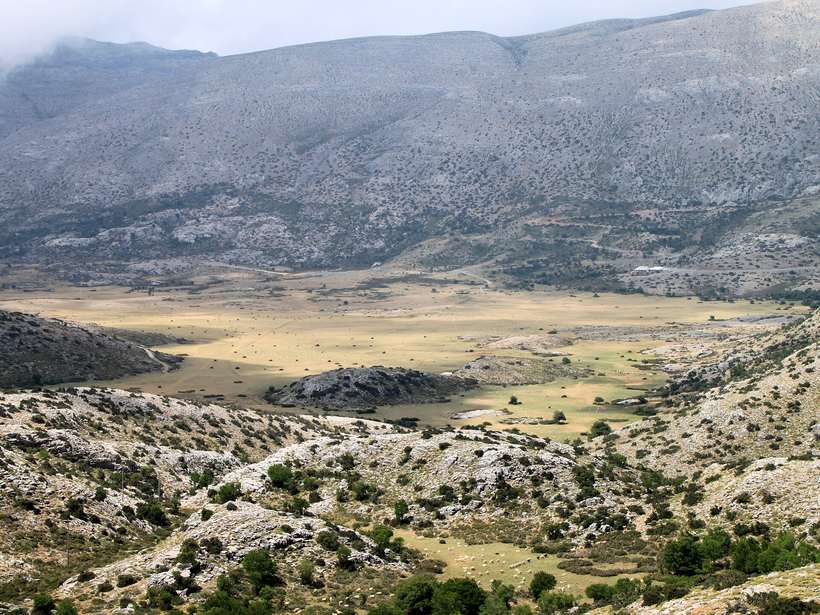
The Nida Plateau is a treeless high basin on the eastern flank of Psiloritis, the tallest mountain of Crete, in the Rethymno district above the village of Anogeia. It sits at around fourteen hundred metres, a flat plain ringed by bare peaks and grazed by sheep through the warm months. Round stone shepherds’ huts called mitata still dot the ground, and a paved road climbs to the basin through high pastures. Vast silence, clear mountain air and the wild heart of the island define this place. Plan your visit to the high country and the wider region with My Greece Tours.
The plateau rewards walkers, climbers and travellers drawn to open ground far from the coast. It is the main starting point for the climb to Timios Stavros, the highest point on the island, and a mountain refuge stands at its edge. The cave of Ideon Andron, an ancient cult site, opens on the slope above the plain. The sections below cover how to reach Nida, what the mitata are for, the summit route, the best season and the food of the pastures. For the full context of the island beyond this mountain, read our Crete travel guide before you set off.
Where is the Nida Plateau in Crete?
The Nida Plateau lies on the eastern flank of Psiloritis in the Rethymno district of Crete, above the mountain village of Anogeia. It rests at around fourteen hundred metres, a flat basin ringed by bare peaks.
A paved road climbs from Anogeia to Nida through high pastures, gaining height in long curves that leave the tree line well below. The drive opens onto a wide, treeless floor closed by bare grey summits on every side, the kind of ground that feels far from the busy coast. Anogeia itself is a weaving and music village with a strong mountain character, and it makes a natural base for the ascent. Travellers who want the wider picture of the island can browse things to do in Crete. A day in the high country pairs neatly with time on the beaches. One trip then holds both the wild interior and the softer edges of the shore.
The contrast between the bare basin and the warm coast below is among the sharpest, yet a short drive links the two.
The plateau belongs to the massif of Psiloritis, the highest range on the island, and its position on the eastern slope shapes the light and the weather across the day. Morning brings clear air and long shadows over the grass, while afternoon cloud can spill across the peaks and close the view within minutes. The basin has no shops and no fuel, so a visit is planned around what a traveller carries in. That emptiness is the point: Nida offers vast silence and a horizon of stone rather than services, a landscape that stands apart from every other corner of Crete and rewards those who arrive prepared for a bare, open plain.
The reward for that preparation is a rare stretch of true wilderness within reach of a made road.
What are the stone mitata huts on the plateau?
Mitata are round stone shepherds’ huts that still dot the Nida Plateau. Herders use them for milking their sheep and for making the hard graviera and other mountain cheeses that the high pastures are known for across the island.
Each mitata is built dry, without mortar, from the grey stone of the mountain, its corbelled roof rising to a small round dome that sheds rain and snow. The thick walls hold a steady cool inside through the summer heat, which suits the slow work of turning milk into cheese. Shepherds gather here through the grazing season, milk the flocks at dawn and dusk, and press the curd into the hard wheels that keep well through the year. This living pastoral craft is one of the hidden gems in Crete, a working tradition rather than a display, and it gives the plateau a human rhythm under the wide and otherwise empty mountain sky.
The sight of a mitata with its curl of smoke marks the plain as lived-in ground.
The cheese of these huts carries the flavour of the wild herbs that the sheep crop across the high grass, and it forms a cornerstone of Cretan food from the mountains. Graviera from Psiloritis is firm and nutty, aged in the cool stone until it slices clean, and it appears on tables far below in Anogeia and Rethymno. Visitors who reach Nida in the grazing months may see flocks moving across the basin and smoke rising from a hut where milk is being worked.
The scene has changed little over generations, a direct thread between the bare plateau and the food of the island, and it lends the place a depth that the raw landscape alone would not convey to a first-time guest. A wedge carried down from Nida tastes of the mountain that made it.
How do you climb Psiloritis from the plateau?
Nida is the main starting point for the climb to Timios Stavros, the summit of Psiloritis and the highest point on Crete. A mountain refuge stands at the plateau edge, and the marked trail rises from there toward the peak.
The route leaves the refuge at the plateau edge and climbs steadily over open rock toward the summit ridge, following waymarks across ground with no shade and no water. Walkers set out early to reach the top before the afternoon cloud gathers, and they carry layers, since the wind at the crest stays cold even in high summer. The reward at Timios Stavros is a view that reaches from sea to sea across the whole width of the island on a clear day.
This ascent ranks among the classic routes for hiking in Crete, a full day on the mountain that demands fitness, sound footwear and respect for weather that can change fast at height on exposed and stony terrain. Steady pacing and an early alpine start turn a hard ascent into a safe one.
The refuge at the plateau lets walkers break the climb over two days, resting at height before the final push to the crest at dawn. The village of Anogeia below serves as the road head and the last point for supplies, so climbers stock up there before driving the paved road up to Nida. The cave of Ideon Andron opens on the slope above the plain, an ancient cult site tied to old mountain myth, and walkers often visit it on the same trip.
The combination of a summit trail, a refuge and a cave within reach of one high basin makes Nida a rare hub for anyone who wants the tallest ground on the island in a single outing. One drive up brings the whole high world of Psiloritis within a day’s walk.
When is the best time to visit Nida in Crete?
Late spring to autumn is the best window for Nida, when the pastures are green or golden and the trails run clear. Snow covers the high basin through winter, and the cold makes the summit route hazardous then.
From late spring the road to the plateau opens fully and the grazing season brings flocks and shepherds back to the basin, filling the empty floor with movement and the sound of bells. Summer days are hot on the plain but the air stays clear and thin at height, and early starts beat the afternoon haze that can veil the peaks. Autumn brings a golden tone to the grass and cooler, steadier conditions that walkers prefer for the summit push. Each season changes the mood of the same ground, from bright green to burnt gold to the first white snow of the year.
A traveller can time a visit to catch whichever face of the high country suits the plan best across the whole calendar.
Winter closes much of this world as snow settles across the treeless basin and the peaks turn white against a low sun. The paved road may hold ice, the refuge grows harsh, and the summit route becomes a serious mountain undertaking for equipped parties rather than a day walk. Even so, the plain under snow has a stark beauty that draws hardy visitors who accept the risk and the cold. For most travellers the safe and rewarding season runs from the thaw to the first snows. That long stretch covers the bulk of the year and lines up neatly with the wider island calendar.
A mountain day at Nida slots easily into a broader Cretan itinerary of coast and interior. There is no need to choose between the sea and the high stone country.
What makes the Nida Plateau worth the drive?
Nida offers vast silence, clear air and the wild heart of the Cretan mountains. The treeless basin, the round stone mitata, the summit route and the ancient cave together give a rare, remote experience far from the crowded coast.
The drive up the paved road is a reward in itself, climbing through high pastures where the land opens wider with every curve until the tree line falls away and only bare grey stone and grass remain. Reaching the flat floor of the basin feels like arriving in a separate country, a place of stone huts and grazing sheep held inside a ring of peaks. The absence of shops, noise and traffic is the whole appeal, an emptiness that clears the head and slows the day. Travellers who value quiet and space over resorts find here a landscape that answers directly.
It stands among the strongest cases on the island for leaving the shore and turning inland toward the true backbone of Crete and its old mountain life.
A day at Nida can be shaped to taste, from a gentle wander among the mitata to a full ascent of the highest peak, with the Ideon Andron cave adding a layer of ancient story to the raw scenery. The high ground pairs well with the culture of Anogeia below and with the mountain food that comes off these pastures, giving a trip both wild terrain and living tradition. Few corners of the island combine such silence, such height and such deep pastoral roots in one accessible basin reached by a made road.
For anyone building a route that goes beyond the beaches, the plateau stands out as a clear and lasting highlight of the interior, well worth every kilometre of the climb from the coast.
Frequently Asked Questions
How high is the Nida Plateau and how cold does it get?
The Nida Plateau lies at around fourteen hundred metres above sea level on the eastern flank of Psiloritis, the highest mountain of Crete. At that height the air stays cool and thin even when the coast far below bakes in summer heat, so a jacket is wise on the plain and essential higher up the summit route. Wind sweeps the open basin with little to break it, and the temperature at the crest of Timios Stavros stays cold through much of the year. Winter brings snow across the treeless floor and turns the surrounding peaks white, closing the high routes to all but equipped mountain parties.
The safe season runs from late spring to autumn, when days are long and the pastures fill with flocks. Travellers should treat Nida as true high country, carry layers whatever the coastal forecast, and start any climb early to stay ahead of afternoon cloud.
Can you buy food or fuel on the plateau?
The plateau has no shops and no fuel, so a visit is planned around what a traveller carries in from below. The village of Anogeia, at the road head, is the last place to stock up on water, snacks and supplies before the paved climb to the basin. A mountain refuge stands at the edge of the plateau and serves walkers who break the summit climb over two days, but it is not a shop and should not be relied on for full provisions. The emptiness of the plain is part of its character, a landscape of stone huts and grazing sheep rather than services.
Bring more water than a coastal day would need, since the open ground offers no shade and no springs on the marked routes. The mitata huts scattered across the basin are working shepherds’ shelters for milking and cheese, not cafes, so plan a self-sufficient day and pack out whatever you carry up.
What is the cave of Ideon Andron near Nida?
The cave of Ideon Andron opens on the slope above the Nida Plateau, an ancient cult site set into the flank of Psiloritis. It was a place of worship in the deep past, tied to old mountain myth. It draws visitors who pair a look at the cave with a walk on the plateau or the climb toward the summit. The setting is stark, a dark mouth in the grey rock above a treeless plain ringed by bare peaks. Reaching it forms part of the wider experience of the high country rather than a separate excursion. Walkers often visit the cave on the same trip that takes in the mitata huts and the refuge at the plateau edge.
The site adds a layer of history to a landscape that already offers silence, clear air and the wild heart of the Cretan mountains. Nida gains both natural and cultural weight, and the long drive up from the coast feels doubly worthwhile in return.