
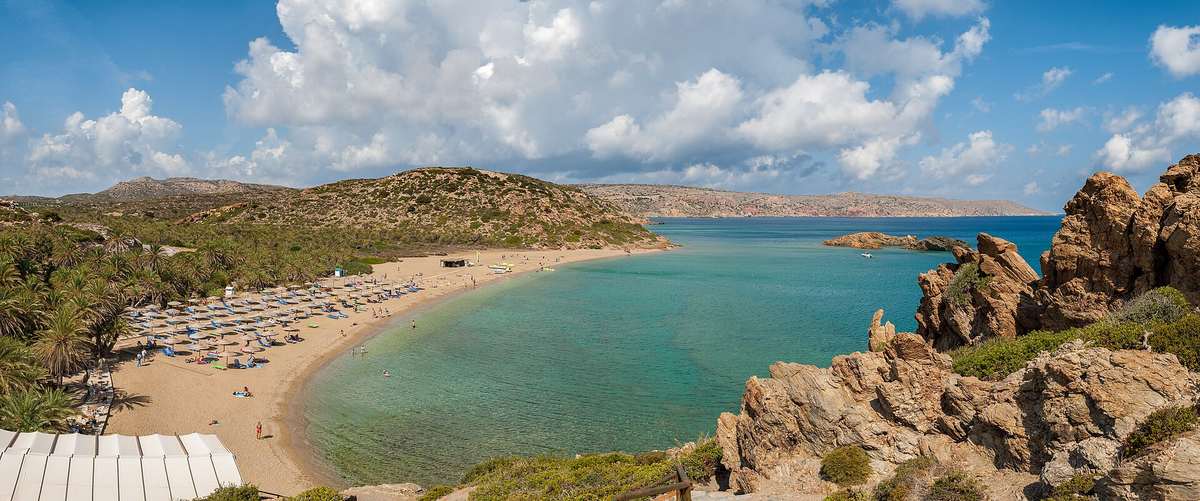
Vai Beach sits on the far north-eastern tip of Crete, in the Lasithi region, and it looks like nowhere else on the island. A dense wall of native date palms rises directly behind the golden sand, forming the largest natural palm grove in Europe. The water is clear and turquoise, sun-loungers line the shore, and a canteen keeps swimmers fed through the long summer days. This is a protected nature reserve, so the palms, dunes and marked paths are all part of the experience. Getting here means a long drive to the eastern edge of Crete, a journey many travellers plan with My Greece Tours.
The palm forest at Vai is made of the Cretan date palm, a species called Phoenix theophrasti that grows wild in this corner of the island. Vai lies beyond Sitia and close to the ancient site of Itanos and the Toplou Monastery, so it pairs well with a wider east-Crete route. Our Crete travel guide places this beach within the island’s bigger picture, from mountain villages to famous lagoons. The sections below cover how to reach Vai, why the palm grove is protected, what a day here involves, and which nearby sights round out the trip.
Where is Vai Beach in Crete?
Vai sits on the far north-eastern tip of Crete, in the Lasithi region, well beyond the town of Sitia. It is the most easterly beach most visitors reach, close to the ancient site of Itanos.
Vai occupies a sheltered bay at the eastern edge of Crete, in the Lasithi region, past the port town of Sitia. The road out here threads through hills, small settlements and long open stretches before the palm grove finally comes into view. Reaching it takes commitment, and that distance is part of why the beach keeps its wild, remote feel. Travellers touring the eastern half of the island often build Vai into a full day, since backtracking to the busy centre of Crete makes little sense once you have driven this far east. The setting rewards the effort with a shoreline unlike any other on the island.
The best way to enjoy Vai is to base yourself somewhere in east Crete rather than attempt it from the western resorts. A stay around Sitia, or further inland near the Agios Nikolaos area, cuts the driving and leaves time for the neighbouring sights. The wider list of things to do in Crete shows how Vai fits alongside the beaches, gorges and old towns of the east. Plan the day as a loop that takes in the palm grove plus a couple of nearby stops, and the long drive becomes a scenic route rather than a chore.
Why is the palm forest at Vai protected?
The grove is the largest natural palm forest in Europe and holds the native Cretan date palm, Phoenix theophrasti. Vai is a protected nature reserve, so visitors keep to marked paths and stay off the palms and dunes.
The palms behind Vai are not imported ornamentals but a wild population of Phoenix theophrasti, the Cretan date palm that has grown in this bay for a very long time. This is the largest natural palm grove on the continent, and it gives the beach a look more often linked with far-warmer latitudes. The trees, the sand dunes and the surrounding habitat all form a fragile system that struggles to recover once trampled. That is why the whole area carries protected status and why signs ask visitors to treat the grove as a living monument rather than a backdrop for wandering.
Respecting the reserve is simple in practice. Stay on the marked paths, keep off the dunes, and do not climb, cut or lean against the palms. The rules protect a habitat that features across the region’s Natura network of conservation sites. Vai also ranks among the standout hidden gems in Crete precisely because that protection has kept its character intact. Follow the guidance and the beach stays exactly as striking for the next arrivals, its palm wall unbroken and its sand free of the scars heavy footfall would otherwise leave behind on such delicate ground.
What is a day at Vai Beach like?
You get golden sand, clear turquoise water, sun-loungers and a canteen backed by the palm forest. Vai gets very busy in summer, so an early arrival buys the calmest water and the best pick of the loungers.
A day at Vai starts with the swim. The bay holds clear turquoise water that shelves gently, and the golden sand runs the width of the cove beneath the palms. Rows of sun-loungers cover much of the beach in season, and a canteen handles drinks and snacks so you need not carry a full picnic. The palm grove throws welcome shade at the edges and gives the whole scene its unmistakable frame. Most visitors settle in for hours, alternating between the water and the loungers, with the green wall of trees standing behind them the entire time as a natural windbreak and shelter. Around the headland, the steady wind at Kouremenos beach draws windsurfers to a livelier shore.
Timing matters more here than at many Cretan beaches. Vai gets very busy through the summer, and the loungers, water and the single access road all fill as the morning wears on. Arrive early and you claim the quiet, glassy water and an easy parking spot; arrive at midday and you join the crowd. A dawn start also frees the afternoon for the nearby monastery and ruins. Pack water, sun cover and swimming gear, and treat the canteen as a backup rather than the plan. That rhythm turns a long drive into a relaxed, full day on one of the island’s most photographed shores.
What can you see near Vai Beach?
Vai lies close to the ancient site of Itanos and the Toplou Monastery, with Sitia the nearest town. These stops turn the long drive east into a rounded day of beach, history and monastic architecture.
Vai does not stand alone. A short distance away lie the remains of ancient Itanos, a coastal settlement whose ruins spread across low headlands beside quiet coves. Inland sits the fortified Toplou Monastery, a striking stone complex with a long history in this remote corner of the island. Together they let you pair a morning swim with an afternoon of walking through history, all within the same eastern loop. Sitia, the nearest town, offers a harbour front, tavernas and a place to fuel up before or after the beach, which makes it a natural anchor for the whole excursion out here.
Further afield, east Crete rewards anyone willing to keep exploring. The former leper island of Spinalonga guards the Gulf of Mirabello, while the wind-mill dotted Lasithi Plateau climbs into the mountains above the coast. Neither sits right beside Vai, yet both belong to the same broad region and suit a multi-day base in the east. Line them up across several days and the palm grove becomes one memorable chapter in a fuller eastern itinerary, joining ancient ruins, mountain plains and island fortresses into a single, varied stretch of Cretan travel.
How do you plan a trip to Vai in east Crete?
Base yourself in the east, near Sitia or the wider Agios Nikolaos area, and treat Vai as a full-day loop. The long drive from central or western Crete makes a same-day return impractical.
The smart way to reach Vai is to stop fighting the geography. This beach sits at the eastern extreme of Crete, so a base near Sitia keeps the drive short and leaves energy for the palm grove itself. Travellers already touring the east can slot Vai between other stops rather than treating it as a single out-and-back mission from a distant resort. A morning at the beach, a mid-day meal in Sitia and an afternoon among the ruins or at the monastery make a balanced day that uses the remote setting well instead of spending it all behind the wheel.
Anyone coming from the centre or west should give Vai its own day and expect a long road in each direction. Build the visit into a wider plan and the eastern corner opens up naturally, from the palm forest to the quiet coves around Itanos. The broader things to do in Crete overview helps you decide how many nights the east deserves and which base fits your route. Approach the trip that way and Vai stops being a tiring detour and becomes the highlight of a well-paced eastern journey across one of the Mediterranean’s largest and most varied islands.
Frequently Asked Questions
Is Vai Beach worth the long drive?
Vai rewards the effort for travellers who like a beach with a genuine sense of place. The palm forest behind the sand is the largest natural grove in Europe, built from the native Cretan date palm, and nothing else on the island matches the look. You get golden sand, clear turquoise water, sun-loungers and a canteen, all framed by that green wall of trees. The catch is the distance, since Vai sits on the far north-eastern tip of Crete beyond Sitia. Treat it as a full-day loop from an east-Crete base and pair it with the nearby ancient site of Itanos and the Toplou Monastery, and the drive pays off.
Attempt it as a same-day return from a western resort and the road eats the day. Base yourself in the east and Vai becomes a highlight rather than a slog, which is how most visitors end up remembering it.
Can you walk into the palm forest at Vai?
Vai is a protected nature reserve, so the palm grove is not an open playground. You keep to the marked paths and stay off the palms and the dunes, both of which form a fragile habitat that damages easily under foot. The grove holds a wild population of Phoenix theophrasti, the Cretan date palm, and the whole area sits within the region’s Natura network of conservation sites. The rules exist to preserve exactly the scenery that draws people here in the first place. From the paths and the beach you still get the full effect: the wall of palms rises right behind the sand, giving shade and a backdrop found nowhere else in Europe on this scale.
Respect the signs, avoid climbing or cutting the trees, and the reserve stays intact for the next arrivals. That small discipline keeps Vai the striking, unspoiled place its reputation promises.
When is the best time to visit Vai Beach?
Vai gets very busy through the peak summer months, so timing shapes the whole visit. Arrive early in the morning and you find the calmest, glassiest water, an easy parking spot and a free pick of the sun-loungers before the crowds build. Come at midday in high season and you share a full beach and a busy single access road. An early start also frees the afternoon for the nearby ancient site of Itanos and the Toplou Monastery, turning a long drive east into a rounded day. The shoulder seasons on either side of high summer bring thinner crowds while the palm forest and turquoise water stay just as striking.
Whichever month you choose, plan around the heat and the traffic: pack water and sun cover, use the canteen as a backup, and set off early. That approach makes the most of a remote beach that rewards visitors who beat the rush.