
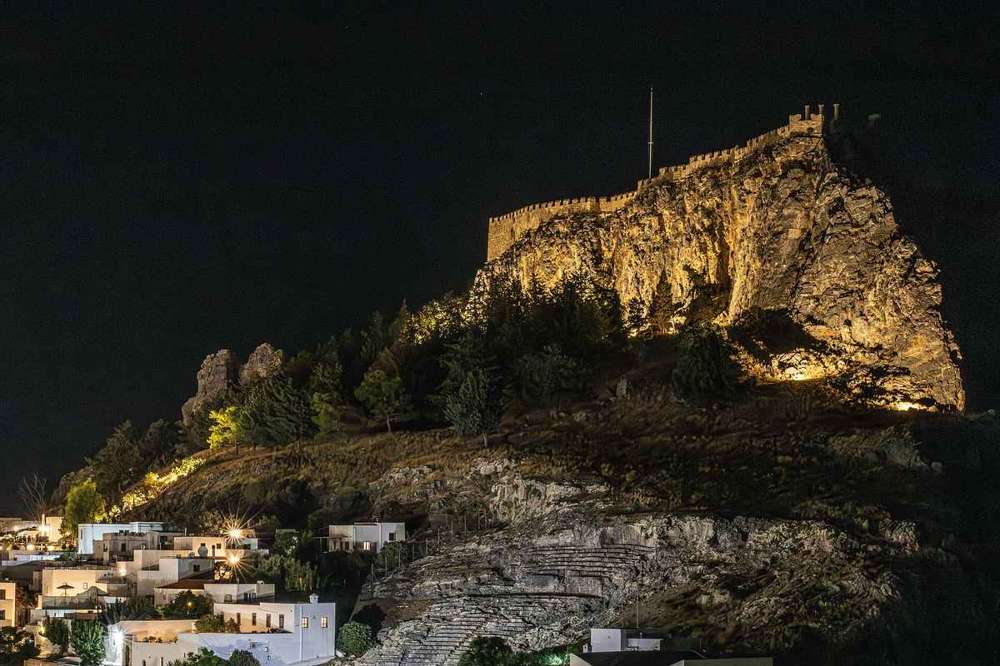
The villages of Rhodes are the island’s quiet heart, a world apart from the packed beaches and neon strips of the coastal resorts. Scattered across the mountains, the forested interior and the far-flung southern tip, these settlements preserve a way of life that the tourist towns lost decades ago. You will find whitewashed lanes barely wide enough for a scooter, shaded squares where old men play backgammon under plane trees, and family tavernas serving whatever the fields and vineyards produced that season. Each village has its own church, its own festival day and its own stubborn character, shaped by farming, wine and honey rather than sun-loungers. Visiting them turns a beach holiday into a proper acquaintance with the real island. This overview is your starting point for the whole cluster, brought to you by My Greece Tours.
Rhodes is far larger and more varied than its coastline suggests, and our Rhodes travel guide treats the interior as seriously as the beaches. The sections below cover what makes a Rhodian village distinctive, the mountain wine country, the green forested hamlets, the historic east-coast settlements, the honey and craft villages, and the practical business of touring them by car so you experience the authentic island rather than the resort version.
What makes a traditional Rhodian village distinctive?
A traditional Rhodian village is built for shade and community rather than tourism: whitewashed stone houses along narrow lanes, a central square with plane trees and a kafeneion, a domed church, and tavernas serving honest food grown in the surrounding fields and vineyards.
The architecture tells the story. Houses are low, thick-walled and lime-washed white to reflect the summer heat, their courtyards paved with black-and-white pebble mosaics known as choklakia. Lanes twist deliberately to break the wind and throw shade, opening now and then onto a square where a plane tree spreads over stone benches and a kafeneion serves Greek coffee and ouzo. The church anchors village life, its bell marking the day and its saint marking the calendar with an annual panigyri. Around the houses lie the working landscape that sustains the place: olive groves, vegetable plots, beehives and vines. Nothing here is staged for visitors, which is precisely the point.
Food is where the character concentrates. Village tavernas cook what the season and the land provide, so you eat wild greens, home-pressed olive oil, grilled local meat, garden tomatoes and cheese from nearby flocks, often washed down with barrel wine. Prices are lower and portions larger than on the coast, and the cook is frequently the owner’s mother. This honest, rooted food is the clearest expression of authentic Rhodian life. Our guide to things to do in Rhodes covers how village lunches fit a wider itinerary, and the next section covers the mountain wine villages of the interior.
Where are the mountain wine villages of the interior?
The island’s wine country sits high on the slopes of Mount Attavyros, the tallest peak on Rhodes, centred on the village of Embonas. Cool altitude and stony, well-drained soils make this the heartland of Rhodian viticulture and rustic mountain cooking.
Embonas is the acknowledged capital of Rhodian wine, sitting high on the northern flank of Attavyros. The surrounding vineyards grow the indigenous white Athiri and red Mandilaria grapes, and several family wineries and cooperatives open their doors for tastings of crisp whites, robust reds and the local firewater, souma. The village itself is unpretentious and workmanlike, its tavernas famous across the island for spit-roasted meat and mezedes served at long tables, especially busy when Rhodians drive up at the weekend for lunch. Traditional dress still appears at the village festivals, and the surrounding slopes are laced with old footpaths between the vineyards and the pine line.
Beyond Embonas the mountain roads climb through Agios Isidoros and the wider Attavyros slopes, where terraced vineyards and old stone threshing floors mark centuries of highland farming. The air is noticeably cooler and pine-scented, and the views stretch down towards both coasts on a clear day. This is walking and driving country, best explored slowly with a long lunch built into the plan. Our guide to Embonas covers the wineries, tastings and tavernas in detail, and the next section covers the green forested hamlets of the inland north.
What are the green forested inland villages like?
The wooded interior north of Attavyros is greener and gentler than the wine mountains, threaded with pine forest, running springs and shady valleys. Its villages cluster near the famous Valley of the Butterflies and the springs at Epta Piges, offering cool walks and quiet squares.
This part of Rhodes surprises visitors who expect a dry island. Dense pine forest covers the hills, and streams keep the valleys green well into summer. The Valley of the Butterflies, or Petaloudes, draws thousands of Jersey tiger moths to its damp, sweet-gum-scented gorge, while nearby villages such as Psinthos sit among orchards and plane-shaded squares built for lingering. The pace is slow, the tavernas serve river-fresh trout and grilled meats, and the whole area rewards those who wander off the coastal ring road. Small chapels dot the hillsides, and beekeepers work the wildflower meadows, so a jar of local honey is never far from the roadside.
Further along lies Epta Piges, the Seven Springs, where cold water gathers into a small lake reached through a short dark tunnel, a favourite weekend picnic spot for local families. The surrounding hamlets are farming communities first and foremost, with beehives on the hillsides and vegetable gardens behind every house. Cool, shaded and unhurried, this green belt is the antidote to the beach crowds. Our guide to Lindos covers the island’s star whitewashed village on the coast, and the next section covers the historic villages of the east coast.
Which are the historic villages of the east coast?
The east coast holds the island’s most storied villages, from the working town of Archangelos with its castle and craft traditions to Lindos, the whitewashed star village crowned by an ancient acropolis. These settlements blend deep history with everyday Rhodian life.
Archangelos is the largest village on Rhodes and one of its most characterful, spread beneath a ruined Knights’ castle and hilltop churches. It has long been a centre of traditional crafts, known for handmade leather boots, pottery and carpet weaving, and its lanes still hum with genuine daily life rather than souvenir stalls. Orange and lemon groves surround the village, and the local dialect and festivals remain strong, making it a rewarding stop for travellers who want to see how a large Rhodian community actually lives and works.
Lindos is the undisputed jewel: a maze of dazzling white cube houses, sea-captains’ mansions with carved doorways and pebble-mosaic courtyards, all climbing to a dramatic clifftop acropolis above two turquoise bays. It is busier than the inland villages, yet outside peak hours its stepped lanes are magical, and its history as an ancient trading city runs deep. Our guide to Archangelos covers its castle, crafts and churches, and the next section covers the honey and craft villages of the south and west.
What are the honey, craft and far-south villages?
The southern and south-western villages are the island’s quietest, known for honey, ceramics and hand-woven textiles. Siana is famous for its thyme honey and souma, while the remote settlements near the southern tip preserve an unhurried, deeply traditional way of life.
Siana clings to a hillside below Mount Akramytis on the road south from Monolithos, and it is celebrated across Rhodes for two products: fragrant thyme honey and souma, a strong grape spirit distilled locally. Roadside stalls and the village tavernas sell both, and the terrace views over forest and sea are among the finest on the island. Craft traditions run deep here and in the neighbouring hill villages, where weaving, pottery and beekeeping still shape the local economy far more than tourism does. The stone church at the heart of the village and the pine-clad ridge behind it make Siana a natural pause on any drive down the wild west coast.
Beyond Siana the far south grows steadily emptier and wilder, with villages such as Mesanagros, Lachania and Kattavia sitting among rolling farmland near the island’s remote tip at Prasonisi. These are lived-in communities where old squares, tiny churches and a single kafeneion set the rhythm, and where visitors are welcomed as guests rather than customers. Exploring them gives you the most authentic Rhodes of all, well away from the resorts. Our guide to Siana covers its honey, souma and viewpoints, and shows why the deep south rewards the drive. Plan your visit and tours through our Rhodes travel guide.
Frequently Asked Questions
Do I need a car to visit the villages of Rhodes?
A hire car is by far the best way to explore the villages of Rhodes, and for most of them it is essential. Public buses do reach the larger settlements such as Archangelos, Embonas and Lindos, but services are infrequent, slow and geared to locals rather than sightseers, and they rarely connect one village to the next in a sensible loop. The real pleasure of the interior lies in stringing several villages together on an inland driving route, pausing for a spring, a viewpoint, a winery or a long lunch as the mood takes you. A small car handles the mountain roads comfortably, parking is usually free at the village edge, and the freedom to stop wherever a plane-shaded square or a honey stall catches your eye is exactly what makes a village day so rewarding. Organised tours are a good alternative if you would rather not drive, and they take the mountain hairpins off your hands.
When is the best time to eat in a Rhodian village?
Lunch is the classic village meal, and weekends are the liveliest and most authentic time to sit down. On Saturdays and especially Sundays, Rhodian families drive up into the mountains and the interior to eat long, unhurried lunches in their favourite tavernas, so the squares fill with locals, the spit-roasts turn and the atmosphere is at its warmest. Arriving in the early afternoon puts you in step with this rhythm rather than eating alone at an odd hour. Aim for a taverna that is busy with Greek families rather than empty, order the daily specials and the barrel wine, and allow a couple of hours; the food is cooked to be lingered over, not rushed. Many village kitchens close in the late afternoon and reopen for a lighter evening service, so a leisurely midday meal is the surest way to eat well and to see village life at its most genuine and welcoming.
How should visitors behave in Rhodian villages?
Rhodian villages are lived-in communities, not open-air museums, so a little courtesy goes a long way. Dress modestly when you wander the lanes and always when you step inside a church, covering shoulders and knees as a matter of respect. Keep your voice down in the squares, ask before photographing people or their doorways, and remember that many of the houses you admire are private homes. Support the village by buying its honey, wine, souma or crafts directly and by eating in the local taverna rather than treating the place as a backdrop for photos. Drive slowly and carefully through the narrow lanes, park considerately at the edge of the village, and greet people with a simple kalimera or kalispera, which is almost always returned with warmth. Approached this way, the villagers open up, and you experience the genuine hospitality that makes the traditional side of Rhodes so memorable and rewarding to seek out.