
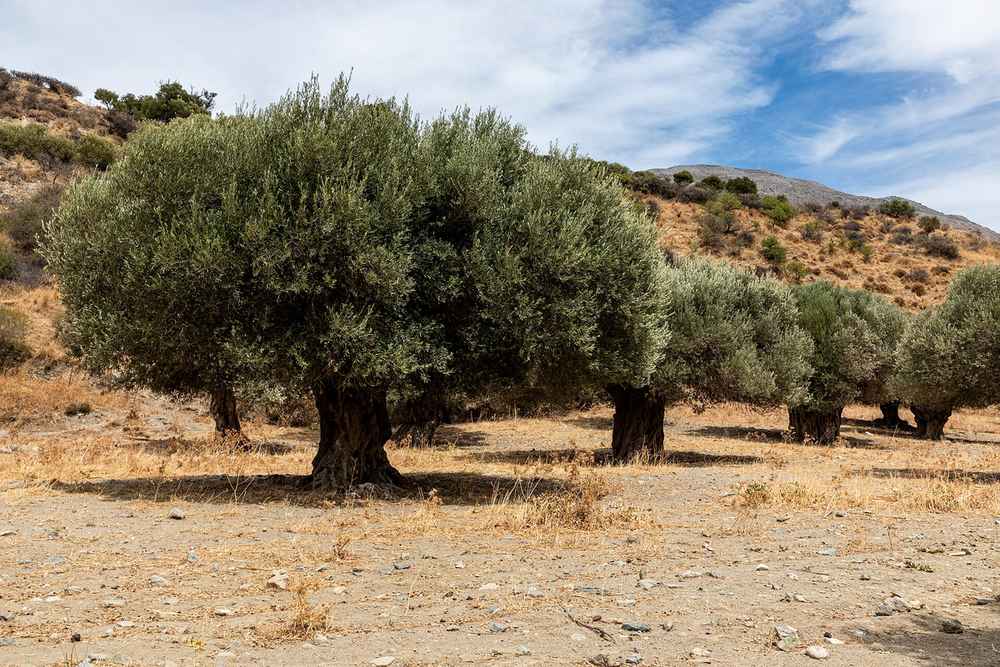
Minoan agriculture was the farming system of Bronze Age Crete, built on cereals, olives and grapes alongside livestock, pulses and orchard crops that fed the island and fuelled its palace economy. This agricultural foundation made Crete one of the wealthiest societies of the ancient Aegean. Plan tickets and tours through My Greece Tours.
The harvests and surplus described here flowed into great storerooms at the Palace of Knossos, the administrative heart of the system. The sections below cover what the Minoans farmed, the Mediterranean triad, how the palaces managed food production and storage, the tools and methods they used, and how agriculture supported Minoan society.
What did the Minoans farm?
The Minoans farmed cereals such as wheat and barley, olives for oil and grapes for wine, together with pulses, figs and saffron, and they raised sheep, goats, pigs and cattle for wool, milk and meat.
Minoan farmers worked a mixed economy. Arable fields, orchards, vineyards and pasture spread across the fertile plains and terraced hillsides of Crete. Cereals gave the staple bread and porridge. Olives and grapes became oil and wine, both of which stored well and travelled far. Pulses such as beans, lentils and chickpeas added protein to the diet. Figs, pears, quinces and other fruit rounded out the harvest.
Specialised crops gave Crete high-value goods. Saffron was the most famous, harvested from crocus flowers and shown in the frescoes of Thera. Flax supplied fibre for linen alongside wool. Herbs, poppy and coriander grew in garden plots. Bees gave honey and wax, the only sweetener and a key ritual material. Together these crops built a broad, resilient farming base that used every part of the Cretan landscape.
The cereals themselves came in several kinds. The Minoans grew emmer and einkorn, older hulled wheats, alongside barley and free-threshing wheat. Barley was hardy and reliable, so it often fed the poorer table and the animals. Wheat made the finer white bread prized by those who could afford it. Millet and oats appear too, and rye grew in the cooler upland fields. Growing a spread of grains was a safeguard: if one crop failed in a bad year, another might still yield. This variety was insurance written into the fields.
Livestock mattered as much as crops. Flocks of sheep and goats gave wool, milk, cheese and meat, and the wool fed a large textile industry. Pigs and cattle added further meat. Oxen supplied the muscle for ploughing, which made cattle vital to the fields as well as the table. This blend of plants and animals spread risk across the seasons and gave farmers a dependable surplus.
The mix also worked as a system, not just a list. Animals grazed the stubble after harvest and manured the fields. Orchards and vines held slopes that grain could not. Legumes returned nitrogen to tired soil. Bees pollinated the crops and gave honey in return. Goats browsed the rough scrub that no plough could use. Each part supported the others, so a Minoan farm behaved like a small, balanced ecosystem. That balance is one reason Cretan farming proved so productive and so lasting. Our guide to Minoan food covers how these crops and animals became meals, and the next section covers the Mediterranean triad.
What was the Mediterranean triad in Minoan agriculture?
The Mediterranean triad was the trio of cereals, olives and grapes at the heart of Minoan agriculture, yielding bread, olive oil and wine, three storable and tradable staples of Bronze Age Crete.
The triad suited the Cretan climate perfectly. Winters were mild and wet, summers hot and dry. Cereals were sown in autumn and reaped in late spring. Olive trees thrived on stony slopes that suited little else. Vines flourished on sunny hillsides. Each crop took a different part of the land and a different part of the year, so together they used the island fully.
Oil and wine were more than food. Both resist spoilage and concentrate value in a small volume. A jar of oil held far more worth than the same jar of grain. That made the triad a form of wealth, not just a meal. The palaces could gather it, store it for years, account for it and ship it across the Aegean. Grain fed the people; oil and wine funded the state.
The olive deserves special note. An olive tree takes years to bear well but then lives for centuries. Planting one was a long-term investment in the land and a sign of a settled, confident society. Oil pressed from the fruit became Crete’s signature export. Scented oils, infused with herbs and flowers, were bottled in fine jars and traded abroad as luxury goods. The perfume industry grew straight out of the orchard.
Each part of the triad carried meaning beyond nutrition. Olive oil lit lamps, dressed skin and hair, made perfume and served in ritual. Wine featured in feasts and offerings to the gods. Bread anchored the daily meal. Processing each crop demanded labour and equipment, from olive presses to treading floors, which the palace helped to organise. Our guide to Minoan trade covers how oil and wine travelled across the sea, and the next section covers how the palaces managed food production and storage.
How did the palaces manage food production and storage?
The palaces gathered surplus grain, oil and wine from the countryside, stored it in great pithoi within their magazines, and recorded the quantities on clay tablets to fund workers, crafts and trade.
The palaces acted as collection and redistribution centres. Produce came in from the surrounding farmland, brought as a tax or contribution rather than sold. The palace pooled this surplus, held it, then handed it back out to those who served the state. This is a redistributive economy, with the palace as its hub. It let a central authority feed and command people who grew no food of their own.
Storage sat at the very heart of the building. Long ranges of storerooms, called magazines, held rows of pithoi, the tall ceramic jars that could each hold hundreds of litres. The west magazines at Knossos ran in a long line beside the central court. Their giant jars once held oil, grain and wine in bulk. Placing this store deep within the palace, beside its ceremonial core, shows that guarding the food supply was treated as a core duty of rule.
The scale of storage was striking. A single palace magazine could hold dozens of pithoi in a row. Some jars stood taller than a person. Beneath and beside them, stone-lined pits called kaselles held smaller valuables or dry goods. The oil alone represented a huge concentration of wealth, since oil was both food and export. A rich palace could store enough to feed its dependants and still ship a surplus abroad.
Record-keeping kept pace with the surplus. Scribes inscribed clay tablets in the Linear B script, listing quantities of each commodity. Sealings and labels tagged the baskets and jars. Officials could then track what came in and went out and plan the shares handed to craftspeople, builders and others. This paperwork turned a heap of stored goods into a managed economy. Our guide to the Knossos pithoi covers these vast storage jars in detail, and the next section covers the farming tools and methods that produced the harvest.
What farming tools and methods did the Minoans use?
Minoan farmers used the ard, a simple ox-drawn wooden plough, sowed by hand, reaped cereals with sickles, ground grain on stone querns, and terraced hillsides to farm the fertile plains such as the Messara.
The ard was the key tillage tool. It was a light wooden plough that scratched a furrow rather than turning the soil over. That suited the thin, stony ground of much of Crete. Teams of oxen drew it, which is one reason cattle mattered so much to farming. After ploughing, farmers broadcast seed by hand. At harvest they cut the ripe cereals with curved sickles edged with flint or bronze.
Hand tools filled the smaller jobs. Hoes and mattocks broke clods and weeded between the rows. Pruning knives shaped the vines and the olive trees. Digging sticks and spades opened planting holes on the terraces where a plough could not reach. Baskets and sacks carried the harvest, and ropes, yokes and simple sledges moved the loads. Much of this close work was done by hand and back, season after season. The farming year was one of steady, patient labour rather than sudden effort.
Threshing and processing followed the harvest. Farmers spread the cut grain on a threshing floor and drove animals over it to loosen the ears. They then tossed the crop into the wind to winnow chaff from grain. Stone querns ground the clean grain into flour for daily bread. Olives were crushed in presses to yield oil. Grapes were trodden in vats to make wine. Much of the farming year went into this steady work of processing and storing.
Presses turned the harvest into stored wealth. Olive presses used a heavy weight or a lever-and-beam to squeeze oil from crushed fruit. The oil then settled in vats before it was drawn off into jars. Grapes were trodden in shallow vats, and the juice ran into sunken pots to ferment into wine. Storage jars, sealed and stacked, kept both for years. This equipment was simple but effective, and every large estate needed it.
The Minoans also shaped the land itself. Terracing turned steep hillsides into stepped, level plots that held soil and water. It extended farming onto slopes that would otherwise erode. The broad plains, above all the Messara in the south, offered the richest arable land and carried dense farming. Careful water management caught winter rain for the dry summer. Our guide to the Minoan palaces of Crete covers the centres these farms supplied, and the next section covers how agriculture supported Minoan society.
How did Minoan agriculture support society?
Minoan agriculture produced the surplus that underpinned society, feeding the population, freeing specialists from the land, and giving the palaces storable oil, grain and wine to fund crafts, administration and overseas trade.
A reliable surplus was the foundation of everything else. Farmers grew more than they needed to survive, so the palaces could store the excess. That stored wealth supported people who did not farm at all: scribes, potters, smiths, fresco painters, builders and priests. This division of labour allowed the flowering of Minoan art, architecture and writing. Without dependable harvests of grain, oil and wine, none of that would have been possible.
Surplus also powered trade and administration. Olive oil and wine were shipped across the Aegean and beyond, exchanged for metals, ivory and luxuries that Crete lacked. Copper and tin for bronze arrived this way, since the island had little of its own. The need to collect, store and redistribute produce drove the growth of writing, sealings and a managed economy. Farming quietly built the machinery of the state.
The oil and wine trade reached far. Cretan pottery and its contents turn up in Egypt, the Levant and the Cyclades. In return came gold, ivory, semi-precious stones and fine textiles. Egyptian records seem to name Cretan envoys bearing gifts. This exchange rested on the farm: without a stored surplus to trade, Crete would have had nothing to offer the wider world. The vineyard and the olive grove were, in effect, the island’s export industry.
The countryside held more than the palaces. Farming villas, small estates and hamlets spread across the land between the great centres. A villa such as Agia Triada gathered produce from its own district and stored it in its own magazines. These smaller hubs fed into the palace system and mirrored it in miniature. Most Minoans lived and worked in this rural world, tending the fields, flocks and orchards that everything else depended on.
The surplus even shaped religion and status. Feasts of bread, meat and wine bound the community and honoured the gods. Control of the storerooms gave the palace elite their power, since whoever held the food held authority. A rich harvest meant security; a failed one meant crisis. The whole brilliant world of Minoan Crete rested on the plough, the olive and the vine. Plan your visit and tours through our Palace of Knossos guide.
How do we know about Minoan farming?
We know about Minoan farming from Linear B tablets, from charred seeds and animal bones dug from the sites, from surviving tools and presses, and from farming scenes in Minoan frescoes and seal art.
The Linear B tablets give the clearest numbers. They list flocks, grain, oil, wine and workers in careful detail. The wool records at Knossos count tens of thousands of sheep. They even track deficits, noting where a flock fell short of its target. These accounts show the scale of the palace economy in the palace’s own hand, a rare gift for so early an age. They set out farming as the administrators themselves saw it.
Archaeology fills in the rest. Excavators sieve the soil for charred seeds and pips, which name the exact crops grown. Animal bones show which beasts were raised and how old they were killed. Presses, querns, sickle blades and storage jars survive in the ground. Pollen cores from lakes and marshes track how the landscape changed as farming spread. Each strand of evidence checks and enriches the others.
The saffron frescoes deserve a mention of their own. On Thera, wall paintings show women and a monkey gathering crocus flowers into baskets. They fix the harvest of this precious spice in vivid colour. Saffron was used as a dye, a medicine and a ritual offering, so its careful depiction signals real economic value. Few ancient farming scenes survive in such detail anywhere in the Bronze Age world.
Art adds the human picture. Frescoes and seal-stones show harvesters, olive trees, saffron-gathering and processions bearing produce. The Harvester Vase from Agia Triada carves a file of workers with tools, singing as they go. These images give faces and gestures to the bare lists of the tablets. Together the texts, the finds and the art build a full account of how Bronze Age Crete fed itself. Our guide to the Heraklion Archaeological Museum covers where these finds are kept.
Frequently Asked Questions
What crops were most important to the Minoans?
The most important crops to the Minoans were the three members of the Mediterranean triad: cereals, olives and grapes. Cereals, chiefly wheat and barley, provided the staple bread and porridge that fed the population day to day. Olives were pressed into oil used for food, lighting, cosmetics and ritual, while grapes were turned into wine for feasts, offerings and trade. Around this core, the Minoans grew pulses such as beans and lentils for protein, figs and other fruit, and high-value aromatic crops, most famously saffron, which appears in their frescoes. The triad mattered above all because oil, wine and stored grain resisted spoilage, concentrated value and could be accumulated and traded, making them the foundation of both diet and the palace economy on Bronze Age Crete.
How did the Minoans store their food surplus?
The Minoans stored their food surplus mainly in pithoi, large ceramic jars that stood in long storerooms called magazines inside palaces such as Knossos. These jars could each hold hundreds of litres. They held olive oil, grain and wine, the storable staples at the heart of the economy. Produce came in from the surrounding farmland as a tax or contribution, and gathered in the palace, where rows of pithoi formed a vast reserve. This storage was managed rather than hoarded. Scribes recorded the quantities on clay tablets, tracking what entered and left the stores. Officials could then redistribute food to craftspeople and builders, fund overseas trade, and cushion the population against poor harvests.
Why was farming so important to Minoan civilisation?
Farming was important to Minoan civilisation because the surplus it produced underpinned everything else. Crete’s mixed economy of cereals, olives, grapes, pulses, orchards and livestock gave farmers more than they needed to survive. That excess could be stored and managed by the palaces. It freed a large part of society from working the land. The result was a rise of skilled specialists such as scribes, potters, metalworkers and fresco painters whose work defines Minoan culture today. Stored oil and wine also became trade goods, shipped across the Aegean for metals and luxuries. The need to record and redistribute produce drove the growth of writing and administration. Dependable harvests created the wealth and organisation that made Minoan civilisation one of the most advanced of the Bronze Age Aegean.
Did the Minoans use irrigation and terracing?
The Minoans relied above all on terracing and careful water management rather than large-scale irrigation. Terracing was their key innovation on Crete’s hilly landscape. Farmers cut steep slopes into stepped, level plots retained by low walls. These held soil and rainwater in place and turned eroding land into productive fields. That greatly increased the area available for cereals, olives and vines. Farmers also worked with the climate, sowing cereals in autumn to catch the winter rains and choosing drought-tolerant olives for the stony uplands. Together, terracing, crop choice and water control let the Minoans farm a rugged island intensively enough to feed a rich civilisation.