
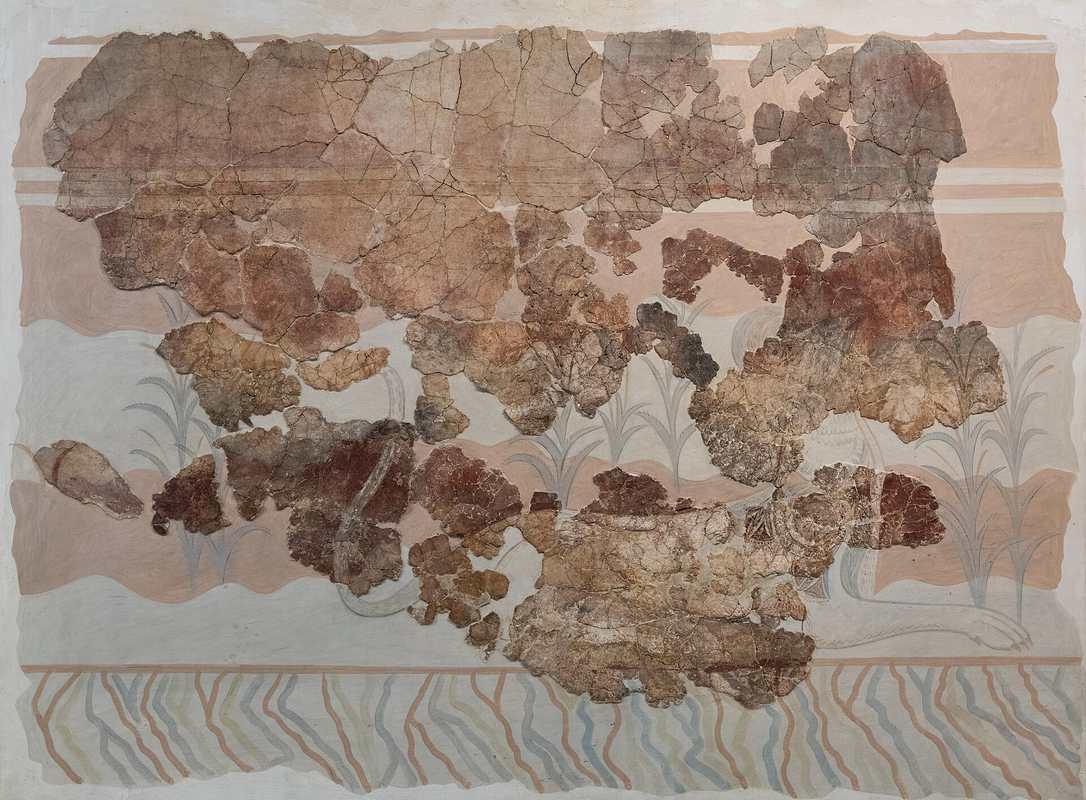
Minoan frescoes are the vivid wall paintings produced by the Bronze Age civilisation of Crete, applied in true buon fresco onto wet lime plaster and finished with bright mineral pigments. They show bull-leaping, sea creatures, processions and elegant figures from a palace world. Plan tickets and tours through My Greece Tours.
These paintings decorated the walls of the Palace of Knossos and other Minoan centres. The sections below cover what Minoan frescoes are, the techniques and colours their painters used, the most famous surviving scenes, what the frescoes reveal about Minoan life, and where you can see them today.
What are Minoan frescoes?
Minoan frescoes are wall paintings made by the Bronze Age civilisation of Crete, applied to wet lime plaster so the pigment bonded into the surface as it dried. They decorated palaces, villas and shrines with scenes of nature, ritual and daily life, and rank among the earliest narrative paintings in Europe.
They covered palace walls.
Pigments fused with plaster.
Subjects came from nature.
They survive in fragments.
A Minoan fresco was an architectural painting, not a movable panel. Plasterers spread fresh lime over the wall, and painters worked the colour straight into the damp surface so it set chemically as the plaster cured. This gave the images a luminous, durable finish that has lasted thousands of years. The frescoes were not isolated pictures but parts of decorated rooms, where borders, rosette friezes and spirals framed the central scenes. They turned the corridors and halls of a palace into a continuous painted environment, signalling wealth, order and the ritual life of the Minoan elite to everyone who passed through.
Most frescoes reach us as scattered fragments, recovered from collapse layers and painstakingly rejoined. Restorers fitted surviving pieces together and filled the gaps, which means much of what we see today is partly reconstruction built around genuine ancient paint. Our guide to Knossos frescoes covers how these wall paintings were excavated and rebuilt, and the next section covers the techniques and colours the painters used.
What techniques and colours did Minoan painters use?
Minoan painters worked mainly in true fresco, laying mineral pigments onto wet lime plaster so the colour bonded permanently, then adding fine detail once the surface had dried. They used a limited but vivid palette of ochres, Egyptian blue, black and white, following strict conventions for skin colour and form.
Plaster stayed wet.
Pigments were mineral.
Men were red-brown.
Women were white.
The core method was buon fresco: pigment applied to fresh, damp lime plaster, so that as the plaster dried the colour became part of the wall itself. Painters could not rework a buon-fresco area once it set, so they planned compositions carefully and worked quickly across each patch of wet surface. Some details — fine outlines, accents and small motifs — were added after the plaster had dried, a secco, on top of the cured surface. This combination gave the images both deep, stable background colour and crisp finishing touches, and explains why so much of the original paint has endured for millennia.
The palette was drawn from natural minerals. Red and yellow ochre supplied warm earth tones, Egyptian blue gave the prized bright blue used for water, monkeys and clothing, while black and white completed the range. Convention governed how figures were coloured: men were painted red-brown and women white, a code that let viewers read gender at a glance. Our guide to Minoan pottery covers how the same love of marine and floral motifs ran through Cretan craft, and the next section covers the most famous Minoan frescoes.
What are the most famous Minoan frescoes?
The best-known Minoan frescoes include the Bull-Leaping or Toreador Fresco, the relief Prince of the Lilies, the Ladies in Blue and La Parisienne, the Dolphin fresco of the Queen’s Megaron, and the blue monkeys and saffron gatherers. Together they define how we picture Minoan art.
Acrobats vault a bull.
A prince walks crowned.
Dolphins swim overhead.
Blue monkeys gather saffron.
The most celebrated scene is the Bull-Leaping Fresco, often called the Toreador Fresco, in which slim acrobats grasp and somersault over a charging bull. It captures the daring bull sports central to Minoan ritual and shows the painters’ skill at movement and overlapping bodies. The Prince of the Lilies is a relief fresco, modelled in raised plaster, depicting a striding crowned figure among lilies. The Ladies in Blue and the fragment nicknamed La Parisienne reveal the elaborate dress, jewellery and hairstyles of Minoan women, rendered with a lively, almost modern elegance that astonished the archaeologists who first recovered them.
Nature scenes are equally famous. The Dolphin fresco of the Queen’s Megaron sets leaping dolphins among smaller fish, turning a palace room into an underwater world. Blue monkeys clamber through rocks and plants, and saffron gatherers pick crocus flowers — a saffron-harvesting theme also celebrated in the painted houses of Akrotiri on Thera, closely linked to Cretan art. Our guide to the Prince of the Lilies covers this relief fresco in detail, and the next section covers what the frescoes tell us about Minoan life.
What do the frescoes tell us about Minoan life?
Minoan frescoes are a vivid record of how the Cretans lived, dressed, worshipped and saw the world. They show ritual processions, bull sports, finely dressed women, sea creatures and flowering landscapes, suggesting a society that prized nature, ceremony and display, with women holding visibly prominent public and ritual roles.
Rituals filled palace walls.
Women appear prominent.
Sea life was celebrated.
Nature shaped their art.
Because so little Minoan writing can be read, the frescoes are among our richest windows onto this civilisation. Processions of figures carrying offerings, bull-leaping displays and gatherings of richly dressed people point to a culture in which ceremony, sport and public ritual mattered deeply. The settings — pillared halls, shrines and open courts — match the architecture excavated at the palaces, so the paintings help us reconstruct how those grand spaces were actually used. They portray a confident, outward-looking society that filled its most important rooms with images of celebration rather than war.
Women feature strikingly often, shown in elaborate flounced skirts and jewellery, taking part in rituals and ceremonies, which has shaped the view that Minoan women enjoyed a notably high status. The constant presence of dolphins, fish, lilies, crocuses and birds shows a people closely attuned to the sea and the seasons of their island. Our guide to Minoan women covers their dress, status and ritual roles, and the next section covers where you can see Minoan frescoes today.
Where can you see Minoan frescoes today?
Most original Minoan frescoes are displayed in the Heraklion Archaeological Museum in Crete, while faithful reproductions stand in their original positions at the Palace of Knossos. Seeing both lets you appreciate the genuine ancient paint and understand how the scenes once filled the palace walls.
Originals fill Heraklion.
Copies stand at Knossos.
Fragments were rejoined.
Both visits reward you.
The surviving original frescoes are gathered in the Heraklion Archaeological Museum, where the Bull-Leaping Fresco, the Ladies in Blue, the Prince of the Lilies and the dolphin and monkey scenes are displayed together. Here you see the real ancient pigment, mounted so that the genuine fragments and the restored areas around them are visible. The museum arranges the paintings by theme and palace context, so a single visit gives a sweeping overview of Minoan art and the conventions, colours and subjects described in the sections above. Our guide to the Heraklion Archaeological Museum covers its galleries and highlights.
At Knossos itself, reproductions are set in the positions the originals once occupied, so you can read each scene against the room it decorated. These copies grew out of the reconstructions made for the early excavations, when the artist Émile Gilliéron produced painted restorations of the fragmentary scenes. Walking the palace with the frescoes in place brings the painted environment back to life in a way the museum cases cannot. Plan your visit and tours through our Palace of Knossos guide.
Frequently Asked Questions
What pigments did Minoan painters use for their frescoes?
Minoan frescoes were painted with a small range of natural mineral pigments that produced surprisingly rich results. Red and yellow ochre, both iron-based earths, supplied the warm browns, reds and golden yellows seen in skin, animals and borders. The famous bright blue came from Egyptian blue, a manufactured pigment that the Minoans prized for water, clothing, monkeys and sky-like backgrounds. Black, often from carbon or manganese, and white, from lime, completed the palette and were used for outlines, highlights and pale skin. Because the colours were applied to wet lime plaster in true fresco, the pigment bonded chemically into the surface as it dried, which is why so much of the original colour survives. Fine details and certain accents were sometimes added a secco, on the dried plaster, on top of the fresco layer. The result was a vivid yet disciplined palette, instantly recognisable as Minoan.
Why are Minoan men painted red-brown and women white?
Minoan painters followed a long-standing colour convention shared with several ancient Mediterranean cultures: men were shown with red-brown skin and women with white skin. This was not an attempt to record real complexions but a visual code that let viewers identify gender immediately, even from a distance or in a crowded procession scene. The red-brown of male figures may evoke a sun-darkened, outdoor life, while the pale tone of women suggested a more sheltered, indoor existence, though the contrast was above all a clear artistic shorthand rather than strict social documentary. The convention runs consistently through Minoan art, from bull-leaping scenes — where you can read the leapers’ roles partly by colour — to ceremonial gatherings of elegantly dressed women. Recognising this code helps modern visitors interpret the frescoes correctly, because skin colour signals who is who long before the details of dress or activity are taken into account. It is one of the most reliable markers of authentic Minoan painting.
Are the frescoes at Knossos originals or reconstructions?
The frescoes you see on the walls at the Palace of Knossos are reproductions, not the originals. The genuine ancient paintings survived only as scattered fragments, recovered from collapse layers during excavation, and these original pieces are now displayed in the Heraklion Archaeological Museum, where the surviving paint and the restored gaps around it can be studied closely. To help visitors picture how the palace once looked, faithful copies were placed at Knossos in the positions the paintings originally occupied. These reconstructions grew from the restoration work carried out for the early excavations, when the artist Émile Gilliéron created painted versions of the fragmentary scenes for Arthur Evans. As a result, a complete appreciation of Minoan frescoes really needs two visits: the museum, for the authentic ancient pigment and the careful distinction between original and restored areas, and the palace, where the reproductions show each scene in its architectural setting and bring the painted rooms back to life.