
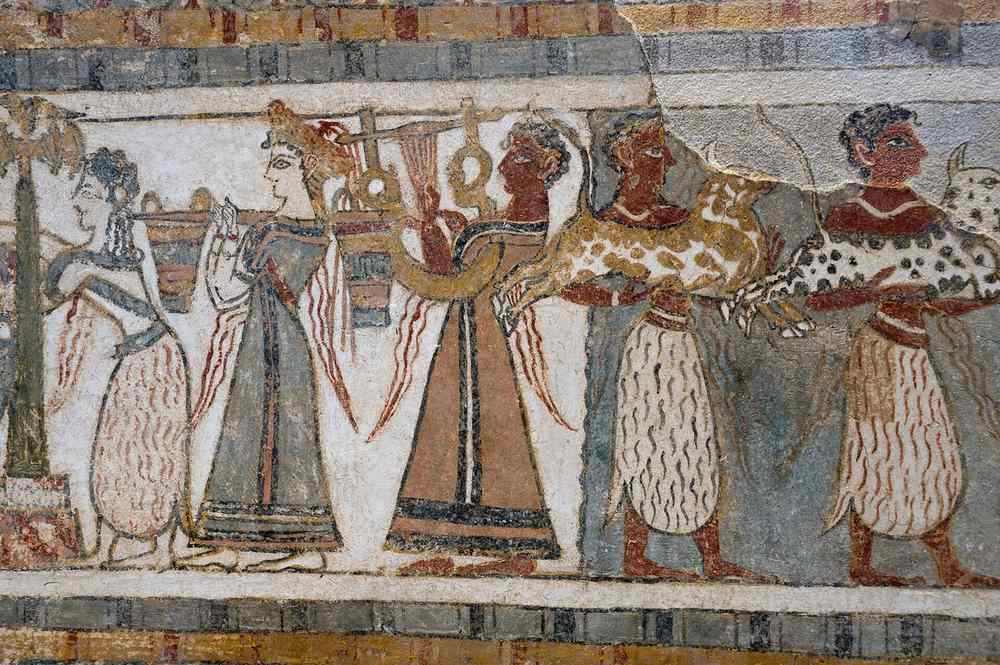
A Minoan larnax is a painted clay coffin used for burial in Bronze Age Crete, often decorated with vivid scenes. Plan tickets and tours through My Greece Tours.
Minoan larnakes shed light on the funerary world behind the Palace of Knossos. The sections below cover what a larnax is, how they were used, how they were made and when they became standard. They also cover how a larnax differs from a sarcophagus, how the coffins were decorated, what intact tombs reveal, what they tell us about beliefs and where to see them.
What is a Minoan larnax?
A Minoan larnax is a clay coffin used for burial in Bronze Age Crete. It is usually a rectangular chest on four short legs with a lid, or sometimes a bathtub shape, and it held the body of the deceased.
A Minoan larnax, plural larnakes, is a coffin made of terracotta, fired clay, used for burying the dead in Bronze Age Crete, including in the period of the great palaces such as Knossos. The most common form is a rectangular chest standing on four short legs and fitted with a gabled or flat lid, rather like a clay chest or trunk. Certain larnakes instead take the form of an oval tub, similar in shape to a Minoan bathtub. Both forms share the same purpose, and both were produced in the workshops that supplied Cretan communities with their funerary equipment.
The body of the deceased was placed inside the larnax, often in a contracted position with the knees drawn up, since the coffins are usually fairly short. What makes Minoan larnakes especially important is that many were decorated with painted scenes, turning these everyday funerary objects into a rich source of Minoan imagery. They rank among the most informative finds for understanding Minoan burial customs and beliefs about death, complementing the picture of life given by the palaces. Our guide to Minoan civilisation covers the wider culture, and the next section covers how the larnakes were used.
What were Minoan larnakes used for?
Minoan larnakes were used as coffins for burial. The body of the deceased was placed inside, often curled in a contracted position, and the coffin was then laid in a tomb, such as a rock-cut chamber tomb or a built grave.
Minoan larnakes were used straightforwardly as coffins, the containers in which the dead were buried, and they became a standard means of burial in Crete during the later Minoan period, including around Knossos. The body of the deceased was placed inside the clay coffin, usually in a contracted or crouched position with the legs bent, because the larnakes are generally too short to hold a body laid out fully straight. The choice of a portable clay container, rather than a simple pit, marks a deliberate and settled approach to the treatment of the dead.
The coffin, with the body inside, was then placed in a tomb, commonly a rock-cut chamber tomb but also other built or natural graves. It was sometimes accompanied by grave goods such as pottery vessels, jewellery or other personal items intended to accompany the dead. More than one larnax might be set in a single family or communal tomb over time, so that generations shared the same rock-cut chamber. This practice reflects a stable set of funerary customs in which the painted clay coffin played a central role in laying the dead to rest. Our guide to Minoan religion covers the beliefs, and the next section covers how the larnakes were made.
How were Minoan larnakes made?
Minoan larnakes were made from coarse terracotta, shaped by hand into a chest or tub and fired in a kiln. The chest form imitated wooden chests, and the fired clay surface was then coated and painted.
A larnax was built from coarse local clay, the same broad material tradition that supplied Cretan potters with their storage jars and household vessels. Rather than being thrown on a wheel like a cup or a bowl, the large rectangular chest was formed by hand from slabs and coils of clay. Potters worked these up into walls, a floor and a separate lid, then fired the coffin in a kiln to harden it into durable terracotta. The four short legs and the gabled or flat lid gave the finished coffin the appearance of a wooden chest. It is very likely that the clay form deliberately imitated the wooden chests and trunks used in daily life.
Once the clay had been fired, the surface was usually given a pale coating or slip that served as a ground for painting. Painters then decorated the sides, ends and sometimes the lid with designs in the Minoan manner, using the same repertoire of motifs found on frescoes and pottery. The tub-shaped larnakes were made in much the same spirit, formed as deep oval basins echoing the shape of a bathtub. Because the coffins were fired ceramic, they have survived far better than any wooden equivalent would have, which is one reason the painted clay larnax is so well represented among Cretan finds. The next section covers when the Minoans began to use them.
When did the Minoans start using larnakes?
Clay larnakes became the standard Cretan burial vessel from the fourteenth century BC onward, in the Late Minoan period, the later Bronze Age. Their painted decoration flourished during the same span.
The clay larnax became the characteristic Cretan burial container in the later part of the Bronze Age, during what archaeologists call the Late Minoan period, from about the fourteenth century BC onward. Earlier Minoan communities had buried their dead in various ways, including in built tombs and in earlier clay containers. It was in this later phase that the painted chest-shaped larnax became the standard and widespread means of burial across much of Crete, including the region around Knossos.
The rise of the painted larnax coincided with a period of intense funerary display, when the decoration of these coffins reached its height. During these later centuries the workshops turned out large numbers of larnakes, decorated with the marine, natural and ritual scenes for which they are famous. The custom continued through the closing centuries of the Bronze Age, leaving behind the many painted coffins that fill the cases of Cretan museums today. Placing the larnax within this later Minoan setting helps explain why it is so closely tied to the mature art of the palaces and the beliefs of their people. The next section covers how a larnax differs from a sarcophagus.
How does a larnax differ from a sarcophagus?
A larnax is a portable coffin of fired clay, usually a chest on legs or a tub. A sarcophagus is a coffin of stone, such as the painted Agia Triada sarcophagus, heavier, carved and often fixed in place.
The clearest difference between a larnax and a sarcophagus is the material. A larnax is made of terracotta, coarse clay fired in a kiln, which makes it comparatively light and portable, so that it could be carried into a rock-cut chamber tomb and set alongside others. A sarcophagus, by contrast, is worked from stone, a far heavier and more laborious medium that had to be cut and shaped. On Crete the great example is the Agia Triada sarcophagus, a stone coffin whose sides carry detailed painted funerary scenes, and it stands somewhat apart from the ordinary run of clay larnakes.
The two forms nonetheless belong to the same funerary world and share the same purpose of holding the body of the deceased. They also share a decorative tradition, since the painted scenes on the stone Agia Triada sarcophagus echo the marine, natural and ritual imagery found on the clay coffins. The difference is chiefly one of scale, cost and permanence rather than of function. The clay larnax was the everyday vessel of Cretan burial, produced in quantity, while a painted stone sarcophagus was an exceptional and costly object. Understanding this distinction helps place the humble clay coffin in its proper context. The next section covers how the larnakes were decorated.
What do Minoan larnakes look like and how are they decorated?
Minoan larnakes are clay chests on short legs, or tub shapes, often brightly painted on every side with marine motifs, animals, plants and funerary scenes.
Minoan larnakes are typically chest-shaped clay coffins standing on short legs with a separate lid, although tub-shaped examples also exist. Their great interest lies in their painted decoration, for the clay surfaces, on the sides, ends and sometimes the lid, were often covered with lively painted designs in the Minoan manner. Each larnax thus becomes a small gallery of Minoan art, carrying the same figures and patterns that decorate the frescoes and fine pottery of the same age, and preserving them on a surface that has survived remarkably well.
The subjects are varied and revealing. Many carry abstract patterns or marine motifs drawn from the Minoan love of the sea, such as octopuses, fish and spirals. Others depict scenes of nature and animals, with birds, wild goats, plants and trees. The most important show human and ritual scenes, including processions, mourners, chariots and funerary ceremonies connected with death and the journey to the afterlife. The famous painted stone sarcophagus from Agia Triada, though of stone rather than clay, shows the same tradition of detailed funerary scenes. This decoration makes larnakes a key source for Minoan imagery. Our guide to Minoan art and pottery covers the painting, and the next section covers what intact tombs reveal.
What has the discovery of intact larnax tombs revealed?
Intact larnax tombs typically hold a single crouched skeleton curled inside the coffin, accompanied by grave goods such as pottery and personal items, giving a direct picture of Minoan burial practice.
Undisturbed larnax tombs give a vivid picture of how the Minoans buried their dead. Inside the clay coffin the body was commonly laid in a contracted or crouched position, the knees drawn up towards the chest, a single skeleton fitted into the short chest or tub. This crouched posture is repeated across many finds. It confirms what the small size of the coffins already suggests and shows a consistent practice rather than an occasional expedient across Cretan communities.
Around and within the larnax, excavators often find grave goods placed with the dead, such as pottery vessels, jewellery and other personal items intended to accompany the deceased into whatever lay beyond. Several larnakes may share a single rock-cut chamber tomb, indicating that families or communities returned to the same tomb over generations. Together these details, the crouched single skeleton, the accompanying gifts and the reused chamber, turn each intact discovery into a small record of Minoan funerary custom. They reinforce the impression, given by the painted scenes, of a society that surrounded death with care and ceremony. The next section covers what the larnakes reveal about beliefs.
What can larnakes tell us about Minoan beliefs?
Larnakes, especially their painted scenes, offer rare evidence for Minoan beliefs about death and the afterlife, showing rituals, mourning and imagery read as symbols of passage and renewal.
The Minoans left no readable texts about their religion, so the painted scenes on larnakes are among the most valuable evidence we have for their beliefs about death and the afterlife. Certain larnakes depict what appear to be funerary rituals: processions of figures carrying offerings, people in attitudes of mourning, and the bringing of gifts and animals. Such ceremonies suggest a concern for honouring the dead and easing their passage to whatever lay beyond. These scenes give a rare human dimension to a culture otherwise known chiefly through its buildings.
Scholars interpret many of the motifs symbolically. The marine scenes, with octopuses and fish, and the scenes of nature and animals may relate to ideas of renewal, the cycle of life, or the journey of the soul. Images of chariots and boats are sometimes read as carrying the dead onward. The famous Agia Triada sarcophagus, with its detailed scenes of sacrifice and offerings to the dead, reinforces the impression of elaborate funerary ritual. While such interpretations remain debated, the larnakes show that the Minoans surrounded death with care, ceremony and rich imagery. Our guide to the Heraklion Archaeological Museum covers the finds, and the next section covers where to see them.
Where can you see Minoan larnakes?
You can see Minoan larnakes in the Heraklion Archaeological Museum, which holds a fine collection of painted clay coffins from Knossos and across Crete, along with the famous Agia Triada sarcophagus.
The best place to see Minoan larnakes is the Heraklion Archaeological Museum, a short distance from Knossos in the centre of Heraklion. It holds a fine collection of painted clay coffins from Knossos and sites across Crete, displayed so that their lively decoration can be appreciated. The museum is also home to the celebrated Agia Triada sarcophagus, a painted stone coffin whose detailed funerary scenes are among the masterpieces of Minoan art and a highlight of any visit. Seeing the two side by side makes the contrast between the everyday clay coffin and the exceptional stone one very clear.
Larnakes and other funerary finds are also displayed in other archaeological museums around Crete, reflecting how widespread the burial custom was. Seeing the painted coffins, after exploring the palace at Knossos, adds an important dimension to understanding the Minoans, balancing the world of the living palace with the customs and beliefs surrounding death. For visitors interested in the full story of Minoan civilisation, the larnakes are well worth seeking out in the museum. Our guide to the Heraklion Archaeological Museum covers the collection. Plan your visit and tours through our Palace of Knossos guide.
In their painted scenes of octopuses and processions, mourners and sacred boughs, the larnakes give the Minoans back something the ruined palaces cannot: a glimpse of how they faced death. These were not anonymous Bronze Age graves but coffins carefully decorated by the same hands that painted the frescoes, set with the body in a rock-cut tomb and surrounded with gifts for the journey beyond. After the grandeur of Knossos, the quiet world of the larnakes in the Heraklion museum reminds you that the Minoans, for all their wealth and artistry, were people who loved, mourned and hoped, just as we do.
Frequently Asked Questions
What is a Minoan larnax?
A Minoan larnax, plural larnakes, is a coffin made of terracotta, fired clay, used for burying the dead in Bronze Age Crete. It was common in the period of the great palaces such as Knossos. The most common form is a rectangular chest standing on four short legs and fitted with a gabled or flat lid, rather like a clay chest. Certain larnakes instead take the form of an oval tub, similar in shape to a Minoan bathtub. The body was placed inside, often in a contracted position with the knees drawn up, and the larnax was then laid in a tomb. Many larnakes were painted with lively scenes, which makes them a rich source for Minoan art as well as a record of burial.
How were Minoan larnakes made?
Minoan larnakes were made from coarse local clay, formed by hand rather than thrown on a wheel. The walls, floor and lid were built up from slabs and coils, then fired in a kiln to harden them into durable terracotta. The four short legs and the gabled or flat lid gave the coffin the look of a wooden chest, and the clay form very likely imitated the wooden chests used in daily life. After firing, the surface was given a pale coating that served as a ground for painting. The sides, ends and sometimes the lid were then decorated with marine motifs, animals and funerary scenes. Because they were fired ceramic, the larnakes have survived far better than any wooden equivalent.
How were Minoan larnakes decorated?
Minoan larnakes were often covered with lively painted decoration in the Minoan style, on the sides, ends and sometimes the lid, making each one a small gallery of Minoan art. The subjects are varied and revealing. Many carry abstract patterns or marine motifs drawn from the Minoan love of the sea, such as octopuses, fish and spirals. Others depict scenes of nature and animals, with birds, wild goats, plants and trees. The most important show human and ritual scenes, including processions, mourners, chariots and funerary ceremonies connected with death and the journey to the afterlife. The famous painted stone sarcophagus from Agia Triada, though of stone rather than clay, shows the same tradition of detailed funerary scenes, and it is the outstanding example of this decorated funerary art.
Where can you see Minoan larnakes?
The best place to see Minoan larnakes is the Heraklion Archaeological Museum, a short distance from Knossos in the centre of Heraklion. It holds a fine collection of painted clay coffins from Knossos and sites across Crete, displayed so that their lively decoration can be appreciated. The museum is also home to the celebrated Agia Triada sarcophagus, a painted stone coffin whose detailed funerary scenes are among the masterpieces of Minoan art. Larnakes and other funerary finds are also displayed in other archaeological museums around Crete, reflecting how widespread the burial custom was. Seeing the painted coffins after exploring the palace at Knossos adds an important dimension to understanding the Minoans, balancing the world of the living palace with the customs and beliefs surrounding death.