
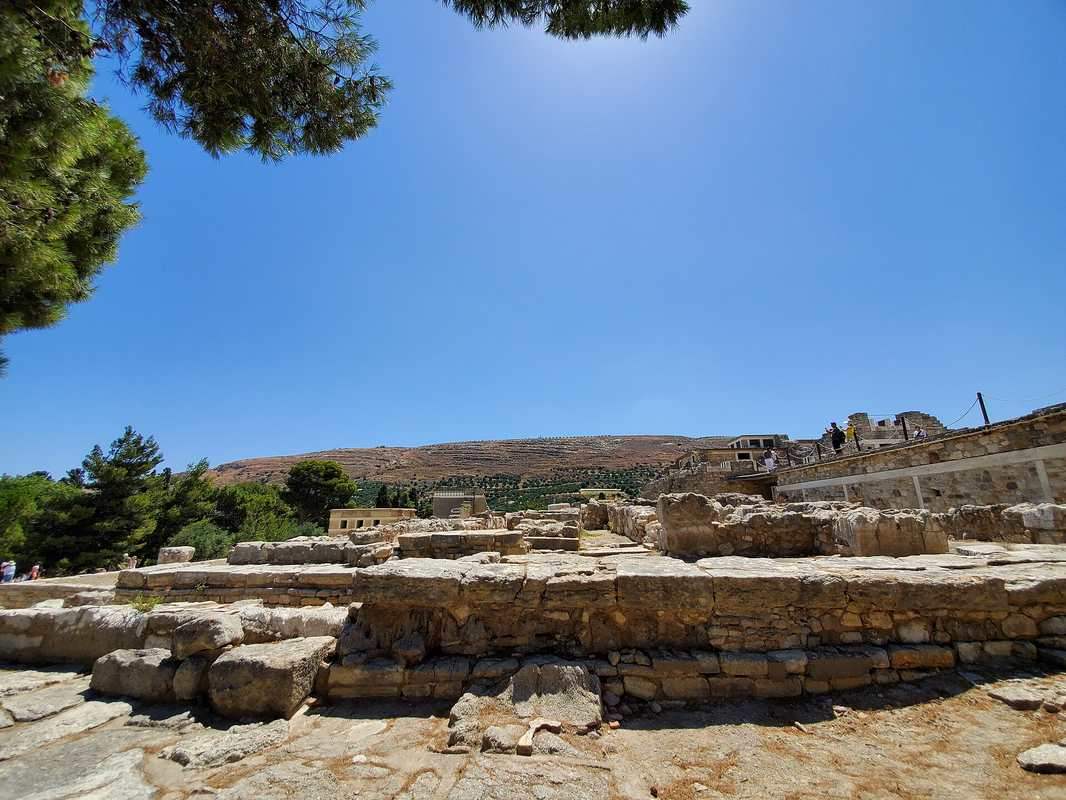
Knossos accessibility is limited by its uneven terrain, steps and gravel paths, but parts of the site can be enjoyed with planning and care. Plan tickets and tours through My Greece Tours.
Accessibility is an important practical question for the Palace of Knossos. The sections below cover how accessible the site is, the terrain, which areas are manageable, an accessible route, facilities, practical tips and getting there.
Is Knossos accessible for visitors with reduced mobility?
Knossos is only partly accessible. The site is a large Bronze Age palace with uneven ground, gravel paths, slopes and frequent steps, which make full wheelchair access difficult.
Knossos presents real challenges for visitors with reduced mobility, and it is only partly accessible. The palace is a large, partly reconstructed archaeological site dating from the Bronze Age. It has uneven ground, loose gravel and earth paths, slopes, and frequent steps and changes of level, because the buildings follow the natural hillside and the multi-storey layout of the palace. Wheelchair users, those using walking aids, and anyone with limited stamina or balance therefore find full, easy movement around the whole site difficult.
This does not mean the site is off-limits. Visitors with limited mobility can reach and enjoy a meaningful part of Knossos with careful planning and realistic expectations. Roughly half of the site can be covered comfortably. The flatter sections near the entrance and around the great central court are the most manageable. A wheelchair-using visitor with a companion and a manual or all-terrain chair can take in the scale of the palace and its main highlights from accessible paths and viewpoints. Understanding the terrain in advance and planning a route makes the difference between a frustrating visit and a rewarding one.
Our tips for visiting Knossos guide covers general advice, and the next section covers the terrain in detail.
Knossos accessibility for wheelchair users at a glance
The main west entrance and the central court are the most reachable parts of the site. An accessible toilet and accessible parking sit near the entrance. The east wing, reached by the grand staircase, and the deeper stepped areas are the hardest to access. A manual or all-terrain wheelchair and a companion are strongly advised, along with an early, cooler start.
What is the terrain like at Knossos?
The terrain at Knossos is uneven and varied, with gravel and earth paths, stone surfaces, slopes, steps and frequent changes of level, as the site follows the hillside and the multi-storey palace plan.
Understanding the terrain is the key to planning an accessible visit to Knossos. The site spreads over a low hillside and follows the plan of a once multi-storey palace, so it is far from flat. Paths are often loose gravel or compacted earth, with stretches of ancient and reconstructed stone. There are frequent slopes, steps and changes of level. Features such as the grand staircase involve significant climbs or descents. These surfaces and gradients are the main obstacle for anyone with limited mobility.
Other conditions add to the difficulty. Ramps are limited, and level routes through the heart of the site are rare. The paving that does exist is old and sometimes tilted, so wheels and walking aids can catch. Knossos also offers very little shade. The strong Cretan sun and summer heat, which regularly climbs above thirty degrees Celsius in July and August, add a real physical demand on top of the ground itself. Loose gravel drains stamina quickly, so distances that seem short on a map feel longer in practice.
Knowing all of this in advance allows a realistic plan. Visiting early in the cooler morning, pacing the walk, and choosing the flatter routes turn a demanding site into a manageable one. The next section covers which areas are the most accessible.
Which parts of Knossos can be seen with limited mobility?
Visitors with limited mobility can usually reach the areas near the entrance and the more level sections, taking in the central court and many highlights from accessible paths and viewpoints.
Not all of Knossos is accessible, but visitors with limited mobility can see and appreciate a large part of the site. The areas nearer the west entrance and the more level sections are the most manageable. From accessible paths and viewpoints it is often possible to reach the great central court, the heart of the palace. You can also view the west facade, the theatral area near the entrance and the outlines of the throne room complex, even where you cannot enter every room.
Certain areas are difficult or impossible for wheelchair users and those with serious mobility limits. These are mainly the parts reached by steps and steep changes of level. The royal apartments in the east wing and the grand staircase, which descends three storeys down the hillside, are the clearest examples. Even so, a great deal of the palace can still be experienced: its scale, its central spaces, and a good number of its famous reconstructed frescoes, which sit at ground level in accessible parts of the site. Seeing the layout from the central court gives a clear sense of how the whole complex fitted together.
It helps to know which named features fall into each category before you arrive. The reachable, ground-level highlights include the west court, the theatral area, the central court, the west facade and the reconstructed north entrance with its charging bull relief. The harder, stepped features include the grand staircase, the royal apartments, the queen’s megaron and the deeper storerooms of the east wing. Frescoes such as the prince of the lilies and the bull-leaping panel are reproductions set at the site, and their positions in the more open parts make several of them viewable without stairs.
A guide can help identify the most accessible route and explain what can be seen from each viewpoint. Our Knossos layout guide covers the site plan, and the next section sets out a practical accessible route.
What is a good accessible route around Knossos?
A good accessible route starts at the west court and entrance, follows the flatter paths to the central court, and views the throne room and west facade, avoiding the stepped east wing and grand staircase.
Planning a route in advance makes an accessible visit far smoother, because it lets you spend your energy on the most rewarding, reachable parts of the palace. A sensible circuit begins in the west court, the broad open space in front of the palace. Here the raised walkways and the theatral area give a first sense of the site on relatively level ground. From there the flatter approach leads toward the great central court, the organising heart of the palace, which is one of the most reachable and impressive spaces on the site.
From the central court a visitor can look across to the west wing and take in the throne room complex, with its gypsum throne and griffin frescoes. You can also view the tall west facade that fronted the court. The reconstructed north entrance, with its famous charging bull relief, sits along a route that is manageable in parts. The stepped descent into the east wing and the royal apartments, reached by the grand staircase, is the section to admire from above rather than attempt, since it involves three flights of steps.
Keeping to this west-and-central circuit covers the essential palace in a shorter, flatter loop. Allowing plenty of time to pause, and treating the harder areas as viewpoints, keeps the visit comfortable. The next section covers the facilities you can rely on at the site.
What facilities does Knossos have for visitors with reduced mobility?
Knossos has an accessible toilet and accessible parking near the entrance, a ticket office and a shop, but limited ramps and no step-free route through the whole site.
The facilities at Knossos are concentrated near the entrance, which is convenient for visitors with reduced mobility who plan a shorter, focused visit. An accessible toilet stands close to the main gate. Accessible parking spaces sit near the entrance, so the walk from a car or accessible taxi to the ticket area is short. The ticket office, a small shop and a shaded rest point are all within the entrance zone, allowing a comfortable base before and after the walk around the ruins.
Beyond the entrance, the built provision for accessibility is limited. Ramps exist in places but do not form a continuous step-free route, and there are no lifts on the multi-storey east wing. Signage and raised walkways guide visitors around the palace. Reduced-price or free admission is available for people with disabilities on presentation of the relevant documentation, which is worth confirming at the ticket office. Provisions can change, so it is wise to check the current arrangements before you travel.
Bringing your own mobility aid is important, since none are hired at the gate, and a companion greatly eases the harder stretches. It is also worth planning around the timing of the day. The site opens at eight in the morning, and the first hour or two brings the coolest air, the thinnest crowds and the emptiest paths, all of which suit a slower, seated pace. A short, focused visit built around the entrance zone, the west court and the central court can be completed comfortably in about an hour, leaving stamina for the return. Our Knossos private tours guide covers tailored options that can be planned around these facilities. The next section covers practical tips.
What are the practical tips for an accessible visit to Knossos?
For an accessible visit to Knossos, go early in the cooler morning, wear sturdy footwear, bring water and sun protection, allow plenty of time, and consider a guide who can plan a manageable route.
A handful of practical steps make an accessible visit to Knossos far more comfortable. Go early in the morning, soon after the site opens at eight, to avoid both the midday heat and the crowds on the largely unshaded ruins. Allow ample time so you can move slowly and rest as needed. Wear sturdy, supportive footwear for the uneven, gravelly ground. Bring water, a hat and strong sun protection, since the site has almost no shade during the long central hours of the day.
Check the current accessibility arrangements and any provisions for visitors with reduced mobility in advance, as conditions can change with the season and with ongoing conservation work. Bring any mobility aids you rely on, and remember that certain surfaces are challenging for wheelchairs, so a companion who can help over gravel and short slopes is valuable. Booking a skip-the-line ticket online saves standing in a queue in the sun, which matters when stamina is limited.
Considering a private or accessibility-focused guided tour can be very helpful, as a knowledgeable guide plans a manageable route, identifies the most accessible viewpoints and explains the parts of the palace you cannot easily reach. Our Knossos private tours guide covers tailored options, and the next section covers getting there.
How do you get to Knossos with reduced mobility?
You can reach Knossos with reduced mobility by accessible taxi or a pre-arranged transfer from nearby Heraklion, which is the easiest option, or by car with parking close to the entrance.
Getting to Knossos is the easy part of an accessible visit, since the site lies only about five kilometres from the centre of Heraklion, a journey of around twenty minutes. The most convenient options for visitors with reduced mobility are an accessible taxi or a pre-arranged private transfer from Heraklion. Either can take you directly to the entrance with minimal walking. Travelling by car, with accessible parking available close to the site, is the other easy choice. A door-to-door transfer removes the changes and waiting that public transport involves.
A frequent local public bus runs from Heraklion to Knossos. A taxi or private transfer is still easier and more comfortable for those with mobility needs, since city buses are not always fully step-free and the walk from the bus stop adds distance. Arranging your transport in advance, especially an accessible vehicle if required, ensures a smooth arrival and a set pickup time for the return. Because the journey is so short, the main considerations for an accessible visit are the terrain and conditions at the site itself rather than reaching it.
Our guide to how to get to Knossos covers transport in detail. Plan your visit and tours through our Palace of Knossos guide.
Frequently Asked Questions
Is Knossos wheelchair accessible?
Knossos is only partly wheelchair accessible. As a large, partly reconstructed Bronze Age site, it has uneven ground, loose gravel and earth paths, slopes and frequent steps. These follow the hillside and the multi-storey palace plan, which makes full wheelchair access difficult. Ramps are limited and there is no continuous step-free route through the heart of the site. The areas near the west entrance and the more level sections are generally manageable, though, and roughly half of the site can be covered comfortably with a manual or all-terrain wheelchair and a companion. From accessible paths it is often possible to reach the great central court and view the main highlights, even if the stepped east wing and grand staircase are difficult or impossible.
Can elderly visitors or those with limited mobility visit Knossos?
Yes, elderly visitors and those with limited mobility can visit Knossos, but it needs planning and a realistic approach. The site is large, uneven and has slopes and steps with little shade. To make it manageable, go early in the cooler morning to avoid the heat and crowds. Wear sturdy footwear, bring water and sun protection, and allow ample time to move slowly and rest. Focus on the more level, accessible areas and viewpoints rather than trying to reach every part. The flatter sections and the central court are generally manageable, while the steep, stepped areas are best admired from a distance. A private guide can plan a comfortable route and explain what can be seen.
Are there steps at Knossos?
Yes, there are frequent steps at Knossos, along with slopes and changes of level, because the site follows the hillside and the layout of a once multi-storey palace. Notable features such as the grand staircase in the east wing involve significant climbs or descents down several storeys, and shorter flights of steps appear across the site. Combined with loose gravel and earth paths and uneven stone surfaces, this makes the terrain demanding. It is hardest for wheelchair users, those using walking aids, and anyone with limited stamina or balance. Ramps are limited and level routes are rare. Visitors with mobility concerns should focus on the more accessible, level areas and viewpoints, go slowly, and consider a guide who can identify a manageable route.
Is there accessible parking and an accessible toilet at Knossos?
Yes, there is accessible parking near the entrance to Knossos, along with an accessible toilet close to the main gate. This makes the entrance zone a comfortable base for visitors with reduced mobility. The walk from an accessible parking space or a dropped-off taxi to the ticket office is short and relatively level. Reduced-price or free admission is available for people with disabilities on presentation of the relevant documentation, which is worth confirming at the ticket office. Provisions and layouts can change with the season and with conservation work, so check the current arrangements before you travel. Bring your own wheelchair or walking aid, since none are hired at the site.