
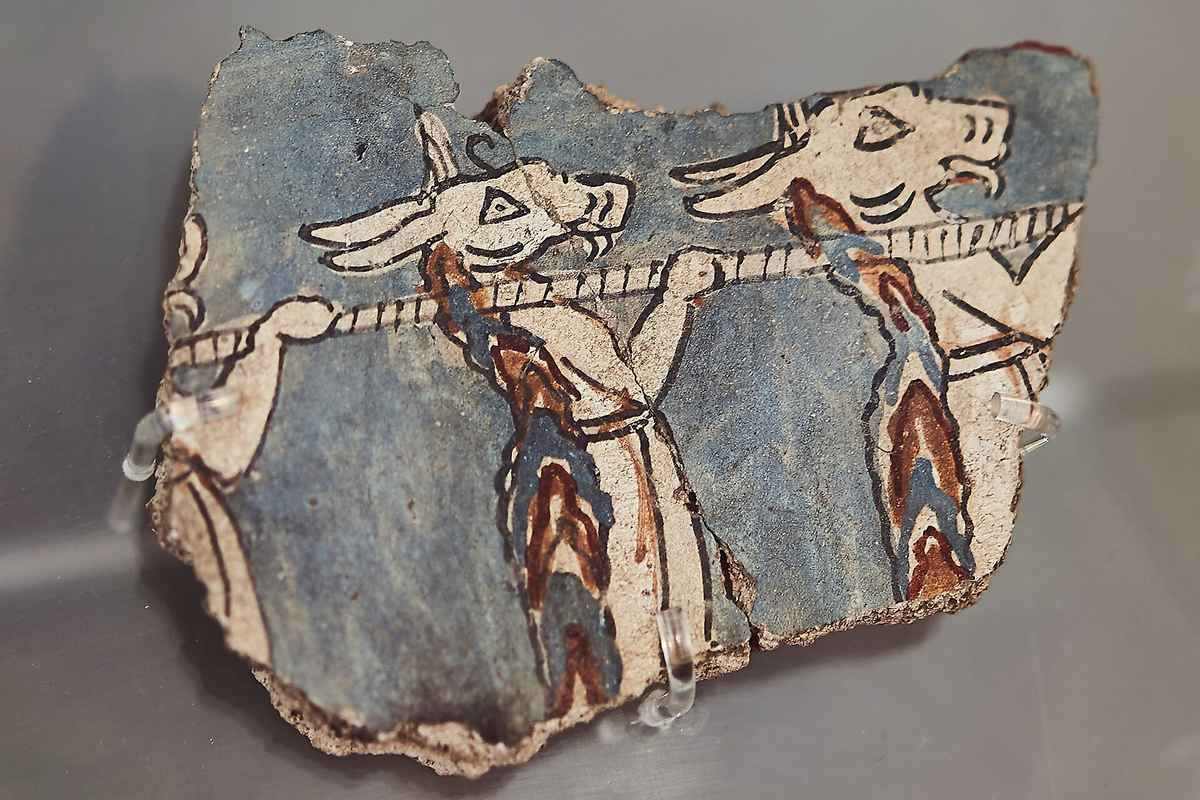
Minoan clothing was elaborate and colourful, from women’s tiered flounced skirts and open bodices to men’s belted kilts, all vividly recorded in the frescoes of Knossos. The garments themselves have perished, so Minoan art carries the whole record. Plan tickets and tours through My Greece Tours.
Dress is a direct window onto the people of the Palace of Knossos. The sections below cover Minoan clothing overall, women’s dress, men’s dress, the materials and dyes, the jewellery, how the clothing is dated, and what it reveals about the society that wore it.
What was Minoan clothing like?
Minoan clothing was colourful, tailored and highly distinctive. Women wore tiered flounced skirts with fitted bodices, and men wore kilts or loincloths belted at the waist. The dress is known from frescoes, figurines and seals, since the textiles themselves have not survived.
Minoan clothing ranks among the most distinctive dress of the ancient Mediterranean, and it gives a clear impression of a refined, prosperous and appearance-conscious society. The evidence comes almost entirely from Minoan art, the wall paintings, faience figurines and engraved seals that show people in their garments. The clothing depicted is tailored, layered and richly decorated, far removed from the simple draped cloth of many contemporary cultures.
The sharpest feature of Minoan dress is the contrast between the sexes and the elaboration of women’s costume. The tiered flounced skirt and fitted bodice worn by Minoan women stand apart from anything else in the Bronze Age Aegean. Men’s clothing was plainer but still shaped and belted, built around kilts and loincloths. The tailoring, the bright colour and the accompanying jewellery and hairstyles together reflect a culture that placed real value on elegance and display. Our guide to the Knossos frescoes covers the art that records it, and the next section covers women’s dress in detail.
What did Minoan women wear?
Minoan women wore long skirts built from tiered horizontal flounces, paired with tight bodices often open at the front and cinched at the waist. Arranged hairstyles and jewellery completed the outfit, shown famously on the snake goddess figurines from Knossos.
Women’s costume is the most elaborate element of Minoan dress. Women are shown in long skirts made of stacked horizontal flounces, layers of decorated fabric that fell in a full, sweeping line to the floor. Above the skirt they wore a close-fitting bodice that gripped the waist and was frequently painted open at the front. The cut required careful tailoring, and the flounces were often patterned with bands, spirals and floral motifs that match the decorative language of Minoan pottery and frescoes.
The outfit was finished with arranged hairstyles of curls and ringlets and with necklaces, bracelets and hair ornaments. The faience snake goddess figurines from the Knossos temple repositories show this attire in precise detail, down to the flounced skirt and the fitted, open bodice. The care and skill visible in women’s dress point to an accomplished textile craft and to a society in which female elegance and standing were emphasised. Our guide to Minoan women covers their prominence, and the next section covers men’s dress.
What did Minoan men wear?
Minoan men wore simpler dress than women, usually a kilt or loincloth fastened with a belt and often leaving the chest bare. A narrow, cinched waist was admired, and the bull-leapers wear short loincloths that free the limbs.
Men’s clothing centred on a wrapped garment held at the waist. The kilt and the loincloth were the standard forms, tied with a belt that pulled the waist in tightly, and the upper body was often left uncovered. This suited the warm Cretan climate and an active way of life. The belted, narrow waist appears repeatedly in Minoan art, marking it as an admired feature of the male figure and matching the tailored aesthetic seen in women’s dress.
Athletic scenes show the practical side of this clothing. The bull-leapers wear short loincloths that free the limbs for vigorous, dangerous movement, and figures in processions wear longer kilts marked out with fringes and patterned bands. Men are also shown with distinct hairstyles and, on occasion, with jewellery. Though plainer than the flounced skirts of the women, Minoan men’s clothing belonged to the same body-conscious style. Our guide to Knossos bull-leaping covers the athletic figures, and the next section covers the materials and dyes.
What materials and dyes did the Minoans use?
The Minoans made clothing chiefly from wool and linen, spun and woven on Crete, then dyed in bright colours and decorated with woven patterns. Flax supplied linen, sheep supplied wool, and marine shells and plants supplied the reds, yellows and blues of the frescoes.
Wool and linen formed the two staple fibres of Minoan dress. Flax was grown, harvested and processed on Crete to make linen, while wool came from the island’s flocks of sheep. Spinning and weaving were domestic and workshop crafts, recorded by the many clay spindle whorls and loom weights found across Minoan sites. The tiered flounced skirt in particular demanded skilled weaving to produce the separate decorated bands that were assembled into the finished garment.
Colour was central to the look. The frescoes preserve garments in strong reds, yellows, blues and whites, and the dyes behind them were valuable trade goods. Crete lay within the eastern Mediterranean world that produced purple dye from murex sea-snails, and saffron, shown being gathered in the Akrotiri frescoes on nearby Thera, yielded a prized yellow. Woven bands, spirals and floral motifs decorated the cloth, matching the ornament of contemporary pottery. Our guide to Minoan trade covers the commerce that carried these dyes, and the next section covers jewellery.
What jewellery accompanied Minoan clothing?
Minoan clothing was completed with fine jewellery in gold, silver, bronze, faience and semi-precious stones. Necklaces, bracelets, rings and hair ornaments adorned women and men, and the gold bee pendant from Malia shows the high standard of Minoan goldwork.
Jewellery was an integral part of the Minoan look rather than an afterthought. Goldsmiths produced necklaces, bracelets, rings, earrings, pendants and hair ornaments using gold, silver, bronze and faience, often set with carnelian, amethyst and rock crystal. The techniques included granulation, filigree and repoussé, all visible on the finest surviving pieces. Beads and pendants strung into necklaces appear on the figures in the frescoes, worn over the open bodice and against the bare chest.
The gold bee pendant from the Chrysolakkos cemetery at Malia stands as the best-known example of this craft, showing two bees or wasps around a drop of honey, worked in granulation and filigree. Such pieces were worn by the Cretan elite and buried with them, linking dress, wealth and status in a single object. The love of fine adornment rounds out the Minoan aesthetic of colour, tailoring and display. Our guide to the Heraklion Archaeological Museum covers where these pieces are shown, and the next section covers how the clothing is dated.
How do we know what Minoan clothing looked like?
We know Minoan clothing from frescoes, faience figurines, engraved seals and clay sealings, because the fabrics themselves decayed. These images fix the shapes and colours of the garments, while spindle whorls and loom weights confirm the weaving crafts that produced them.
No Minoan textile survives whole, so the dress is reconstructed from art and tools. Wall paintings at Knossos and on Thera preserve the colours and cut of complete outfits, from the flounced skirt to the belted kilt. The faience snake goddess figurines give a three-dimensional record of women’s costume, and engraved seal-stones and their clay impressions add small, detailed figures in dress. Read together, these sources let scholars trace the outline of a garment even without a single surviving thread.
The craft evidence supports the images. Clay spindle whorls, loom weights and the occasional carbonised fibre confirm that spinning and weaving were widespread on Crete, and the scale of the finds points to organised textile production tied to the palaces. Care is needed, since art can stylise or idealise dress rather than record it plainly, and the open bodice may be partly a convention. Even so, the combined record makes Minoan clothing one of the best-documented wardrobes of the Bronze Age. The next section covers what the dress reveals about Minoan society.
What does Minoan clothing reveal about their society?
Minoan clothing reveals a prosperous, appearance-conscious society with skilled textile and jewellery crafts and a prominent role for women. The tailoring, colour and adornment point to an elite enriched by trade, matching the standing of women in Minoan art.
Dress carries clear social information. The tailoring of the flounced skirt and fitted bodice, the bright dyes and the patterned bands all point to an advanced textile craft and an elite able to command fine cloth. The wealth that paid for valuable dyes, gold and imported stones came from the reach of Minoan trade, so the clothing is also a marker of commercial success. Costume, in other words, tracks the same prosperity that filled the palace storerooms.
The elaboration of women’s dress carries its own meaning. Women appear in Minoan art as central, esteemed figures, often larger and more richly dressed than the men around them, and the detail lavished on their costume fits that prominence. The clothing of the Minoans therefore speaks of a refined, wealthy and aesthetically driven civilisation in which appearance mattered and women were proudly depicted. Our guide to the Minoan women covers their role further. Plan your visit through our Palace of Knossos guide.
What did Minoan priests and ritual figures wear?
Minoan priests and ritual figures wore heightened versions of everyday dress. Women in cult scenes wear the flounced skirt and open bodice with sacred symbols, while male figures appear in long robes or hide skirts, carrying ritual objects such as double axes.
Religious dress drew on the same wardrobe as daily life but heightened it for the sacred setting. The snake goddess figurines, holding snakes and crowned with a feline, wear the standard flounced skirt and open bodice, which suggests that this striking costume itself carried ritual weight. Processional frescoes show women in richly patterned skirts bearing offerings toward a shrine, their dress more ornate than that of the figures around them, and set apart by the objects in their hands rather than by a wholly different cut.
Male ritual figures are dressed differently again. Some wear a long robe reaching the ankles, a garment reserved for priests and high officials that contrasts with the short kilts of athletes and workers. Others wear a hide skirt of animal pelt, marking a distinct ceremonial role. The figure once called the priest-king in the Prince of the Lilies fresco wears an elaborate crown of lilies and feathers, showing that headgear as well as garment signalled rank and sacred function in Minoan dress.
How did Minoan clothing change over time?
Minoan clothing grew more elaborate through the Bronze Age, from plainer earlier dress to the full flounced skirt and fitted bodice of the palatial period. Mycenaean control of Crete later shifted the costume shown in art toward mainland Greek styles while keeping some Minoan features.
The dress recorded in art belongs mainly to the palatial centuries, when Minoan textile craft reached its height. Earlier figures wear simpler wrapped and belted garments, and the fully developed flounced skirt, with its stacked bands of decorated cloth, appears alongside the grand frescoes and the snake goddess figurines. The tailored bodice and layered skirt therefore mark a mature stage of Minoan costume rather than its whole span, and they coincide with the wealth and organisation of the palace economy.
Change followed the political shift on the island. Once Mycenaean Greeks held Knossos in the later Bronze Age, the wall paintings and figurines begin to show mainland influence, and the flounced skirt persists beside plainer robes drawn from Greek fashion. The Minoan open bodice fades from the record, while jewellery and patterned bands continue. Costume thus tracks the same transition from Minoan to Mycenaean authority that shows in pottery, writing and burial across Crete.
How did Minoan dress compare to Egyptian and Mycenaean clothing?
Minoan dress was more tailored and colourful than the draped linen of Egypt and more elaborate for women than early Mycenaean clothing. Egyptian dress favoured plain white linen wraps, while the Minoan flounced skirt and fitted bodice had no close parallel in either neighbour.
Egyptian clothing of the same era relied on lengths of fine white linen wrapped and pleated around the body, light and cool for the Nile climate but plain in colour and cut. The Minoan wardrobe went the other way, toward stitched, shaped garments in strong dyed colours with patterned bands. Trade and diplomacy linked the two worlds, and Egyptian tomb paintings even show Aegean visitors, called Keftiu, wearing kilts recognisably close to the Minoan form.
The Mycenaean comparison is closer, because the mainland Greeks who took over Crete borrowed heavily from Minoan costume. Mycenaean women in frescoes wear versions of the flounced skirt and fitted bodice, adapted to a more martial mainland culture whose men favoured armour and weapons. The Minoan look supplied the template, while the Mycenaeans added their own emphasis on the warrior. Reading the three wardrobes together sets Minoan clothing apart as the most tailored and decorative dress of the Bronze Age Aegean.
Frequently Asked Questions
What did the Minoans wear?
The Minoans wore distinctive, elaborate clothing known mainly from their frescoes and figurines, since the textiles themselves have not survived. Women wore long skirts made of tiered horizontal flounces paired with tight bodices often shown open at the front and cinched at the waist, completed with arranged hairstyles and jewellery; the snake goddess figurines from Knossos show this famously. Men wore simpler dress, usually a kilt or loincloth fastened with a belt and often leaving the chest bare, with a notably narrow cinched waist seen on the athletic bull-leapers. The cloth was made from wool and linen, dyed in bright colours and decorated with woven patterns. Taken together, the dress reflects a refined, prosperous and appearance-conscious culture.
Why did Minoan women’s clothing leave the chest exposed?
Minoan women in the frescoes and figurines are often shown in tight bodices open at the front, exposing the breasts, and the exact meaning of this remains debated. It could reflect actual fashion, a stylised artistic convention, or a ceremonial and religious significance, since the open bodice is prominent on the snake goddess figurines, which had a ritual function. Some scholars link it to fertility, cult or the prominence of women in Minoan culture, while others caution that art may not straightforwardly record everyday dress. Because the Minoans left no readable descriptions of their clothing, the precise reason for this feature cannot be settled, but it stands as one of the most striking traits of Minoan costume and continues to draw scholarly attention.
What jewellery did the Minoans wear?
The Minoans wore fine jewellery and were highly skilled goldsmiths. They made necklaces, bracelets, rings, earrings, hair ornaments and pendants in gold, silver, bronze, faience and semi-precious stones, worked with granulation, filigree and repoussé. Jewellery adorns both women and men in the frescoes and figurines, completing their tailored dress. The gold bee pendant from Malia, showing two bees or wasps around a drop of honey, is the celebrated example of the standard Minoan jewellers reached. This adornment reflects a wealthy, appearance-conscious culture, and the finest pieces are displayed today in the Heraklion Archaeological Museum alongside the other treasures of the Minoan world, where visitors can study the goldwork at close range.