
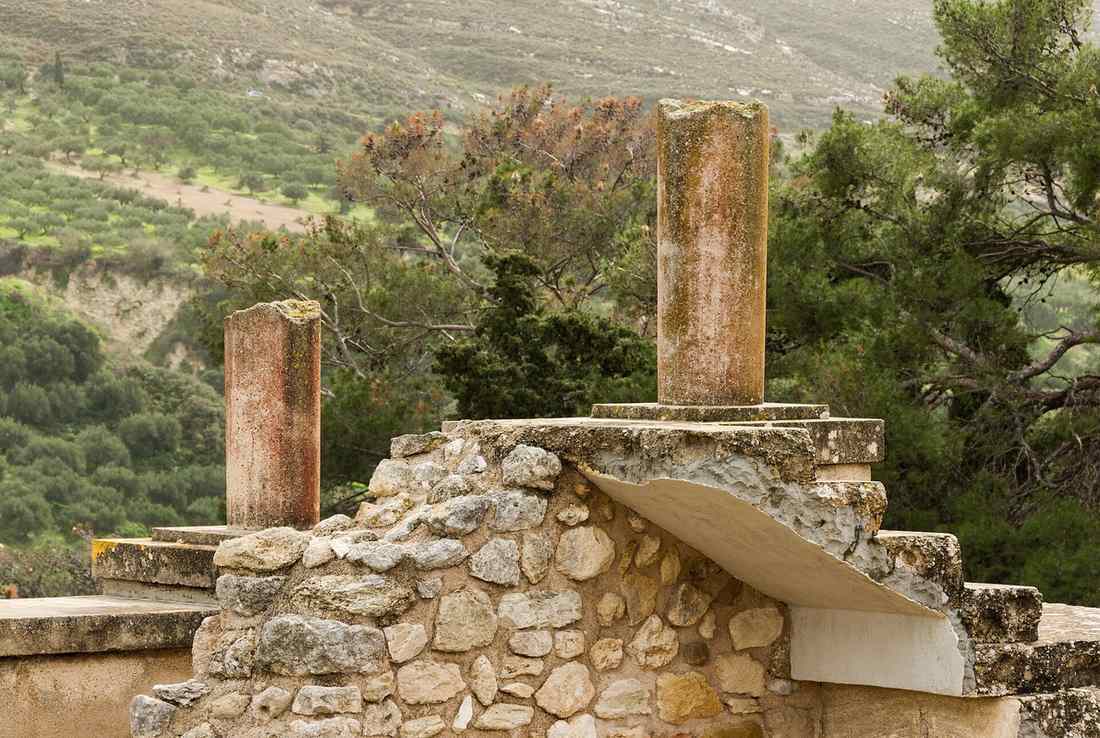
Sir Arthur Evans was the British archaeologist who excavated and controversially reconstructed Knossos and named the Minoan civilization. Plan tickets and tours through My Greece Tours.
Arthur Evans shaped how we experience the Palace of Knossos today, from the walls you walk between to the very name of the culture that built them. The sections below cover who he was, how he excavated the site, why he reconstructed it, what he found, how he named the Minoans, why he remains controversial and what his lasting legacy is.
Who was Sir Arthur Evans?
Sir Arthur John Evans was a British archaeologist, born in the nineteenth century into a wealthy scholarly family, who excavated the palace of Knossos on Crete from the very start of the twentieth century and named the Minoan civilization he uncovered there.
Arthur Evans came from a wealthy and scholarly English family, and that background gave him both the money and the intellectual training to pursue a great archaeological project. His father, Sir John Evans, was a paper manufacturer and a respected antiquarian, so the young Evans grew up surrounded by collectors, artefacts and the study of the ancient past. He was educated at Harrow and then at Brasenose College, Oxford, where he took a degree in history, and this combination of inherited wealth and rigorous learning shaped the confident, independent scholar he became.
Evans built a formal career in the study of antiquity long before Knossos made his name. He served as keeper of the Ashmolean Museum in Oxford for over two decades, transforming it into a major centre for archaeology, and he later held a professorship in prehistoric archaeology at the same university. That museum work sharpened his eye for small inscribed objects and for the writing systems of the ancient Mediterranean, an interest that would eventually draw him to Crete. His standing as a curator and scholar meant that when he turned to excavation he did so with authority, resources and a clear sense of what he was looking for.
Arthur Evans became one of the most influential and most controversial figures in the whole history of archaeology. He revealed an entire forgotten Bronze Age civilisation that predated classical Greece, gave it the name we still use, and rebuilt large parts of its greatest palace in concrete. Our guide to the history of the Palace of Knossos covers the wider story, and the next section covers how he found and excavated the site.
How did Arthur Evans discover and excavate Knossos?
Arthur Evans followed his study of Cretan seal-stones to the island, bought Kephala hill, and began large-scale excavation at the start of the twentieth century with Duncan Mackenzie. Within a year he had uncovered palace ruins covering some five and a half acres.
Evans came to Crete through his fascination with small engraved Cretan seal-stones and the mysterious signs cut into them. In the closing years of the nineteenth century, his search for the source of these writing-bearing objects led him first to the island itself, and he became convinced that a great undiscovered civilisation lay beneath the mound of Kephala hill near Herakleion. He purchased the hill so that he could control the excavation completely, an option his private fortune made possible where others had been blocked.
Political timing mattered as much as money. After Crete gained its freedom from Ottoman rule, Evans obtained permission to dig, and at the very start of the twentieth century he launched a full-scale excavation, working alongside the meticulous Scottish archaeologist Duncan Mackenzie, whose careful daybooks recorded the layers as they came up. The team cleared away centuries of earth to expose walls, courtyards, grand staircases and rooms, and the buried palace steadily rose back into daylight across a huge footprint.
The pace of discovery was extraordinary. Within roughly a year the excavation had revealed palace ruins spread across some five and a half acres, and Evans pressed on for roughly the next quarter-century, digging in places below the Bronze Age palace down to Neolithic remains far older than the Minoans themselves. The scale and richness of what he uncovered astonished the world and rewrote the early history of Europe. Our guide to the Minoan civilization at Knossos covers what he revealed, and the next section covers why he reconstructed the palace.
Why did Arthur Evans reconstruct Knossos?
Arthur Evans reconstructed parts of Knossos to preserve the fragile ruins and to help visitors picture the original palace. Using reinforced concrete, he rebuilt walls and columns, restored upper storeys and installed fresco replicas, and these heavily interpreted reconstructions remain controversial.
Evans gave two main reasons for what he called reconstituting the palace. The first was preservation. The excavated remains, including mud-brick walls and the spaces once spanned by timber columns and floors, were fragile and exposed to weather, and he used reinforced concrete to consolidate and protect them from collapse. Timber that had long since rotted away left gaps that made whole sections unstable, and concrete let him fill and support them permanently.
The second reason was interpretation. Evans wanted ordinary visitors to picture Knossos as a living building rather than a confusing field of low foundations. To achieve that vivid effect he rebuilt walls to their former height, recreated the distinctive downward-tapering Minoan columns in painted concrete, restored upper storeys and rooms, and had the frescoes reconstructed so that replicas could be installed where the originals had been found in fragments. The result gives modern visitors a strong, immediate sense of Minoan architecture.
These reconstructions are vivid and have shaped the popular image of Knossos, yet they go well beyond what the surviving evidence strictly supports, which is exactly why they remain controversial. Evans blended solid archaeology with confident imagination and then fixed the blend in place. The next section covers what he actually discovered on the site.
What did Arthur Evans discover at Knossos?
Arthur Evans uncovered the throne room with its alabaster throne, brilliantly coloured frescoes, great storerooms lined with giant pithoi, sophisticated drainage and light-wells, and thousands of inscribed clay tablets, all spread across a palace of some five and a half acres.
The throne room ranks among Evans’s most famous finds. At its heart stood a carved alabaster throne set against the wall, flanked by stone benches and, in the reconstruction, guarded by painted griffins. Around it he uncovered brilliantly coloured frescoes showing bull-leaping, processions, elegant courtiers and stylised nature, fragments that revealed a confident, sophisticated art unknown before his excavation. These images did more than decorate the palace; they gave Evans much of his evidence for how Minoan society looked and behaved.
The palace also proved to be a centre of storage and administration on a grand scale. Evans revealed long storerooms lined with rows of enormous pithoi, the giant ceramic storage jars that once held oil, grain and wine, showing an economy able to gather and redistribute surplus. He documented advanced engineering too, including stone drainage channels and cleverly placed light-wells that carried daylight and air deep into the multi-storey complex. Such systems marked Knossos as a technically accomplished building far ahead of its age.
Arthur Evans also recovered thousands of inscribed clay tablets and sealings from the palace archives. These administrative documents, baked hard when the palace burned, preserved the writing of the Minoans and their successors and became the raw material for decades of later study. Together the throne room, frescoes, pithoi-filled storerooms, drainage and tablets let Evans reconstruct not just walls but a whole picture of Bronze Age Cretan life. The next section covers how he named that civilisation.
How did Arthur Evans name the Minoan civilization?
Arthur Evans named the civilisation he uncovered the Minoans, after the legendary King Minos of Knossos. He linked the palace’s maze-like plan to the myth of the labyrinth and the constant bull imagery to the story of the Minotaur.
Evans uncovered a great Bronze Age civilisation that had no name in recorded history, so he supplied one himself. He called it Minoan after King Minos, the legendary ruler who in Greek myth reigned from Knossos and kept the Minotaur imprisoned in the labyrinth. The choice tied his brand-new discovery directly to one of the most famous stories in the ancient world, and it framed the whole culture through the lens of that legend.
The connection felt natural to Evans because the site itself seemed to echo the myth. The palace’s sprawling, maze-like layout of corridors and rooms recalled the labyrinth of the tale, and the bull, so central to the story of the Minotaur, appeared everywhere he dug, in leaping-scene frescoes, in great sculpted horns of consecration and in ritual objects. The physical evidence and the ancient legend seemed to reinforce one another, and the name captured that overlap in a single memorable word.
The term Minoan proved remarkably durable. Archaeologists and historians still use it today for the sophisticated Bronze Age civilisation of Crete, long after many of Evans’s other interpretations have been questioned. It stands as a lasting example of how Arthur Evans shaped not just the appearance of Knossos but the very language we use to describe the ancient Aegean. Our guide to the Minotaur and the labyrinth covers the myth, and the next section covers how he approached the Minoan scripts.
How did Arthur Evans approach the Minoan scripts?
Arthur Evans defined rather than fully deciphered the Cretan scripts. He identified an early pictographic script, Linear A and Linear B, and recovered thousands of inscribed tablets. Linear A stays undeciphered, while others later showed Linear B recorded an early form of Greek.
Evans made the writing systems of ancient Crete a central part of his work, and defining them was one of his most solid achievements. From the mass of inscribed material he separated an earlier pictographic script from two later linear systems, which he labelled Linear A and Linear B. This classification imposed order on what had looked like a jumble of signs and gave every scholar who followed a clear framework for studying Aegean writing.
Evans did not, however, crack the languages themselves, and it is important to keep that distinction clear. Linear A, the script of the Minoans proper, records an unknown language and remains undeciphered to this day despite more than a century of effort. Evans recovered and catalogued the tablets and studied the signs closely, but the meaning of the Minoan texts stayed locked away, a limit he could not overcome with the evidence and methods of his time.
Linear B told a different story, though its resolution came from others rather than from Arthur Evans. The script was later shown to record an early form of Greek, cracked by work that built directly on the tablets and classifications Evans had provided. In that sense his greatest contribution to the scripts was groundwork: he defined the systems and preserved the thousands of tablets that made eventual decipherment possible. The next section covers why his overall work remains controversial.
Why is Arthur Evans controversial?
Arthur Evans is controversial because he rebuilt large parts of Knossos in permanent concrete with heavy guesswork, especially the upper storeys, colours and frescoes recreated from small fragments in his own era’s style, fixing his interpretations so later scholars cannot revise them.
The core of the criticism is the concrete itself. Evans did not merely stabilise ruins; he rebuilt upper storeys, ceilings and whole rooms that no longer survived, and he did so in a material that cannot be undone. Where the evidence ran out, he filled the gaps with confident reconstruction, so a visitor today often cannot tell genuine Minoan wall from Evans’s addition. Because the reconstitutions are permanent, later archaeologists are effectively locked into his conclusions.
The frescoes draw particular objection. Many were recreated from small surviving fragments, with large areas of colour and detail supplied by artists working under Evans in the taste and style of his own early-twentieth-century period. Critics argue that these vivid images tell us as much about his era’s idea of a graceful lost civilisation as about the Minoans themselves, and that their beauty gives a misleading impression of certainty about how the palace truly looked.
Set against this is a genuine case for the defence, which is why the debate never fully settles. Evans’s reconstruction undeniably saved a fragile site from decay and lets millions of ordinary visitors grasp the scale and grandeur of the palace in a way bare foundations never could. The honest verdict is that his work was both a rescue and an imposition, and Arthur Evans remains controversial precisely because those two judgements are both true. The next section covers his lasting legacy.
What is Arthur Evans’s legacy at Knossos?
Arthur Evans’s legacy is the rediscovery of a lost Bronze Age civilisation, the dramatic walkable palace millions of visitors enjoy, the enduring word Minoan, and the scholarly links that connect Knossos to the Ashmolean Museum in Oxford, where he long served.
Evans gave the world back an entire lost civilisation. Before his excavation the Minoans were only a shadow behind Greek myth, and after it they were a documented Bronze Age culture with art, architecture, writing and trade. He was knighted for his services to archaeology, recognition of a discovery that pushed the known history of Europe back by many centuries and established Crete as the cradle of the first great Aegean civilisation.
His most visible legacy is physical. The reconstructed palace at Knossos remains one of the most visited archaeological sites in Greece, and the walkable rooms, restored columns and vivid frescoes that draw those crowds are largely his creation. Even the debates about accuracy keep his name attached to every corridor, so that touring Knossos means engaging with Arthur Evans’s vision at every turn, for better and for worse.
Evans also left an intellectual and institutional legacy that outlives the concrete. The word Minoan is now permanent in scholarship and in popular culture, his classification of the Cretan scripts underpinned their later decipherment, and his long association with the Ashmolean Museum in Oxford tied Knossos into the wider study of the ancient world. Plan your visit and tours through our Palace of Knossos guide, and remember that what you walk through is a blend of genuine Bronze Age remains and one determined scholar’s confident vision of how they once looked.
Frequently Asked Questions
Who discovered the palace of Knossos?
The palace of Knossos is most associated with the British archaeologist Sir Arthur Evans, who purchased the site and led its full-scale excavation from the very start of the twentieth century, although the mound had long been suspected of hiding ancient remains and earlier attempts had been made. Over roughly a quarter-century, Evans uncovered the vast Minoan palace, revealing the throne room, frescoes, storerooms and thousands of artefacts, and he gave the lost Bronze Age civilisation the name Minoan after the legendary King Minos. He also controversially reconstructed parts of the palace in concrete, and his decades of work and interpretation shaped the way visitors experience Knossos today.
Why is Knossos reconstructed?
Knossos was reconstructed by Sir Arthur Evans for two main reasons: to preserve the fragile excavated remains and to help visitors picture the original palace. The mud-brick walls and the spaces once spanned by timber columns and floors were vulnerable, so Evans used reinforced concrete to consolidate and protect them. He also rebuilt walls, recreated the distinctive downward-tapering Minoan columns, restored upper storeys and installed fresco replicas so the site would read as a living building rather than a confusing field of foundations. These reconstructions are vivid and shaped the popular image of Knossos, but because they involved considerable guesswork and are now fixed in concrete, they remain controversial among archaeologists.
Did Arthur Evans name the Minoans?
Yes, Sir Arthur Evans named the Minoan civilization. When he uncovered the great Bronze Age culture at Knossos, it had no name in history, so he called it Minoan after King Minos, the legendary ruler of Crete who in Greek myth reigned from Knossos and kept the Minotaur in the labyrinth. The connection felt fitting, as the palace’s maze-like layout recalled the labyrinth and the bull, central to the myth, appeared throughout the site. The name linked the newly discovered civilisation to one of the most famous legends of the ancient world, and it endures: archaeologists and historians still use Minoan today for the Bronze Age civilisation of Crete.
Did Arthur Evans decipher Linear A and Linear B?
Arthur Evans defined the Cretan scripts but did not fully decipher them. He separated an early pictographic script from two later linear systems, which he named Linear A and Linear B, and he recovered thousands of inscribed clay tablets that preserved Minoan and later writing. Linear A, the language of the Minoans themselves, remains undeciphered to this day, so Evans could catalogue and classify it but never read it. Linear B was later shown by other scholars to record an early form of Greek, and that breakthrough rested directly on the tablets and classifications Evans had provided, making his groundwork essential to a decipherment he did not achieve himself.
Why is Arthur Evans’s reconstruction of Knossos controversial?
Arthur Evans’s reconstruction of Knossos is controversial because it mixes genuine evidence with a great deal of interpretation and then fixes that mixture in permanent concrete. He rebuilt upper storeys, columns and whole rooms that no longer survived, and he had frescoes recreated from small fragments in the artistic style of his own era, so visitors often cannot tell true Minoan remains from his additions. Supporters point out that the work saved a fragile site and helps millions of people grasp the scale of the palace. Critics counter that the guesswork is now impossible to revise. Both judgements are fair, which is why the debate endures.