
Greek Orthodox Easter in Athens is the most important and moving celebration of the year, with candlelit Holy Week processions, the dramatic midnight resurrection service, fireworks and the Sunday lamb feast. Experience it alongside skip-the-line sightseeing tickets and tours from My Greece Tours for an unforgettable visit.
This profound celebration is a spiritual highlight of the Athens travel guide. The sections below cover what Greek Easter is, the Holy Week traditions, Good Friday, the midnight resurrection service, Easter Sunday’s feast, experiencing it as a visitor, and tips.
What is Greek Easter in Athens?
Greek Orthodox Easter, Pascha, is the most important and deeply felt celebration in the Greek calendar, far surpassing Christmas. Usually falling in April or early May, often on a different date from Western Easter, it unfolds over Holy Week with solemn services, candlelit processions, the dramatic midnight resurrection service with fireworks, and joyful feasting on Easter Sunday. Experiencing it in Athens offers a profound, moving and unforgettable insight into Greek faith, culture and tradition.
Of all the times to visit Athens, Easter offers perhaps the most profound and moving cultural experience, for Greek Orthodox Easter, known as Pascha, is the most important and deeply felt celebration in the entire Greek calendar, holding even greater significance for Greeks than Christmas. The date of Orthodox Easter is calculated differently from the Western Christian date and so often falls on a different Sunday, usually in April or early May, a timing worth checking if you hope to witness it. Far more than a single day, Greek Easter is the culmination of the long and solemn period of Holy Week, the Megali Evdomada or Great Week, during which the city’s churches hold a sequence of beautiful and emotional services, and the celebration unfolds through candlelit processions, the dramatic and uplifting midnight resurrection service on Holy Saturday accompanied by fireworks, and the joyful family feasting of Easter Sunday.
To witness even part of this in Athens, with its blend of deep religious devotion, ancient custom and communal joy, offers an extraordinary and unforgettable window onto the soul of Greek faith and culture. It is the heart of the Greek year. Its observance begins in the solemnity of Holy Week.
What are the Holy Week traditions?
Holy Week in Athens builds through a series of moving church services and customs. On Holy Thursday, families dye eggs deep red, symbolising the blood of Christ, and bake the sweet braided tsoureki bread. The churches hold daily evening services commemorating the Passion of Christ, growing more solemn toward the weekend. The whole city takes on a reverent, anticipatory atmosphere, with the rhythms of fasting, churchgoing and preparation drawing communities together in the lead-up to Easter.
The drama and emotion of Greek Easter build steadily through Holy Week, the great week leading up to Easter Sunday, which is observed in Athens with a sequence of moving services and time-honoured customs that draw the whole community into the rhythm of the season. Throughout the week, the city’s many churches hold daily evening services that commemorate, day by day, the final events of the life of Christ, his Passion, growing progressively more solemn and emotionally charged as the week advances toward its climax. A particularly cherished day is Holy Thursday, when, in homes across the city, families traditionally dye hard-boiled eggs a deep, rich red, the colour symbolising the blood of Christ and the eggs representing rebirth, and bake the fragrant, sweet braided bread called tsoureki, flavoured with mahleb and mastic, that is so associated with Easter.
Many of the faithful observe a period of fasting during Lent and Holy Week, abstaining from meat, fish and dairy. As the week unfolds, a palpable atmosphere of reverence, anticipation and quiet busyness settles over Athens, with churchgoing, fasting and preparation binding families and communities together. It is a time of deep meaning. The emotion reaches a first peak on Good Friday. The Epitaphios procession is unforgettable.
What happens on Good Friday?
Good Friday is the most solemn day, mourning the crucifixion and death of Christ. During the day, women decorate the Epitaphios, a wooden bier symbolising Christ’s tomb, with masses of fresh flowers, creating works of art. In the evening, around 9pm, each parish carries its flower-covered Epitaphios in a candlelit procession through the streets, accompanied by hymns and the faithful holding candles, a deeply moving and beautiful spectacle that fills the neighbourhoods of Athens.
Good Friday, Megali Paraskevi, is the most solemn and mournful day of Holy Week in Athens, given over entirely to commemorating the crucifixion, death and burial of Christ, and it is marked by one of the most beautiful and moving rituals of the entire Greek year. During the daytime, in each parish church, the women of the congregation lovingly decorate the Epitaphios, an ornate wooden canopied bier that symbolises the tomb of Christ, covering it entirely with masses of fresh flowers in elaborate, fragrant arrangements that are genuine works of art, each parish taking pride in its creation. Then, in the evening, typically around nine o’clock, the emotional heart of the day arrives as each church carries its flower-laden Epitaphios out in a slow, candlelit procession through the surrounding streets of the neighbourhood, led by clergy and followed by the faithful holding lit candles and singing the haunting, sorrowful hymns of the day, the church bells tolling mournfully.
As these processions wind through the districts of Athens, with the flickering candlelight, the flowers, the chanting and the hushed crowds, the effect is profoundly atmospheric and moving, even for non-believers. It is a spectacle of great beauty and solemnity. The mood transforms utterly at midnight on Saturday. The resurrection service is the climax of it all.
What is the midnight resurrection service?
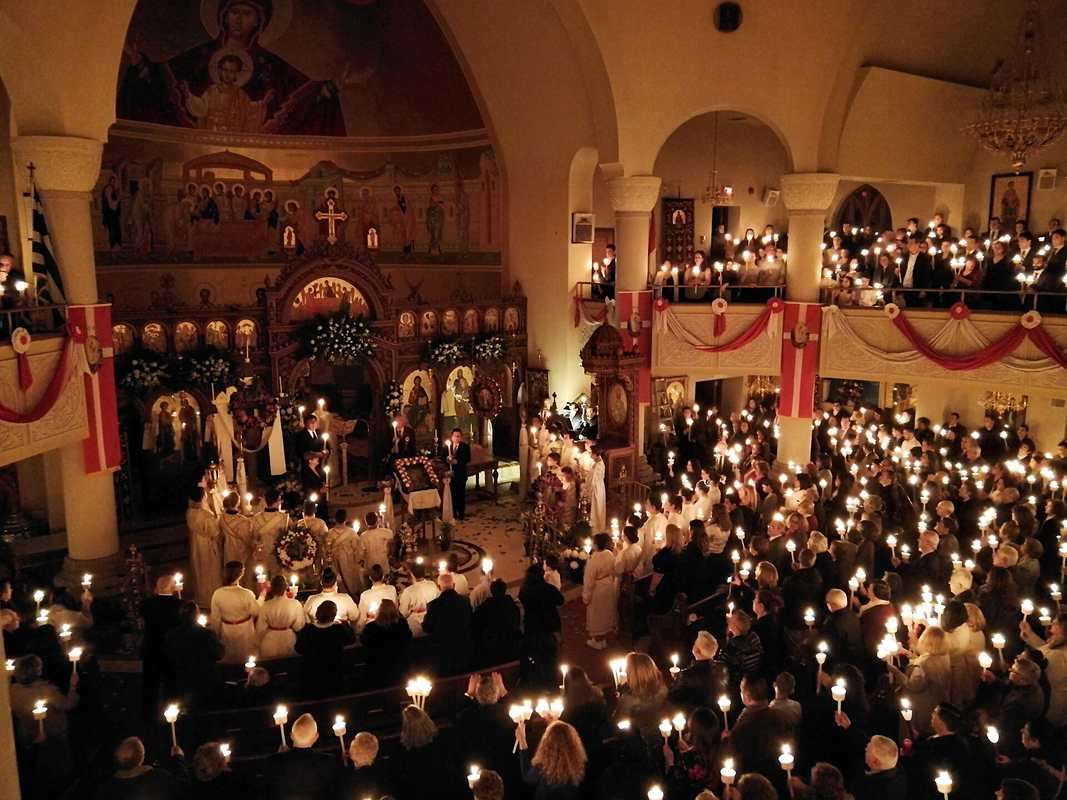
The dramatic climax of Greek Easter is the midnight resurrection service on Holy Saturday. Crowds fill the churches and squares before midnight, holding candles. At midnight, the church lights go out, then the priest emerges with the holy flame, proclaiming “Christos Anesti”, Christ is Risen. The light passes from candle to candle through the crowd as bells ring and fireworks explode overhead, a euphoric, unforgettable moment. People then carry the flame home to bless their houses.
The supreme and most exhilarating moment of the entire Greek Easter, and one of the most extraordinary experiences a visitor can have in Athens, is the midnight resurrection service on the night of Holy Saturday, when mourning gives way to triumphant joy. As the night approaches midnight, people in their Sunday best gather at churches across the whole city, the faithful packing inside from late evening while many more assemble in the churchyards and surrounding squares, each person holding an unlit white candle, with children often carrying special decorated candles, lambades, given by their godparents. Then, at the stroke of midnight, all the lights in the church are extinguished, plunging the scene into darkness, until the priest emerges bearing the holy flame, lit from a flame traditionally brought from Jerusalem, and joyfully proclaims the ancient words “Christos Anesti”, Christ is Risen, to which the crowd responds “Alithos Anesti”, Truly He is Risen.
The single flame is then passed from candle to candle, person to person, until the whole church and square glow with a sea of flickering candlelight, while the bells peal out wildly and fireworks and firecrackers explode overhead, creating a euphoric, electric and unforgettable atmosphere of celebration. Afterwards, people carefully carry their lit candles home to bless their houses with the holy flame. It is pure magic. The joy continues into a great feast.
What happens on Easter Sunday?
Easter Sunday is a day of joyful feasting, marking the end of the long Lenten fast. The centrepiece is the traditional roasting of whole lambs on the spit, tended for hours over charcoal, shared with family and friends in gardens and courtyards amid music, dancing and wine. Many break the fast late on Saturday night with magiritsa, a traditional Easter soup. The cracking of the red eggs, tsoungrisma, is a beloved custom, making the day warm, festive and convivial.
After the spiritual intensity of the midnight service, Easter Sunday itself is a day of pure joy, family, feasting and celebration, marking the end of the long weeks of Lenten fasting with one of the great culinary traditions of Greece. Many families first break their fast in the early hours after the Saturday midnight service with a bowl of magiritsa, the traditional Easter soup made from lamb offal and herbs in an egg-lemon broth, a gentle reintroduction of meat to the body. The great event of Sunday itself, however, is the lamb roast: across Athens, in gardens, courtyards, balconies and villages, families gather to roast whole lambs or goats on the spit, the men rising early to light the charcoal and then slowly turning the animal over the coals for many hours until it is golden and succulent, the aroma filling the air everywhere.
The roast lamb is then shared in a long, convivial feast among extended family and friends, accompanied by abundant food, wine, traditional music and dancing, in an atmosphere of warmth and celebration. A beloved custom is the tsoungrisma, the cracking of the red-dyed eggs, where people tap their eggs against each other, the one whose egg remains uncracked declared the winner. It is a joyous, life-affirming day. Visitors can share in much of this. Knowing how to experience it helps.
How can visitors experience Greek Easter, and what tips help?
Visitors are warmly welcome to experience Greek Easter in Athens. Attend a Good Friday Epitaphios procession in a neighbourhood like Plaka, and above all join the midnight resurrection service on Holy Saturday at a local church or square, candle in hand. Be respectful in churches, dress modestly, and embrace the warm Greek hospitality, as you may be invited to share Easter food. Note that many shops and sites close over Easter, so plan around the holiday, and book accommodation early.
Far from being a closed family affair, Greek Easter in Athens is something visitors are warmly welcomed to witness and even share in, and a little knowledge helps you experience it respectfully and fully. The two unmissable moments are the Good Friday evening, when you can join or watch the beautiful candlelit Epitaphios procession winding through a neighbourhood such as the atmospheric Plaka or any local parish, and above all the midnight resurrection service on Holy Saturday, for which you should head to a church or its square before midnight, buy or bring a candle, and stand among the crowd to share in the magical moment of the flame, the bells and the fireworks, an experience open to all.
When entering churches, behave respectfully and dress modestly, covering shoulders and knees, and observe quietly. The famous Greek hospitality means that visitors are often spontaneously invited to share in Easter food and celebrations, an invitation worth gratefully accepting. On the practical side, be aware that many shops, businesses and some attractions close or keep reduced hours over the Easter period, especially Good Friday and Easter Sunday, so plan your sightseeing and meals around the holiday, and because Easter is a peak time, book your accommodation well in advance. Embracing the occasion makes for a deeply memorable trip. The season is explored in the Athens in spring guide. The questions below cover the points visitors ask most.
Frequently Asked Questions
When is Greek Easter in Athens?
Greek Orthodox Easter usually falls in April or early May, though it is calculated differently from Western Easter and so often lands on a different Sunday; the date varies each year, so it is worth checking. It is the most important celebration in Greece, observed through Holy Week with services and processions, the midnight resurrection service on Holy Saturday, and feasting on Easter Sunday.
What happens at the Greek Easter midnight service?
At the midnight resurrection service on Holy Saturday, crowds gather at churches before midnight holding candles. At midnight the lights go out, then the priest brings out the holy flame and proclaims “Christos Anesti”, Christ is Risen. The light passes from candle to candle through the crowd as bells ring and fireworks explode overhead, a euphoric moment. People then carry the flame home to bless their houses.
Can tourists experience Greek Easter in Athens?
Yes, tourists are warmly welcome to experience Greek Easter in Athens. You can watch the moving candlelit Epitaphios procession on Good Friday and join the midnight resurrection service on Holy Saturday at a local church or square, candle in hand. Be respectful and dress modestly in churches. Note that many shops and sites close over Easter, so plan ahead and book accommodation early.