
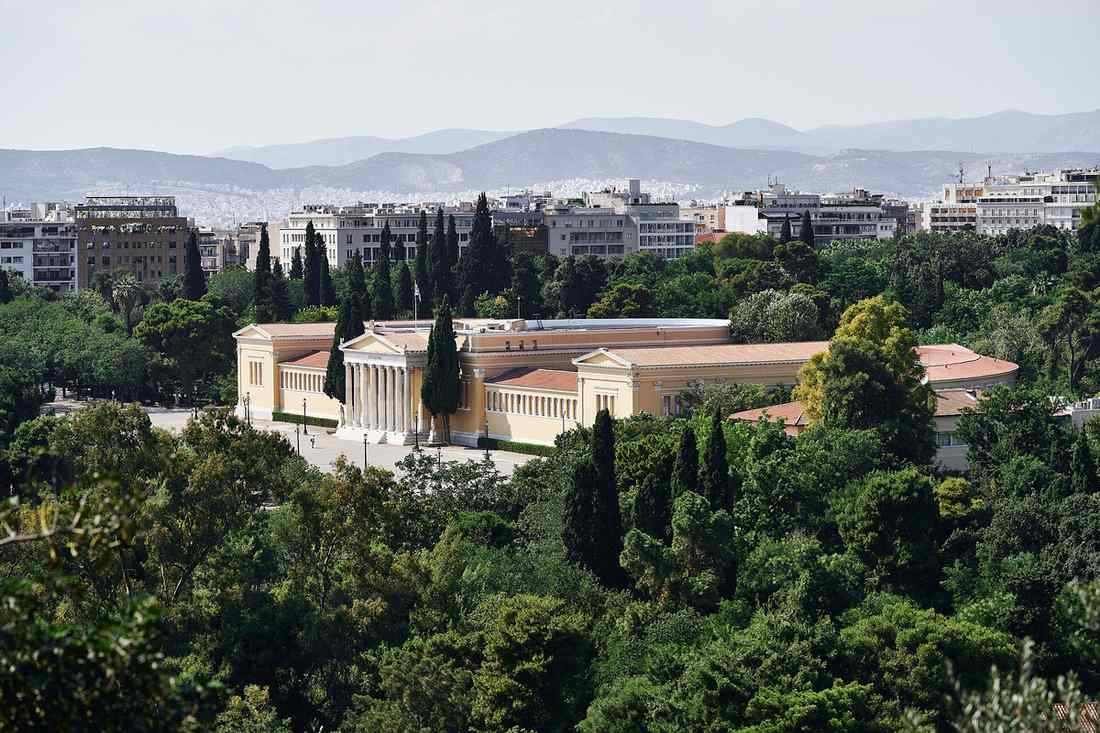
The Zappeion Hall in Athens is a grand 19th-century neoclassical building beside the National Garden, linked to the first modern Olympics and still used for major conferences, exhibitions and state events. Admire it on a central walking route with skip-the-line sightseeing tickets and tours from My Greece Tours. Plan the whole trip with Greece Tours.
This elegant landmark is a highlight in the Athens travel guide. The sections below cover what it is, its history, the Olympic links, the architecture, the gardens, what it is used for today and how to visit.
What is the Zappeion Hall?
The Zappeion Hall (Zappeion Megaron) is a grand neoclassical building in central Athens, on the southern edge of the National Garden near Syntagma. Built in the 1870s and 1880s as a conference and exhibition hall, it is closely tied to the revival of the modern Olympic Games and remains a prestigious venue for state events, conferences and exhibitions, surrounded by elegant landscaped gardens.
One of the most graceful and historically significant buildings in central Athens, the Zappeion Hall is an imposing neoclassical landmark that every visitor passes on a stroll through the city’s green heart. Officially the Zappeion Megaron, it stands on the southern side of the lovely National Garden, only a short walk from Syntagma Square and surrounded by its own formal gardens, marble walks and statues. The building was conceived in the nineteenth century as a hall for national and international exhibitions and conferences, part of the cultural flowering of the newly independent Greek state, and it was built thanks to the generosity of two wealthy national benefactors.
From the outset it was bound up with one of the great projects of the age, the revival of the ancient Olympic Games in the modern era, and it played a real role in the first modern Olympics of 1896. Today the Zappeion continues in its original purpose as a prestigious venue for major conferences, exhibitions, ceremonies and state occasions, and its elegant architecture and tranquil gardens make it a beautiful and dignified sight in its own right. It complements the green oasis in the National Garden guide. Its creation owes much to two benefactors.
What is the history of the Zappeion?
The Zappeion is named after its benefactors, the cousins Evangelos and Konstantinos Zappas, wealthy patriots who funded the revival of the Olympic Games and the building’s construction. Designed mainly by the architect Theophil Hansen, with work beginning in 1874 and completed by 1888, it was Greece’s first building erected specifically for the modern Olympic movement and for national exhibitions.
The story of the Zappeion is closely tied to two visionary national benefactors and to the dream of reviving the ancient Olympics. The building takes its name from the cousins Evangelos Zappas and Konstantinos Zappas, wealthy Greek philanthropists of the nineteenth century who were among the earliest champions of restoring the Olympic Games in the modern era and who left their fortunes to support Greek culture, education and the Olympic cause. It was their generosity that funded the construction of a grand hall in Athens to serve the revived games and to host national exhibitions showcasing the progress of the young Greek state.
The original plans were drawn up by the French architect François Boulanger, and work began in 1874, but the resulting stately neoclassical building was largely the design of the celebrated Danish architect Theophil Hansen, the architect of much of neoclassical Athens, including the Academy, and it was completed by 1888. The Zappeion thus holds the distinction of being the first building in the world erected specifically in connection with the modern Olympic Games, a fitting monument to the Zappas cousins’ vision. This heritage gives it real significance. Its Olympic role soon followed. The Olympic connection is central to its story.
How is the Zappeion linked to the Olympics?
The Zappeion is deeply linked to the modern Olympics. It served as the fencing venue at the first modern Games of 1896, as the Olympic Village at the intermediate Games, and as the main press and media centre at the Athens Olympics. Built to support the Olympic revival funded by the Zappas benefactors, it remains a symbol of the games’ rebirth in Athens.
Few buildings are as closely connected to the modern Olympic Games as the Zappeion, a link that runs through its entire history. Conceived and funded specifically to support the revival of the ancient games, championed by the Zappas cousins, the hall was ready in time to play a part in the very first modern Olympic Games, held in Athens in 1896, when it served as the venue for the fencing competitions, hosting these contests in its grand interior. A decade later, at the intermediate or “Intercalated” Olympic Games of, also held in Athens, the Zappeion took on a different role as the Olympic Village, providing accommodation and facilities for the athletes.
The building’s Olympic story continued into the modern era: during the Athens Olympic Games, when the games returned triumphantly to their birthplace, the Zappeion was pressed into service as the main Olympic press and media centre, the hub for the world’s journalists covering the event. Through these repeated roles across more than a century, the Zappeion has remained a living symbol of the Olympic movement and of Athens’s special place as the cradle of both the ancient and modern games. This Olympic legacy adds depth to a visit. The building’s architecture is equally notable. Its design reflects classical ideals.
What is the architecture of the Zappeion like?
The Zappeion is a stately neoclassical building with a symmetrical facade and a central temple-like portico of Corinthian columns, designed by Theophil Hansen. Its most distinctive feature is a circular interior courtyard, the atrium, ringed by a marble peristyle of columns. Built largely of marble, it embodies the 19th-century neoclassical revival inspired by ancient Greek architecture.
The Zappeion is a fine and dignified example of the nineteenth-century neoclassical architecture that gave modern Athens so much of its character, the work principally of the master architect Theophil Hansen. The building presents a symmetrical, harmonious facade dominated by a central, temple-like entrance portico crowned with Corinthian columns, which gives it the air of an ancient Greek temple and announces its cultural purpose. From this central element, lower wings and porticoed sections extend symmetrically to either side, lending the whole composition balance and grandeur. The Zappeion’s most distinctive and beautiful architectural feature, however, lies within: an elegant circular interior courtyard, or atrium, open to the sky and ringed by a graceful marble peristyle of columns, a serene and impressive space that has hosted many important events.
Built largely of gleaming marble, with classical proportions and restrained ornament, the building embodies the ideals of the neoclassical revival, which consciously looked back to the architecture of ancient Greece for inspiration. The combination of the temple-like exterior and the unusual circular peristyle court makes the Zappeion an architectural gem. It rewards a closer look. Its gardens extend the National Garden. The surrounding grounds are a delight.
What are the Zappeion gardens like?
The Zappeion is surrounded by its own elegant landscaped gardens, effectively an extension of the National Garden, with formal marble walks, statues, busts of notable Greeks, a cafe and a peristyle court. Peaceful and shaded, the gardens are a lovely place to stroll, and they sit close to the Panathenaic Stadium, the Temple of Olympian Zeus and Hadrian’s Arch.
Part of the pleasure of the Zappeion is its beautiful setting, for the building is wrapped in its own elegant landscaped grounds that flow seamlessly out of the great National Garden, forming a graceful, park-like quarter in the heart of the city. These Zappeion gardens are laid out with formal marble walkways, fountains, hedges and lawns, and are dotted with statues and busts commemorating notable figures from Greek history, mythology and the arts, turning a stroll into a quiet open-air gallery; among the sculptures are figures recalling poets, statesmen and the spirit of the nation. A pleasant café within the grounds offers a shady spot to pause over a coffee. The peaceful, tree-lined paths make the gardens a lovely place to wander, picnic or simply escape the bustle of the city, much like the adjoining National Garden.
Crucially, the Zappeion’s position places it within a short walk of several major sights: the marble Panathenaic Stadium lies just across the way, while the towering columns of the Temple of Olympian Zeus and the elegant Arch of Hadrian are close by, and Syntagma Square is only minutes away. This makes the Zappeion and its gardens a natural part of any central walking route. The nearby stadium is covered in the Panathenaic Stadium guide. Today the hall remains a busy venue. The building still serves the nation.
What is the Zappeion used for today, and how do you visit?
Today the Zappeion is a leading conference and exhibition centre, hosting congresses, trade fairs, ceremonies, cultural events and state functions; Greece signed its EU accession here. The gardens are freely open and a lovely public stroll, while the building’s interior is accessible during events. It stands beside the National Garden, a short walk from Syntagma metro, easily combined with nearby sights.
The Zappeion remains very much a working building, continuing in the cultural and civic role for which it was created over a century ago. It functions today as one of the country’s foremost conference and exhibition centres, hosting major international congresses, trade fairs, exhibitions, concerts, ceremonies, official functions and state events within its grand halls and circular atrium. The building has witnessed moments of national importance: it was here, in its marble peristyle hall, that Greece signed the treaty formalising its accession to the European Community, taking effect, a landmark in modern Greek history. For visitors, the experience is chiefly of the magnificent exterior and the surrounding gardens, which are freely open to the public as a beautiful and peaceful place to stroll at any time, while the interior can usually be glimpsed or visited when events or exhibitions are open to the public.
The Zappeion stands on the southern edge of the National Garden, only a short walk from Syntagma metro station on lines 2 and 3, and it combines easily with the National Garden, the Panathenaic Stadium, the Temple of Olympian Zeus and Hadrian’s Arch on a central walking tour. Admiring it and wandering its gardens is free and rewarding. The wider routes appear in the getting around Athens guide. The questions below cover the points visitors ask most.
Frequently Asked Questions
What is the Zappeion Hall used for?
The Zappeion Hall is a major conference and exhibition centre in Athens, hosting congresses, trade fairs, exhibitions, ceremonies, cultural events and state functions. Built in the 19th century for national exhibitions and the Olympic revival, it has served as an Olympic fencing venue, Olympic Village and press centre, and Greece signed its EU accession here.
Can you visit the Zappeion in Athens?
Yes, you can freely admire the Zappeion’s grand neoclassical exterior and stroll its surrounding landscaped gardens, which are open to the public at any time. The interior, with its circular marble peristyle court, can usually be visited when exhibitions or events are open. It stands beside the National Garden, a short walk from Syntagma.
Why is the Zappeion linked to the Olympics?
The Zappeion is linked to the Olympics because it was built to support the revival of the modern Olympic Games, funded by the Zappas benefactors. It served as the fencing venue at the first modern Games in 1896, as the Olympic Village, and as the main press centre at the Athens Olympics.