
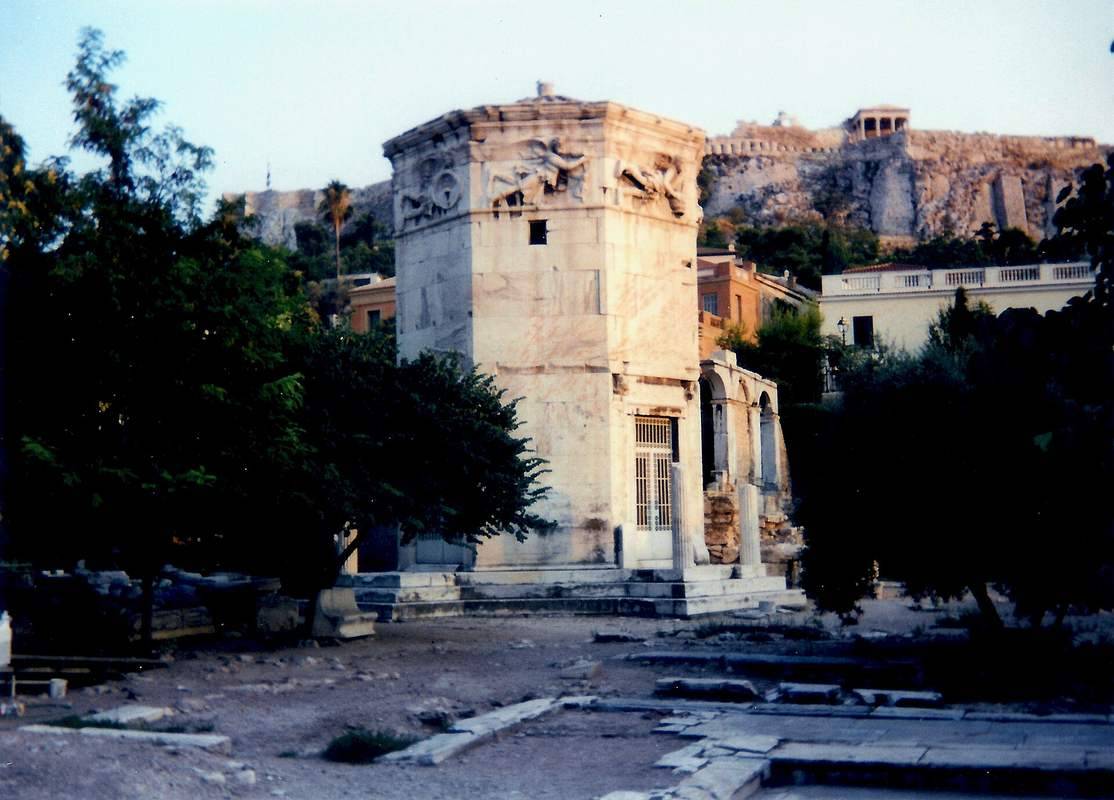
Athens’s Tower of the Winds is a beautifully preserved octagonal marble tower standing in the Roman Agora, the world’s first weather station, decorated with reliefs of the eight wind gods and once holding a water clock and sundials. See it on a Roman Agora visit with skip-the-line and combined-ticket access from My Greece Tours.
This remarkable ancient monument is a fascinating stop in the Athens travel guide. The sections below cover what it is, its history, the eight winds, how it told time, its later uses, practical details and how to visit.
What is the Tower of the Winds in Athens?
The Tower of the Winds is an eight-sided marble tower in the Roman Agora of Athens, rising about thirteen and a half metres. Named after eight wind-god reliefs, it served as a horologium and is regarded as the world’s first weather station.
The monument dates from the first or second century before the common era. As a horologium it combined a water clock, sundials on its outer faces and a bronze weathervane, letting Athenians read both the time and the wind from one structure.
One of the most intriguing and best-preserved monuments in all of Athens, the Tower of the Winds is an elegant octagonal tower standing within the archaeological site of the Roman Agora, just below the northern slopes of the Acropolis. Built entirely of fine Pentelic marble and rising about 13.5 metres tall atop a three-stepped base, it is an unusually complete survivor from classical antiquity, remaining virtually intact after more than two thousand years. The tower takes its name from the eight beautifully carved relief figures of wind gods that adorn the upper part of its eight sides, each facing the direction of the wind it personifies.
Far from being merely decorative, the building was a sophisticated piece of ancient technology, functioning as a horologium, or timekeeping device, that combined a water-powered clock inside with sundials on its outer faces and a bronze weathervane on its roof. Through these features, ancient Athenians could read both the time and the prevailing wind, which is why the tower is often celebrated as the world’s first meteorological station. Compact, graceful and ingenious, it is a genuine highlight of the Roman Agora. It stands within the site detailed in the Roman Agora guide. Its origins reach back over two millennia.
What is the history of the Tower of the Winds?
The astronomer Andronicus of Cyrrhus designed the monument, finished by roughly the mid-first century before the common era. It stood in the Roman Agora as a public timekeeper and survived because it was continuously reused over the centuries.
Some scholars date the tower a century earlier. Its unbroken reuse, first as a Christian building and later by Ottoman dervishes, kept it roofed and largely intact down to the present.
The tower’s long history is as remarkable as its design, and it explains the extraordinary state of preservation. The ancient writers Vitruvius and Varro record that Andronicus of Cyrrhus, an astronomer from Macedonia, designed the structure. It was finished by roughly the mid-first century before the common era, since Varro referred to it soon after, though some scholars place its construction a century earlier.
Builders raised the tower on the eastern side of what became the Roman Agora, the commercial heart of Roman-era Athens. There it served as a grand public timepiece and weather indicator for the city’s citizens and traders. Most ancient monuments fell into ruin, yet the Tower of the Winds survived almost intact. It was never abandoned but continuously occupied and adapted for new uses across the centuries.
In late antiquity it appears to have been used as a Christian building, perhaps a baptistery or martyrium, as suggested by a carved cross and traces of paintings inside, and under Ottoman rule it became a place of worship for Sufi whirling dervishes. This unbroken reuse kept it roofed and maintained, allowing it to come down to us as one of the few classical buildings still standing virtually whole. This continuity gives the monument unique value. The Roman era it belongs to is explored in the Hadrian’s Library guide. Its carved winds are its defining feature.
What are the eight winds on the tower?
The tower’s eight sides each face a point of the compass and carry a carved relief of the wind god of that direction. Each figure carries attributes that reflect the character of its wind, from cold and stormy to warm and gentle.
The eight winds are Boreas (north), Kaikias (northeast), Apeliotes (east), Eurus (southeast), Notus (south), Livas (southwest), Zephyrus (west) and Skiron (northwest). Their placement forms a precise compass carved in Pentelic marble.
The defining feature of the monument is the frieze of eight wind gods carved in relief around the upper part of its eight faces, which gives the tower its name. Each side is precisely oriented toward a point of the compass. Each carries a personified figure of the wind that blows from that direction, shown in flowing robes with attributes that capture the wind’s character.
To the north is Boreas, the cold north wind, shown blowing a conch shell. To the northeast is Kaikias, scattering hailstones, and to the east is Apeliotes, bearing fruit and grain for the gentle eastern breeze. Eurus holds the southeast, while to the south Notus, the rain-bringing south wind, empties a water jar. Livas marks the southwest, the mild Zephyrus scatters flowers in the west, and Skiron carries a vessel of charcoal for the dry northwest winter wind.
Together these eight figures form a vivid ancient guide to the winds and weather, blending mythology, art and practical meteorology. Carved with grace and still clearly legible today, they are the artistic glory of the tower and a fascinating window onto how the ancient Greeks understood the natural world. Looking up to identify each wind is a highlight of any visit. The mythology connects to the wider Greek heritage of the city. The tower also told the time with great ingenuity.
How did the tower tell the time?
The Tower of the Winds combined several timekeeping devices. A water clock inside ran day and night, sundials on the eight faces told the daytime hours, and a bronze Triton weathervane on the roof marked the wind.
The water clock, or clepsydra, was fed by a stream channelled from the Acropolis slopes above. Together these instruments let citizens in the agora read both the time and the weather at a glance.
Beyond its beauty, the Tower of the Winds was a marvel of ancient engineering, a single building that allowed Athenians to read both the time and the weather with remarkable sophistication. Its core was an elaborate water clock, or clepsydra, housed inside the tower and supplied with a steady flow of water channelled from a spring on the slopes of the Acropolis above; by measuring the rise or fall of water, the mechanism could indicate the hours continuously, by night as well as by day, an important advantage over sun-based methods. On the exterior, sundials were carved into each of the eight marble faces, casting shadows that told the time during daylight from whichever direction the sun struck.
Crowning the structure, a rotating bronze weathervane in the form of the sea god Triton turned with the wind, its staff pointing to the relief of whichever wind god was blowing, so that anyone in the agora could instantly see the wind direction. Through this combination of water clock, sundials and weathervane, the tower functioned as an integrated public instrument for orienting the city’s people in both time and space, an astonishing achievement for the ancient world. Its ingenuity still impresses modern visitors. The scientific spirit echoes the ancient technology displayed elsewhere in Athens. Its survival owes much to its later uses.
What were the tower’s later uses?
The Tower of the Winds was repeatedly reused, which preserved it. In late antiquity it likely served as a Christian church or baptistery, shown by a carved cross inside. Under Ottoman rule it became a tekke for Sufi whirling dervishes.
This continuous occupation kept the building roofed and largely intact to the present day. Faint traces of Christian wall paintings survive inside, marking its centuries of religious use across two faiths.
The tower’s function changed across the centuries, and that history of reuse is the very reason it survives so completely. Countless ancient monuments were quarried for stone or left to collapse. This building, by contrast, was never abandoned but adapted again and again to serve new communities and faiths.
In late antiquity, as Christianity spread through Athens, the tower was pressed into religious service, perhaps as a small church, a baptistery or a martyrium. A cross carved on an interior wall and faint traces of Christian wall paintings inside point to this use. Centuries later, under Ottoman rule, the tower took on another spiritual role. It became a tekke, a lodge and place of worship for the Sufi order of whirling dervishes, who performed their meditative dances within its octagonal walls.
This sacred Ottoman use is even credited with helping to protect the monument, as it is thought to have dissuaded Lord Elgin from carrying it off to England in the early nineteenth century. Through these successive lives, the tower remained roofed, occupied and cared for, coming down to us as a rare, near-complete classical building. This layered story adds depth to a visit. The Ottoman chapter is reflected across the old city. Visiting today is straightforward.
How do you visit the Tower of the Winds?
The tower stands inside the Roman Agora archaeological site, near Monastiraki and Plaka. Admission is part of the Roman Agora ticket and the Athens combined ticket. The nearest metro is Monastiraki, and it pairs well with nearby sights.
You reach the site from its entrance on Aiolou Street, at the edge of Plaka. Allow around half an hour for the agora, and combine the tower with Hadrian’s Library and the Acropolis close by.
Visiting the Tower of the Winds is easy and fits neatly into a walk around the historic centre, since the monument stands within the compact archaeological site of the Roman Agora. You enter from the gate on Aiolou Street, at the edge of the Plaka and Monastiraki districts just below the Acropolis. The tower rises at the eastern end of the site, where you can walk all around its eight marble faces and admire the carved winds, though the interior is not generally open.
Admission is via the Roman Agora ticket, which is modestly priced. The site is also included in the Athens combined ticket that covers the Acropolis, Ancient Agora and other monuments, so the tower can be visited at no extra cost with that pass.
The nearest metro station is Monastiraki, served by lines 1 and 3, only a few minutes’ walk away. Allow around half an hour to explore the Roman Agora and the tower at a relaxed pace, and combine it easily with the adjacent Hadrian’s Library, the Ancient Agora, Plaka and the Acropolis, all within a short stroll. Comfortable shoes help on the uneven ancient ground. Combined tickets are explained in the getting around Athens guide. The questions below cover the points visitors ask most.
What are the other names of the Tower of the Winds?
The Tower of the Winds is also called the Horologion of Andronikos Kyrrhestes, after its designer and its function as a clock. Greeks know it as Aerides, meaning “the winds”, and Ottoman-era sources called it the tekke of the dervishes.
The oldest name is the Horologion, a Greek word meaning timepiece or clock, which describes the building’s original purpose. Ancient sources attach the name of Andronicus of Cyrrhus to it, honouring the astronomer who devised its instruments. This scholarly title, Horologion of Andronikos Kyrrhestes, remains the formal designation used in archaeology.
In everyday Greek the monument is known as Aerides, the plural word for winds, a direct reference to the eight carved wind gods on its faces. Local usage kept this name alive through the centuries. Under Ottoman rule the tower gained a further identity as a dervish tekke, and travellers of that era often recorded it under that name. These layered names trace the building’s changing role from public clock to place of worship to celebrated antiquity.
What does the octagonal design of the tower look like?
The Tower of the Winds is a hollow octagon of Pentelic marble, its eight equal sides rising about thirteen and a half metres on a three-stepped base. A conical marble roof, crowned by a bronze Triton weathervane, completed the design.
Two small columned porches once framed the doorways on its northeast and northwest faces, sheltering the entrances that led inside the tower.
The building’s shape is a regular octagon, chosen so that each of its eight faces could align with one of the eight winds and their compass points. This geometry was practical rather than decorative, giving every wind god a wall of its own facing the correct quarter of the sky. The walls are built of fine Pentelic marble, the same prized white stone quarried near Athens that faced the Parthenon and other great monuments of the city.
The tower rests on a stepped base of three tiers, which raises it above the surrounding ground and gives it a firm, elegant footing. Two modest porches with columns once projected from the northeast and northwest faces, sheltering the doorways that led inside. Above the wind reliefs rose a conical roof of marble slabs arranged like the ribs of an umbrella, and at its apex turned the bronze figure of Triton that served as the weathervane. The result is a compact, self-contained design in which structure, decoration and scientific function are fused into a single harmonious form.
What is the legacy of the Tower of the Winds?
The Tower of the Winds influenced later architecture across Europe. Its octagonal form inspired Renaissance and later designers, and copies and adaptations appear in Britain and beyond. It remains a defining image of ancient Athens and a landmark study of classical building.
Beyond its role in ancient Athens, the tower had a long afterlife in the history of architecture. When travellers and scholars documented the monuments of Greece in the eighteenth century, precise drawings of the tower circulated widely across Europe. Architects admired its clean octagonal geometry and its blend of ornament and purpose, and the form began to reappear in new buildings far from Athens.
Echoes of the design can be found in garden buildings, clock towers and follies in Britain and elsewhere, where the eight-sided plan and carved figures were consciously imitated. The monument thus became a model that carried the vocabulary of Greek architecture into later centuries. For visitors today, the tower is more than a curiosity. It is a rare chance to stand before a complete classical building that shaped how later ages pictured ancient Athens, and it anchors any walk through the Roman Agora and the surrounding old town.
What is near the Tower of the Winds in Plaka?
The Tower of the Winds sits amid the richest cluster of ancient sights in Athens. Hadrian’s Library, the Ancient Agora, the Acropolis, Monastiraki and the lanes of Plaka are all a short walk away, making it a natural stop on any historic-centre itinerary.
The tower’s setting is one of its great advantages, as it stands at the heart of the old city where many of Athens’s finest monuments lie within a few minutes on foot. Just to the north is Hadrian’s Library, a vast Roman complex, while a little further west opens the Ancient Agora, the political and civic centre of classical Athens. The Acropolis and its museum rise directly above, crowning the whole quarter.
Around the tower spread the narrow, atmospheric streets of Plaka, lined with tavernas, shops and neoclassical houses, and the lively square of Monastiraki with its flea market and metro station. This concentration of sights means a visitor can easily see the Tower of the Winds, the Roman Agora and several neighbouring monuments in a single relaxed itinerary. Planning the route in advance helps, and the getting around Athens guide sets out how the sites connect on foot and by metro.
Frequently Asked Questions
What is the Tower of the Winds famous for?
This octagonal ancient marble tower in the Roman Agora of Athens is famous as a monument regarded as the world’s first weather station. It is named after the carved reliefs of the eight wind gods around its top and once held a water clock, sundials and a bronze weathervane, telling both time and weather.
Can you go inside the Tower of the Winds?
This ancient tower is generally admired from the outside within the Roman Agora archaeological site, where you can walk all around its eight marble faces and the carved wind gods. The interior, which once held the water clock and later served religious uses, is not normally open to visitors, but the exterior is the main attraction.
How do you visit the Tower of the Winds?
It stands inside the Roman Agora, entered from Aiolou Street near Monastiraki and Plaka. Admission is via the Roman Agora ticket and is included in the Athens combined ticket. The nearest metro is Monastiraki, and it combines easily with Hadrian’s Library and the Acropolis nearby.
How old is the Tower of the Winds?
The monument dates from the first or second century before the common era, making it more than two thousand years old. The astronomer Andronicus of Cyrrhus designed it as a public clock and weather station for the Roman Agora, and it survives today almost intact.
What is the Tower of the Winds made of?
The tower is built of Pentelic marble, the fine white stone quarried near Athens that also faced the Parthenon. It has eight sides, rises about thirteen and a half metres on a three-stepped base, and was once crowned by a conical roof with a bronze Triton weathervane.
Why is the Tower of the Winds octagonal?
The eight-sided shape lets each face align with one of the eight winds and its compass direction. Every wall carries the carved relief of the wind that blows from that quarter, so the octagon works as a stone compass as well as a clock and weather marker.