
Petros the Pelican is the beloved official mascot of Mykonos, a great white pelican first adopted by islanders who became such a fixture of the town that two islands once fought a court case over his custody. This guide covers the story, his rise to fame, the custody case, his legacy and where to see the pelicans today.
Petros is one of the most charming pieces of local lore in the Mykonos travel guide, often spotted around the Old Port. The sections below cover the story in full.
Who is Petros the Pelican?
Petros the Pelican is the official mascot of Mykonos, a great white pelican first adopted by islanders. Found wounded by a fisherman, the bird was nursed back to health, chose to stay, and became so woven into island life that he is a beloved symbol of Mykonos, often seen around the town.
Petros the Pelican is one of the most charming and unusual symbols of Mykonos, the island’s official and much-loved mascot. The story began, when a wounded great white pelican was found off the coast of Mykonos by a local fisherman. Rather than leave the injured bird, the islanders nursed it back to health and cared for it, and once recovered the pelican made the remarkable choice to stay on the island rather than fly away. Adopting the name Petros, given as a joke among the locals, the bird became deeply integrated into daily life in Mykonos Town, wandering the harbour and lanes, befriending residents and visitors, and growing into a genuine local celebrity and the unofficial then official mascot of the island. His friendly, comical presence among the whitewashed alleys and the waterfront endeared him to everyone, and he became as much a symbol of Mykonos as the windmills or Little Venice. His story is a beloved part of island folklore, set out alongside the guide to the Old Port. His fame grew far beyond Greece.
How did Petros become famous?
Petros became famous as Mykonos grew into a glamorous destination, charming locals and the many visitors and celebrities who came to the island. In the 1970s he even travelled to New York for a filming, where he famously went missing and was found taking himself on a stroll along the avenues, adding to his legend.
Petros rose to fame alongside Mykonos itself, as the island became one of the most glamorous and fashionable destinations in the world from the 1960s and 1970s. As the rich, famous and stylish flocked to Mykonos, they were charmed by the friendly pelican wandering the harbour, and Petros became a star attraction, photographed endlessly and woven into the island’s image. His fame even took him abroad: during the 1970s Petros made a trip to New York to appear in a film shoot, and there he produced one of his most famous escapades, when he vanished from the studios one day and was eventually found out walking along the city’s avenues entirely on his own, taking himself on a tour, before being found taking a nap between parked cars. Stories like this only added to his legend and his endearing, characterful reputation. By then he was firmly established as the beloved symbol of Mykonos, set out alongside the guide to things to do. One episode even reached the courts.
What was the pelican custody court case?
An unusual legal case arose when Petros flew to the neighbouring island of Tinos, and the two islands of Mykonos and Tinos went to court over his custody. It is said to be the first and only court case in Greece over the custody of a bird, and the ruling went in favour of the Mykonos islanders, who got Petros back.
One of the most extraordinary chapters in Petros’s story is the custody court case, which shows just how deeply the islanders treasured their pelican. At one point Petros flew across to the nearby island of Tinos, where the locals also grew fond of him and were reluctant to give him up, leading to a genuine dispute between the two islands over who could keep him. Remarkably, the matter ended up in court, with Mykonos and Tinos formally going to law over the custody of the bird, a dispute said to be the only court case ever heard in Greece over who should keep a bird. The court ultimately found for the Mykonos islanders, and Petros came back to his familiar harbour and haunts on Mykonos, much to the relief of his many local friends. This affectionate, almost comical episode has become one of the best-loved parts of his legend, a testament to how beloved he was, set out alongside the guide to Mykonos Town. His legacy lives on through new pelicans.
What happened to Petros and his legacy?
The original Petros died, hit by a car, after nearly three decades on the island. He was so beloved that new pelicans took up residence, with one named Petros in his honour, and Jackie Kennedy Onassis is said to have donated a pelican to Mykonos. The tradition of the town pelican continues today.
The original Petros lived on Mykonos for nearly three decades, an extraordinary span that cemented his place in the island’s heart, until he died in December after being hit by a car, a sad end to a beloved life. Such was the affection for him that the islanders did not let the tradition die: new pelicans took up residence around Mykonos Town, and one of them was given the name Petros in his honour, carrying on the legacy. The story goes that Jackie Kennedy Onassis, charmed by the bird, is said to have donated a pelican to the island, and other pelicans joined over the years, so that the town has continued to host its famous pelicans ever since. Today, the pelicans of Mykonos remain a cherished symbol and a delight for visitors, keeping alive the memory of the original Petros and his remarkable story. This enduring tradition makes the pelicans one of the island’s most charming and unique features, set out alongside the guide to Mykonos with kids. You can still meet them today.
Where can you see the pelicans in Mykonos?
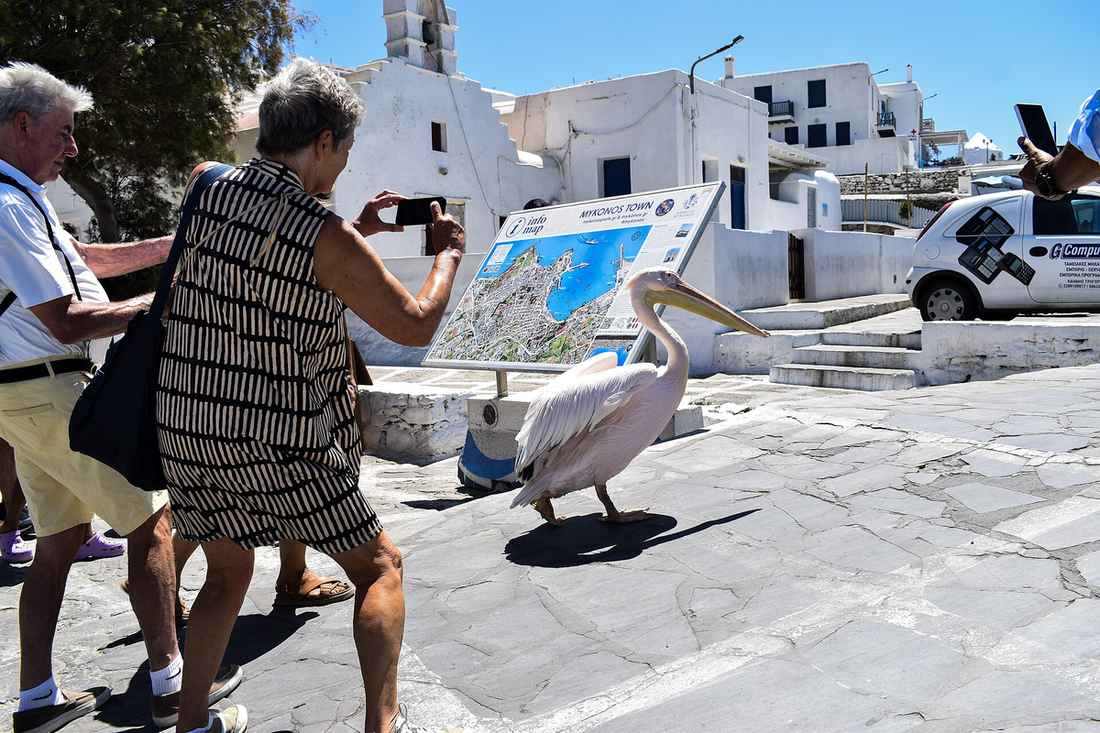
You can see the pelicans of Mykonos wandering around Mykonos Town, especially near the Old Port, the waterfront and the lanes of the Chora, where they roam freely among the cafes and visitors. They are a beloved sight, so keep an eye out, photograph them respectfully and do not feed or crowd them.
For visitors hoping to meet the famous pelicans, the good news is that they roam freely around Mykonos Town and are a regular, delightful sight. The pelicans are most often seen around the Old Port and the harbourfront, where they wander among the fishing boats, cafes and tavernas, as well as through the whitewashed lanes of the Chora and along the waterfront, sometimes posing near Little Venice or strolling unbothered through the crowds. Encountering one of these large, characterful birds up close, as it ambles past the shops or preens by the water, is a charming and memorable moment, and they are very photogenic, making them a favourite with visitors and children. When you do meet a pelican, enjoy the encounter but treat the bird with respect: photograph it without crowding or chasing it, and avoid feeding it, so the pelicans stay healthy and the tradition continues. Spotting a pelican is one of the simple joys of a stroll through town, set out alongside the guides to Little Venice and Matoyianni Street. The questions below cover the points travellers ask most.
Why is Petros important to Mykonos?
Petros is important to Mykonos as a beloved symbol and unofficial then official mascot, embodying the island’s charm and character alongside the windmills and Little Venice. His remarkable story, devoted islanders and the enduring tradition of the town pelicans make him a cherished part of Mykonos’s identity and folklore.
Petros the Pelican holds a special place in the identity and affection of Mykonos that goes well beyond a single bird. Over nearly three decades the original Petros became woven into the daily life and image of the island, so much so that he grew into its official mascot and, alongside the windmills, Little Venice and the whitewashed lanes, one of the enduring symbols of Mykonos, instantly associated with the place in the minds of visitors and locals alike. His story embodies the island’s character: the kindness of the fishermen and islanders who saved and cared for him, the charm and good humour of a community that adopted a wandering pelican as its own, and the colourful, larger-than-life spirit that has always defined Mykonos, captured in tales like his New York escapade and the famous court case with Tinos over his custody. The devotion of the islanders, who carried on the tradition with new pelicans after his death, shows how deeply he was loved. Today the pelicans of Mykonos delight visitors and keep his memory alive, making Petros a cherished, unique piece of the island’s folklore and a reminder of its warmth and charm, set out alongside the guides to the Old Port and things to do. For visitors, encountering one of the famous pelicans ambling through the lanes is a delightful, only-in-Mykonos moment that connects them to this charming story, and for the islanders the tradition is a point of pride carried forward with affection. From the harbour cafes to the souvenir shops, his cheerful image and his memory are woven through the fabric of the town and its identity. He remains an enduring symbol of the island’s warmth and heart.
Frequently Asked Questions
Who is Petros the Pelican?
Petros the Pelican is the official mascot of Mykonos, a great white pelican first adopted by islanders. Found wounded by a fisherman, the bird was nursed back to health, chose to stay, and became so woven into island life that he is a beloved symbol of Mykonos, often seen around the town.
Why did Mykonos and Tinos go to court over Petros?
When Petros flew to the neighbouring island of Tinos, the locals there grew fond of him, and Mykonos and Tinos went to court over his custody. It is said to be the only legal dispute ever heard in Greece over who should keep a bird. The court found for Mykonos, and Petros came home.
Where can you see the pelicans in Mykonos?
You can see the pelicans of Mykonos wandering around Mykonos Town, especially near the Old Port, the waterfront and the lanes of the Chora, where they roam freely among the cafes and visitors. They are a beloved sight, so photograph them respectfully and do not feed or crowd them.