A stay at Mykonos wellness retreats lasts 6 to 8 days on the one booking site that counts four of them. Across seven public retreat timetables, two of them on Mykonos, the median day opens with a teacher-led session at 08:00 and closes with dinner at 19:00, with about six free hours in between.
The health side rests on public bodies: WHO guidance puts the weekly minimum at 150 minutes of moderate activity, adults need 7 or more hours of sleep, and the EU authorises no detox claim. Readers who want a different island for their retreat will find every other region on the Greece Tours homepage.
What is a wellness retreat, and what do Mykonos wellness retreats include?
A wellness retreat is a structured programme over multiple days. It bundles movement, food, rest, mind work, treatments and time in nature. Mykonos wellness retreats list daily yoga or meditation, included meals and a setting beside the Aegean Sea.
The WHO constitution sets the base for the idea. It defines health as “a state of complete physical, mental and social well-being”. The same sentence adds that health is not merely the absence of disease or infirmity.
The Global Wellness Institute (GWI) defines wellness in one line. Wellness is “the active pursuit of activities, choices and lifestyles that lead to a state of holistic health”. The GWI adds that wellness is not a passive or static state and is different from healthcare.
The GWI lists six dimensions of wellness: physical, mental, emotional, spiritual, social and environmental. Its page adds that a model can list up to 9 or 12 dimensions. On retreat pages, Mykonos wellness retreats cover the physical side with yoga and the mental side with meditation.
Wikipedia separates a day spa from a destination spa. The destination spa adds hotel facilities “so that people can stay multiple nights”. Its programme lists “spa services, physical fitness activities, wellness education, healthy cuisine, and special interest programming”.
A wellness hotel is a third format. Wikipedia says wellness services sit in resort centres, small hotels or sections of larger hotels themed for the purpose. One of the Mykonos wellness retreats books its lodging at a hotel and resort.
A medical stay is a fourth format. Wikipedia defines medical tourism as “the practice of traveling abroad to obtain medical treatment”. It calls health tourism a wider term for travel that focuses on medical treatments and the use of healthcare services.
The GWI defines wellness tourism as “travel associated with the pursuit of maintaining or enhancing one’s personal wellbeing”. A primary wellness traveller picks the trip or destination mainly for wellness. A secondary traveller joins wellness experiences on any leisure or business trip.
A listing for one of the Mykonos wellness retreats names items that fall into the six blocks a retreat bundles:
- Movement: sunrise yoga, Pilates, mindful movement and guided nature hikes.
- Mind: meditation, breathwork, sound healing and tea ceremonies.
- Treatments: a 30-minute massage and hydrotherapy.
- Food: a cooking class and a farm-to-table dinner.
- Rest: unscheduled time for the beach or for rest.
- Nature: a yacht excursion to Delos with swimming and snorkelling.
The same listing calls one of the Mykonos wellness retreats an intimate, small-group experience. It counts three daily meals, plus water, tea and coffee through the day. It caters for vegan and vegetarian diets.
The workshops on that listing cover body reset and nervous system restoration, ancient Greek longevity rituals and a cooking class. Wellness consultations sit in the daytime block. Evenings hold sunset meditation, sound healing and tea ceremonies.
A second listing of Mykonos wellness retreats runs one morning block at 08:00: pranayama and meditation, then Ashtanga yoga. Brunch follows at 11:15. Four afternoon workshops run from 17:00 to 19:00, and two days have no workshops or scheduled dinners.
That listing counts 7 morning classes in all. Its yoga shala overlooks the Aegean Sea, about 5 km from Mykonos Town. Among the Mykonos wellness retreats, this listing places practice in view of the water.
The same page names cycling, hiking, kayaking, stand-up paddleboarding, surfing and swimming nearby. For Mykonos wellness retreats, the nature block is plain: the sea and the coast are the setting.
A retreat booking site lists 4 Mykonos wellness retreats. All 4 name yoga, 3 name meditation and 2 name breathwork. One names daily yoga classes, breakfast or brunch each day and 3 dinners. Another pairs barre with yoga and opens with a three-course welcome dinner.
How big is wellness tourism, and where does Greece stand for Mykonos wellness retreats?
The GWI counts 524.4 million wellness trips at the start of its series and 936.4 million at the peak. Mykonos wellness retreats sit in a market where Europe logged the largest trip total in an earlier count.
From the first year of the series to the peak, wellness trips grew 8.6% a year. In the next span the GWI covers, they grew 30.2% a year. It projects 14.7% a year for trips through the end of its forecast.
Wellness trips were 5.8% of all tourism trips in the first year of the series. They were 7.8% in a later count. The GWI projects 8.3% of all tourism trips by the end of its forecast. A guest of Mykonos wellness retreats adds one trip to that count when wellbeing is the aim.
An earlier GWI report counts 830 million wellness trips, 139 million more than two years before. Europe logged the largest total, with 292 million trips. Italy appears in its top ten national markets, with 13.1 million trips. Asia-Pacific wellness trips grew 33% in two years.
Wikipedia gives Europe 216.2 million wellness trips against 171.7 million for North America in an earlier count. It adds that secondary wellness travellers make up 92% of wellness trips. Domestic wellness travel is 84% of trips and international travel 16%.
The GWI country rankings cover 145 countries. A retreat booking site lists 114 wellness retreats across Greece. The Mykonos page of that site holds 4 of the Mykonos wellness retreats, with 90 reviews.
The island that hosts Mykonos wellness retreats measures 85.5 square kilometres. Wikipedia places it in the Cyclades, 150 kilometres east of Athens. It calls Mykonos the second top summer destination in Greece and estimates at least 1.5 million visitors per year. The Mykonos island guide covers where the island lies and how to reach it.
The Greek National Tourism Organisation words its Mykonos page as “entertainment and tranquillity, tradition and modern luxury”. Its article on Greek wellness roots the idea in ancient Greek medicine, which “perceives humans as holistic entities”. The article says coastal regions gave a haven to those seeking mental revitalisation.
The article names four public hot springs. They are Lake Vouliagmeni, Aidipsos on Evia, Pozar in western Macedonia and Kaiafas in the Peloponnese. Wikipedia counts 752 thermal springs in Greece. It adds that thermal tourism was one of the earliest forms of tourism in the ancient world.
A trade news report quotes the Ministry of Tourism: 66 thermal spring facilities approved and 52 under assessment.
Greece wrote health tourism into a bill on thematic tourism and special forms of tourism. A trade news report on the bill lists these points:
- The 19-article bill defines thematic and special interest tourism by category.
- 14 ministries cooperated on the draft.
- The National Organisation for Healthcare oversees health tourism.
- Thermal spring treatment centres must have on-the-spot medical facilities.
- The tourism minister called health tourism “a strategic choice and one of our priorities”.
- The Ministry of Tourism is the competent body for the special operating label of thalassotherapy centres.
- Applications go through the Citizens Service Centres or the ministry registry office.
The Greek law that simplifies how tourism businesses and tourism infrastructure get licensed defines thalassotherapy centres. They use heated seawater, sand, mud or volcanic stones, seaweed and other marine substances. The use is for health, preventive or therapeutic reasons, under medical supervision. A centre can stand alone or work with a four- or five-star hotel.
How long, in days, do Mykonos wellness retreats run, and what do vacation studies say about how long the benefits hold?
One booking site counts four retreats on Mykonos. Mykonos wellness retreats there run 6 to 8 days, or 5 to 7 nights. Studies of holidays find that the well-being gain fades in the first week back at work. Burnout scores fade within one month.
The four Mykonos wellness retreats start in late spring, in June and in September. Two run 6 days, which the listing counts as 5 nights. Two run 8 days, which the listing counts as 7 nights. The off-season planning facts show how ferries and hotels run in the months around the main season.
The site’s wellness list for Greece, the wider set around Mykonos wellness retreats, holds 114 results. Its first 30 listings run from 3 days to 22 days. Fourteen of them run 8 days, and 8 run 7 days. The 22-day listing is a professional shiatsu training course, not a guest retreat.
A list of weekend retreats in Greece holds 13 listings. Three of them run 2 nights, and the page defines a weekend retreat as Friday night to Sunday afternoon. Four listings on a medical-retreat page say their programmes come in 7, 10, 14 or 21-day versions. The four Mykonos wellness retreats include no weekend and no 14-day format.
- Weekend format in Greece: 2 nights, or 3 days.
- Weekend list in Greece, longer listings: 4 to 5 days.
- Mykonos list: 6 days, which is 5 nights.
- Mykonos list: 8 days, which is 7 nights.
- Programmes sold in 7, 10, 14 or 21-day versions in Greece.
- Professional training course in Greece: 22 days.
A meta-analysis of 7 studies found a small gain in well-being after a vacation (effect size 0.43). The gain faded after work resumed (effect size -0.38). The authors state that vacation activities and experiences have barely been studied. They ask for designs with repeated measures before, during and after the vacation.
A later meta-analysis combined 13 studies with 1,428 people. The average vacation lasted 11 days, with a range of 4 to 23 days. Well-being rose by an effect size of 0.25, and life satisfaction by 0.10. In the first week after the return, levels no longer differed significantly from the pre-vacation level.
Vacation length did not change the effect in that analysis, and longer vacations gave no larger gain. A 6-day and an 8-day stay at Mykonos wellness retreats both fall inside the range it covered. The authors recommend regular short vacations through the year. They state that vacations longer than 3 weeks need more research.
A study of 131 teachers found work engagement up and burnout down after a vacation. Both gains faded within one month. Job demands after the return sped up the fade, and relaxation in leisure time slowed it. The study measured the teachers once before the vacation and three times after.
A study of 30 airport ground staff compared workday sleep with sleep after at least two weeks off. Median self-reported sleep rose from 6.3 to 8.0 hours in the 21 workers with shift work disorder. It rose from 7.0 to 8.5 hours in the 9 workers without it. The authors name self-reported sleep and a small sample as limits.
A study of 1,530 Dutch adults asked about happiness before and after a trip. Vacationers were happier before they left. After the return, only those who rated the trip very relaxed gained more. The authors write that this benefit lasts a maximum of two weeks. They had no information on the type of holiday.
Who can lead sessions at Mykonos wellness retreats, and which credentials count?
A yoga teacher can show a 200-hour or 500-hour training from a registered school. Physiotherapists and dietitians file an announcement with the Greek Ministry of Health. Mykonos wellness retreats can post each of these proofs on a teacher page.
Yoga Alliance registers teachers at a 200-hour level and a 500-hour level. It calls the 200-hour training the foundational training, and it calls the 500-hour training a comprehensive training. The letter E in E-RYT stands for experienced, and those credentials add teaching requirements. Mykonos wellness retreats can cite either level.
Wikipedia states that the Yoga Alliance registry is voluntary and is not a certification programme. Joining it is a choice for a yoga teacher at Mykonos wellness retreats. The article reports 75 hours of techniques, training and practice in the core curriculum of a 200-hour school. The yoga guide lists the classes and styles on the island.
The UK network’s good-practice guidelines for teaching mindfulness-based courses name a teacher training of at least 12 months. A mindfulness teacher at Mykonos wellness retreats can cite daily formal and informal practice. The guidelines also name annual residential teacher-led retreats and regular supervision with an experienced teacher. They name ongoing development through further training.
A physiotherapist at Mykonos wellness retreats files an announcement of practice with the Greek Ministry of Health. The applicant holds a degree from a recognised physiotherapy school, or a foreign degree with a recognition document. The file includes a solemn declaration about criminal convictions linked to professional practice.
The Ministry of Health runs a matching announcement for dietitian-nutritionists who advise guests at Mykonos wellness retreats. The applicant needs a degree from a named Greek dietetics and nutrition department or an equivalent foreign one. The file includes a certificate of registration with the Hellenic Dietitians-Nutritionists Association. Both announcements follow a three-month rule: after the deadline, free practice is presumed.
The rules for a gym or sports school name two groups of trainers and coaches. One group holds a physical education and sport science degree, Greek or an equivalent foreign one. The other holds a professional licence from the relevant state body. A coach at Mykonos wellness retreats can show either proof. The Ministry of Culture is the competent body.
The sports coach procedure for a foreign university degree runs through the General Secretariat of Sports. The applicant needs a degree recognised for equivalence and a clean criminal record. A first-aid certificate must cover CPR and use of an automatic defibrillator. The service can prohibit practice within 90 days if the conditions are not met.
A Norwegian research centre’s country profile on massage states that no specific regulation has been found on massage in Greece. A news report on the Greek wellness rules calls non-therapeutic massage a relaxation treatment with no medical or physiotherapeutic claim. A massage therapist at Mykonos wellness retreats can still show a qualification and the body that issued it.
- The name of the certificate and the body that issued it.
- The training hours on the certificate, such as 200 or 500.
- A registry listing, such as the Yoga Alliance teacher listing.
- For a physiotherapist: the Ministry of Health certificate of practice.
- For a dietitian: registration with the Hellenic Dietitians-Nutritionists Association.
- For a mindfulness teacher: 12 months of training and regular supervision.
- For a sports coach with a foreign degree: a first-aid certificate with CPR and defibrillator use.
Staff from another EU country at Mykonos wellness retreats can use the EU directive on the recognition of professional qualifications. It opens a job that needs a national qualification to a person with a similar qualification from another member state. Your Europe states that a profession is regulated if a specific degree is required to access it.
How much movement do health bodies recommend, and how do Mykonos wellness retreats fit it in?
The WHO asks adults for 150 to 300 minutes of moderate activity a week, or 75 to 150 of vigorous. Mykonos wellness retreats list movement sessions every day, so one stay can pass that minimum.
The WHO ties this range to substantial health benefits, which makes it the yardstick for Mykonos wellness retreats. It says adults who want more can go above 300 minutes of moderate activity. The WHO fact sheet compares two groups. Insufficiently active people have a 20% to 30% higher risk of death than sufficiently active people.
The NHS gives the same two numbers. It says 75 vigorous minutes give about the same benefit as 150 moderate ones. Its talk test sorts the effort of a session at Mykonos wellness retreats. At moderate effort you can talk but not sing. At vigorous effort you can say only a short phrase.
The WHO puts moderate activity at 3 to under 6 METs and vigorous at 6 or more. Wikipedia defines one MET as 3.5 mL of oxygen per kilogram per minute, the cost of sitting quietly. Its table lists 3.0 for walking at 4.8 km/h and 8 to 11 for hard swimming. Light-effort cycling at 16 to 19 km/h is 6.0.
One retreat page among Mykonos wellness retreats lists two workouts a day, at 08:30 and 18:30. It calls them a varied program of barre, yoga and stretch. The page gives 45 minutes for the first evening workout. If every workout runs 45 minutes, a day holds 90 minutes of movement.
Seven days at that pace in Mykonos wellness retreats add up to 630 minutes, or 10.5 hours. That is 4.2 times the 150-minute floor and 2.1 times the 300-minute ceiling for moderate activity. The sum counts time only. The talk test decides whether each session counts as moderate or vigorous effort.
- An 8-day, 7-night retreat page lists 7 morning yoga classes, with the day starting at 08:00.
- The same page lists 4 afternoon workshops, from 17:00 to 19:00, and leaves 2 afternoons free of workshops.
- A second 8-day page among Mykonos wellness retreats lists daily yoga classes and nature hikes with a guide.
- A 5-night page lists daily yoga classes and guided nature hikes.
- A hotel programme lists a 90-minute morning session, a 55-minute Pilates session and a one-hour evening class.
- The 90-minute and 55-minute sessions add up to 145 minutes, 5 short of the weekly floor, in a single day.
Two days of that hotel pace reach 290 minutes, inside the WHO range of 150 to 300. Two of those Mykonos wellness retreats add nature hikes led by a guide. Walking at 4.8 km/h is 3.0 METs, which sits at the moderate line. The route facts sit on the hiking tour page.
The WHO says any physical activity beats none. It asks adults to limit sedentary time but names no number, because the evidence is insufficient. Replacing sitting with activity of any intensity brings health benefits. The CDC says activity can be split into chunks. Two workouts, at 08:30 and 18:30, make two chunks of a day at Mykonos wellness retreats.
A pooled analysis of 15 studies followed 47,471 adults. Risk of death levelled off at 6,000 to 8,000 steps a day in adults aged 60 and over. In adults under 60 it levelled off at 8,000 to 10,000. The top step quartile had a 40% to 53% lower risk of death. Its authors say it cannot show cause and effect.
A review of 57 studies from 35 cohorts compared 7,000 steps a day with 2,000. It found a 47% lower risk of death from any cause. The gain levelled off near 5,000 to 7,000 steps. The authors name limits: small study counts per outcome, no analysis by age and possible bias from other factors.
What do strength, balance and mobility sessions add to Mykonos wellness retreats?
The WHO asks adults for strength work on 2 or more days a week. Adults aged 65 and over get 3 or more days of balance and strength work. The NHS says strength work does not count toward aerobic minutes, so Mykonos wellness retreats need a slot for it.
The WHO guideline asks adults to do muscle-strengthening at moderate or greater intensity on 2 or more days a week. These work all major muscle groups. The NHS lists them: legs, hips, back, abdomen, chest, shoulders and arms. The 2-day rule gives Mykonos wellness retreats a clear test for a timetable.
For adults aged 65 and over, the WHO adds varied multicomponent activity with functional balance and strength training. It sets 3 or more days a week at moderate or greater intensity, to support functional capacity and prevent falls. The NHS rule differs: strength, balance and flexibility activities on at least 2 days a week.
Wikipedia defines strength training as exercise designed to improve physical strength. It defines flexibility as the anatomical range of movement in a joint or series of joints. Range of motion is how far a moving part can normally travel while attached to another. Each term names a session type on the timetables of Mykonos wellness retreats.
In biomechanics, balance is the ability to keep the line of gravity within the base of support. Wikipedia says it needs input from the vestibular, somatosensory and visual systems. The same article states that one in three adults aged 65 and over falls each year. That is the risk that balance sessions at Mykonos wellness retreats work against.
The NHS describes its balance and flexibility routines as a way to help improve your health and mobility. Its balance page names five moves: sideways walking, the grapevine, the heel-to-toe walk, the one-leg stand and the step-up. The one-leg stand is held for 5 to 10 seconds, 3 times on each side.
Wikipedia calls Pilates a mind-body exercise developed in the early 20th century. Its founder called the method Contrology. The article lists Mat Pilates and Reformer Pilates as styles. It defines functional training as exercise that trains the body for daily-life activities such as lifting, squatting and climbing.
One retreat page among Mykonos wellness retreats lists daily yoga classes and Pilates in the mornings. A hotel programme on the island lists equipment-supported Pilates instruction. A guest who wants strength work looks for these session names on the timetable. The injury-prevention points below come from the NHS and Wikipedia.
- The NHS says to do balance moves near a wall or a stable chair, in case you lose your balance.
- The NHS says to choose a solid chair without wheels for sit-to-stand and to keep the back straight on mini-squats.
- The NHS says to build up slowly and to add repetitions over time.
- Wikipedia notes that improper form can lead to strains and fractures.
- Wikipedia says stretching for too long or too much can give way to an injury.
- Wikipedia’s stretching article recommends an active dynamic warm-up before exercise in place of static stretching.
The ACSM position stand on resistance training applies to complete novices, so it fits first-timers at Mykonos wellness retreats. It asks for training at least twice a week, with all major muscle groups. It asks for at least two sets per exercise. Training to failure is not required. It suggests ending a set 2 to 3 repetitions short.
Guests of Mykonos wellness retreats who have not trained for a while can start with the NHS numbers. For a sit-to-stand, aim for 5 repetitions, and the slower the better. For a wall press-up, do 3 sets of 5 to 10 repetitions. For a biceps curl, do 3 sets of 5 with light weights. Filled water bottles will do.
What can a menu at Mykonos wellness retreats claim, and what do the EU claim rules require?
A menu at Mykonos wellness retreats can carry only the nutrition claims that the EU regulation lists. Examples are “low fat” and “high protein”, and each has a fixed limit. A health claim needs a place on the EU list and its approved wording.
The EU rules on claims about food split them into two kinds. A nutrition claim states or implies that a food has particular beneficial nutritional properties. A health claim is any statement about a relationship between food and health. The local cuisine guide covers the dishes; this part covers the words that Mykonos wellness retreats attach to them.
The regulation covers claims in labelling, presentation and advertising of foods that reach the final consumer. That includes foods placed on the market unpacked or supplied in bulk. It also covers foods supplied to restaurants, hospitals, schools and canteens. The text names presentation and advertising, so a claim does not need to sit on a pack to count.
Only claims on the annex of the regulation count as permitted nutrition claims. Each carries a limit per 100 g, per 100 ml or as a share of energy. So “high protein” or “low sugars” on a menu at Mykonos wellness retreats points to a number. Seven of those numbers follow.
- Low fat: no more than 3 g of fat per 100 g of a solid
- Low sugars: no more than 5 g of sugars per 100 g of a solid, or 2.5 g per 100 ml of a liquid
- Sugars-free: no more than 0.5 g of sugars per 100 g or 100 ml
- Source of fibre: at least 3 g of fibre per 100 g
- High fibre: at least 6 g of fibre per 100 g
- Source of protein: at least 12% of the food’s energy value comes from protein
- High protein: at least 20% of the food’s energy value comes from protein
“High protein” counts energy, not grams. Protein must supply at least 20% of the food’s energy value. A plate at Mykonos wellness retreats with 12% of its energy from protein earns “source of protein” and stops there. Fibre has two steps as well. A food with 4 g per 100 g meets “source of fibre” but misses “high fibre”.
“With no added sugars” is its own claim. The food holds no added mono- or disaccharides and no food used for sweetening. If sugars occur naturally, the label also states “contains naturally occurring sugars”. So a dish from Mykonos wellness retreats can carry this claim and still hold sugars that occur naturally in it.
EFSA is responsible for verifying the scientific substantiation of submitted claims. It gives non-binding advice, and the European Commission and the Member States decide. The list of permitted claims holds each claim’s wording and conditions of use. Mykonos wellness retreats can look up every permitted nutrition claim and every authorised or non-authorised health claim in the register.
A health claim at Mykonos wellness retreats carries set information. The labelling or advertising states the importance of a varied and balanced diet and a healthy lifestyle. It also gives the quantity of the food and the pattern of consumption that the effect needs. A reworded claim with the same meaning for consumers carries the same conditions of use.
General talk of overall good health or health-related well-being is allowed only beside a specific listed claim. One retreat page says its menu supports “energy, digestion, recovery and overall wellbeing”. A guest at Mykonos wellness retreats can check such a line against one rule. A general benefit needs a specific listed claim beside it.
A health claim at Mykonos wellness retreats is prohibited unless it is authorised and on the lists. Three kinds are barred outright. One suggests that not consuming the food affects health. One cites the rate or amount of weight loss. One cites recommendations of individual doctors or health professionals.
What do olive oil polyphenols do, and which health claim has the EU approved for Mykonos wellness retreats?
One EU health claim says that olive oil polyphenols help protect blood lipids from oxidative stress. The oil must hold 5 mg or more of hydroxytyrosol and its derivatives in every 20 g. Mykonos wellness retreats that quote the claim keep that limit.
Mykonos wellness retreats that quote the EU claim need the term polyphenols. Wikipedia defines them as a large family of natural compounds with multiples of phenol units. It lists four main classes: phenolic acids, flavonoids, stilbenes and lignans. Polyphenols react with oxidation, so laboratory studies call them antioxidants. Wikipedia calls the older idea of polyphenols as antioxidants obsolete.
Hydroxytyrosol is the compound the claim names first. Wikipedia calls it a phenylethanoid, a relative of phenethyl alcohol. It says hydroxytyrosol and its derivatives occur in olives and in wines. Oleuropein is a bitter compound in green olive skin, flesh, seeds and leaves. An ester bond links it to hydroxytyrosol.
Tyrosol is a phenylethanoid too, and Wikipedia names olive oil as its principal source in the human diet. The EU claim names the oleuropein complex and tyrosol as examples of the derivatives it counts. A guest who reads a label at Mykonos wellness retreats meets these words inside the claim.
The EU list gives the claim a fixed wording. The subject is olive oil polyphenols. The action is “contribute to the protection of blood lipids”. The wording ends with the threat: oxidative stress. The consumer must also hear that the effect comes with 20 g of olive oil a day.
EFSA concluded that a cause-and-effect relationship exists. It links olive oil polyphenols to protection of blood lipids against oxidative damage. Mykonos wellness retreats that cite the claim cite that opinion. The opinion covers polyphenols in olive and the protection of LDL particles from oxidative damage.
A trade report on the opinion describes three studies of oxidised LDL. They found that oxidised LDL fell with the dose over three weeks of intake. It counts two more studies, one short-term and one acute, that showed LDL resisting oxidation. It adds that polyphenol levels in olive oils can fall too low to give 5 mg.
A second report says the EFSA panel turned down claims worded for any virgin olive oil. It found no human trials showing lower systolic blood pressure. The studies it reviewed all ran under eight weeks, which EFSA treats as the minimum for stable effects. On HDL cholesterol, one key study’s rise was not replicated, and the study ran too short.
The International Olive Council publishes a trade standard for olive oils and olive-pomace oils. The EU rules on olive oil set limits for three virgin categories: extra virgin, virgin and lampante. Extra virgin carries the tightest limits, listed below. The tasting side sits in the guide on how an olive oil tasting runs, so only the numbers follow here.
- Extra virgin acidity: no more than 0.8%
- Extra virgin peroxide value: no more than 20 mEq O2 per kg
- Extra virgin taste test: median of defects 0 and fruity median above 0
- Extra virgin fatty acid ethyl esters: no more than 35 mg per kg
- Virgin acidity: no more than 2.0%, with a median of defects up to 3.5
- Lampante acidity: above 2.0%
- Lampante taste test: median of defects above 3.5
In the EU table, a virgin oil changes category if one limit differs from the stated values. The polyphenol claim names no category. It names a content: 5 mg per 20 g of olive oil. So an extra virgin label alone does not qualify an oil for the claim at Mykonos wellness retreats.
Which Greek herbs and teas show up at Mykonos wellness retreats, and what do the EU herbal monographs say?
The EMA has herbal monographs for Greek mountain tea, chamomile, thyme and lemon balm, and each rests on traditional use. Mykonos wellness retreats list tea among their inclusions, but a traditional-use monograph asks for long use, not clinical trials.
One retreat page lists water, tea and coffee served throughout the day, plus a welcome drink. A page for a six-day retreat names fresh fruits, juices and wellness drinks at breakfast. Its evening programme lists tea ceremonies. The herb in a cup at Mykonos wellness retreats is a question to ask on arrival.
Sideritis is known as ironwort, mountain tea and shepherd’s tea. Its Greek name, sideritis, reads as “he who is made of iron”. The genus grows above 1,000 m, on rock surfaces with little soil.
Sideritis scardica is native to Albania, Bulgaria, Greece, Kosovo and North Macedonia, and in Greece particularly around Mount Olympus. Sideritis raeseri is a commonly cultivated species, grown in Albania, Bulgaria, Greece and North Macedonia. The IUCN lists Sideritis scardica as Near Threatened.
If Mykonos wellness retreats pour mountain tea, the EMA monograph is the public source. It covers the dried aerial parts of four species: Sideritis scardica, S. clandestina, S. raeseri and S. syriaca. Its listed uses are relief of cough with a cold and relief of mild stomach and gut discomfort.
The monograph limits use to adults. It advises a doctor visit if a cough lasts over one week or worsens. For gut discomfort it names two weeks. The EMA page also states that clinical trial evidence is insufficient. Guests at Mykonos wellness retreats can read these limits before choosing the tea.
Traditional use has a fixed meaning in EU rules. A product needs at least 30 years of use, including at least 15 years in the EU. The EMA says no clinical tests and trials on safety and efficacy are required. A traditional-use monograph for any herb at Mykonos wellness retreats records a history, not a trial result.
- Chamomile: the flower heads of Matricaria recutita; the Greek name chamaimelon means “earth-apple”.
- Thyme: the leaves and flowers of Thymus vulgaris or Thymus zygis.
- Lemon balm: the leaf of Melissa officinalis; Melissa is Ancient Greek for honey bee.
- Oregano: Origanum vulgare, from Classical Greek origanon; carvacrol and thymol can make up over 80% of its oil.
- Sage: Salvia officinalis; the EMA and its herbal committee recommend a daily limit of 6 mg of thujone for supplemental use.
A reader comparing Mykonos wellness retreats can set the monographs side by side. The chamomile monograph lists minor gastrointestinal complaints such as bloating and minor spasms, and relief of common cold symptoms. The thyme monograph lists productive (chesty) coughs with colds. The lemon balm monograph lists mild symptoms of stress, aid to sleep and mild digestive disorders.
The chamomile monograph names adults and adolescents above 12 years. The thyme monograph names the same age band for its main preparations. The lemon balm monograph names adults and children over 12 years. The chamomile and thyme texts advise a doctor after one week of symptoms. The lemon balm text advises one after 2 weeks.
Statins, antidepressants, metformin, ramipril, warfarin and the combined pill do not mix well with herbal medicines, says the NHS. It says to check with a pharmacist before mixing a herbal medicine with other medicine. In pregnancy, the NHS advises against more than 4 cups of herbal tea a day. Guests of Mykonos wellness retreats can ask a pharmacist first.
What do health bodies say about alcohol, caffeine and water at Mykonos wellness retreats?
The WHO says no level of alcohol is safe for health. EFSA’s figure for healthy adults is 400 mg of caffeine a day. It sets adequate water intake at 2.0 litres for women and 2.5 litres for men. Use all three figures to judge Mykonos wellness retreats.
The WHO Europe headline reads: no level of alcohol consumption is safe for our health. The statement finds no amount of alcohol that leaves health unaffected. The International Agency for Research on Cancer lists alcohol in Group 1, its highest risk group, with asbestos and tobacco.
Alcohol causes at least seven types of cancer, including bowel cancer and female breast cancer. Any alcoholic drink carries this risk, regardless of price or quality. The evidence cannot show a level at which the cancer effect switches on. That holds for a glass poured at Mykonos wellness retreats as it does anywhere else.
More than 200 million people in the WHO European Region are at risk of developing alcohol-attributable cancer. Around half of the Region’s alcohol-attributable cancers occur in people whose drinking does not count as heavy drinking. The European Region has the highest alcohol consumption level and the highest proportion of drinkers worldwide.
The NHS advises men and women not to drink more than 14 units a week on a regular basis. It advises spreading 14 units over 3 or more days. To find units, multiply the volume in ml by the ABV and divide by 1,000. The same sum works for any drink poured at Mykonos wellness retreats.
- A 175 ml glass of wine at 12% ABV: 2.1 units.
- A 125 ml glass of the same wine: 1.5 units.
- A 25 ml single measure of spirits at 40% ABV: 1 unit.
- A 35 ml large single measure of spirits: 1.4 units.
- A pint of strong lager: 3 units.
- A pint of lower-strength lager: just over 2 units.
A tasting added to a week at Mykonos wellness retreats adds units to the weekly count. The wine tasting guide covers the island’s tastings. The NHS says alcohol in pregnancy can cause long-term harm to the baby, so avoiding it is safest. One booking site carries an Alcohol Free filter for retreats.
EFSA names up to 400 mg of caffeine a day for healthy adults, spread across the day. That covers a guest at Mykonos wellness retreats too. It adds a single-dose figure of 200 mg, about 3 mg per kg of body weight. For pregnant and breastfeeding women the figure is 200 mg a day from all sources.
EFSA lists 80 mg of caffeine in a 60 ml espresso. A 200 ml cup of filter coffee holds 90 mg. A 220 ml cup of black tea holds 50 mg. Four filter coffees add up to 360 mg. Single doses of 100 mg, taken close to bedtime, can affect sleep duration and patterns in adults, EFSA states.
EFSA sets adequate total water intake for adults at 2.0 litres a day for women and 2.5 litres for men. At Mykonos wellness retreats, the total counts drinking water, beverages of all kinds and the moisture in food. The values assume moderate environmental temperature and moderate physical activity. In pregnancy, EFSA proposes the same intake plus 300 ml a day.
The NHS says to aim for 6 to 8 cups or glasses of fluid a day. Water, lower-fat milk and lower-sugar drinks, including tea and coffee, count. It lists thirst, headache, tiredness and a dry mouth as signs of dehydration. It advises drinking enough that pee is a pale colour.
What is mindfulness, and how long are the evidence-based programmes behind Mykonos wellness retreats?
Mindfulness is steady attention to the present moment, without judging it. The two evidence-based courses behind it run for eight weeks. One retreat page on Mykonos lists seven days, so Mykonos wellness retreats run shorter than a course.
The NHS defines mindfulness as paying attention to what is going on inside and outside ourselves, moment by moment. Wikipedia adds a non-judgmental attitude to that definition. The word derives from the Pali word sati, a significant element of Buddhist traditions. Use these definitions as a yardstick when a programme at Mykonos wellness retreats calls a session mindful.
Wikipedia names two ways to practise. Formal practice means sustaining attention on the body, the breath or sensations. Informal practice applies the same attention to daily life. The NHS describes formal practice as sitting silently and noticing thoughts, sounds and the sensations of breathing. Check which kind of practice a session at Mykonos wellness retreats offers.
The stress course is called mindfulness-based stress reduction. It runs for eight weeks. Each weekly group meeting lasts 2.5 to 3 hours, and an orientation session comes before the first class. A university medical centre clinic first ran it. Wikipedia classifies it as an educational intervention rather than a form of psychotherapy.
One all-day session falls between weeks six and seven and lasts 6 to 7.5 hours. Home practice adds about 45 to 60 minutes a day, six days a week. The course teaches three core techniques: mindfulness meditation, body scanning and simple yoga postures. Compare a timetable at Mykonos wellness retreats with these hours before you call it a course.
The depression course is mindfulness-based cognitive therapy, or MBCT. Wikipedia says it runs for eight weekly sessions of two hours each, with one day-long class after the fifth week. It was developed to target vulnerability to depressive relapse. It shows the strongest effect in people with at least three past episodes of major depression.
NICE describes group mindfulness and meditation as 8 regular sessions for 8 to 15 people. NICE says to consider group CBT or MBCT for people at higher risk of relapse after antidepressant treatment. That relapse course has 8 sessions over 2 to 3 months, plus optional sessions in the next 12 months.
The NHS describes a calming breathing exercise for stress, anxiety and panic. It can be done anywhere, so test it at home before you book Mykonos wellness retreats. The exercise runs like this:
- Stand, sit in a chair that supports your back, or lie on a bed or a mat.
- Let the breath flow deep into the belly, without forcing it.
- Breathe in gently and steadily through the nose, and count from 1 to 5 if you wish.
- Breathe out through the mouth, and count from 1 to 5 again.
- A count of 5 can be out of reach at first, says the NHS.
- Repeat for at least 5 minutes; the NHS says regular practice in a daily routine brings the greatest benefit.
One page for Mykonos wellness retreats lists a seven-day programme with twice daily yoga classes and twice weekly meditation. A retreat page on Kea, another Cyclades island, lists six days with silent meditation or yoga at sunrise. A Greek retreat page lists five-day and seven-day versions with a 25-minute group meditation. Each runs shorter than the eight-week courses.
The NHS says studies show mindfulness can help with stress, anxiety and depression. It says other conditions need more research, and that it does not help every person. NCCIH calls much of the research preliminary. In one review of 83 studies, about 8 percent of participants had a negative effect, mainly anxiety and depression.
What is a sound bath, and what does the research say about crystal bowls at Mykonos wellness retreats?
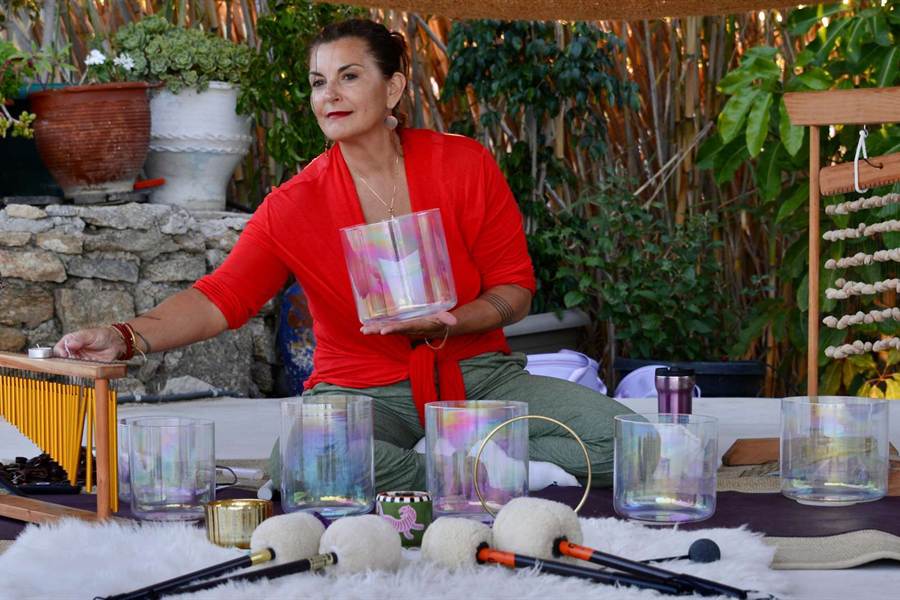
A sound bath is a session where you lie down while bowls, gongs and bells play. A study of 62 adults found less tension afterwards, but it had no control group. Weigh crystal bowl claims at Mykonos wellness retreats against that limit.
Wikipedia describes a singing bowl as a standing bell: an inverted bell, supported from below with the rim uppermost. A player strikes it, or rotates a mallet around the outside rim to excite continuous vibrations. Standing bells are made substantially of bell metal, a copper-tin alloy. Wikipedia adds that standing bells serve religious purposes, music making and meditation.
Wikipedia notes that a modern crystal bowl can be made of re-formed crushed synthetic crystal. The study described next placed quartz crystal bowls near the centre of the room. They were played by rubbing the rim with a felt-covered mallet. Ask whether the crystal bowls at Mykonos wellness retreats are quartz or synthetic.
The study calls its session a sound meditation. Participants lay down, and the lead musician allowed them to fall asleep. The instruments played in a set order of tingshas, Tibetan bowls, bells, crystal bowls and gongs, on repeat. The session lasted about 60 minutes, a length to compare with a bowl hour at Mykonos wellness retreats.
The study had 62 participants aged 21 to 77. After one session they reported less tension, anger, fatigue and depressed mood, and each change was statistically significant. Participants who had never tried a bowl meditation showed a larger drop in tension than experienced participants. The authors name the missing control group as the main limit.
A retreat page on Kea lists sound baths with singing bowls beside silent meditation and yogic breathing. A Greek retreat page lists a 50-minute sound session with Tibetan singing bowls and a 25-minute group meditation. Check each programme at Mykonos wellness retreats for a bowl session by name.
A systematic review covered 14 quantitative studies of Tibetan singing bowls. The authors see potential for stress reduction and psychological well-being. That is the evidence behind a bowl claim at Mykonos wellness retreats. They ran no meta-analysis, because the designs differed and the articles were limited. They call for rigorously designed controlled trials with follow-up assessments.
NCCIH cites two reviews of music-based interventions for stress. One found a small-to-medium effect on physical measures and a medium-to-large effect on psychological measures. NCCIH flags potential bias in the stress studies and asks for larger studies. Loud volume can contribute to noise-induced hearing loss, so ask how loud a bowl session at Mykonos wellness retreats plays.
One listing describes a sound experience and guided relaxation session with crystal bowls, Tibetan singing bowls and more. Compare the listing with the programmes at Mykonos wellness retreats if you want a bowl session on its own. The listing states these facts:
- The session lasts 1 hour.
- The booking offers English and Greek.
- Adults aged 13 to 99 can book, and ages 12 and younger are not permitted.
- The session is wheelchair accessible.
- The listing carries free cancellation.
The booking form accepts 1 to 15 participants, so a solo guest and a group can both book. If you travel alone, the solo travel guide covers where to stay and how to get around.
How much sleep do adults need, and what habits help sleep at Mykonos wellness retreats?
Adults aged 18 to 60 need 7 or more hours of sleep a night on a regular basis. A panel of 15 experts from the American Academy of Sleep Medicine and the Sleep Research Society says so. That figure holds at Mykonos wellness retreats too.
The panel links less than 7 hours on a regular basis to weight gain, obesity and diabetes. It adds hypertension, heart disease, stroke and depression, and an increased risk of death. Impaired immune function, increased pain, more errors and a greater risk of accidents sit on the same list.
Wikipedia names N1, N2 and N3 as non-REM stages, with REM as the fourth. A night at Mykonos wellness retreats runs in the order N1, N2, N3, N2, REM. One cycle of alternating non-REM and REM sleep averages 90 minutes. A good night holds 4 to 6 cycles. Deep N3 sleep fills a greater share of the early night.
The NHS gives 7 to 9 hours a night for healthy adults. It says the exact amount differs for each person. Guests at Mykonos wellness retreats can use its habits as written. Go to bed and get up at similar times each day, including non-working days. Keep the room quiet, dark and cool.
- No phones, tablets or computers for an hour before bed (NHS).
- Switch devices off at least 30 minutes before bedtime (CDC).
- Relax for at least 1 hour before bed, with a bath or a book (NHS).
- If awake after around 20 minutes, get up and sit somewhere comfortable (NHS).
- Stop tea and coffee at least 6 hours before bed (NHS).
- Avoid exercise in the 4 hours before bed (NHS).
- Avoid large meals close to bedtime (NHS).
Mykonos wellness retreats keep Eastern European Time, which is UTC+2. In winter that is one hour ahead of Central European Time at UTC+1. Summer time moves the island to UTC+3. Clocks go forward from 03:00 to 04:00 on the last Sunday of March. They go back from 04:00 to 03:00 on the last Sunday of October.
London sits on UTC+0 until the clocks go forward, then on UTC+1. So Mykonos wellness retreats run 2 hours ahead in both seasons. New York keeps UTC-5 in winter and UTC-4 in summer, so the gap is 7 hours. The United States changes clocks on the second Sunday in March and the first Sunday in November.
Wikipedia states that full recovery from jet lag takes one day per time zone crossed. It adds that travelling east is harder. A flight to Mykonos wellness retreats goes east from London and from New York. By that rule London means 2 days and New York means 7 days.
For eastward trips to Mykonos wellness retreats the CDC advises bed an hour or two earlier than usual. It also advises arriving at least 2 days before any important event. After landing, the NHS advises changing the sleep schedule to the new time zone as quickly as possible. It adds an alarm to avoid oversleeping and sleep only at night.
One of the Mykonos wellness retreats lists 2 yoga classes a day on its page. They start at 08:00 and at 17:30 or 18:30. Dinner follows at 19:00 or 20:00. The page calls the timetable tentative and says the weather can change it. A 20:00 dinner and an 08:00 class leave 12 hours, enough for the 7-hour floor.
A private retreat page on Mykonos states that guests are fully disconnected from phones and internet for the stay. Sleep conditions differ by room, so compare rooms in the hotel guide before booking a stay for Mykonos wellness retreats.
How does morning light set the body clock, and when does the sun rise at Mykonos wellness retreats?
Light that reaches the eyes soon after waking moves the body clock earlier, and light before sleep moves it later. The sun rises at 05:58 on 21 June and at 07:29 on 21 December at Mykonos wellness retreats.
A circadian rhythm is a natural oscillation that repeats about every 24 hours. The suprachiasmatic nucleus is the central pacemaker of mammals, so it sets the clock of guests at Mykonos wellness retreats. It sits above the optic chiasm in the hypothalamus and holds about 10,000 neurons.
One type of retinal ganglion cell senses light directly. These cells hold the pigment melanopsin and send signals to the nucleus along the retinohypothalamic tract. Melanopsin responds to blue light of about 480 nanometres. A sleep education body gives the natural clock of an adult as 24.2 hours on average.
Outdoors at Mykonos wellness retreats, a table of illuminance gives full daylight outside direct sun as 10,000 to 25,000 lux. It gives direct sunlight as 32,000 to 100,000 lux. Shade lit by a clear sky at midday is about 20,000 lux. A midday under an overcast sky is 1,000 to 2,000 lux. Office lighting is 320 to 500 lux.
- Light and dark have the biggest influence on circadian rhythms (NIGMS).
- Light and darkness are powerful zeitgebers, the cues that set the clock.
- The brain begins producing melatonin as the sun sets.
- Rising light in the morning halts melatonin output.
- Blue light from electronic devices can inhibit melatonin production.
- Brighter light works better than dim light.
Wikipedia states that exposure to light soon after waking advances the circadian rhythm and that exposure before sleeping delays it. Consistent exposure has a greater effect than intermittent exposure. After a flight to Mykonos wellness retreats, the NHS says to go outside during the day. Natural light helps the body clock adjust.
A sleep education body advises opening the curtains in the morning and stepping outside when tired. It states that the master clock runs slightly longer than 24 hours. It corrects itself by about 12 to 18 minutes each day. The same habit applies at Mykonos wellness retreats.
Four dates set the sunrise range at Mykonos wellness retreats. The sun rises at 06:22 on 20 March, the March equinox, and at 05:58 on 21 June, the June solstice. It rises at 07:07 on 23 September, the September equinox, and at 07:29 on 21 December, the December solstice.
At Mykonos wellness retreats the March time falls on winter time and the September time on summer time. The sun rises at 06:10 on 28 March and at 07:09 on 29 March. Clocks move forward that morning, so the printed time sits about an hour later.
Two retreat pages show how Mykonos wellness retreats place light in the day. One begins each morning with sunrise yoga, Pilates, meditation and breathwork, followed by breakfast. It makes evenings quieter, with sunset meditation and dinner. The other lists optional morning and sunset yoga and no mandatory group sessions.
The NIGMS states that short-term disruption of the rhythm brings drowsiness, poor coordination and difficulty with learning and focus. Long-term sleep loss and continually shifting rhythms can raise the risks of obesity, diabetes, mood disorders and heart problems.
What does sea swimming do for the body, and how do you swim safely at Mykonos wellness retreats?
Sea water is denser than fresh water, and a sea swim scores 6.0 METs in the Compendium of Physical Activities. Safe swimming at Mykonos wellness retreats means swimming with others, entering slowly and staying inside the buoys.
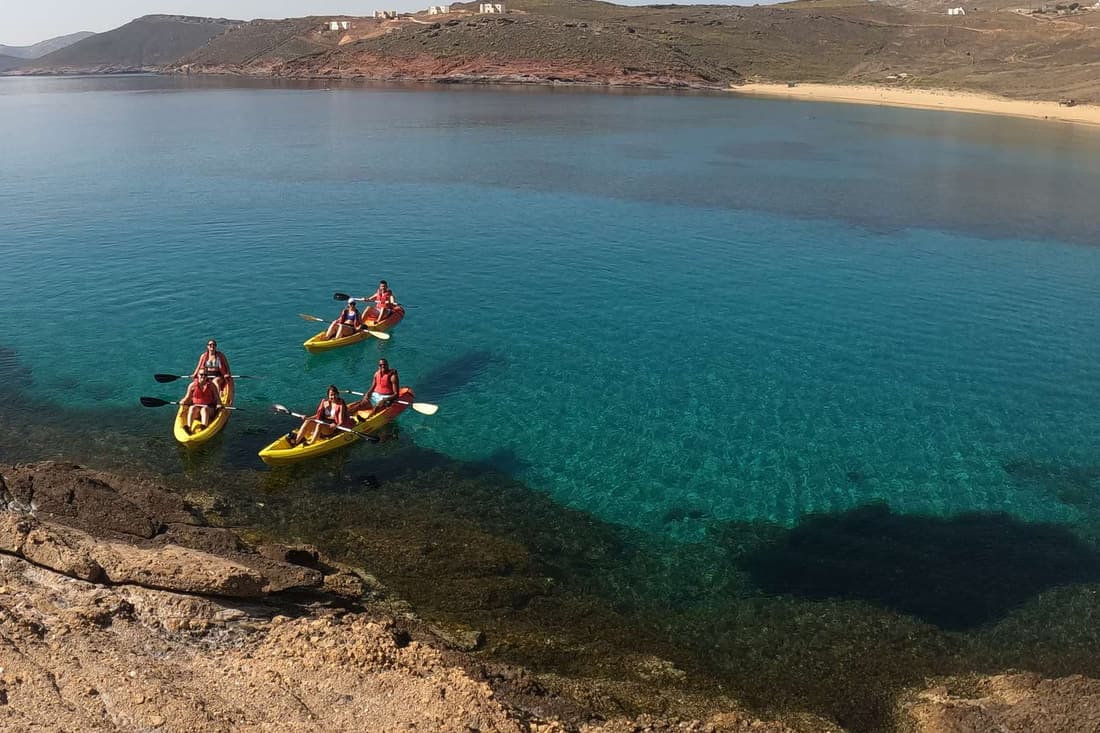
A swim at Mykonos wellness retreats starts with salt. Salinity is the share of salt in water. Wikipedia gives the deep water of the Aegean Sea a salinity of 3.91 to 3.92 percent. Its salinity article sets saline water at 3 to 5 percent salt and fresh water at under 0.05 percent.
The Dead Sea shows what extra salt does. Wikipedia gives it a salinity of 342 grams per kilogram, or 34.2 percent. It calls the lake 9.6 times as salty as the ocean. It adds that anyone can float there easily because of natural buoyancy.
In one study, 37 people sat in water up to the chest. The water neither warmed nor cooled the body. Their vagally mediated heart rate variability rose above baseline. Cold water on the face works another way. Wikipedia says it slows the human heart rate by 10 to 25 percent.
The Compendium of Physical Activities lists swimming in a lake, ocean or river at 6.0 METs. One MET is the energy cost of sitting quietly, says Wikipedia. The same page sets 6 METs and above as vigorous effort. A sea swim at Mykonos wellness retreats sits on that line.
A leaflet on swimming for people with heart conditions comes from a body of cardiac rehabilitation physiotherapists. It says the buoyancy and temperature of water make it easy to underestimate how hard the body works. It adds that currents and wave size raise the effort in open water.
The Hellenic Ministry of Health lists these rules for the sea at Mykonos wellness retreats and every other Greek coast:
- Do not swim alone.
- Swim only at beaches that qualified lifeguards supervise.
- Do not swim out beyond the buoys.
- Enter the water slowly and feet first, after you check for objects.
- Never dive headfirst into water you have not been in before and that is under 1.5 metres deep.
- Do not swim after drinking alcohol.
- Do not race out to a floating buoy, because tides and currents can change.
Cold water shock is the first reaction to a sudden plunge. The Met Office says the initial effects last around 90 seconds. The National Water Safety Forum says they last up to three minutes. Both name 15 degrees Celsius as the line, which matters for every swim at Mykonos wellness retreats.
The Met Office says breathing rate rises rapidly and heart rate spikes. The forum lists gasping, hyperventilation, panic and loss of swimming ability. In a study of healthy children in 11 degree water, heart rate rose 31 percent and breathing rate 58 percent. Both peaked at 30 seconds.
Both bodies give one answer: lean back, keep the head up and float, control the breathing, then call for help. The forum adds that a wetsuit, slow entry and repeated exposure lower the risk. A guest at Mykonos wellness retreats who enters slowly follows that advice.
The Ministry covers trouble in the water too. If a tide carries you out, do not fight it. Swim slowly and diagonally across it toward shore. For cramp, float in the mushroom position and stretch the muscle the other way. Children under 8 need special attention and stay in sight of an adult.
Four retreat pages show how Mykonos wellness retreats handle the sea. One five-day page, with a four-night stay, asks guests to pack swimwear for dips in the sea. One eight-day page lists a day on the boat and the water. One seven-day page keeps a day open to swim. One eight-day page lists swimming among nearby options.
How much time in nature supports well-being, and how do Mykonos wellness retreats schedule it?
An English survey of 19,806 people links 120 minutes a week in nature with good health and well-being. The link peaks at 200 to 300 minutes. Mykonos wellness retreats place outdoor time at sunrise, at sunset and on free afternoons.
The survey is the Monitor of Engagement with the Natural Environment Survey, weighted to be nationally representative. Weekly contact was counted in 60 minute blocks. At 120 to 179 minutes, the odds ratio for good health was 1.59 against no contact. For high well-being it was 1.23.
Positive links peaked at 200 to 300 minutes a week, with no further gain. The pattern held for older adults and for people with long-term health issues. The survey counted recreational contact over the last seven days, and people reported their own health.
The authors call prospective longitudinal and intervention studies a critical next step. They want weekly nature guidelines like those for physical activity. A page about Mykonos wellness retreats that quotes the 120 minutes is quoting a survey result, not a rule.
A census study for England found that good health is more prevalent the closer people live to the coast. The authors suggest the benefit is greater in more deprived communities. They hypothesise stress reduction and more physical activity as the routes. For Mykonos wellness retreats, the finding is about where people live, not where they visit.
Wikipedia defines forest bathing as therapeutic relaxation in a forest or natural atmosphere. A director at the Japanese Ministry of Agriculture, Forestry and Fisheries coined the term. The practice answered the growth of cities and technology in Japan.
A review of 11 studies linked forest bathing with a lower heart rate, at a mean difference of -4.00. Heterogeneity between studies ran from moderate to very high. A pilot study in graduate students found that a forest therapist gave no extra benefit over unguided forest time.
The WHO Regional Office for Europe summarised the health benefits of urban green space. It names relaxation, social contact, movement and less exposure to polluted air, noise and heat. Its guidance targets cities, not an island that hosts Mykonos wellness retreats. A paper testing its indicator recommends a green space of at least 1 hectare within 300 metres.
Wikipedia gives Mykonos 85.5 square kilometres, no rivers and a hot semi-arid climate. The island lies in the rain shadow of the Pindus mountain range. A botanical study says coppicing, fire management, grazing and arable farming gave it a treeless look.
The same study describes granite, schists and greenstone, with a highest elevation below 400 metres. Secondary phrygana, a cover of dwarf shrubs, and grassland of annual plants dominate the vegetation. That is the setting for outdoor hours at Mykonos wellness retreats: open land, not forest.
The public pages of Mykonos wellness retreats place outdoor time like this:
- One four-day programme starts a sunrise hike to a lighthouse at 07:00 on day 3, with meditation.
- The same programme sets sunset yoga with breathwork from 18:00 to 19:00 on day 3.
- One six-day programme lists a sunset walk to the beach on day 1 and an optional hike on days 3 and 4.
- One eight-day programme starts practice at 08:00 each morning and runs workshops from 17:00 to 19:00 on four afternoons.
- That eight-day programme leaves two afternoons free of workshops and scheduled dinners.
- One seven-day programme keeps morning and evening practice, an optional morning catamaran cruise to Rhenia and one open day.
- One five-day page leaves free time on day 2 to rest or to explore the beach.
The survey found it did not matter whether the 120 minutes came in one long visit or in shorter ones. A retreat with free afternoons can meet the figure either way. Guests at Mykonos wellness retreats can read the beach guide to pick a shore for those hours.
What is thalassotherapy, and does anything like it run at Mykonos wellness retreats?
Thalassotherapy is therapy that uses seawater, and its name comes from the Greek word thalassa, meaning sea. Two hotel spa pages on Mykonos list seawater or thalassotherapy basins, so something like it runs beside Mykonos wellness retreats.
Wikipedia defines thalassotherapy as a form of therapy that uses seawater. It adds the systematic use of sea products and the climate of the shore. French Wikipedia names the tools: marine climate, seawater, sea mud, algae, sand and other sea products. A reader of Mykonos wellness retreats can use that list to check which tool a hotel offers.
French Wikipedia says a physician from Crémieu, near Lyon, coined the term in a thesis. A congress of 150 doctors at Boulogne-sur-Mer then made the word official. The first thalassotherapy institute opened in Roscoff, in Brittany. English Wikipedia adds that heated saltwater public baths opened in the 19th century and were popular with the higher classes.
A spa guide describes a seaweed wrap. The therapist brushes the dry skin, then paints warm seaweed gel on the front and back of the body. The client lies wrapped in a sheet for about 20 minutes. The writer’s visit took 60 minutes. A wrap on the timetable of Mykonos wellness retreats can be checked against those times.
One hotel spa page on Mykonos lists three indoor seawater basins. It says salinity and temperature are monitored closely and that the water is enriched with marine minerals. The same page lists a sauna and a hammam in a spa of 200 square metres. A guest weighing Mykonos wellness retreats finds seawater, dry heat and steam under one roof there.
A second hotel spa page on Mykonos lists heated thalassotherapy basins and hydromassages. It says seawater has been praised since Greek antiquity. A travel magazine names one Crete resort for thalassotherapy programmes of two, four and six days. Those lengths give Mykonos wellness retreats a yardstick for any programme a hotel lists.
One hotel programme on the Athenian Riviera runs four days and lists seven treatments. It gives Mykonos wellness retreats a model for a seawater course. The treatments are a salt-water hydromassage, an affusion shower, cryotherapy, three massages and a jacuzzi bath. The programme joins treatments, nutrition and exercise. Spa lists and treatment menus sit in the spa guide.
- Daily access to a thalassotherapy basin
- 16 areas of water jets in that basin
- Three personal training sessions of pilates, yoga and stretching
- A private consultation with nutrition and fitness instructors at the start
- Menus that join therapy-focused nutrition with traditional Greek cuisine
- Use of a hammam, a sauna and a fitness centre
The international standard for thalassotherapy services names four aims. They are service quality, respect for the concept, hygiene and safety, and customer comfort. It does not judge claimed benefits, and it leaves medical decisions to the medical profession. Accommodation and catering fall outside it. For Mykonos wellness retreats, it sets service rules, not proof of results.
A narrative review searched PubMed and found 566 articles. Of these, 16 met its inclusion rules. They studied skin disorders such as psoriasis, atopic dermatitis and vitiligo, and rheumatic conditions such as fibromyalgia and ankylosing spondylitis. The authors report the strongest evidence for psoriasis and fibromyalgia. That list names what researchers studied, not what Mykonos wellness retreats offer.
The same authors say more research is needed on effect size, long-term benefits and risks. Wikipedia says there is no scientific evidence that thalassotherapy is effective. On balneotherapy, it says a majority of studies carry methodological flaws. On hydrotherapy, it says systematic reviews found no clear effects. Seawater at Mykonos wellness retreats stays a leisure feature, not a proven treatment.
What do saunas, hammams and thermal baths do, and what do health bodies advise for Mykonos wellness retreats?
A Finnish sauna heats the air to 80 to 100 degrees Celsius at head level. A hammam steams at about 50 degrees, and a thermal bath holds spring water above 20 degrees. Health sources advise short sessions, water and no alcohol at Mykonos wellness retreats that add heat.
A Finnish study of 1,688 people describes a Finnish sauna as dry, with humidity of 10 to 20 percent. Air at floor level sits near 30 degrees. Sessions run 5 to 20 minutes, and the median session in the study was 13 minutes. A sauna listed at Mykonos wellness retreats can be read against those figures.
Wikipedia sorts saunas by heat source, so a reader of Mykonos wellness retreats can ask which type a hotel runs. A smoke sauna has no chimney, and its air sits near 60 degrees. A heat storage sauna reaches 80 to 110 degrees. A steam bath holds humidity near 100 percent.
A hammam added to Mykonos wellness retreats follows a plan that Wikipedia traces to the Roman thermae. The earliest known Islamic hammams were built in Syria and Jordan. The Ottomans spread hammams across their lands, including Southeastern Europe. Constantinople’s Greek population kept up the Eastern Roman bath culture.
Bathers pass through four rooms in a fixed order. They go from a changing room to a cold room, then a warm room, then a hot room. They wear a loincloth and move into hotter rooms until they sweat. The hot room holds a heated marble table called the navel stone. The scrub uses a rough mitten called the kese.
Greek laws recognise thermal-mineral waters as hot waters above 20 degrees with over 1 gram of dissolved salts per litre. A review sorts them: hypothermal at 20 to 34 degrees, homeothermal at 35 to 38, hyperthermal above 38. The Hellenic Survey of Geology and Mineral Exploration records the springs and gives the counts below.
- 750 thermal springs counted in Greece
- 128 of them active
- 52 recognised and certified by the Ministry of Tourism
- Milos: a spring at 38.8 degrees Celsius
- Kimolos: a spring at 51.9 degrees
- Kythnos: springs at 20.4 and 50.9 degrees
- Median spring: 38.2 degrees, with the hottest at 82.3 on Lesvos
Milos, Kimolos and Kythnos belong to the Cyclades, the same island group as Mykonos. Kythnos has a village named Loutra, the Greek word for baths, and its bathhouse keeps marble tubs. The island carried the name Thermia in the Frankish period, from its hot mineral springs. A review says the first Greek baths were built on Kythnos.
In that study, cardiovascular deaths ran at 10.1 per 1,000 person-years with one weekly session. With four to seven sessions, they ran at 2.7. The study is observational, so it cannot show cause and effect. The result is uncertain for people not used to regular sauna use. That limit covers a guest at Mykonos wellness retreats with no sauna habit.
A university health letter gives limits for a sauna slot at Mykonos wellness retreats. It says saunas seem safe with stable heart disease. Unstable angina, poorly controlled high blood pressure or low pressure means staying out. It caps a session at 15 to 20 minutes and advises no alcohol before or after. It adds two to four glasses of water.
NHS advice on pregnancy covers heat at Mykonos wellness retreats. In saunas, hot tubs and steam rooms, the body cannot lose heat well by sweating. It names a large rise in core temperature as a possible harm, particularly in the first 12 weeks. It lists dehydration and fainting. It puts the ceiling for a hydrotherapy basin at 35 degrees.
Which quality labels exist for spas and wellness facilities, and how do you read them at Mykonos wellness retreats?
Four kinds of label apply to a spa. They are a spa type, a quality seal, a hotel star rating and an ISO service standard. Each measures a different thing, so Mykonos wellness retreats need more than one proof for the spa.
The International Spa Association defines every spa type in a public glossary. A day spa offers professionally administered spa services on a day-use basis. A resort or hotel spa sits inside a resort or hotel and adds fitness and wellness parts. These terms are the first label to look for at Mykonos wellness retreats.
A destination spa has one main purpose: guiding individual spa-goers to healthy lifestyles. Wikipedia describes packages with diet, exercise, wellness lessons and yoga. Guests live on site for the whole stay. Mykonos wellness retreats that sell a stay with lessons match it. A mineral springs spa has an on-site source of mineral, thermal or sea water.
A medical spa needs a full-time licensed health care professional on site, and the glossary names a Doctor of Medicine. Wikipedia calls it a mix of a medical clinic and a traditional spa. Ask Mykonos wellness retreats that use the word medical which licensed professional works on site.
The European Spas Association and EuropeSpa wrote uniform standards for medical spa and wellness providers. EuropeSpa assesses providers against them and awards quality certificates. The criteria cover service, safety, hygiene and infrastructure. Three areas exist: Medical Spa, Medical Wellness and Wellness. A seal at Mykonos wellness retreats names one of these areas.
The association’s book of quality standards runs 181 pages. It holds around 1,000 quality and safety criteria, from medicinal water and saunas to treatments, human resources, cuisine and accommodation. A scientific committee built them from more than 30 national and international laws. Mykonos wellness retreats that hold the medical certificate have met them all.
Greece rates hotels from one to five stars through the Hotelstars system, shared by 21 member countries. The Hellenic Chamber of Hotels is the Greek contact. A hotel is assessed on 239 criteria. They cover room and bathroom facilities, service quality, leisure facilities and catering. For the hotels themselves, read the luxury hotel guide.
Each criterion carries 1 to 20 points. Every star category has mandatory criteria, and optional ones earn more points. Meeting the minimum alone does not earn a category. The stars give a standardised baseline, while online reviews capture subjective and more recent experiences. Read the stars that way at Mykonos wellness retreats.
The ISO standard for wellness spas sets service requirements. It fits any type or size of spa, also inside a hotel, a gym or a hospital. It leaves out accommodation, food and drink, medical spas and thalassotherapy centres. A separate ISO standard covers thalassotherapy centres, with aims of service quality, hygiene and safety. It leaves out accommodation and catering.
- The spa type in the glossary’s terms: day, destination, hotel, mineral springs or medical
- For a medical spa, a full-time licensed health care professional on site
- A quality seal, and the area it covers: service, safety, hygiene or infrastructure
- The ISO standard the spa follows, and the service it covers
- The hotel’s star category from the Hellenic Chamber of Hotels
- The label that covers the spa, not only the rooms, at Mykonos wellness retreats
Before a hotel opens, the operator notifies the Ministry of Tourism. The EUGO service page says this notification has replaced the Special Operation Mark. Within 50 days, a hotel has to receive its classification certificate, which the Hellenic Chamber of Hotels issues. It must also hold an approved distinctive title. The same steps bind a hotel that hosts Mykonos wellness retreats.
How do detox and cleanse programmes stand against the evidence at Mykonos wellness retreats?
The EU authorises no detox claim, because EFSA assessed every submitted cleansing or detoxifying claim negatively. A review of eight popular detox diets found no compelling evidence for toxin removal or weight management. Read every cleanse at Mykonos wellness retreats against those two facts.
Check the organs before any detox claim at Mykonos wellness retreats. An NHS hospital trust page says the liver does hundreds of jobs, filtering harmful substances from the blood. Each kidney holds about a million filtering units, says a US institute for kidney and digestive diseases. The kidneys filter about 150 quarts of blood a day.
The EU register of health claims lists authorised and non-authorised claims, with the reasons for each refusal. A food-law commentary quotes the Commission on the word detox. On a food, it signals a bodily function or an implied health effect. That brings the word inside the EU law on nutrition and health claims, also at Mykonos wellness retreats.
A negative opinion can come from wording that is too general, not from missing science. EFSA treated detox and detoxification as non-specific claims. A non-specific claim is allowed only under conditions. An authorised or pending specific claim must stand next to it or after it. A footnote or asterisk elsewhere on the page does not meet the rule.
One page about Mykonos wellness retreats lists multi-day retreat and detox programmes next to yoga, massage and chef-prepared food. The page says its retreats mix movement, mindfulness, spa therapies and clean nutrition. On that page, a detox programme is a bundle of movement, spa work and food.
A review of eight popular detox diets covered diets that mix fasting, supplements, food changes and laxatives. It found no compelling evidence for weight management or toxin elimination. No randomised controlled trial in humans had tested a commercial detox diet. The authors call for health professionals to discourage these diets. Apply that finding to Mykonos wellness retreats.
The authors add that commercial detox diets rarely name the toxins they target. Published studies had small samples, no control groups and self-reported results. NCCIH counts only a small number of detox studies in people, of low quality. None covers long-term effects. A review of juicing found that weight can return once normal eating resumes.
A study of 20 healthy adults tested three days of juice only. Weight fell 1.7 kg by day 4, and stood 0.91 kg below the start after 14 days of normal eating. The authors call for more studies to confirm the link to gut bacteria. NCCIH and Wikipedia name these risks of cleanses and fasts:
- Headaches, fainting, weakness and dehydration during fasting (NCCIH)
- Drastic falls in sodium, potassium and magnesium in a fast above 24 hours (Wikipedia)
- Roughly two-thirds of the weight lost early in a prolonged fast is lean muscle (Wikipedia)
- Refeeding syndrome after days without food, with a risk of death when severe (Wikipedia)
- Laxatives: diarrhoea, dehydration and poor absorption of nutrients (NCCIH)
- Large amounts of water or herbal tea with no food for days: dangerous electrolyte imbalance (NCCIH)
- Unpasteurised juice, and high-oxalate juice from leafy greens or beets for people prone to kidney stones (NCCIH)
An NHS health site for London tells people with a history of eating disorders not to attempt intermittent fasting. Pregnant or breastfeeding women get the same advice. Anyone who is pregnant, has diabetes or has had an eating disorder is told never to delay or skip meals. Wikipedia adds growing children and adolescents.
Colon cleansing, also called colonic irrigation, washes out the large bowel with enemas. Wikipedia reports no scientific evidence for the alleged benefits. It names rectal perforation as a rare but severe event, and amoebic infection from poorly sterilised equipment. NCCIH names higher risk of harm with gastrointestinal disease, colon surgery, severe haemorrhoids, kidney disease or heart disease.
Who needs a doctor’s check before Mykonos wellness retreats, and what do medical bodies say about exercise and heat?
The NHS says to speak to your GP first if you have not exercised for a while. It says the same for medical conditions or concerns. Mykonos wellness retreats combine daily sessions with Aegean sun, so the check and the heat rules come before you book.
One Greek retreat page lists yoga every day from 10:00 to 12:30, which is 2.5 hours. Another lists two classes a day of 1.5 hours each. The NHS says to make sure activity and intensity suit your fitness. Read the schedule of Mykonos wellness retreats against that line first.
The Canadian Society for Exercise Physiology wrote the PAR-Q, a form of seven yes-or-no questions. A yes to one or more means talking with a doctor before a programme starts. The questions cover chest pain during activity, balance, bone or joint problems, prescribed medicines and heart conditions. Ask whether Mykonos wellness retreats use a form like it.
A paper in the journal of the American College of Sports Medicine lists these signs of cardiovascular disease. It tells a person with such signs to seek medical clearance before activity. Routine clearance is no longer recommended for people with no symptoms and no known disease. Inactive or moderately active people with known disease seek clearance before vigorous exercise.
- Pain or discomfort in the chest, neck, jaw or arms, at rest or with exertion
- Unusual breathlessness
- Dizziness
- Fainting or blackouts
- Ankle swelling
- A forceful, rapid or irregular heartbeat
- Burning or cramping in the legs when walking short distances
The NHS names the signs of heat exhaustion: tiredness, dizziness, headache, nausea, heavy sweating and cramps. Its four steps are a cool place, less clothing, water to drink and a cooled skin. It says to call for emergency help if the person is still unwell after 30 minutes. Ask where the cool place is at Mykonos wellness retreats.
Heatstroke is different. The NHS calls it a medical emergency that needs immediate help. Its signs are a very high temperature, hot skin without sweating, fast breathing and heartbeat, confusion and seizures. Until help comes, it says to wrap the person in a cool, wet sheet or sponge them with cold water.
WHO Europe lists dizziness, nausea, confusion and excessive sweating as heatstroke signs, and says to seek medical attention at once. It advises sightseeing in the cooler mornings or evenings. One page for Mykonos wellness retreats lists sunrise yoga and sunset meditation. The NHS lists children, older people and people with diabetes or heart problems as higher risk.
The NHS says tetracycline antibiotics can make skin sensitive to sunlight, sun lamps and sunbeds. It says to avoid long spells in bright light while taking them. Its doxycycline page lists sun sensitivity, with rash, itching and redness, as a serious side effect. The rash can be harder to see on brown or black skin.
The NHS tells pregnant women to ask a midwife about safe activities. It advises against starting a new vigorous activity. It says to avoid sports with a risk of falling or a knock to the tummy. It says to stop if you feel uncomfortable, too hot or unwell. Take the schedule of Mykonos wellness retreats to that talk.
Ask the host of Mykonos wellness retreats for a health form and a cancellation rule. One retreat page lists the deposit refund by days before the start. It is 100% at 60 or more days, 50% from 59 to 30 days and 0% inside 29 days. It tells guests to listen to their body and recommends travel insurance.
How do solo travellers, couples and groups choose among Mykonos wellness retreats?
Solo travellers, couples and groups choose by group size, room format and the share of optional sessions. The pages for Mykonos wellness retreats list groups of 8, about 10 and 20 to 32 guests. Rooms are shared or private.
A retreat booking platform lists four retreats on Mykonos, two of 6 days and two of 8 days. None of the four states a group size. Its Greece yoga page counts 114 retreats and shows 11 labelled women only. Group size, room format and audience of Mykonos wellness retreats come from each retreat’s own page.
Among Mykonos wellness retreats, one 6-day villa programme aimed at busy women lists a group of 8. A 7-day villa programme lists 20 to 32 guests and twelve en-suite bedrooms. A private villa page lists about 10 guests for 7 or 14 days. A 6-day small-group page gives no number and calls the group intimate.
The Global Wellness Institute reports that more destinations and tour companies focus on all-women adventures and retreats. A spa trade magazine reports a survey of nearly 200 travel businesses. Over 45% of respondents were raising group size to between 11 and 20 people per trip.
One page among Mykonos wellness retreats says solo travellers are warmly welcomed. It offers a shared luxury suite, where you pair with another participant, or a private ensuite with limited space. A booking platform states that over 65% of guests at Greek wellness retreats arrive solo. On that count, a solo guest is in the majority.
The platform’s couples page for Mykonos wellness retreats lists no retreat on the island. Its couples-titled Greek listings run 6 days on Paros, 5 on Santorini and 7 on Crete. One Mykonos page lists a couples stay of 5 nights with daily meditation and yoga. A pair that wants the island side of the trip can read the couples guide.
A Greek lifestyle site describes a 4-day women-only stay among Mykonos wellness retreats. It lists a small group, one theme a day and optional activities. No fitness level or prior experience is required. A guest review of a women’s retreat on Syros calls the single-sex setting crucial to the stay.
The WHO says social connection can reduce inflammation, lower the risk of serious health problems and prevent early death. It counts 1 in 6 people worldwide as affected by loneliness. Its steps for individuals include greeting a neighbour and joining a local group. A group programme at Mykonos wellness retreats gives a solo guest company.
- Solo, wants a room alone: ask for the count of private ensuite rooms, since one page calls the space limited.
- Solo, wants company: pick a group week, such as the 7-day villa programme for 20 to 32 guests with paired rooms.
- Couple, one shared schedule: pick the 5-night couples stay, or a private villa week of 7 or 14 days for couples.
- Couple, different paces: pick a programme with optional sessions; one private villa page says everything is an invitation.
- Women who want a single-sex week: pick the 4-day women-only stay with a small group and optional activities.
One guest review reports that part of a group of over 10 stuck to their own circles. Friends who want everyone to mingle at Mykonos wellness retreats pick a group of up to 10. Friends who want their own week book a private villa.
What does a day at Mykonos wellness retreats look like, hour by hour?
A day at Mykonos wellness retreats starts with a teacher-led block at 08:00 and ends with dinner at 19:00. Breakfast comes at 09:15 and a second block at 17:00. These are the median times on seven public timetables, two from Mykonos and five from other Greek islands.
Seven public pages print a clock-time timetable. Two describe Mykonos wellness retreats. Three describe retreats on Amorgos, one on Kea and one on Evia. No page prints a wake-up time.
The first teacher-led line falls at 07:00 on two pages, at 07:30 on one and at 08:00 on four. One Mykonos page lists coffee and tea at 07:30, then yoga at 08:00. The other opens at 08:00 with breathing practice and meditation, then led or Mysore-style Ashtanga yoga.
Breakfast comes at 09:00 on three pages, at 09:15 on one, at 09:30 on one and at 10:00 on one. The seventh page serves brunch at 11:15 every day. Mykonos wellness retreats on the two Mykonos pages sit at 09:15 and 11:15.
Four pages show the open stretch between the morning block and the afternoon block. One Mykonos page prints free time from 10:15 to 17:30. Another leaves 10:30 to 16:30 open. The Mykonos immersion page serves brunch at 11:15 and starts its workshop at 17:00. The Evia page marks 09:00 to 12:00 and 13:00 to 16:00 as free.
Second blocks start at 16:00 on one page and at 16:30 on two. Three pages start at 17:00 and one at 17:30. The three Amorgos pages fill it with a quiet session, a workshop or a restorative class. At Mykonos wellness retreats it is yoga at 17:30 on one page and a workshop at 17:00 on the other.
- First teacher-led line: 07:00 to 08:00, median 08:00
- Breakfast or brunch: 09:00 to 11:15, median 09:15
- Open stretch: 5 hours 45 minutes to 7 hours 15 minutes, median 6 hours
- Second block: 16:00 to 17:30, median 17:00
- Dinner: 18:30 to 19:30, median 19:00
- Teacher-led lines a day: 2 to 4, median 2
- Meals a day: 2 to 3, median 2
Dinner falls at 18:30 on one page, at 19:00 on three and at 19:30 on two. The Mykonos immersion page prints only its welcome dinner, at 19:30. The Evia page adds a 19:30 line after dinner for a relaxed hour or a group activity.
Teacher-led lines run from two to four a day: four pages print two, two print three and one prints four. Both pages on Mykonos wellness retreats print two. Six pages state meals per day. Four serve two, breakfast or brunch and dinner, and two serve three. The immersion page lists six brunches and five dinners across eight days.
A short stay trims the day. One 3-night programme on Lesvos runs four days. Day one holds a welcome drink, a talk with a nutritionist and dinner. Days two and three carry the activities. Day four is breakfast and check-out. That leaves two full days out of four.
A 6-night Amorgos programme runs five of its seven days on one timetable. Days two to six run yoga at 08:00, breakfast at 10:00, a workshop at 17:00 and dinner at 19:00. The 7-night page on Mykonos wellness retreats repeats its 08:00 block on seven mornings. It frees two days from workshops and scheduled dinners.
What can you book next to Mykonos wellness retreats for a calm day on the island?
Four listings fit a calm day beside Mykonos wellness retreats. They are a south-coast cruise, a farm and village tour, a farm wine tasting and a winery walk. Each runs from 2 to 4.5 hours with free cancellation.
One retreat page for Mykonos wellness retreats lists three optional add-ons beside its yoga. A cruise to Delos and Rhenia runs 10:15 to 17:00. A tour with wine tasting and lunch on Mykonian land runs 10:30 to 16:00. A walking history and food tour of Mykonos Town runs 11:00 to 17:00. Each ends before the 17:30 evening class.
The south-coast cruise runs 4 to 4.5 hours. Its summary promises a sunset sail past bays with a drink in hand and a light dinner of fish. Its headline names lunch, so ask the operator which meal you get.
Adults on the cruise are ages 3 to 99. Infants aged 2 and younger join free but must be added to the booking. Guests who want to read more about evening sailings can open the sunset cruise guide.
The farm, village and beaches tour runs 4 hours. Its summary names remote villages, harbours and beaches on an island tour. Adults are ages 13 to 99, children 4 to 12 and infants 3 and younger. The farm tour page covers the island’s farm formats in more detail.
The farm wine tasting runs 3 hours and carries a small-group tag. Its summary names four Greek wines paired with a dish of local products, plus the basics of wine tasting. Its summary calls it a group tour at a farm in the heart of the island. Its only age band is adult, shown as age 99 and younger.
The winery walk runs 2 hours. It is a guided vineyard walk with a talk on traditional wine production and a tasting of food and wine. Adults are ages 18 to 99, children 4 to 17 and infants 3 and younger. Infants join free but must be added to the booking.
- Cruise: English and Greek, pickup, up to 70 people per booking, booking closes 10 hours before the start
- Farm and village tour: English, Spanish and Italian, pickup, booking closes 10 hours before the start
- Farm wine tasting: English only, pickup, up to 15 people per booking, booking closes 10 hours before the start
- Winery walk: English and Greek, no pickup tag, up to 30 people per booking, booking closes 1 hour before the start
- Private option: shown on the cruise only
- Cancellation: each widget words the rule as free cancellation
By stated hours the cruise is the longest listing and the winery walk is the shortest. The cruise is also the only listing filed as a water activity. It gives the longest stretch on the water. None of the four states a split between indoor and outdoor time.
Any of the four fits the open stretch of a retreat day at Mykonos wellness retreats. The longest listing ends within 4.5 hours, and every open stretch counted above is longer. A 10-hour cut-off means a 10:00 start closes for booking at 00:00.
What else do travellers ask about Mykonos wellness retreats?
What do the labels full board and all-inclusive mean on pages for Mykonos wellness retreats?
Pages rarely define them. One Greek retreat page lists full board as an inclusion without naming the meals. A planning guide uses all-inclusive for massages and spa treatments in its top tier. Read each page’s meal list, not the label.
What do Mykonos wellness retreats leave out of the package, and what can you ask the host?
Lunch sits outside the daily meals on five of the seven timetable pages. One Mykonos page leaves out flights to the island. A page on Kea also excludes airport transfer, alcohol and spa services. Ask each host for the not-included list and the meal list.
How do the pages for Mykonos wellness retreats word the minimum age for guests?
Mykonos wellness retreats word it in three ways. One page says there is no specific age requirement beyond being an adult. Another gives 18+ as the recommended age and also tags itself all ages welcome. A third says all ages welcome.
What are the Greek words for yoga, massage and spa when you read about Mykonos wellness retreats?
Yoga is Γιόγκα, which Greek Wikipedia calls a physical, mental and spiritual practice from India. Massage is μασάζ (masáz), borrowed from French. A spa town is a λουτρόπολη, and its thermal springs are ιαματικές πηγές. Greek Wikipedia’s entry for Σπα is a Belgian town known for those springs.
Does the daily plan change with the weather at Mykonos wellness retreats, according to the pages?
Pages say it can. One Mykonos page calls its schedule tentative and subject to change based on weather. One Kea page says its schedule will vary and gives a general idea of the day’s flow. Ask each host how the plan changes.
How do retreat pages word free time at Mykonos wellness retreats, and does every hour have a session?
One Mykonos page says it is not a retreat where every minute is scheduled. Another offers free time here and there to relax and explore. A third says guests have time to rest, reflect, swim, read or do nothing at all.