
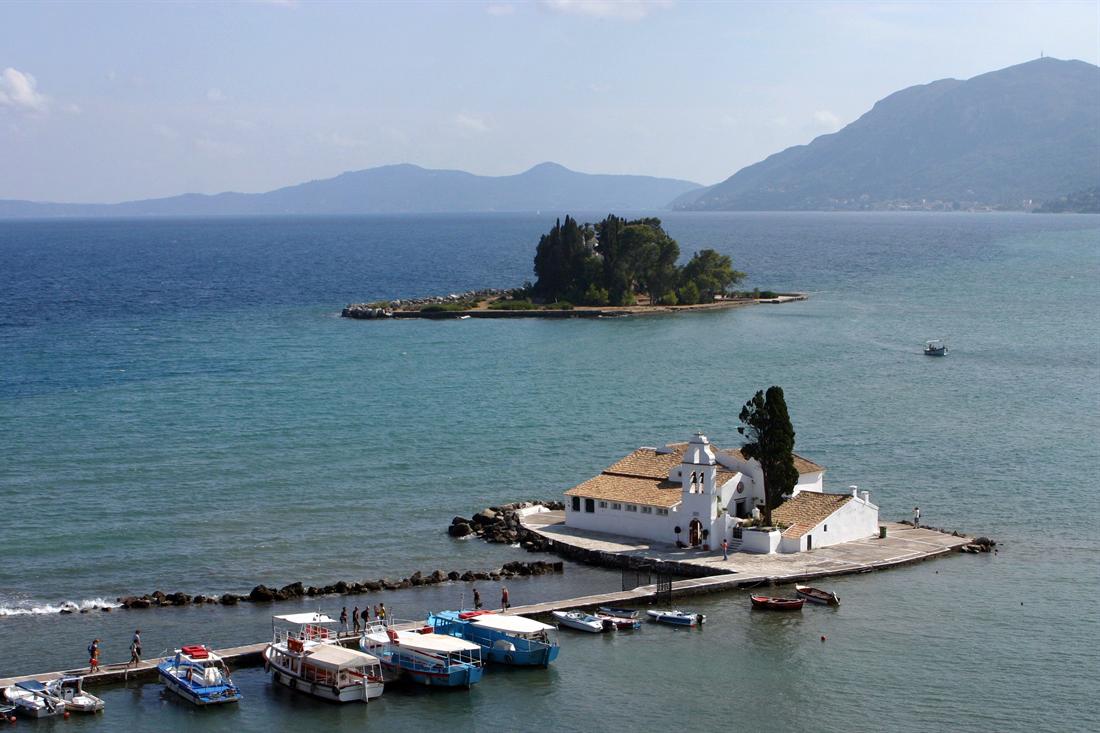
Kanoni Corfu is the headland south of Corfu Town where visitors look over the Vlacherna monastery, Mouse Island and a working airport runway. Find more trip ideas on Greece Tours.
Below we follow the name, the lagoon, the planes, the 2A bus, the beach and the tours that stop at Kanoni.
What is Kanoni Corfu and where does it sit?
Kanoni Corfu is a headland district 5.5 kilometres south of Corfu Town. It lies on the edge of the modern town, beside the Palaiopolis archaeological area. It looks over a lagoon, a runway and two islets.
A Kanoni Corfu visit centres on the highest point of the Analipses peninsula. The official Corfu tourism site places the Kanoni site south of Palaeopolis, the old city.
Corfiots who say Kanoni tend to include the Vlacherna monastery in the area, says the Corfu Blog.
Our Corfu Town page covers the Old Town and its fortresses to the north. This page follows the headland: the name, the view, the planes, the buses, the beach and the tours.
Why is the district called Kanoni?
Kanoni means cannon. The official Corfu tourism site says the name comes from two French cannon. They were set up there in seventeen ninety-eight, and one cannon from that battery still survives.
A Greek tourism site says French generals chose the Kanoni Corfu spot that year for their battery and key fortifications. Visitors can inspect the French cannon up close.
A Dutch guide to Kanoni Corfu places a surviving cannon on the central square of the district. Another Dutch guide says the cannons guarded the entrance to the lagoon, once the main harbour of the island.
A blogger who climbed up from Perama writes that the name comes from an old cannon on a green hill. All these accounts tie the name to cannon.
What stood near Kanoni before Corfu Town moved north?
The old city of Corfu stood on the Kanoni Corfu headland. Wikipedia places Chersoupolis, meaning city on the promontory, between Garitsa Bay and Kanoni. The Ostrogoths destroyed it in 551 during the Gothic War.
Afterwards the main settlement moved north to the site of the Old Fortress. The old site is now Palaiopolis, which means old city, and people kept living there for centuries.
The Corfu Blog says ancient Corfu was settled from the eighth century BC by Corinthian colonists. It minted its own coin, the Phoenix, and had the second largest fleet in Greece after Athens.
A Dutch guide adds that Kanoni was once the capital of the island. Wikipedia also records a church of Saints Iason and Sosipatrus, built outside the Palaiopolis city wall in the Macedonian dynasty.
What does the Kanoni Corfu viewpoint look out over?
The Kanoni Corfu viewpoint looks two ways. One side faces the airport runway. The other side faces the Vlacherna monastery and the islet of Pondikonissi, known as Mouse Island.
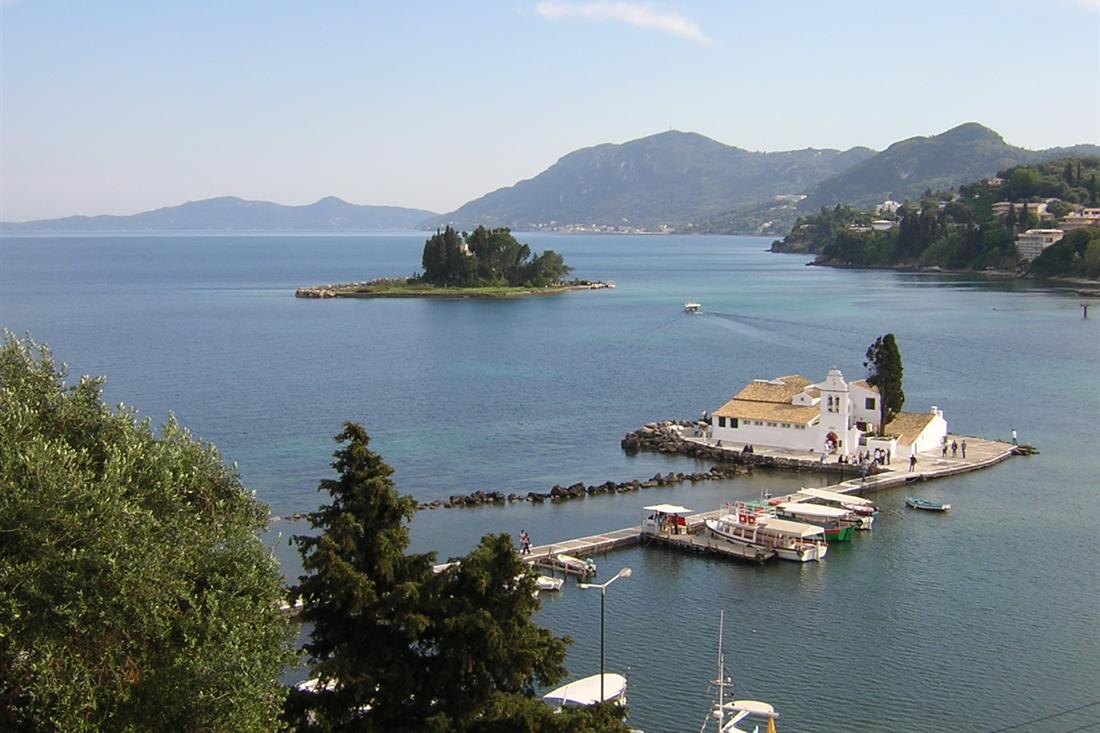
Just below the Kanoni Corfu viewpoint stands the Monastery of Vlachernae, which dates to the seventeenth century. Small boats sail from the quay to Pontikonissi and its chapel of the Pantocrator, says the official Corfu tourism site.
The islet lies about 300 metres from the shore, joined by a small footbridge, says a Greek tourism site. Boats for Pontikonisi tie up at that footbridge, and a stair leads down from Kanoni to a spot near it. Our Mouse Island page covers the islet itself.
The monastery takes its name from a large monastery in Constantinople. It once ran as a convent, and no nun lives there now. Visitors enter under an arched gate formed by the bell tower, and inside are a wooden iconostasis and wall icons. Its feast day falls on 2 July.
A 3.5-hour guided bike tour stops for photos at Vlacherna, the Mon Repos gardens and the Temple of Hera.
What is the lagoon below the Kanoni Corfu viewpoint?
It is the Halikiopoulos lagoon, a wetland about 3 kilometres south-southwest of the Corfu centre, where the international airport stands. Pontikonisi and the Vlacherna monastery sit at its entrance.
The wetland below Kanoni Corfu covers about 266 hectares. Its land part was much larger in the past and shrank through landfill, drainage, farming, building and road works.
A concrete footbridge 400 metres long joins the two banks at the sea edge. Walkers cross it with the sunset, Pontikonisi and the landing planes in view.
The lagoon below Kanoni Corfu has 4 recorded amphibian species and 11 reptile species, and migratory birds use it. In the migratory months rare birds gather on its banks. Half of the wetland lies in a Special Area of Conservation.
A Dutch guide adds that an egret spends the winter here, which draws birdwatchers.
How low do planes fly over Kanoni, and where do you watch them?
Close to the Kanoni Corfu headland. The airport lies 2 kilometres south of Corfu Town and half a kilometre north of Pontikonisi. A Dutch guide says the planes come in relatively low, and at times it seems you can touch them.
Landing planes approach to the northeast. Wikipedia says passengers get aerial views of Pontikonisi, the Vlacherna monastery and the hills of Kanoni. The landing runway lies near these landmarks.
The runway grew with the traffic. It measured 600 metres in wartime and reached 1,260 metres in the early fifties. After the last extension it finished at 2,373 metres.
At Kanoni Corfu, stand on the dam, about halfway along, to see landings and take-offs. A Dutch guide says this part of the dam runs just behind the runway.
To reach the dam, walk down the steps from Kanoni and cross to the far side. The planes fly over your head toward the runway, says another Dutch guide.
A Kanoni Corfu terrace gives a wider frame. The same guide describes landing and rising planes against the blue sea from the terrace.
When is the right time to visit Kanoni Corfu?
Visit Kanoni Corfu in the morning for the planes and at sunset for the light. A Dutch guide says that around nine or ten in the morning planes from across Europe land one after another.
Monday and Saturday are the busiest days at the airport, says another guide. Wikipedia adds that air traffic peaks from April to October.
Sunset adds a second reason. A Dutch holiday site recommends sunset for the viewpoints. A Greek tourism site says that on lucky evenings the full moon rises as the sun sets.
In the summer months the viewpoint tends to be crowded, according to a Dutch guide. A Kanoni Corfu morning visit fits the nine to ten slot that the guide names.
How does the 2A bus reach Kanoni from Corfu Town?
Take city bus 2A to Kanoni Corfu from Spianada Square beside the Liston. It heads for Mon Repos, Kanoni and Pontikonisi. A Dutch guide gives the ride as about nine minutes over 5.5 kilometres.
The operator publishes the timetable for bus 2A, with a separate list for weekdays and for Sundays and holidays. Check it on the day you travel, because the first and last trips differ between the two lists.
Buy a ticket at a kiosk next to a stop before boarding. Tickets sold on the bus cost more. Except for the daily ticket, a ticket is valid for one trip only.
An open-top bus is the other way to a Kanoni Corfu stop. The GetYourGuide listing for the open-top bus that serves the Old Town and Kanoni has 7 stops. The booking card shows 50 minutes, and the full route takes 70 minutes. Our Corfu hop on hop off page compares the bus tickets.
How do you reach Kanoni Corfu from the airport?
Take bus 15 from the airport into the centre, then board line 2A for Kanoni Corfu. By car or taxi the airport is 2.7 kilometres from Corfu city, a drive of about 10 minutes, says Wikipedia.
Line 15 passes the intercity bus station and San Rocco Square on its way to the port, says the operator. San Rocco Square has an information kiosk and a cluster of departure points.
The dam joins the village of Kanoni with Perama, so walkers can arrive from that side. A blogger crossed the lagoon and the causeway from Perama early in the morning, then climbed up to Kanoni.
Drivers follow a road that runs largely beside the runway, says a Dutch guide. A Dutch holiday site names bus and taxi as the ways to travel between Kanoni and Corfu Town.
What do you pass on the road between Corfu Town and Kanoni?
The last kilometre before Kanoni passes the Mon Repos estate, the Palaiopolis basilica and the Agii Theodori monastery. At the last fork the road splits toward Pondikonissi and Kanoni, so travellers pick one.
Mon Repos was a royal summer home south of Corfu City, set in the forest of Palaeopolis. Our Mon Repos page covers the villa and its museum.
The official Corfu tourism site dates the early Christian basilica of Palaiopolis to the fifth century. A Dutch holiday site lists the residence of Empress Sissi among the sights before Kanoni.
The Corfu Blog calls modern Kanoni a quiet suburb of the town. It describes the area as a continuation of Mon Repos Park.
The four-hour Kanoni Corfu tour with Mon Repos and the Old Town of Kerkyra is a guided tour. Its listing promises the main local points of interest, with pickup available.
Does Kanoni have a beach?
Yes. Kanoni Beach is a pebble beach in a small bay. A Dutch guide calls it child-friendly, with clear water and a gentle slope into the sea. Snorkelling, diving and paragliding are on offer there.
Restaurants stand within walking distance of the beach, says the guide. The guide adds that the beach is also good for walking.
Perama Beach is also pebble. A Dutch holiday site says the water looks bluer there and that the beach has a view of Mouse Island.
Gouvia and Benitses are within reach of Kanoni Corfu and have beaches developed further for tourism, says the Dutch guide.
Where do visitors eat, stay and spend the evening near Kanoni?
Kanoni Corfu has hotels, apartments, restaurants, souvenir shops and bars, says a Dutch guide. The district also has a park, a casino and a bar with traditional live music in the evenings.
Both Dutch sites list the Corfu Holiday Palace hotel at Kanoni. The Corfu Blog adds restaurants with Corfiot and other cuisines.
Supermarkets and minimarkets within walking distance cover daily shopping. The guide calls the district a relatively quiet resort where the noise of the planes is not a large problem.
After dark, the private Magic of Corfu at Night tour runs for 2 hours. It visits Kanoni, the Old Fortress and Liston Square, and the guest can customise the itinerary. A Kanoni Corfu evening on this tour comes with a personal driver and guide.
Which Kanoni Corfu tours can you book?
Four kinds of Kanoni Corfu tours are on sale. They are bus rides, guided van tours, boat trips to Mouse Island and half-day island tours. Viator and GetYourGuide list them with Kanoni or Mouse Island in the title or on the route.
The Viator list for Corfu includes a tour whose title names Paleokastritsa, Kanoni, Mouse Island and the Old Town. It also lists a sunset private cruise to Mouse Island.
The Easy City Tour is a 3.5-hour guided tour with pickup available. It covers the Old Town, Mouse Island and Achilleion Palace.
The City Sightseeing hop-on hop-off ticket on Viator includes a Kanoni line. The address of a fourth listing names a bus trip to Pontikonisi, Mon Repos, Achilleion and a swim.
More trips across the island sit on our Corfu tours page.


Which half-day tours pair Kanoni with Paleokastritsa and Lakones?
A 5-hour half-day tour from Corfu Town joins Kanoni, the villages of Pelekas and Lakones and a monastery in Paleokastritsa. The listing marks it as a small group with pickup available.
A 4.5-hour small-group car tour visits Kanoni, the Paleokastritsa monastery and Lakones village, with an Ionian Sea view. Its title says up to 6 guests.
A 5-hour panoramic tour visits the Kaiser’s Throne, the monastery of the Virgin Mary, Bella Vista in Lakones and Kanoni. The listing marks it as a private group and wheelchair accessible. Each of these Kanoni Corfu half-day tours differs by group type.
Which Kanoni tours start at the cruise port?
Two Kanoni Corfu listings start at the Corfu cruise port. The 4-hour City Highlights tour shows views of Mouse Island and the Old Town. The 4.5-hour Panoramic Island Highlights van tour lists the Kanoni viewpoint.
The City Highlights tour lists an optional audio guide. Its booking window closes 15 minutes before the start.
The van tour also lists Paleokastritsa beach and its monastery, Vasilakis Kumquat and the old town. Its booking window closes 1 hour before the start.
Is there a private or accessible tour to Kanoni?
Yes. The Accessible Private Tour of Kanoni, Mon Repo Palace and Corfu Town lasts 4 hours. It visits the church of Vlaherena, the Mon Repos Palace and the historic centre of Corfu Town.
Its listing marks it as a private group with wheelchair access and pickup. A 5-hour private tour from the port to Palaiokastritsa and Corfu Town carries the wheelchair-accessible tag too. Its listing address names Kanoni.
The Achilleion Palace, Kanoni and Corfu Old Town private tour runs 4 hours by minibus. It lists skip the line access, pickup and free cancellation. A private Kanoni Corfu day can also run 5.5 hours on the West Corfu tour, with lunch in Makrades.
How do you book a Kanoni Corfu tour?
Book online on GetYourGuide or Viator and check the cut-off first. The Kanoni Corfu listings in this guide close between 15 minutes and 10 hours before the start. The GetYourGuide listings show free cancellation.
The open-top bus closes 2 hours before the start. The half-day van tour closes 5 hours before, and the bike tour 10 hours before.
Pickup is available on the guided Mon Repos tour, the half-day van tour and the bike tour.
What do travellers ask about Kanoni Corfu?
Can you visit the Vlacherna monastery for free?
Yes. A Dutch guide to Kanoni Corfu says visitors can view the Vlacherna monastery freely.
Which company runs bus line 2A?
A Dutch guide names KTEL Kerkyras and Corfu City Bus as the operators of the Kanoni buses. The timetable and ticket pages are on astikoktelkerkyras.gr.
Does bus 2A run on Sundays?
Yes. Bus 2A has its own Sunday and holiday timetable, and it runs fewer trips than on weekdays.
What is the weather like at Kanoni?
The weather at Kanoni Corfu follows the island climate. Corfu has a Mediterranean climate, says a Dutch guide. Summers are warm and dry with average temperatures between 25 and 30 degrees Celsius, and winters are mild and wet.
Which sights pair with Kanoni on the same day?
A Dutch holiday site names the Old Town of Corfu, which is on the UNESCO list, and the Achilleion Palace. Empress Elisabeth of Austria had the palace built.