
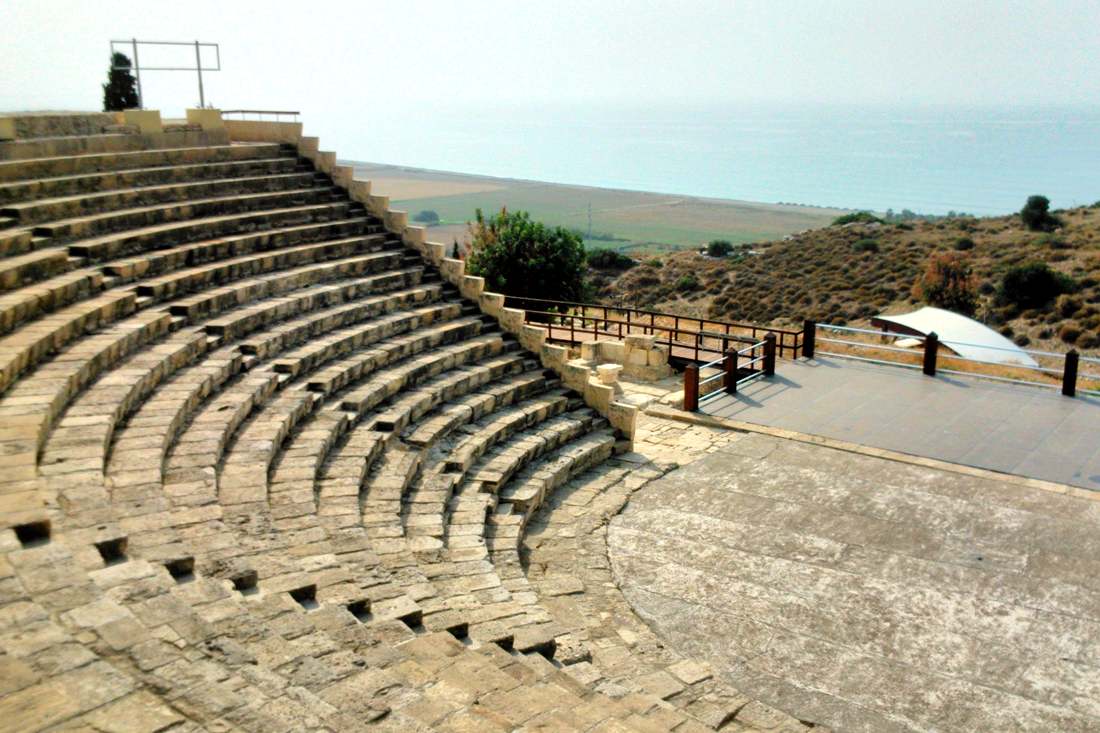
A Kourion tour visits the ancient city of Kourion above Episkopi Bay. It covers the Greco-Roman theatre, the mosaics, the early church and the stadium. Longer days add Kolossi Castle, Paphos or Omodos. Find more trip ideas on Greece Tours.
Below we compare the formats, walk the site building by building and cover opening times, travel and booking.
What is a Kourion tour?
A Kourion tour is a guided or self-paced visit to the ancient city-kingdom of Kourion, called Curium in Latin. The city stood on the south-west coast of Cyprus. Visitors walk a Greco-Roman theatre, mosaic houses, baths, basilicas and a stadium above the sea.
A Kourion tour starts at the archaeological site in Episkopi, west of Limassol on the road to Paphos. The Cyprus Tourism Organisation calls Kourion one of the major city-kingdoms of ancient Cyprus. Its hills overlooked the fertile valley of the river Kouris.
GetYourGuide groups 11 tours under its Ancient Kourion location. Viator lists eight products named after Kourion or Curium. A Kourion tour starts in Limassol, Paphos, Larnaca, Ayia Napa or Protaras and lasts from 3 to 10.5 hours.
This page walks the site building by building. It then covers the opening times, the journey, the neighbouring sights and the booking rules. The Cyprus tours hub shows how a Kourion tour fits among the island’s other day trips.
Which Kourion tour formats can you book?
Four Kourion tour formats exist. They are a private tour, a guided day trip, a winery day and a self-guided audio walk. The first three include transport. The walk starts at the site gate.
The private format keeps the group small. GetYourGuide’s Ancient Kourion and Apollon Hylates tour lasts 5 hours. It runs as a private small-group tour and lists pickup. The Sancytours Private Kourion Tour lasts about 6 hours.
Guided day trips suit a base in Limassol or Paphos. The Kourion tour from Limassol with Paphos Town lasts 7 hours. The trip from Paphos with Kolossi Castle also lasts 7 hours. From the east coast, the Paphos and Kourion day lasts 10 hours.
TUI sells a Kourion tour with a Paphos Harbour visit that lasts more than 8 hours. Its page lists entrance fees, a guide and transport. Guiding runs in German and English.
The Musement audio walk is a self-guided Kourion tour for visitors who set their own pace. It lasts from 30 minutes to 1 hour and starts at the site entrance. The phone app plays each story by GPS and adds animated videos at its stops. It works offline once downloaded. Entrance tickets are not included.
The Cyprus Tourism Organisation also publishes an audio guide on visitcyprus.com. It has tracks for the theatre, the basilica, the House of Eustolios and the other monuments.


How does the private Kourion tour with Apollo Hylates work?
The private Kourion tour with Apollo Hylates collects you at your hotel. It visits two sites: the ancient city and the sanctuary outside it. GetYourGuide lists it as a 5-hour private small-group tour with pickup and free cancellation.
Sancytours runs its own private Kourion tour. It collects guests at about 9:00 from the hotel or a meeting point. It plans about 6 hours, since the pace depends on the group. It asks guests to bring comfortable shoes.
Sancytours picks guests up free of charge in the Perivolia and Kiti area, in Limassol and in the Larnaca district. Its examples include Oroklini, Pyla and Livadia. Pickups from more distant places are also possible.
On a private Kourion tour the pace is yours. Sancytours says the format leaves time for photographs, questions and quiet moments. It takes bookings by email or through an online form. GetYourGuide asks for a booking at least 10 hours ahead.
What does a Kourion tour show at the Greco-Roman theatre?
A Kourion tour shows a Greco-Roman theatre on a slope above the sea. It began as a smaller Hellenistic theatre in the late second century BCE. It reached its present size under Trajan, between about 98 and 111 CE.
The first builders used the hillside to carry the rows of seats. Hellenistic architects did the same across the eastern Mediterranean. Later Roman work cut the seating to a half circle and rebuilt the scene building. Only its foundations survive.
Between 214 and 217 CE the building was changed to host gladiator games and wild-animal hunts. It returned to a plain theatre after 250 CE. Wikipedia estimates that it held up to 3,500 people.
Restorers have rebuilt much of the seating. The Cyprus Tourism Organisation says open-air musical and theatrical performances take place here, mainly in the summer months. The theatre is one of the venues of the International Festival of Ancient Greek Drama.
What do the mosaics of the House of Eustolios show on a Kourion tour?
On a Kourion tour, the House of Eustolios shows mosaic floors with fish and birds. It stands above the theatre on the southern cliffs. A Greek inscription names its Christian builder, Eustolios.
A mosaic in the vestibule reads “Enter for the good luck of the house”. Another inscription sits in the eastern portico. It names Eustolios as the builder and ends “this house is girt by the much venerated signs of Christ”.
The floors show fish and birds. Wikipedia lists a grey goose, a guinea hen, a falcon, a partridge and a pheasant. The cold room of the baths shows Ktisis, a personification of Creation. She holds an architect’s ruler.
A Kourion tour walks through a complex of more than thirty rooms. The southern courtyard surrounds a central pool. Wikipedia says the house began as an elite private home. It became a public bathing facility in the early fifth century.
The Cyprus Tourism Organisation counts four mosaic panels in the central room. It adds that a bathing complex lies at a higher level, north of the building, reached by steps.
On a Kourion tour, visitors can still see the hypocausts in the bath wing. These channels carried hot air under the floor tiles and through the walls. The built-in basins of the hot room survive as well.
What do the Houses of the Gladiators and Achilles show on a Kourion tour?
A Kourion tour stops at two named houses. The House of the Gladiators holds the only gladiator mosaics found in Cyprus. The House of Achilles shows Achilles unmasked among the women of Skyros.
The House of the Gladiators dates to the late third century CE. Two panels in the courtyard portico show gladiators in combat. One names the fighters Margarites and Hellenikos. The other shows gladiators being separated by a referee.
Wikipedia reads the building as an elite home or as a public palaestra, a training hall. It favours the palaestra and cites the small number of living rooms and the entrance through the attached baths. The east rooms stayed in use until the middle of the seventh century.
The House of Achilles stood outside the walls, near the proposed Paphos Gate. It dates to the early fourth century CE. Archaeologists read it as a reception hall for imperial and provincial dignitaries. Columns surround a central courtyard.
The main mosaic shows Odysseus revealing the identity of Achilles. The scene is set in the court of King Lycomedes on Skyros. Thetis had hidden her son there among the women to keep him from the Trojan War. Other panels show Thetis bathing Achilles for the first time and the abduction of Ganymede.
What do the Agora, the Nymphaeum and the baths add to a Kourion tour?
The civic centre has three parts. The Agora was the central square of the city. The Nymphaeum was a monumental fountain for the water nymphs. The baths surround it.
The forum took its present form in the late second or early third century CE. Colonnaded porticos ran along three sides. The eastern portico was 65 metres long and fronted a row of shops. The Cyprus Tourism Organisation adds marble columns on both sides of the square.
A Kourion tour passes the Nymphaeum. It grew through four phases, from the first century CE to the middle of the seventh century. After a rebuild between 98 and 117 CE it measured 45 metres by 15 metres. Wikipedia ranks it among the largest in the Roman Mediterranean.
After the fourth-century earthquakes, builders turned the Nymphaeum into a three-aisled basilica. It served as a temporary church from 370 to 410 CE. The cathedral precinct was under construction at the time.
The baths date to the early or middle fourth century CE. The Nymphaeum splits them into east and west wings. In the east wing, a central corridor opens onto a steam room, a hot room and a warm room.
Water arrived by aqueduct. Joseph Last identified two lines. One came from a spring near Sotira, 11 km away. The other came from Souni, 20 km away. The Sotira line used an estimated 30,000 clay pipes, and the Souni line an estimated 60,000. Before the aqueducts, the acropolis relied on rainwater stored in cisterns.
What does the Early Christian basilica add to a Kourion tour?
The Early Christian basilica was the cathedral of the Bishop of Kourion. Builders raised it at the start of the fifth century CE on the cliff crest beside the forum. A Kourion tour sees its columns, its apse, its mosaic nave and its separate baptistery.
On a Kourion tour the basilica reads as a three-aisled church with a semicircular apse at the east end. Colonnades of twelve columns separated the aisles from the nave. White marble covered the walls. Coloured mosaics paved the nave.
A bishop’s palace, a baptistery and columned courtyards belonged to the same precinct. Wikipedia reads the project as a sign that Christianity now stood at the centre of the city’s religious life. The sanctuary of Apollo fell out of use at the same time.
Two more churches stood nearby. A second basilica rose on the heights north-west of the acropolis in the late fifth century CE. Another stood on the beach below the cliffs in the early sixth century. It measured about 27.5 metres by 14 metres and had six Corinthian columns in the nave.
Christianity reached Kourion early. Bishop Philoneides of Kourion died a martyr in the Diocletianic Persecution, long before the cathedral rose.
What did the earthquakes of the fourth century do to Kourion?
Five strong earthquakes hit Kourion between 365 and 370 CE. They wrecked the houses and public buildings on the acropolis. Builders restored the city in the late fourth and early fifth centuries, but parts of the acropolis stayed empty.
Archaeologists found the clearest evidence in the Earthquake House, 155 metres south-east of the basilica. It dates to the late first or early second century CE. Its owners repeatedly subdivided and extended it.
The collapse trapped the people inside. The dig found two skeletons posed in an embrace. It found a juvenile who had fallen from the upper floor into the stable. It found a young woman with an infant, held by a man of about twenty-five. Three adult men aged 25 to 40 lay nearby.
A mule stood chained to a limestone trough in the stable. David Soren excavated the house. The Kourion Urban Space Project has continued the work there since.
Arab raids in 648 and 649 CE destroyed the acropolis. The centre of life moved to Episkopi, 2 km to the north-east.
What stands at the stadium of Kourion?
The stadium of Kourion is the only excavated stadium in Cyprus. Builders raised it in the Antonine period, between about 138 and 180 CE. It seated about 6,000 spectators on seven rows of seats.
The whole building measured 229 metres long and 24 metres wide. Two round stone posts marked the starting line. They stood wide enough apart for eight runners. Curved seating enclosed the track on the north, west and south.
The seating bank was 217 metres long and 17 metres wide. It rested on an ashlar wall 6 metres thick. Gaps in the middle of the north, south and west sides led onto the track.
The stadium stands between the city and the sanctuary of Apollo Hylates, outside the main site. Take Me To Europe Tours notes a small free car park in front of it. The stadium was abandoned in the later fourth century.
Why did people worship Apollo Hylates near Kourion?
Apollo Hylates was the god of the woods. Take Me To Europe Tours says inscriptions point to him as the protector of Kourion. His sanctuary was a pan-Cypriot shrine. Only the sanctuaries of Zeus at Salamis and Aphrodite at Paphos ranked above it.
A private Kourion tour adds the sanctuary. The site sits 1.7 km west of the acropolis, set back 0.65 km from the shore. The earliest offerings date to the late eighth century BCE. They went to “the god”, not yet to Apollo. Wikipedia links the name Apollo to the middle of the third century BCE.
The sanctuary took its present form in the first century CE. The Augustan temple measured 13.5 metres by 8.35 metres, with a porch of four columns. Trajan restored the complex after the earthquake of 76 or 77 CE. He added a southern portico and a bathhouse.
A palaestra, a sacred street and a circular monument belong to the earlier Augustan layout. The temple fell out of use in the late fourth century after earthquake damage. The cathedral rose in the city at about the same time.
Both the GetYourGuide and the Sancytours private Kourion tour include the sanctuary in their route.
How did Kourion grow from a kingdom into a Roman city?
The Kouris valley had hilltop villages from the Neolithic. Kourion became a kingdom in the Cypro-Geometric period and served Persia and the Ptolemies. It thrived as a Roman city until Arab raids ended its life in the seventh century CE.
In the Late Bronze Age, Alassa and Episkopi-Bamboula controlled the Troodos copper trade. Episkopi-Bamboula flourished in the 13th century BCE and was abandoned in the eleventh century BCE.
Kings ruled the city in the Cypro-Archaic period. King Damasos appears on an Assyrian prism. King Stasanor joined a Cypriot revolt against Persia, then betrayed its leader Onesilos in battle. King Pasikrates later helped Alexander the Great at the siege of Tyre.
Cyprus passed to the Ptolemies in the early third century BCE and to Rome in the first century BCE. Under Rome, Kourion had its own council, a clerk of the market and priesthoods of Apollo Hylates and of Rome. A proconsul oversaw the city.
The Roman and early Byzantine periods account for the bulk of the remains. A Kourion tour is therefore largely a Roman visit.
Luigi Palma di Cesnola dug at the cemetery and the sanctuary in the nineteenth century. He sold the bulk of his finds to the Metropolitan Museum of Art. The British Museum and then the University of Pennsylvania dug more systematically. The Department of Antiquities manages the site today.
Which stops join a Kourion tour besides the ruins?
A Kourion tour adds Kolossi Castle, Aphrodite’s Rock, Omodos or a winery, and Paphos or Limassol Old Town. GetYourGuide pairs the ruins with Kolossi on its Paphos and Limassol day trips. Its Omodos day adds a winery tasting.
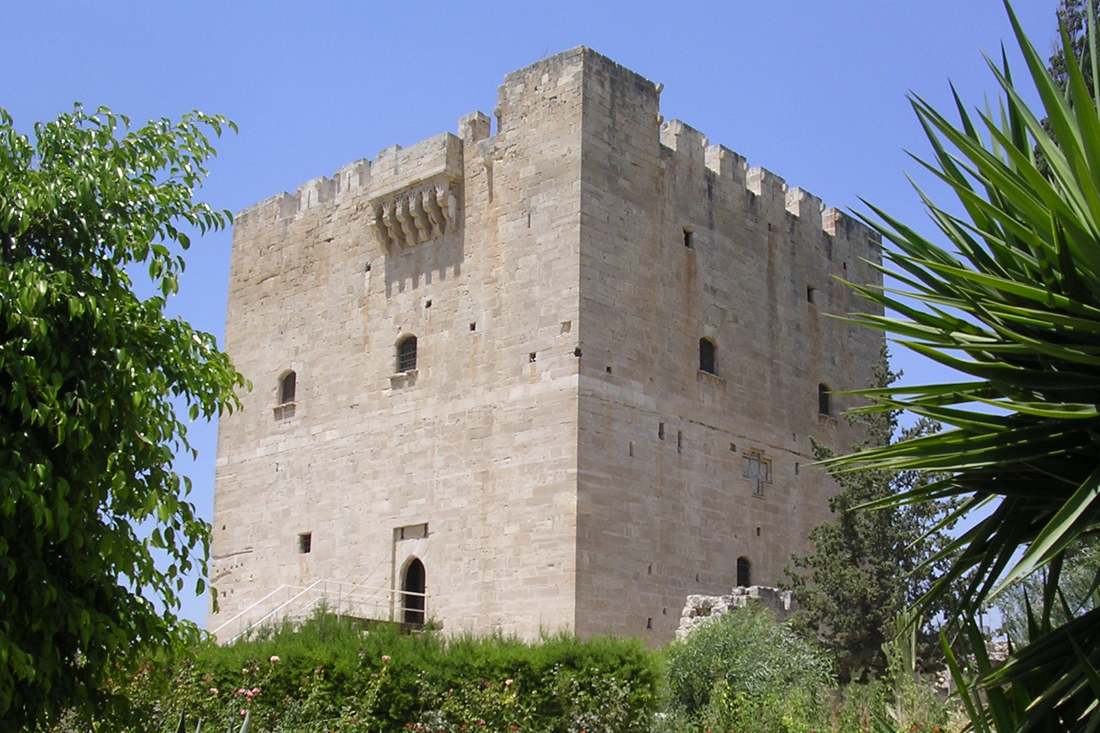
Kolossi Castle is the partner of a Kourion tour on the Paphos and Limassol days. It stands 14 kilometres west of Limassol at Kolossi village. Wikipedia places the first castle in the early 13th century. King Hugh I gave the land to the Order of St John. Sugar mills processed local cane there, a main export of medieval Cyprus.
Petra tou Romiou, or Aphrodite’s Rock, is a sea stack at Kouklia. It stands off the shore on the main Paphos to Limassol road. A local legend says the hero Basil hurled the rock from the Troodos Mountains to stop Saracen raiders. TUI’s Kourion day makes a photo stop there.
GetYourGuide’s Beyond Paphos tour joins Kourion, Omodos and the Rock of Aphrodite. It adds a traditional lunch and a tasting at a local winery. The Troodos wine tour page covers the wine villages in depth.
Which Kourion tour goes on to Paphos or Lefkara?
Four day trips pair Kourion with Paphos. The Limassol start takes 7 hours. Two east-coast days take 10 and 10.5 hours. TUI’s day includes Paphos Harbour. One GetYourGuide day adds Lefkara instead.
The Kourion tour with Paphos Town from Limassol lasts 7 hours. It lists pickup and free cancellation. GetYourGuide describes it as a full-day historical tour.
TUI’s Ancient Kourion tour with Paphos Harbour visit starts with a coffee stop. It then walks the theatre, the Agora and the ruined House of Eustolios. It adds a photo stop at Aphrodite’s Rock. In Paphos it adds a guided visit to the Tombs of the Kings and the House of Dionysos mosaics.
The 10.5-hour east-coast day from Protaras, Ayia Napa and Larnaca visits ancient Curium and then Paphos. It offers optional mosaics, a stop for Cyprus Delights in Geroskipou and photos at the legendary birthplace of Aphrodite.
The other east-coast day lasts 10 hours. GetYourGuide says it covers archaeology in Paphos and Kourion, a stop at Aphrodite’s Rock and a taste of traditional sweets.
The Lefkara day lasts 7 hours. GetYourGuide’s description names Aphrodite’s birthplace, a UNESCO village, Limassol and cliffside Roman ruins. The Paphos tours page shows the other day trips that start in the west.
How do you reach Kourion from Limassol, Larnaca and Ayia Napa?
Kourion lies west of Limassol on the road to Paphos. The Cyprus Tourism Organisation puts it 19 km from the city. Day-trip operators collect guests in Limassol, Paphos, Larnaca, Ayia Napa and Protaras. Independent visitors drive or take the bus.
From Limassol, Take Me To Europe Tours lists bus line 16 from Archiepiskopou Makariou III Avenue towards Kourion Beach. The ride takes about 40 minutes, followed by a walk of under 10 minutes. The same guide gives about half an hour by car.
A Kourion tour removes the logistics. GetYourGuide lists hotel pickup on the Limassol, Paphos and east-coast day trips. The 7-hour trip from Paphos reaches Limassol with hotel transfers. The Limassol tour page covers the city’s other day trips.
From the east coast, the 8-hour Polish-language day and the 10-hour day both leave from Ayia Napa, Protaras and Larnaca. The Ayia Napa tours page shows what else starts there.
Free cancellation appears on each GetYourGuide listing named here. The private tour, the Limassol tour and the Paphos tour ask for a booking at least 10 hours ahead.
When is Kourion open, and what do you pack for a Kourion tour?
Kourion is open daily from 8:30 to 17:00 between 16 September and 15 April. Between 16 April and 15 September it stays open until 19:30. It closes on Christmas Day, New Year’s Day and Greek Orthodox Easter Sunday.
The Cyprus Tourism Organisation adds that times can change without notice. It advises visitors to check before they go. The Department of Antiquities sells entry cards valid for one, three or seven days at its museums and ancient monuments. Organised groups of more than 10 people get a reduction.
The site has little shade. Take Me To Europe Tours warns of no shade and no food, and suggests a hat and water. TUI asks guests to bring a hat, sunblock and suitable footwear for its Kourion tour.
A roof over the House of Eustolios lets visitors see its mosaics all year. Freedom Travel notes that the area is partly accessible for people with reduced mobility, with short stairs in places.
Summer brings performances in the theatre. Take Me To Europe Tours points visitors to the Greek drama festival’s ticket page for those events.
What does the Kourion Museum at Episkopi hold?
The Local Archaeological Museum of Kourion stands in Episkopi village, 14 km west of Limassol. It holds finds from the nearby sites in two exhibition halls. It occupies the former home of George McFadden, who led the University of Pennsylvania digs.
The halls show red polished ware of the Early Bronze Age, Mycenaean pottery and gold jewellery. They also hold a large number of offerings from the Sanctuary of Apollon Hylates. Skeletons of inhabitants who died in the fourth-century earthquakes, found in place in a Roman house, are on display.
The museum opens Monday to Friday from 8:00 to 15:30 and closes on public holidays. Check the current notice on visitcyprus.com before you plan a museum stop.
What do travellers ask about a Kourion tour?
Is Kourion the same place as Curium?
Yes. Curium is the Latin name of the city, and Kourion is the Greek name. GetYourGuide’s listings use both spellings.
How long does a visit to the ruins take?
The Musement audio walk lasts from 30 minutes to 1 hour. A guided Kourion tour lasts between 5 and 10.5 hours because it adds other stops.
Can you hear the guiding in another language?
Yes. GetYourGuide lists a Polish-language day and a French-speaking half-day from Paphos. TUI’s Kourion tour with Paphos Harbour runs in German and English.
Can cruise passengers book a Kourion tour?
Yes. Viator lists the Curium, Kolossi and Limassol Discovery private shore tour under Limassol.
What do visitors see first on a Kourion tour?
The Amathus Gate cemetery is the first group of monuments on the entry road. It has rock-cut chamber tombs along the cliffs.
Where can you see the finds online?
The Penn Museum runs a Digital Kourion collection of finds from the excavations.