
A Famagusta tour crosses the border to the Venetian walls, the Varosha ghost town and ancient Salamis. Day trips start in Ayia Napa, Protaras, Larnaca, Paphos and Limassol. Find more trip ideas on Greece Tours.
Below we compare the formats, the border rules, the sights and the departures.
What is a Famagusta tour?
A Famagusta tour is a guided trip to Famagusta (Gazimağusa) on the east coast of Cyprus. It visits the walled old city, the Varosha ghost town and the ruins of ancient Salamis.
Famagusta lies in the Famagusta District, east of the capital Nicosia. Northern Cyprus controls the larger part of the district, and the Republic of Cyprus holds the rest. Our Cyprus tours page compares routes across the island; this page covers Famagusta alone.
The city carries three names. Greek speakers say Ammochostos, and the informal Turkish name is Mağusa. The formal Turkish name adds the title gazi, which means veteran.
The GetYourGuide listings we compared run from 2.5 hours to 12 hours. Each one lists pickup, so a Famagusta tour starts at your hotel or a meeting point, not at the border.
Which Famagusta tour formats can you book?
Famagusta tour formats fall into three groups. Ghost town walks last 2.5 to 4.5 hours. Old town and Varosha days last 5 to 9 hours. Salamis days last 8 to 12 hours.
The short Famagusta tour options focus on Varosha. A private Varosha tour from Protaras or Ayia Napa lasts 2.5 hours, and a group version lasts 4 hours. Both list pickup.
The middle group adds the old town. A half-day Famagusta and Varosha tour from Ayia Napa lasts 5 hours. The Red Bus 3-in-1 day lasts 7 hours, and the Larnaca day lasts 9 hours.
The long group adds Salamis and the St Barnabas Monastery. One day runs 8 hours with a licensed guide. The Ayia Napa version lasts 10 hours, and Paphos departures last 11 to 12 hours.
Private options exist in each group of Famagusta tour formats. The 6-hour old-town tour runs as a small group, and the 2.5-hour Varosha tour is private.
How does a Famagusta tour cross the border at Deryneia?
The list of Cyprus crossing points pairs Deryneia with Famagusta (Gazimağusa). A United Nations buffer zone separates the two sides. Wikipedia says citizens of any country are permitted to cross the line.
Crossings stayed very limited for decades. A nearly 30-year ban ended when the Turkish Cypriot side eased its travel rules. The Republic of Cyprus later dropped its own limits for EU citizens.
The UK government says you can use any crossing point to move between north and south. Mr John’s tour site says guests cross through the designated checkpoint and enter the reopened areas of Varosha.
Check the entry rules before you book a Famagusta tour. Entering the Republic of Cyprus through the north, such as at Ercan Airport, counts as illegal entry. Time in the north counts toward the 90-day visa-free total.
What do you carry on a Famagusta tour?
Carry a valid passport or an EU identity card. Mr John’s tour site asks every guest for one of the two. Restrictions apply to particular nationalities, so confirm your status with the operator before you book.
One GetYourGuide listing for a Famagusta tour from Ayia Napa and Protaras states “Passport required” in its summary. Treat the document as the first item in your bag.
Customs controls apply when you return south from a Famagusta tour. The UK government says they cover the types and quantities of goods you buy in the north and carry south. The authorities can confiscate goods.
A hire car adds a second check. The UK government says you will not pass a crossing without the correct insurance documents. A Famagusta tour with pickup removes that task, because the operator drives.
Avoid photographs near military buildings. The UK government warns of arrest for them. Its High Commission has limited power to help in the north.
What does a Famagusta tour show inside the Lala Mustafa Pasha Mosque?
The Lala Mustafa Pasha Mosque is the largest medieval building in Famagusta. Builders raised it as the Cathedral of Saint Nicholas, and it has stayed a mosque since the Ottoman conquest.
The cathedral follows the Rayonnant Gothic style, which is rare outside France. Its parallels to Reims Cathedral earned it the nickname “the Reims of Cyprus”. It has three doors, twin towers over the aisles and a flat roof.
The Lusignan kings of Cyprus took a second crown here. They were crowned kings of Jerusalem in this cathedral. They were crowned kings of Cyprus in Saint Sophia Cathedral in Nicosia.
Earthquakes and the Ottoman bombardment damaged the upper parts of both towers, and nobody repaired them. After the conquest, the new owners removed or plastered over the statues, stained glass and frescos. The Gothic structure survived.
The building takes its present name from Lala Mustafa Pasha. He was the grand vizier who led the Ottoman forces against the Venetians. The gonorthcyprus.com itinerary puts the cathedral in the heart of town on its old-city walk. That Famagusta tour also lists the Lion Gate and abandoned cannons.
Which walls and towers does a Famagusta tour circle?
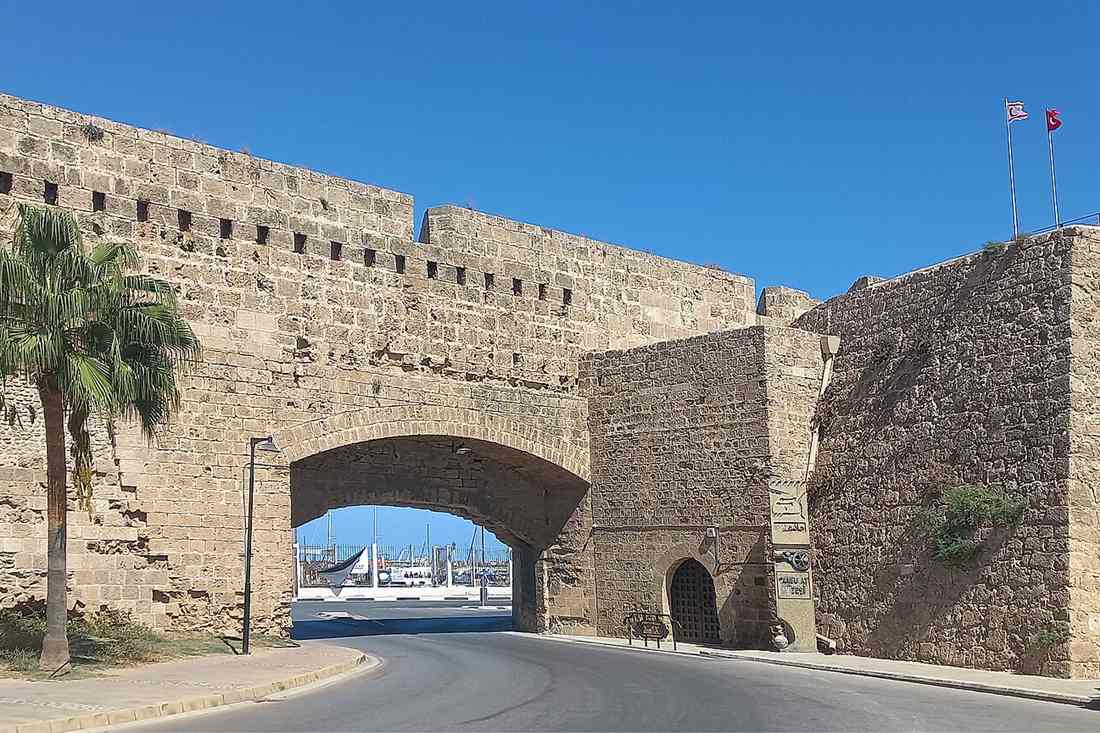
The walls of Famagusta hold 14 bastions, two gates and Othello Castle. A rock-hewn ditch rings the landward side, and the harbour guards the seaward side. Venetian engineers redesigned the Lusignan defences into the form you see today.
The bastions carry the names of Venetian families. The engineer Giovanni Girolamo Sanmicheli arrived around the middle of the 16th century. He designed the Martinengo Bastion, which became a prototype for fortifications in Europe and America.
He died in Famagusta before the work ended. The walls of Famagusta resemble those of Rhodes. Both show the move from medieval fortification to the bastioned forts of the early modern period.
Othello Castle stands where the walls meet the harbour. The Lusignans built it in the 14th century as the main entrance to the town. Very deep ditches earned it the name “impenetrable fortress”.
The Venetians swapped its square towers for round ones that suit artillery. A relief of the Lion of Saint Mark sits over the main entrance. Nearby, an inscription names Captain Nicolo Foscari, who directed the changes.
Inside, four circular towers stand around a yard with cannonballs left by Spanish and Ottoman forces. The name comes from a stage note in Shakespeare’s play Othello. The play is set in a harbour town in Cyprus.
Which churches and museums add depth to a Famagusta tour?
The old town holds three smaller sights for the free time on a Famagusta tour. They are the Nestorian Church, the Ganchvor Monastery and the Namık Kemal Dungeon. Each one tells a story that the cathedral and the walls leave out.
The Nestorian Church, also called Saint George the Exiler, dates to the 14th century. Chroniclers credit two wealthy Nestorian merchant brothers. The Ottomans used it as a camel stable. Since the late 1980s a university has run it as a cultural centre.
The Ganchvor Monastery is an Armenian church. Armenian refugees from Cilicia built it in the middle of the 14th century. It stood unused after the siege, and a recent restoration returned it to the Armenian community.
The Namık Kemal Dungeon stands on part of the old Venetian palace site. The sultan exiled the Turkish writer Namık Kemal to Cyprus. He wrote the plays Gülnihal and Akif Bey in this building.
The dungeon is now a museum. It holds his belongings and documents about him.
How did the siege end the wealth of Famagusta?
Famagusta grew rich as a Lusignan, Genoese and Venetian port. It fell to the Ottomans in August after an 11-month siege that Marco Antonio Bragadin led.
The fall of Acre sent Christian refugees to the town. They turned a tiny village into one of the richest cities in Christendom. By the middle of the 14th century, people said its citizens were the richest in the world.
Genoa seized the port in the 14th century, and Venice took the island in the 15th. The garrison under Bragadin had about 8,500 men and 90 guns. The attackers grew to more than 200,000 men with 145 guns.
The Ottomans piled earth around the walls and dug tunnels under them. They breached the defences in July. Only nine hundred soldiers remained, and Bragadin asked for terms on 1 August.
The siege tied down the Ottoman forces. They were slow to redeploy when the Holy League built the fleet that later won at Lepanto. After the fall, the Ottomans expelled the Latins. Greek Cypriots had to settle outside the walls, in the area that became Varosha.
The history splits every Famagusta tour in two. The walled city holds the medieval wealth, and Varosha holds the modern chapter.
What does a Famagusta tour show in Varosha?
A Famagusta tour walks the reopened streets of Varosha, the southern quarter of Famagusta. The private tour listing on GetYourGuide promises empty streets and crumbling hotels. The Red Bus listing adds a map of the relevant buildings.
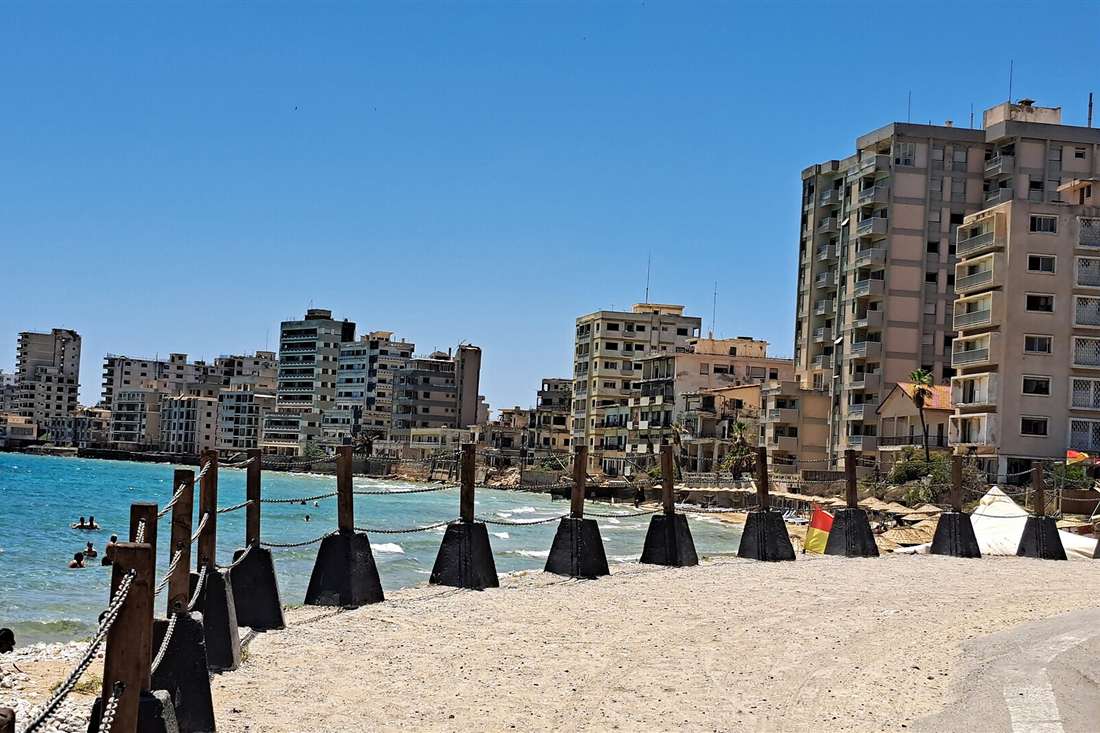
John F. Kennedy Avenue was the main street. It ran from close to the port, through Varosha, parallel to Glossa beach. The King George, Asterias, Grecian and Florida hotels lined it.
Leonidas Street branched off the avenue towards Vienna Corner. It was the shopping and leisure street, with bars, restaurants, nightclubs and a Toyota dealership.
Nature has moved in since. Metal corrodes, windows lie broken, and plants push roots into the walls and pavements. Plants also grow wild in old window boxes.
The Original Red Bus offers an optional audio and picture guide app that shows the resort as it once looked. It adds a free detailed map. Mr John’s tour lists an optional audio guide. His site says a Turkish Cypriot guide from the same era joins the walk.
Four future members of ABBA visited Varosha on a promotional holiday. They played an informal show for Swedish United Nations peacekeepers. Accounts call it the first time all four performed together.
When did Varosha open to Famagusta tour visitors?
The Turkish army fenced Varosha in August of nineteen seventy-four and kept it fenced until October twenty twenty. Then Northern Cyprus reopened streets to visitors, from the Officers’ Club to the Golden Sands Hotel.
Visitors came in large numbers. From the opening to the start of twenty twenty-two, nearly 400,000 people visited Varosha.
A beach strip at Golden Sands, 600 metres long and 400 metres wide, later opened for commercial use. Operators installed sun beds and umbrellas from the King George Hotel to the Oceania Building.
The status of the quarter stays disputed. United Nations Security Council Resolution 550 calls any attempt to settle Varosha with people other than its inhabitants inadmissible. It calls for the transfer of the area to United Nations administration.
After the beach opening, the United Nations force said its position on Varosha was unchanged. The GetYourGuide Larnaca departure describes the walk as covering the publicly reopened part of the quarter.
What does a Famagusta tour add at Salamis?
Salamis shows the later life of the ancient city. Earthquakes struck in the early 4th century, and Constantius II rebuilt the city as Constantia. Saint Epiphanius held its bishopric. A Famagusta tour with a Salamis day walks this site.
The basilica of Bishop Epiphanios, who served from AD 367 to 403, was the metropolitan church of Salamis. The saint lies buried at the southern apse, and a baptistery heated by hypocausts survives.
An aqueduct from Kythrea supplied the city with water, and a large cistern near the agora stored it. The necropolis covers about 7 square kilometres west of the town, and a museum shows its finds.
Excavations began in the late 19th century under the Cyprus Exploration Fund. The British Museum holds finds from these digs, including a marble capital with carved figures between winged bulls. It dates between 300 and 250 BC.
Two battles took place at Salamis. In 306 BC, Demetrius defeated the fleet of Ptolemy I there. Silting of the harbour later caused the slow decline of the town.
Salamis left stones inside Famagusta. The gonorthcyprus.com Famagusta tour notes pillars from Salamis in a palace opposite the mosque. The Loggia Bembo of the cathedral has late antique marble seats at its entrance. Wikipedia links them to Salamis.
What does the St Barnabas Monastery add to a Famagusta tour?
The St Barnabas Monastery adds the tomb of the patron saint of Cyprus and a museum of icons. It lies about 2 km west of Constantia, and the gonorthcyprus.com Famagusta tour lists it beside Salamis.
Barnabas came to Cyprus to preach with Saint Paul. The Famagusta tour itinerary says his remains were unearthed 400 years after his death. His tomb is a site of pilgrimage for Cypriots.
A basilica stood near the spot where Archbishop Anthemius found the body. Emperor Zeno financed it in the late 5th century. The church now serves as a museum of icons.
The former cloisters house an archaeological museum. Its artefacts go back to the Neolithic. The monastery also keeps important archaeological collections from Salamis.
Where does a Famagusta tour stop for a swim?
A Famagusta tour with a swim is the Red Bus 3-in-1 day, which lists a swim on the beach. The 9-hour Larnaca day gives free time at Golden Beach. The Original Red Bus site names Palm Beach on its Famagusta and Varosha View tour.
The Red Bus 3-in-1 day lasts 7 hours. It combines free time in Varosha, a swim and a drive through the Red Villages. The listing marks it as wheelchair accessible.
The Larnaca, Ayia Napa and Protaras Famagusta tour lasts 9 hours. Guests swim at Golden Beach or explore the publicly reopened part of Varosha. They sightsee independently in the old town.
The Red Bus Famagusta and Varosha View tour explores the walled city with free time. It then moves to Palm Beach, which overlooks the abandoned resort. Its buses are open-top and seat guests together upstairs.
Which Famagusta tour starts from Ayia Napa, Protaras or Larnaca?
From Ayia Napa and Protaras, a Famagusta tour lasts 4 to 10 hours. Larnaca departures last 8 to 9 hours. Every listing includes pickup.
The 4.5-hour Famagusta Ghost Town and Varosha tour runs as a small group in English and German. It lists door-to-door pickup from Ayia Napa and Protaras. The Mr John 3-in-1 tour lasts 6 hours and adds the dividing line.
The 5-hour half-day tour crosses the border on a guided coach. It visits Saint Nicholas Cathedral and walks the accessible parts of Varosha. The 10-hour guided tour adds the ruins of Salamis.
The Larnaca departures make a longer Famagusta tour. The 8-hour day stops at the Varosha ghost town, Salamis and the St Barnabas Monastery with a licensed guide. The 9-hour day adds the Golden Beach stop and lets children aged 1 and under join free.
The Ayia Napa tours page puts Famagusta beside the caves jeep safari. The Protaras tour page adds the Cape Greco trails. The Larnaca tour page covers the salt lake and Hala Sultan Tekke.
Which Famagusta tour starts from Paphos, Limassol or Nicosia?
From Paphos, a Famagusta tour lasts 10 to 12 hours, and one 10-hour day also picks up in Limassol. From Nicosia, Viator lists a circular tour that links Famagusta and Kyrenia.
GetYourGuide lists a 10-hour Famagusta tour from Paphos and Limassol in English and Greek. Two 11-hour days run from Paphos, one as a walking tour and one with a bestseller badge. A 12-hour day lists three stops.
The north side runs its own Famagusta tour. The gonorthcyprus.com day starts with hotel pickup in Kyrenia, Nicosia and Famagusta between 08:00 and 09:30. It includes lunch, a guide and the entrance fees for Saint Barnabas, Salamis and Othello’s Tower.
The itinerary places lunch at a seaside restaurant in summer and at an inland restaurant in winter. Our Nicosia tour page explains the Green Line crossings in the capital.


Which Famagusta tour adds Kyrenia, a jeep safari or a boat?
Combination days add a second goal. The Kyrenia and Famagusta day lasts 10 hours, and the jeep and Blue Lagoon cruise lasts 8 to 9 hours. Both list pickup.
The Kyrenia day starts from Larnaca, Ayia Napa or Protaras. It stops in Famagusta, Bellapais Abbey and Kyrenia, and ends with a view of Varosha. The listing runs in English.
The jeep and boat combination is a land-and-sea day across eastern Cyprus. It runs as a small group in English, German and Polish. Children aged 2 and under join free.
From the north, a private 6-hour tour covers Kyrenia, Saint Hilarion Castle and Bellapais. It runs in Turkish, English, Russian, Spanish and Italian.
What do travellers ask about a Famagusta tour?
Which languages do Famagusta day trips offer?
Beyond English, listings offer German, Polish, Greek and Turkish. The north-side tour adds Russian, Spanish and Italian.
How far ahead can you book a Famagusta tour?
The Ayia Napa, Larnaca and Paphos listings on GetYourGuide close 10 hours before departure. The Mr John listings ask for 4 hours. Each listing we checked offers free cancellation.
Do children join a Famagusta tour?
Yes. Children aged 1 and under join a Famagusta tour free on the Larnaca, Paphos, Limassol, Salamis and Kyrenia days. Children aged 2 and under join free on the jeep and boat day. Add them to the booking.
Are Ayia Napa and Protaras part of Famagusta?
Yes. The Visit Famagusta tourism site presents Ayia Napa and Protaras as part of the Famagusta Region. It adds the red soil villages of Deryneia, Sotira and Achna. The walled city lies in the part that Northern Cyprus controls.
Who controls Famagusta?
Northern Cyprus controls the city, and the Republic of Cyprus holds part of the wider district. The UK government does not recognise the self-declared Turkish Republic of Northern Cyprus.
Which stories are set in Famagusta?
Shakespeare set his play Othello in a harbour town in Cyprus, and the castle took its name from it. Victoria Hislop set her novel The Sunrise in Famagusta.