
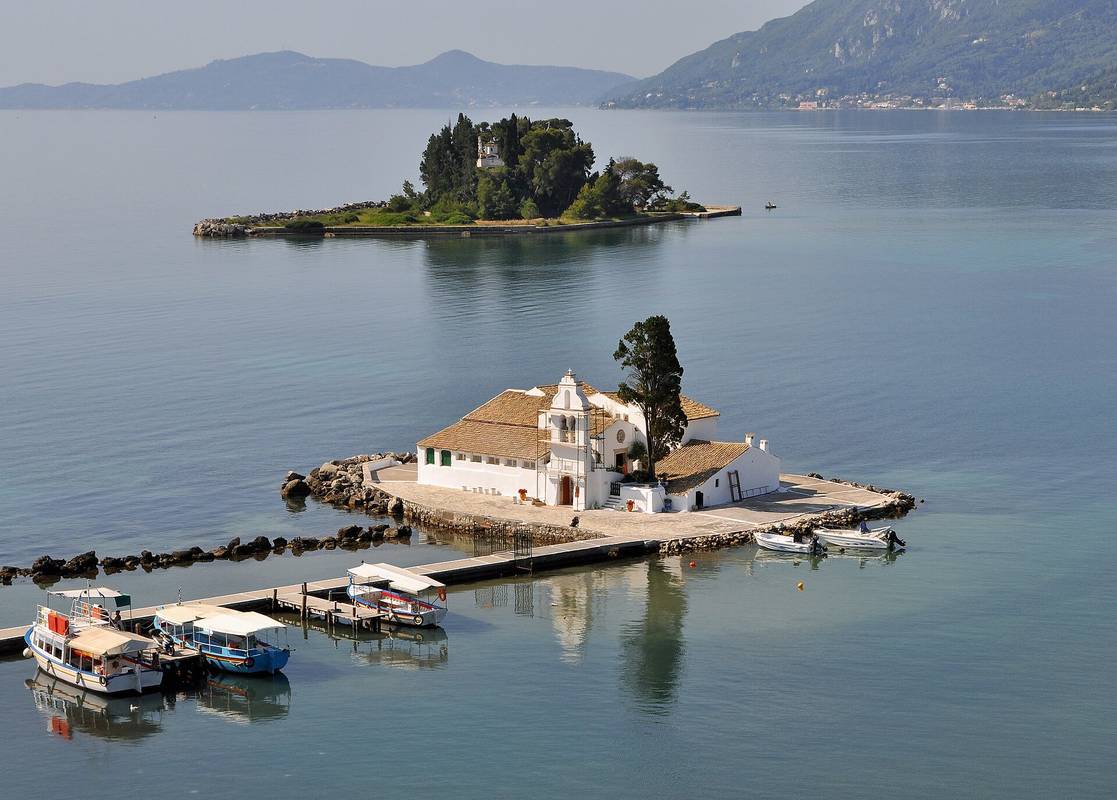
Mouse Island Corfu, known as Pontikonisi, is the island’s most photographed sight, a tiny green islet crowned by a Byzantine chapel, seen from the Kanoni viewpoint beside the causeway to Vlacherna Monastery. This guide covers what it is, the view from Kanoni, how to reach the islet by boat and how to get there. Plan the whole trip with Greece Tours.
This iconic trio is a highlight in the wider Corfu tours and travel guide. Kanoni is a district of Corfu Town, a couple of kilometres south of the centre. The sections below cover the visit.
What is Mouse Island?
Mouse Island, or Pontikonisi, is a tiny wooded islet off Corfu’s east coast, crowned by an 11th or 12th-century Byzantine chapel amid dark cypress trees. Its name comes from the white chapel steps, which from afar resemble a mouse’s tail.
Pontikonisi is small but unforgettable. The green islet rises from the sea south of Corfu Town, almost entirely covered by tall cypress trees. The little white chapel of Pantokrator, dating from around the 11th or 12th century, stands hidden among them. Its curious name, “Mouse Island”, comes from the narrow white staircase leading up to the chapel, which from the shore looks like the tail of a mouse. The islet is steeped in legend and even linked to the ship of Odysseus, turned to stone by Poseidon. Its perfect, miniature form makes it Corfu’s signature image, set within the wider things to do in Corfu. The classic view is from Kanoni.
What is the view from Kanoni?
The classic view is from Kanoni, a hilltop district of Corfu Town, looking down over the causeway to Vlacherna Monastery in the foreground and Pontikonisi beyond. This is the most photographed panorama in Corfu, with cafés at the top.
Kanoni offers the postcard view that defines the island. From the terrace at the top of this leafy peninsula, the eye runs down over the slender white causeway leading to the little island monastery of Vlacherna. Beyond it, Pontikonisi rises green from the blue water. The composition of monastery, sea and cypress-clad islet is the single most photographed scene in Corfu. Cafés and a viewing terrace at Kanoni let visitors linger over the panorama, which is especially lovely in the soft light of early morning or late afternoon. The scene sits alongside the guide to Corfu Town. Vlacherna lies within reach below.
What is Vlacherna Monastery?
Vlacherna is a dazzling-white 17th-century monastery on a tiny islet off Kanoni, reached on foot along a short causeway. Its bell tower and chapel almost fill the rock, and access along the causeway is free.
Vlacherna is the jewel in the foreground of the view. The little monastery, founded in the 17th century and dedicated to the Virgin Mary, occupies almost the entire surface of its minuscule islet. Its white walls, red-tiled roofs and slender bell tower mirror in the calm water. A short pedestrian causeway links it to the shore at Kanoni, and visitors walk out to it free of charge to see the tiny chapel and courtyard. Set against Pontikonisi behind, it completes the famous trio of viewpoint, monastery and island. The monastery sits alongside the guide to Paleokastritsa and its own clifftop monastery. Reaching Mouse Island itself takes a boat.
How do you visit Mouse Island?
You visit Mouse Island by small boat from the Vlacherna causeway jetty, a short crossing for a small return fare. White steps climb to the Pantokrator chapel among the cypresses, and a visit takes fifteen to thirty minutes. The crossing runs most often in summer.
Setting foot on Pontikonisi is a simple pleasure. Small boats run all day in summer from the jetty next to the Vlacherna causeway, charging a small fare for the short return crossing of minutes each way. On the islet, a winding white staircase climbs through the cypresses to the tiny Byzantine chapel of Pantokrator, where a resident peacock is often seen. A visit usually takes only fifteen to thirty minutes. Boat services run more frequently in the busy months and may pause out of season. The brief trip rounds off the Kanoni experience, set out alongside the guide to Corfu boat tours. Getting to Kanoni is easy.
How do you get to Kanoni?
You reach Kanoni in about ten minutes from Corfu Town, by the number 2a Blue Bus from San Rocco Square, by car with limited parking, or on a coastal walk from Garitsa Bay. Kanoni is a district of Corfu Town.
Kanoni lies very close to the centre of the capital. The easiest option is the number 2a Blue Bus, which runs often from the San Rocco Square stop and ends right at the viewpoint. Driving takes only about ten minutes from the town centre, though parking at Kanoni stays limited in summer. For a pleasant alternative, a coastal walk of thirty to forty minutes leads from Corfu Town’s Garitsa Bay around to Kanoni. Visitors often combine the trip with a stroll in the Old Town and the nearby Mon Repos estate. The route sits alongside the guides to how to get to Corfu and a Corfu itinerary. The legend behind the islet adds to the visit.
What is the legend of Pontikonisi?
Legend links Pontikonisi to the Odyssey. Homer’s tale casts Corfu as Scheria, home of the Phaeacians, and folklore holds that the islet is their ship, which carried Odysseus home before Poseidon turned it to stone in the bay.
The islet carries one of the oldest stories on Corfu. In the Odyssey, the seafaring Phaeacians ferry Odysseus back to Ithaca after years away, and an angry Poseidon petrifies their returning ship within sight of harbour. Corfiot tradition identifies that petrified vessel with Pontikonisi, its cypress crown standing in for the ship’s mast and rigging. The tale gives the small green rock a scale far beyond its size and threads the view at Kanoni into the ancient map of the Ionian Sea.
Whether taken as myth or metaphor, the legend deepens the scene for travellers who pause on the terrace and picture the ship frozen mid-voyage. The story sits alongside the guide to Achilleion Palace and Corfu’s other links to classical culture. Artists have long been drawn to the same view.
Why do artists paint Pontikonisi?
Artists paint Pontikonisi because its balanced form, the cypress-clad islet framed by causeway and monastery, makes a naturally complete composition. The view has featured in landscape painting, in old engravings of Corfu and, more recently, on postcards and stamps.
The Kanoni panorama has drawn painters and photographers for generations. The neat pairing of Vlacherna in the foreground and Pontikonisi behind gives a ready-made subject, with the causeway leading the eye across still water toward the wooded rock. European travellers of the Grand Tour era sketched and engraved the scene, and it later became one of the most reproduced images of Greece on postcards and stamps.
The same frame now fills phone screens and camera viewfinders throughout the day. Sunrise and the golden hour before sunset give the softest light, while a passing aircraft on final approach to the nearby airport adds a modern counterpoint to the ancient rock. The composition sits within the wider record of Corfu’s museums and art. Practical timing matters for the best visit.
When is the best time to visit Mouse Island?
The best time to visit Mouse Island is late spring through early autumn, when boats to Pontikonisi run most often and the light is warm. Early morning and the hour before sunset bring the softest colours at the Kanoni terrace.
Timing shapes the experience at Kanoni and on the islet. From May to October the boat shuttle to Pontikonisi runs frequently, the sea stays calm and the cafés at the top are open through the day. Midsummer brings the strongest sun and the busiest terrace, so early risers and evening visitors enjoy cooler air and quieter views. The golden light of the last hour before sunset flatters the monastery and the cypress-clad rock together, making it the favourite slot for photographers.
Out of season the boats may pause and some cafés close, though the free causeway to Vlacherna stays open and the panorama remains. Planning around the light and the shuttle keeps the visit smooth, alongside the guide to the best time to visit Corfu. Nearby sights round out the trip.
What is near Mouse Island?
Near Mouse Island lie the Mon Repos estate, Corfu Town’s Old Town and Old Fortress, and the Achilleion Palace a short drive south. Kanoni’s position, walkable from the centre, folds the view into a wider day in the capital.
Kanoni sits within easy reach of Corfu’s main sights, so the Mouse Island view rarely stands alone. The wooded Mon Repos estate, with its Doric temple ruins and quiet paths, adjoins the peninsula and pairs naturally with the viewpoint. A short walk or bus ride north returns visitors to the Venetian Old Town, the Old Fortress and the arcaded Liston. To the south, the Achilleion Palace and the coastal resorts of Benitses and Perama lie within a brief drive. Combining Kanoni with these nearby anchors turns a fifteen-minute photo stop into a full half-day. The cluster sits alongside the guide to Mon Repos and the Old Fortress. The questions below cover the points travellers ask most.
Frequently Asked Questions
Why is it called Mouse Island?
Mouse Island, or Pontikonisi, takes its name from the narrow white staircase that climbs to its chapel, which from a distance is said to resemble a mouse’s tail. The green islet is crowned by an 11th or 12th-century Byzantine chapel among cypress trees.
Can you go onto Mouse Island in Corfu?
You can visit Mouse Island on small boats that run from the jetty by the Vlacherna causeway at Kanoni, a short crossing for a small fare return. On the islet, white steps lead up to the Pantokrator chapel, and a visit takes about fifteen to thirty minutes.
Where do you see Mouse Island from?
The classic view is from the Kanoni viewpoint, a hilltop district of Corfu Town, looking over the causeway to Vlacherna Monastery and Pontikonisi beyond. It is the most photographed panorama in Corfu, with cafés and a terrace at the top.
Is there an entrance fee for Vlacherna Monastery?
Access to Vlacherna Monastery along the short pedestrian causeway from Kanoni is free. Visitors walk out to see the tiny white chapel, bell tower and courtyard that almost fill the islet. Reaching Pontikonisi itself is separate and needs the short boat crossing.
How long should you spend at Kanoni and Mouse Island?
Plan about one to two hours for Kanoni and Mouse Island together. The Kanoni terrace, the walk out to Vlacherna and a coffee take up an hour, while the boat crossing to Pontikonisi and the climb to its chapel add another thirty to forty-five minutes.
Is Mouse Island good for families with children?
Mouse Island suits families well. The causeway to Vlacherna is flat and free, the café terrace at Kanoni gives shade and drinks, and the short boat crossing to Pontikonisi is a small adventure for children. The chapel steps on the islet are steep, so young children need a hand on the climb.